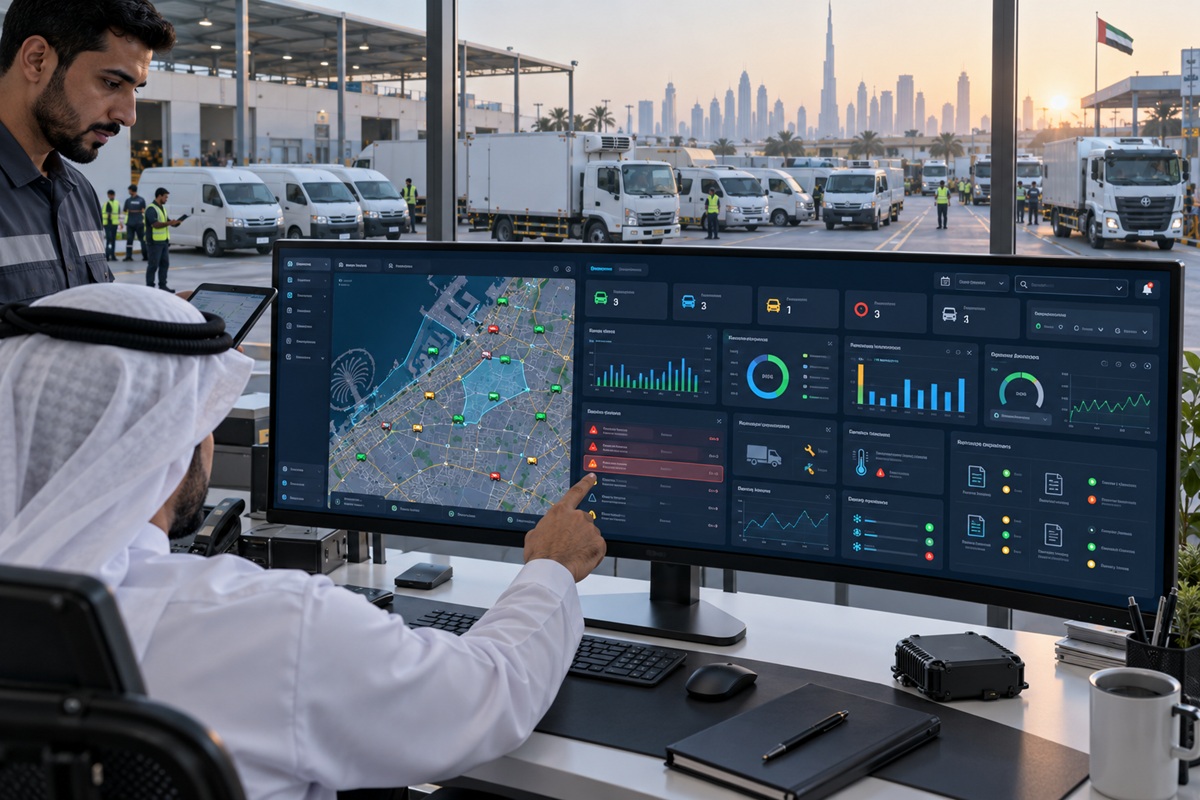
The UAE fleet manager’s role is one of the most operationally demanding positions in commercial operations responsible for assets worth millions of dirhams, compliance with multiple UAE government programmes, the safety of dozens of drivers on roads with high incident rates, and cost performance that represents 30 to 40 percent of the company’s total vehicle operating expenditure. The responsibilities are genuine and consequential; the frustration for many UAE fleet managers is not the responsibility but the way they are currently required to discharge it through a constant stream of phone calls, WhatsApp messages, spreadsheet updates, and paper-based checks that consume the working day and still leave gaps in visibility that only surface when something goes wrong.
This article walks through a realistic working day for a UAE fleet manager responsible for 50 commercial vehicles first as it typically looks without comprehensive fleet management technology, and then as it looks with GPS telematics, automated compliance monitoring, and integrated fuel management fully deployed. The contrast is not between a bad fleet manager and a good one; it is between a capable fleet manager spending most of their day on information gathering and a capable fleet manager spending most of their day on management decisions.
Key Takeaways
- A UAE fleet manager responsible for 50 vehicles without telematics spends an estimated 3 to 4 hours per day on information gathering calling drivers to get vehicle locations, checking paper logs for compliance expiry dates, manually reviewing fuel card statements, and following up on maintenance through phone calls to the workshop. This leaves 3 to 4 hours for actual management decisions, driver interactions, and planning.
- With GPS fleet management technology, information gathering is replaced by exception-based management: the fleet manager reviews alerts, dashboard exceptions, and automated reports spending 1 to 1.5 hours on information review and 5 to 6 hours on management decisions, coaching, compliance actions, and stakeholder communication.
- The three highest-stress events in a UAE fleet manager’s day breakdown on a remote route, Asateel non-compliance alert, and a driver involved in a traffic incident are each managed significantly faster with fleet technology: GPS location is known immediately, compliance status is visible in the dashboard, and GPS incident reconstruction data is available within minutes of the driver’s report.
- UAE-specific compliance management Asateel, IVMS, SecurePath, Mulkia renewals, driver licence expiry is a full-time administrative function for a fleet manager managing 50 vehicles manually. Fleet management software with automated compliance tracking and advance expiry alerts reduces the compliance administration from 2 to 3 hours per week to 20 to 30 minutes of exception review.
- The fleet manager’s strategic contribution identifying cost reduction opportunities, managing driver safety culture, planning vehicle procurement, and managing vendor relationships is most available when operational fire-fighting is minimised by technology-enabled proactive management.
The UAE Fleet Manager’s Day Side by Side Comparison
The table below follows a representative working day for a UAE fleet manager responsible for 50 commercial vehicles, showing how each time block is spent with and without fleet management technology.
| Time | Activity | ✓ With Fleet Technology | ✗ Without Technology |
| 6:30 AM | Pre-departure fleet check | Open Wialon mobile app 47 of 50 vehicles show ignition on, departing. 3 vehicles still at depot tap to see pre-trip inspection status. All 3 have completed digital inspections. 1 vehicle flagged a tyre pressure issue already escalated to workshop. | Call the depot supervisor to check who is out. Get approximate count. Remind drivers to fill in paper defect books. No visibility on vehicle condition or tyre issues until the driver calls in. |
| 7:15 AM | Compliance dashboard review | Automated compliance summary delivered by email at 7:00 AM: 2 vehicles have Mulkia expiring in 28 days alert flagged for renewal action. 1 driver licence expiring in 45 days. All Asateel devices showing green data submission current. | Check the compliance spreadsheet (if it was updated last week). Try to recall which vehicles are due for Mulkia. Call the PRO to check on renewal status. Discover two renewals were missed last month vehicles were technically non-compliant. |
| 8:00 AM | Operations briefing / driver dispatch | Review the day’s route assignments in dispatch module. 2 vehicles showing route deviations from yesterday’s planned routes GPS trip replay shows one stopped at an unapproved location for 25 minutes. Flag for driver conversation. | WhatsApp drivers to confirm they’re on route. Get ‘yes boss’ replies. No way to verify. Follow up on yesterday’s queries by calling 4 drivers 3 answer, 1 doesn’t. Take notes on a notepad. |
| 9:30 AM | Fuel and cost review | Weekly fuel efficiency report is automatically available 6 drivers flagged as above-baseline consumption. 2 vehicles have card reconciliation exceptions from yesterday (GPS location didn’t match card transaction location). Idling total for the fleet yesterday: 4.2 hours, cost AED 35. Flag 2 card exceptions for investigation. | Call the office admin to get this week’s fuel card statement. Wait for the PDF to be forwarded. Open Excel, manually enter figures from the PDF, calculate consumption per vehicle approximately 45 minutes of work. Still doesn’t show card misuse or GPS location comparison. |
| 10:15 AM | Incident management driver reports minor collision | Driver calls fender bender at a roundabout in Al Quoz. Open the fleet platform GPS shows the vehicle’s exact location. Pull the GPS speed trace for the 60 seconds before the collision. Speed was 22 km/h, no harsh event. Forward-facing dashcam footage locked remotely. Instruct driver to photograph and exchange details. Note the incident in the platform. Notify the insurer electronically with GPS data attached. | Driver calls fender bender. Ask driver for address (takes 5 minutes to describe). Call the insurer. Try to get more details from the driver about speed and circumstances. Make notes on the call. No GPS evidence to determine what happened. Hope the driver’s account is accurate. Spend another 30 minutes on follow-up calls. |
| 11:30 AM | Driver coaching weekly safety review | Open the safety scorecard dashboard bottom 5 drivers by score identified automatically. Driver Ahmed: 58/100, 7 harsh acceleration events concentrated on the E311 approach. Schedule a 15-minute call with Ahmed for 2:00 PM. Pull the GPS map of his events to show specific locations during the call. | Look through paper driver logs trying to identify who has had incidents or complaints recently. Recall from memory who seemed to be driving poorly last week. Call a driver for a general ‘drive carefully’ conversation without specific data. The driver doesn’t know what to change. |
| 1:00 PM | Maintenance approvals and workshop coordination | 2 GPS mileage alerts in the dashboard: Vehicle 23 at 9,800 km since last service (10,000 km trigger), Vehicle 31 has an OBD warning code P0128 (coolant temperature below thermostat regulating temperature minor, schedule inspection). Approve Vehicle 23 for next available workshop slot. Create OBD fault work order for Vehicle 31. | Get a call from the workshop manager asking when Vehicle 23 is due for service. Try to remember. Check the paper service log. Realise it hasn’t been updated since last month. Guess that it should be soon and ask the driver to bring it in. No OBD data the first you’ll know about Vehicle 31’s thermostat is when the driver reports a warning light. |
| 2:30 PM | Stakeholder reporting operations manager meeting | The monthly fuel and fleet KPI report was auto-generated last night: cost per km by vehicle, driver safety score trends, compliance status summary, maintenance spend vs budget. Present the data confidently specific vehicle names, specific cost figures, specific improvement from last month’s coaching programme. | Spend 1 hour before the meeting manually extracting data from multiple sources to put together a summary. The numbers don’t quite reconcile because the fuel card data and GPS data are separate. Present approximate figures with caveats about data accuracy. Hard to show specific improvement when you don’t have specific before/after data. |
| 4:00 PM | After-hours alert setup review | Check that after-hours geofence alerts are active for all depot vehicles. Construction site vehicle (Vehicle 44) GPS shows it’s still on site at 4:30 PM, which is normal for this contract. Confirm the after-hours alert exception is set for Vehicle 44 until 6:00 PM. Everything else is configured and active. | Call the site supervisor to make sure Vehicle 44 will be secured overnight. Write a note to check in the morning if it’s back at depot. No alert will fire if any vehicle moves after hours you’ll only know there’s a problem if a driver calls or a neighbour notices. |
| 5:30 PM | End-of-day day summary | Review the day’s automated summary: 3 idling alerts actioned (drivers coached), 2 card exceptions under investigation, 1 incident documented with GPS data, 1 OBD fault work order created, 2 compliance renewals initiated. Tomorrow: Driver Ahmed coaching call at 2:00 PM, Vehicle 23 workshop appointment at 9:00 AM. | Try to recall what happened today and write notes for tomorrow. Some things will be forgotten. A driver who was due a coaching conversation didn’t get called because other things came up. Two maintenance items are unresolved because there’s no tracking system for follow-up. The Mulkia that was meant to be renewed this week wasn’t done. |
Time Allocation: With vs Without Technology
| Activity Category | Time Without Technology (daily) | Time With Technology (daily) | Time Saved | Quality of Output |
| Information gathering (vehicle locations, status, compliance) | 2.5-3.5 hours (calls, WhatsApp, spreadsheet checks) | 20-30 minutes (dashboard review, alert triage) | 2-3 hours saved | Without: approximate; With: precise and current |
| Fuel and cost management | 45-60 minutes (manual extraction, Excel calculation) | 10-15 minutes (exception review of auto-generated report) | 35-45 minutes saved | Without: monthly, delayed; With: daily, real-time |
| Incident management | 45-90 minutes per incident (calls, note-taking, insurer coordination) | 20-35 minutes per incident (GPS data retrieval, dashcam lock, electronic notification) | 25-55 minutes saved per incident | Without: driver account; With: GPS evidence + dashcam |
| Driver coaching | 30-45 minutes (recall-based, generic conversation) | 20-30 minutes (data-driven, specific GPS event discussion) | 10-15 minutes saved; significantly better quality | Without: ‘drive carefully’; With: ‘your 7 harsh events on E311’ |
| Compliance management | 60-90 minutes/week (spreadsheet checks, renewal chasing) | 15-20 minutes/week (alert triage, action flagged items) | 45-70 minutes/week saved | Without: reactive when expired; With: proactive with advance alerts |
| Maintenance coordination | 30-45 minutes (calls to workshop, driver follow-up) | 10-15 minutes (GPS alert to work order, OBD fault triage) | 20-30 minutes saved | Without: service missed until driver mentions it; With: proactive trigger |
| Reporting and stakeholder communication | 60-90 minutes (manual data extraction, report preparation) | 10-15 minutes (review auto-generated report, add context) | 50-75 minutes saved | Without: approximate, delayed; With: precise, current |
| TOTAL DAILY TIME | 5.5-7.5 hours on management tasks | 1.5-2.5 hours on management tasks | 4-5 hours saved daily | Management quality improved across all categories |
What UAE Fleet Managers Do With Recovered Time
The 4 to 5 hours recovered daily through fleet management technology is not free time it is management capacity that transfers from reactive information gathering to proactive fleet management activities that produce better fleet outcomes. UAE fleet managers who have implemented comprehensive fleet management technology consistently describe the same shift: from spending the day answering questions about where things are and what happened, to spending the day making decisions about what should happen next.
Strategic Fleet Planning
Vehicle replacement timing, fleet composition optimisation, new route assessment, vendor relationship management, and insurance renewal preparation are strategic tasks that improve long-term fleet cost and performance but are consistently deferred by fleet managers whose days are consumed by operational information gathering. With technology handling the daily information aggregation, these strategic tasks receive the attention they deserve and fleet managers can present data-backed recommendations to senior management rather than intuition-based assessments.
Driver Development and Safety Culture
The difference between a ‘drive carefully’ WhatsApp broadcast and a 15-minute one-on-one coaching conversation built around specific GPS event data is the difference between nominal safety management and genuine behaviour change. Fleet managers with recovered time can conduct weekly individual coaching conversations with their bottom-quartile safety scorers, recognise top-performer drivers publicly, and build the safety culture that reduces the incident rate by 30 to 40 percent over 12 months. This outcome is not achievable when the fleet manager is spending the equivalent of their entire afternoon on information gathering.
Vendor and Workshop Management
Workshop quality, tyre supplier pricing, fuel card terms, and insurance broker relationships all benefit from active management that fleet managers without technology cannot consistently provide. With the time recovered from operational information gathering, fleet managers can conduct monthly workshop performance reviews using the KPI data from the fleet management platform, renegotiate fuel card terms based on fleet volume data, and manage insurance renewals proactively using the fleet’s telematics safety data as a negotiating tool.
VZone International Fleet Management Technology for UAE Fleet Managers
VZone International’s platform gives UAE fleet managers a single dashboard for GPS vehicle tracking, Asateel and IVMS compliance monitoring, automated Mulkia and document expiry alerts, driver safety scoring and coaching data, fuel monitoring and card reconciliation, and maintenance scheduling replacing 4 to 5 hours of daily information gathering with 1.5 hours of exception-based management. Contact our team for a demo tailored to your fleet size and sector.
Frequently Asked Questions
A UAE fleet manager's core responsibilities span four domains. Operations: managing vehicle dispatch and routing, coordinating driver schedules, responding to breakdowns and incidents, and ensuring vehicles are available for operational requirements. Compliance: maintaining Asateel, IVMS, SecurePath, and other UAE GPS compliance certifications; tracking Mulkia (vehicle registration) renewals and vehicle inspections; managing driver licence expiry; and maintaining ADNOC IVMS HSE documentation for contractor fleets. Driver management: driver safety performance monitoring and coaching, incident investigation, driver onboarding and training, and managing disciplinary processes in accordance with UAE labour law. Cost management: fuel spend monitoring and budget tracking, maintenance cost oversight, insurance renewal management, and reporting fleet operating costs to senior management. In a 50-vehicle fleet without comprehensive fleet management technology, these responsibilities generate 25 to 35 manual tasks per day. With GPS telematics and automated compliance monitoring, the same responsibilities generate 8 to 12 exception reviews and management decisions per day.
GPS fleet management software shifts the UAE fleet manager's role from information gathering to exception-based management. Without technology, the fleet manager spends 5 to 7 hours per day calling drivers and supervisors, checking paper logs, manually extracting fuel card data, and following up on maintenance through phone calls gathering information that is still approximate and often delayed. With GPS fleet management, the same information is available in real time on a dashboard and delivered as alerts when it deviates from normal the fleet manager's time shifts to reviewing dashboard exceptions, conducting data-driven driver coaching conversations, managing the compliance calendar from advance expiry alerts, and producing stakeholder reports from auto-generated data. The role becomes more analytical and strategic because the operational information gathering that currently consumes most of the day is automated.
UAE fleet managers typically hold a combination of formal qualifications and operational experience. Formal qualifications that are relevant include a degree or diploma in logistics, transport management, engineering, or business; professional fleet management certifications such as the Institute of Fleet Management (IFM) certification or equivalent; and specific UAE regulatory knowledge including Asateel and IVMS compliance requirements for the fleet's vehicle categories. Practical experience managing commercial vehicle fleets, handling UAE traffic law and compliance frameworks, and managing multi-cultural driver teams is typically required by UAE employers alongside formal qualifications. Technology proficiency specifically with fleet management platforms, GPS tracking systems, and reporting tools is increasingly important as UAE fleet management becomes more data-driven. UAE fleet managers also benefit from Arabic language proficiency for driver communication and government portal interaction, though many UAE fleet management roles are conducted primarily in English.
The most consistent challenges for UAE fleet managers are: compliance complexity (Asateel, IVMS, SecurePath, OPAL, Mulkia, and driver licence requirements across multiple government portals create a compliance management overhead that consumes disproportionate management time, particularly in manual tracking systems); driver behaviour and safety culture (managing drivers from diverse cultural and training backgrounds on UAE roads with high commercial vehicle incident rates requires consistent data-driven coaching that is difficult to sustain without GPS telematics data); fuel cost management (fuel at 32 to 42 percent of total operating cost is the largest cost lever, but managing it effectively requires per-vehicle data that most UAE fleets still track only at fleet-total level from card statements); summer operational challenges (extreme heat creates vehicle maintenance demands, driver welfare considerations, and tyre management requirements that have no equivalent in temperate-climate fleet management); and information fragmentation (critical fleet information vehicle locations, compliance status, fuel spend, driver performance is typically held in multiple disconnected systems, making unified management reporting a manual exercise).