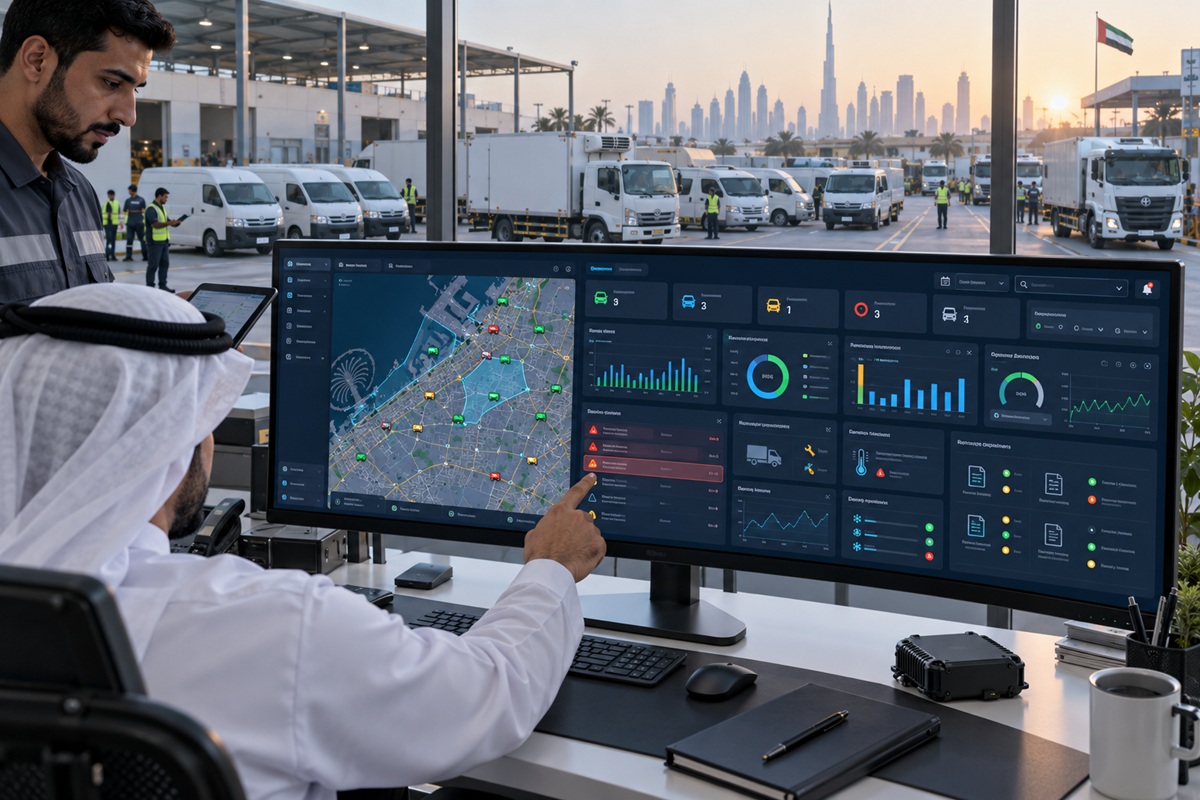
The fleet manager who successfully managed a 20-vehicle fleet and now faces a 100-vehicle operation faces a management problem, not just a workload problem. A 100-vehicle fleet is not five times as much work as a 20-vehicle fleet it is a qualitatively different management challenge that requires a different team structure, different technology deployment, different communication protocols, and a fundamentally different relationship between the fleet manager and the day-to-day operations.
The fleet managers who burn out managing large UAE fleets share a common pattern: they are managing a 100-vehicle fleet with the habits and processes they developed for a 20-vehicle fleet personally monitoring every vehicle position, receiving every alert on their own phone, making every maintenance decision, handling every driver complaint, and compiling every report manually. This approach fails not because the fleet manager is inadequate but because the management model does not scale. This guide explains what does scale: the team structure, technology configuration, and management discipline that enables a single fleet manager supported by the right team and the right technology to manage 100 to 200 vehicles sustainably.
Key Takeaways
- The transition from managing 20 to managing 100+ vehicles requires a shift from personal monitoring to exception-based management the fleet manager no longer personally monitors every vehicle; the technology monitors continuously and delivers only the exceptions that require human judgment and decision.
- A 100-vehicle UAE fleet requires a management team structure, not a single fleet manager: fleet manager (strategy, exception escalation, stakeholder reporting), depot supervisors (operational vehicle and driver management per depot), safety officer (driver coaching programme, incident investigation, ADNOC HSE compliance), and workshop coordinator (maintenance scheduling, parts management, workshop KPIs). The fleet management platform provides the data layer that connects all four roles.
- Automation is the scalability mechanism every manual workflow that the fleet manager currently performs personally (maintenance alert → call workshop, compliance expiry → reminder to PRO, fuel card exception → manual cross-reference) must be automated before the fleet scale increases. Each automated workflow saves 15 to 30 minutes of fleet manager time; 20 automated workflows save 5 to 10 hours per day enough to make a 100-vehicle fleet manageable by a team rather than overwhelming for an individual.
- Delegation without visibility is abdication fleet managers who hand operational responsibility to depot supervisors without shared platform access and weekly KPI reporting create information silos that produce compliance failures, cost overruns, and safety incidents. The technology platform must give each team member visibility of their data scope, and the fleet manager must retain executive visibility across all scopes simultaneously.
- The correct metric for fleet management scalability is not the number of vehicles per fleet manager but the number of exception decisions per fleet manager per day which should be 8 to 15 regardless of fleet size when technology automation handles routine monitoring and team members handle routine operational responses.
Why Managing 100 Vehicles Is Not Just Managing 20 Vehicles × 5
The management challenges of a 100-vehicle fleet are not simply five times those of a 20-vehicle fleet they are qualitatively different in several ways that make the 20-vehicle management approach structurally inadequate at scale.
Volume Creates Information Overload
A 20-vehicle fleet generates approximately 40 to 60 GPS alerts, 4 to 6 maintenance events, 2 to 3 compliance items, and 1 to 2 incidents per week a volume that a single attentive fleet manager can track and respond to personally. A 100-vehicle fleet generates 200 to 300 GPS alerts, 20 to 30 maintenance events, 10 to 15 compliance items, and 5 to 10 incidents per week a volume that exceeds any individual’s capacity to personally monitor and respond to, even with extended working hours. The fleet manager who tries to personally track all 200 to 300 weekly alerts will either miss significant events buried in the volume or spend their entire day in alert review with no time for management decisions.
The solution is not more hours but different architecture: technology that filters alerts by severity and routes each alert to the appropriate team member (critical alerts to fleet manager and depot supervisor simultaneously, warning alerts to depot supervisor, informational alerts to a dashboard queue), and team members who handle their scoped alerts without requiring the fleet manager’s attention for each one.
Complexity Creates Coordination Overhead
A 100-vehicle fleet typically operates across multiple depots, serves multiple clients or business units, has multiple vehicle types with different compliance requirements, and involves multiple workshops or service providers. The coordination overhead ensuring that each depot’s compliance status is current, that each vehicle type’s maintenance schedule reflects its specific UAE requirements, that client-specific driver behaviour requirements are applied to the drivers serving each client scales with fleet complexity faster than it scales with vehicle count.
Managing this coordination overhead manually through calls, WhatsApp groups, and spreadsheets is where the information fragmentation that causes compliance failures and cost overruns originates. A single platform that connects all depots, all vehicle types, all client requirements, and all service providers eliminates the coordination overhead by making the relevant information available to all team members simultaneously rather than requiring the fleet manager to manually maintain coordination across fragmented systems.
The 100-Vehicle Fleet Management Team Structure
| Role | Headcount | Responsibilities | Platform Access | Reports To |
| Fleet Manager | 1 | Strategy and policy setting; exception escalation handling; stakeholder reporting (board, finance, operations); vendor relationship management; fleet procurement decisions; budget management | Full platform access all vehicles, all data, all depots | Operations Director / CFO |
| Depot Supervisor(s) | 1 per depot (or 1 per 30-40 vehicles in single-depot) | Daily vehicle and driver operations in their depot; routine alert response; driver coaching (non-escalation cases); daily pre-trip inspection compliance; vehicle availability management | Depot-scoped access their vehicles and drivers only | Fleet Manager |
| Safety Officer | 1 for 100 vehicles; 2 for 200+ | Driver safety coaching programme; incident investigation and documentation; ADNOC IVMS HSE report generation; driver induction and training; escalation coaching for persistent high-risk drivers | Full driver safety data access across all depots; no cost or financial data | Fleet Manager |
| Workshop Coordinator | 1 for 100 vehicles | Maintenance scheduling from GPS mileage alerts; work order management; parts procurement and inventory; workshop KPI tracking (MTTR, FTFR, planned/unplanned ratio); third-party workshop relationship management | Maintenance module access vehicle service history, work orders, OBD alerts | Fleet Manager |
| Fleet Administrator / PRO | 1 | Compliance document management (Mulkia renewals, insurance renewals, vehicle inspection bookings); driver licence tracking; ITC Asateel portal queries; ADNOC IVMS registration maintenance | Compliance module access document expiry tracking, renewal queue | Fleet Manager |
For fleets between 50 and 100 vehicles, the full team structure above may be partially combined a depot supervisor who also handles workshop coordination is common at this scale. For fleets above 150 vehicles, additional depot supervisors and a second safety officer are typically required. The fleet manager’s role at any fleet size above 50 vehicles should be primarily strategic and exception-based if the fleet manager is spending more than 2 hours per day on operational monitoring and routine response, the team structure is under-resourced or the technology automation is under-configured.
The Technology Configuration That Makes Scale Manageable
Technology automation is the mechanism that enables a fleet team of 5 to manage 100 vehicles with the same exception-based discipline that a single fleet manager applies to 20 vehicles. The key automation requirements for a 100-vehicle UAE fleet are:
Alert Routing by Role and Severity
Every alert generated by the fleet management platform should be routed to a specific role not broadcast to everyone, and not visible only to the fleet manager. Critical alerts (OBD critical fault, after-hours geofence exit from depot, fuel sensor siphoning event) route to both the fleet manager and the relevant depot supervisor simultaneously two people aware, either can respond. Warning alerts (GPS mileage approaching service threshold, driver safety score below 60 for second consecutive week, compliance document within 14 days of expiry) route to the relevant depot supervisor or safety officer they handle the response; the fleet manager sees the alert in the dashboard queue but does not need to personally action it. Informational alerts (trip completed with all items normal, vehicle returned to depot after hours within authorised window) are logged in the platform without push notification available for review if needed, not generating notification noise.
Automated Weekly Reports by Role
Weekly reports delivered automatically to each team member’s email eliminate the fleet manager’s report compilation burden and ensure each team member has the data they need for their management conversations without the fleet manager needing to produce and distribute individual reports:
- Depot supervisors: their depot’s vehicle availability rate, top 5 drivers by safety score, bottom 5 drivers needing coaching, open maintenance items, compliance items due this week
- Safety officer: fleet-wide driver safety scorecard, week-on-week score trends, incidents requiring investigation, ADNOC IVMS compliance status, coaching appointment schedule
- Workshop coordinator: vehicles approaching service threshold in the next 14 days, open work orders status, parts procurement outstanding items, MTTR and FTFR for the week
- Fleet administrator: compliance document expiry calendar for the next 30 days, Asateel submission status summary, renewal actions overdue
- Fleet manager: executive KPI summary fleet-average safety score, total fuel cost vs budget, at-fault incident count, compliance currency rate, vehicle availability rate
Escalation Protocol Automation
The escalation protocol the defined sequence of responses when a specific event or KPI deviation occurs should be documented and, where possible, automated in the platform. When a driver’s safety score falls below 55/100 for three consecutive weeks, the platform should automatically create a coaching escalation task assigned to the safety officer and notify the fleet manager. When a vehicle’s fuel CPK exceeds 30 percent above baseline for five consecutive trips, the platform should automatically create an investigation task assigned to the depot supervisor. When a compliance document reaches 7 days before expiry without a completed renewal action, the platform should escalate the alert from fleet administrator to fleet manager with an urgent flag. These automated escalations ensure that items that should reach the fleet manager’s attention actually do without requiring the fleet manager to personally monitor every subordinate’s task queue.
The Fleet Manager’s Weekly Rhythm at Scale
The fleet manager of a 100-vehicle UAE fleet should structure their week around four types of management activity each with a defined time allocation that keeps the total fleet management time within a sustainable working day:
| Activity Type | Frequency | Time Allocation | Content | Technology Enabler |
| Dashboard exception review | Daily (Monday-Saturday) | 20-30 minutes/day | Review escalated alerts from the past 24 hours; note any KPI deviations requiring investigation; confirm compliance items are on track | Five-panel fleet dashboard with exception filtering only escalated items visible at fleet manager level |
| Team coordination | Weekly (Monday AM) | 45-60 minutes | Review weekly KPI summaries from each team member; identify cross-team issues; set priorities for the week; discuss any escalated exceptions requiring fleet manager decision | Automated weekly KPI report package delivered Sunday evening |
| Stakeholder reporting | Monthly | 60-90 minutes | Prepare executive summary for operations director/CFO; fleet cost vs budget; safety trend; compliance position; procurement recommendations | Auto-generated monthly management report fleet manager adds context and recommendations |
| Strategic management | As required | Variable | Vehicle procurement decisions; vendor contract negotiations; insurance renewal; fleet policy updates; technology roadmap review | Fleet utilisation data, cost benchmarking, vendor performance data from platform |
| Escalation responses | As triggered | 15-30 min per escalation | Handle exceptions that have been escalated from depot supervisor or safety officer; investigate OBD critical fault decisions; respond to compliance emergencies | Alert detail with GPS data, dashcam footage, OBD fault record all accessible from escalation notification |
Total fleet manager time per week using this structure: approximately 3 to 4 hours of active fleet management activity (daily dashboard reviews + weekly team coordination + escalation responses) plus strategic and reporting activities as required. This is the sustainable management workload for a 100-vehicle fleet significantly less than the 6 to 8 hours per day that many UAE fleet managers currently spend on operational monitoring and information gathering for much smaller fleets.
Common Scaling Failures and How to Prevent Them
| Scaling Failure | What Happens | How It Manifests | Prevention |
| Fleet manager as single information hub | All fleet data flows through fleet manager; no role-based delegation | Fleet manager receives 200+ alerts/day, works 12-hour days, misses critical events in the volume | Role-based alert routing + team structure with data-scoped platform access |
| Technology deployed but not configured for scale | GPS tracking active but alert routing, automation, and reporting not configured for team use | Platform generates data that no one reviews; team members without access; fleet manager still making all decisions manually | Platform configuration review at 50-vehicle threshold; escalation protocol setup before 100-vehicle deployment |
| Delegation without accountability structure | Fleet manager delegates to depot supervisors but has no KPI visibility into their performance | Depot-level compliance failures not discovered until compliance authority contact; cost overruns in specific depots invisible at fleet level | Weekly KPI reporting per depot; fleet manager retains executive visibility across all depots; weekly team coordination meeting |
| Alert fatigue from over-alerting | Every GPS event generates a notification; team members receive 500 alerts/week | Alerts ignored; critical events missed because they are buried in noise; team stops reviewing the dashboard | Conservative threshold configuration; alert routing so each recipient receives only actionable alerts for their role; target 5-15 alerts per team member per day |
| Manual compliance management at scale | Compliance tracked in shared spreadsheet managed by fleet administrator | Compliance spreadsheet not updated consistently; document expires before replacement; Asateel submission gap discovered at ITC notice | Automated compliance platform with advance alerts; fleet administrator’s role is to action alerts, not to maintain the tracking system |
VZone International Enterprise Fleet Management for 100+ Vehicle UAE Fleets
VZone International’s Wialon platform scales from 10 to 5,000+ vehicles with role-based access, automated alert routing, team KPI dashboards, escalation protocol automation, and multi-depot management. The same platform that manages a 20-vehicle fleet manages a 200-vehicle fleet the configuration changes to match the team structure and reporting requirements; the technology investment does not. Contact our enterprise team for a 100+ vehicle fleet deployment assessment.
Frequently Asked Questions
A single fleet manager without a team and without technology automation can effectively manage approximately 20 to 30 UAE commercial vehicles at this scale, personal monitoring and relationship management of every vehicle and driver is feasible within a working day. With GPS fleet management technology but no team, a fleet manager can manage approximately 50 vehicles effectively through exception-based monitoring reviewing alerts and reports rather than personally checking each vehicle. With both technology and a team (depot supervisors, safety officer, workshop coordinator), a fleet manager can provide strategic oversight of 100 to 200 vehicles their role becomes exception escalation, stakeholder reporting, and strategic decision-making rather than operational monitoring. Above 200 vehicles, a fleet management function with a dedicated fleet manager and a team of 6 to 10 people, supported by enterprise fleet management technology with role-based access and automated reporting, is the appropriate structure. The correct ratio is not vehicles per fleet manager but exception decisions per fleet manager per day which should be 8 to 15 regardless of fleet size.
A 100-vehicle UAE fleet needs five technology layers deployed and integrated. GPS telematics on every vehicle (Teltonika devices with Asateel and IVMS certification for UAE compliance requirements) the data foundation. Fleet management platform (VZone International's Wialon) with role-based access, alert routing by role and severity, automated weekly report delivery, and escalation protocol automation. Fuel management integration (fuel card API, vehicle fuel sensors on high-risk vehicles, depot bulk tank monitoring where applicable). Maintenance management integration (workshop work order system connected to GPS mileage alerts and OBD fault codes). Compliance management module (automated Asateel/IVMS submission, document expiry tracking with 30/14/7-day alerts, driver licence expiry monitoring). The integration of these five layers into a single platform rather than five separate tools requiring manual data sharing is what distinguishes effective 100-vehicle fleet management from the information fragmentation that causes compliance failures and cost overruns.
Building a fleet management team in UAE for a 100-vehicle fleet requires hiring or designating four roles alongside the fleet manager. Depot supervisors (one per depot or per 30 to 40 vehicles if single-depot): operationally experienced individuals who understand commercial vehicle operations, can conduct effective driver coaching conversations, and are comfortable using a GPS fleet management platform dashboard. Safety officer: someone with fleet safety management experience, ideally familiar with ADNOC IVMS compliance requirements; responsible for the driver coaching programme and incident investigation. Workshop coordinator: someone with vehicle maintenance background who can manage workshop scheduling, parts procurement, and supplier relationships. Fleet administrator (PRO function): someone with UAE government portal experience (ITC Asateel portal, ADNOC IVMS registration, RTA portal) who manages the compliance renewal cycle. Each role requires training on the fleet management platform for their specific data scope; the platform configuration should mirror the team structure so that each person's dashboard shows exactly the data they need for their management conversations.
Managing 20 vehicles allows personal monitoring a UAE fleet manager can personally know every vehicle's status, every driver's performance history, and every maintenance item for a 20-vehicle fleet within a manageable working day. Managing 100 vehicles requires systems the fleet manager cannot personally know 100 vehicles' statuses, 80+ drivers' performance profiles, and 20 to 30 active maintenance items without technology to aggregate the data and a team to handle routine operational responses. The management shift is from 'I know everything about every vehicle' to 'the system monitors everything and alerts me to the exceptions I need to decide on.' For UAE fleet operators, this shift also requires adapting to UAE-specific scale challenges: ADNOC IVMS compliance across 100 vehicles requires automated submission management that a 20-vehicle fleet can handle semi-manually; Asateel certification status across 100 vehicles requires systematic compliance tracking that a spreadsheet cannot maintain at scale; and fuel theft monitoring across 100 vehicles requires sensor and card reconciliation infrastructure that works at scale without the fleet manager manually cross-referencing each transaction.