
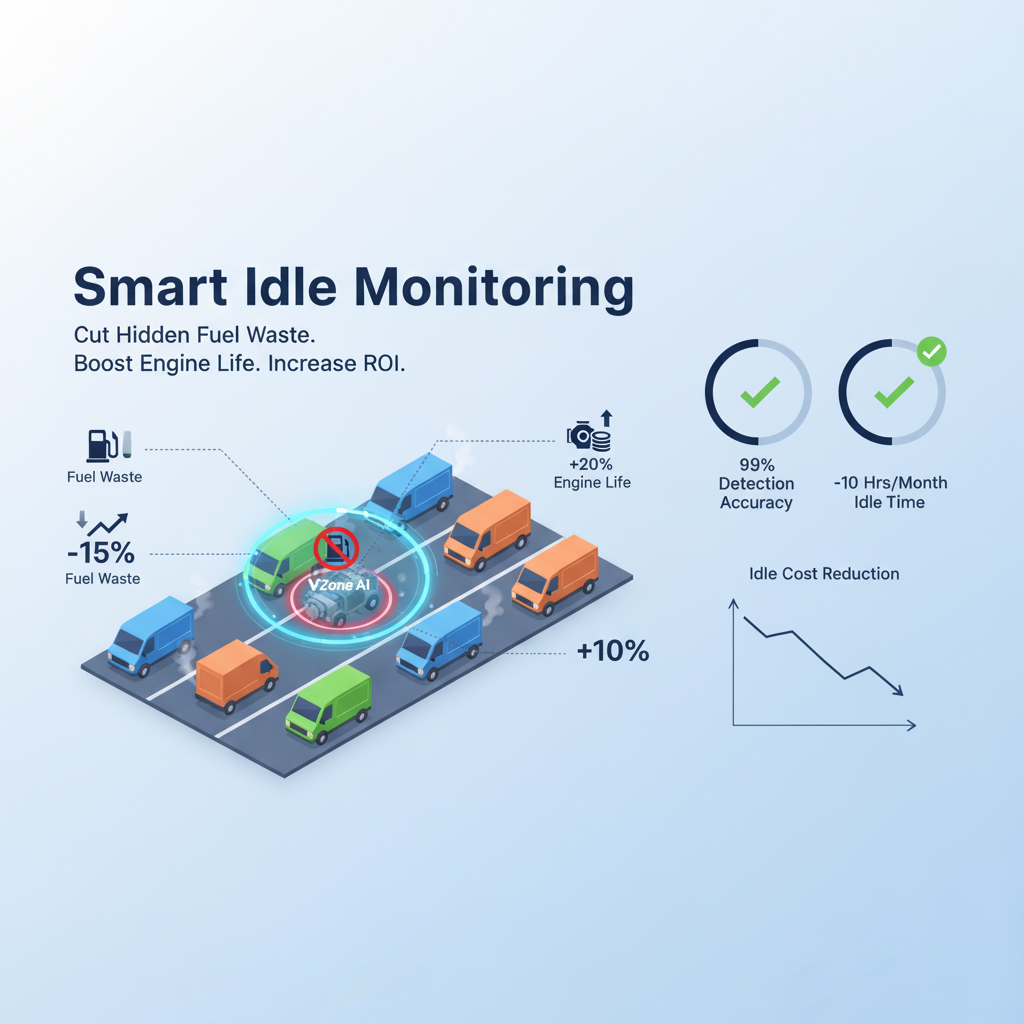
Smart Idle Monitoring
Cut Hidden Fuel Waste. Boost Engine Life. Increase ROI.
Idling is the silent killer of your fleet’s profitability. Every unnecessary minute your engine runs costs you fuel, damages the engine, and erodes productivity. With V Zone’s Excess Idle Detection, you gain the power to spot, reduce, and eliminate waste in real time and at scale.
Most fleet managers know idling is a problem but can’t quantify it. V Zone turns idle time from an invisible cost into a measurable, manageable KPI broken down by driver, vehicle, route, location, and time of day.
🚨 Why Idling Hurts Your Business
A single hour of idling burns up to 1.5 litres of fuel and across a fleet of 50 vehicles, that adds up to thousands of dirhams wasted every month. Beyond fuel cost, excessive idling accelerates engine wear, increases maintenance frequency, inflates your total cost of ownership, and contributes to emissions that can trigger regulatory penalties in the UAE and GCC.
- ⛽ Wastes Fuel: 1 hour of idling = up to 1.5 litres of fuel wasted
- 🛠️ Accelerates Wear & Tear: Engine hours build up even when the vehicle doesn’t move
- 📉 Low Driver Accountability: Without monitoring, idling is invisible
- 💸 Inflated Operating Costs: Increases fuel bills, maintenance cost, and TCO
- 🌍 Environmental Impact: More emissions = potential regulatory penalties
📈 What V Zone Tracks for Idle Detection
V Zone doesn’t just flag “engine on, vehicle stationary.” The platform tracks idle behaviour across multiple dimensions duration, time of day, location, vehicle state, and driver so you can distinguish between necessary idling (loading bay, traffic, AC for passengers) and wasteful idling that needs to be addressed:
| Metric | Description |
|---|---|
| Idle Duration Thresholds | Set smart limits by time of day, temperature, job type, or vehicle class |
| Vehicle State Context | Detect if idling is with AC, engine-only, PTO engaged, or refrigeration unit active |
| Location-Based Idling | Track idling at specific POIs client sites, depots, fuel stations, restricted zones |
| Driver-Specific Idling | Score and compare idle patterns across drivers for coaching and accountability |
| Alerts & Escalation | Trigger alerts when idling crosses thresholds SMS, push, email, or webhook |
| Idle Cost Calculations | Estimate fuel waste and cost impact per event, per driver, and per fleet in reports |
⚙️ Smart Idling Policies Configured Your Way
Not all idling is equal. A refrigerated truck needs its engine running at a delivery stop. A passenger bus runs AC between school pickups. V Zone lets you design intelligent idle control policies that match your operational reality so you’re not penalising drivers for doing their job, only for wasting fuel:
- Different rules for day vs. night and weekday vs. weekend
- Allow idling for refrigeration units but not HVAC-only vehicles
- Auto-escalation for idling in restricted or high-cost zones
- Exemption tagging for authorised cases traffic, loading, client sites
- Custom thresholds by vehicle type, department, or route
🛠️ How Smart Idle Monitoring Works
V Zone’s idle detection uses a combination of engine-state data from OBD/CAN, GPS position, and AI context to classify every idle event accurately so you get actionable data, not noise:
⚙️ Engine State Detection
Live engine monitoring via OBD, CAN, or GPS device detects ignition on + zero speed instantly.
📚 Idle Definition Logic
You define what counts as unacceptable idle by duration, location, time, vehicle type, or job context.
🔔 Real-Time Alerts
Instant notifications for excessive idle events sent to the driver, supervisor, dashboard, or mobile app.
📊 Reports & Scorecards
Daily/weekly reports with idle stats by driver, vehicle, time, and location with trend analysis.
🔁 Behavioural Feedback Loop
Use scorecards to coach drivers and reward improvement creating a culture shift, not just a policy.
📊 Measurable Business Impact
Smart Idle Monitoring delivers ROI from the first month because idle waste is one of the easiest fleet costs to measure and one of the fastest to reduce. Here’s what V Zone clients typically see:
| KPI | Measurable Result |
|---|---|
| Fuel Cost Reduction | ⬇️ 10–20% average savings in fuel usage from idle reduction alone |
| Maintenance Cost Reduction | ⬇️ Fewer oil changes and engine hours = savings on servicing |
| Driver Productivity | ⬆️ More active driving time, less parked-engine idle per shift |
| Fleet Emissions | ⬇️ Reduced CO₂ footprint = ESG alignment and compliance |
Results based on V Zone client deployments across logistics, FMCG, and construction fleets in the UAE. Actual savings vary by fleet size, vehicle type, and operational patterns. All claims should be verified with V Zone.
🏭 Industry Use Cases
Idle waste looks different in every industry and V Zone’s monitoring adapts to each one. A delivery fleet idles at loading bays. A construction fleet idles at remote sites. A cold chain fleet runs refrigeration units that need to be distinguished from wasteful engine idling. Here’s how it maps:
- Last-Mile Delivery: Reduced idle time during drop-offs drivers trained to switch off between stops
- Public Transport: Alert when drivers leave engines running on breaks AC exemptions configured separately
- Construction Fleets: Tracked PTO-related idling vs. waste equipment idle separated from vehicle idle
- Cold Chain Logistics: Smart distinction between cooling-related idling and wasteful engine running
- FMCG Distribution: Idle tracking at warehouse loading bays and retail delivery points across the UAE
💻 Dashboard Features You’ll Use Every Day
V Zone’s idle monitoring dashboard is designed for daily use not buried in a reports menu. Fleet managers and supervisors see idle data live, with context, and with the tools to act on it immediately:
- Real-time idle alerts with location, driver, and duration
- Driver-wise idle heatmaps showing patterns over time
- Auto-generated reports to compare trends week-on-week
- Fuel cost estimates for each idle event and cumulative impact
- Custom thresholds by vehicle type or shift for targeted control
🔧 Add-On Capabilities
For fleets that want to go beyond basic idle detection, V Zone offers add-on modules that turn idle data into driver coaching tools, trip-level analytics, and ROI reporting:
- AI Driver Coaching for High Idlers: Automated coaching prompts based on idle patterns
- AC Usage Detection during Idling: Separate AC-on idle from pure waste
- Idling vs. Trip Playback Overlay: See idle events in the context of the full trip timeline
- Custom Idle Score for Performance Reviews: Weighted scoring for HR and fleet manager use
- Integration with Fuel Cards for ROI Comparison: Match idle reduction to actual fuel card savings
✅ Why Choose V Zone for Idle Monitoring?
V Zone doesn’t treat idle monitoring as a checkbox feature it’s a fully configurable module built on 15+ years of fleet diagnostics experience across the UAE and GCC:
- 15+ years of deep fleet diagnostics experience in the region
- Proven reduction in fleet idle cost within 30 days of deployment
- Custom rules engine for any industry or vehicle type
- Plug-and-play integration with your fuel and telematics stack
- Live visibility + historical insights in one clean dashboard
🚀 Let’s Eliminate Idle Waste Together
Your vehicles are meant to move not burn fuel while standing still.
We help you make every second and drop count.
💬 FAQs
How does V Zone detect idle time and how accurate is it?
V Zone detects idle time by combining engine-state data (from OBD, CAN bus, or the GPS device’s ignition wire) with GPS position data. When the engine is running and the vehicle speed is zero for longer than your configured threshold, the system logs an idle event. Accuracy is high because V Zone uses actual engine data rather than relying on GPS speed alone which means it can distinguish between a vehicle truly idling and one crawling slowly through traffic. Each idle event is timestamped, GPS-tagged, and linked to the driver on duty.
Can I set different idle thresholds for different vehicle types?
Yes. V Zone’s idle monitoring is fully configurable by vehicle type, department, route, time of day, and even specific locations. For example, you might allow 10 minutes of idle at a warehouse loading bay but only 3 minutes at a fuel station. You can set separate rules for refrigerated trucks (where engine running may be necessary for cooling) versus standard delivery vans. Thresholds can be adjusted at any time without requiring technical support fleet managers can update them directly from the dashboard.
Does V Zone distinguish between necessary and wasteful idling?
Yes this is one of V Zone’s key differentiators. The system uses vehicle-state context (PTO engagement, AC compressor status, refrigeration unit activity) combined with location data and time-of-day rules to classify idle events. Idling at a client site during a scheduled delivery window can be tagged as authorised. Idling in a parking lot for 45 minutes after the shift ends is flagged as waste. You control the classification rules, and the AI learns your fleet’s patterns over time to reduce false positives.
How quickly will I see results after enabling idle monitoring?
Most V Zone clients see measurable idle reduction within the first 2–4 weeks. The initial impact comes from visibility itself once drivers know their idle time is being tracked and scored, behaviour changes. The second wave of improvement comes from targeted coaching based on idle reports and scorecards. Typical results include a 10–20% reduction in fuel costs attributable to idle reduction, with the fastest gains in fleets that had no prior idle visibility. V Zone’s onboarding team helps you set the right thresholds from day one so you’re not drowning in alerts.
Can idle data be integrated with our fuel card system?
Yes. V Zone supports integration with major fuel card providers and fuel management systems used across the UAE and GCC. By matching idle reduction data with actual fuel card transaction volumes, you can verify the real-world AED impact of your idle reduction programme not just projected savings, but actual litres and dirhams saved. This integration is available via API or scheduled data export, and V Zone’s team assists with the setup at no additional cost.