
Healthcare & Ambulance Fleet
Every Second Counts. Every Move Tracked. Every Life Protected.
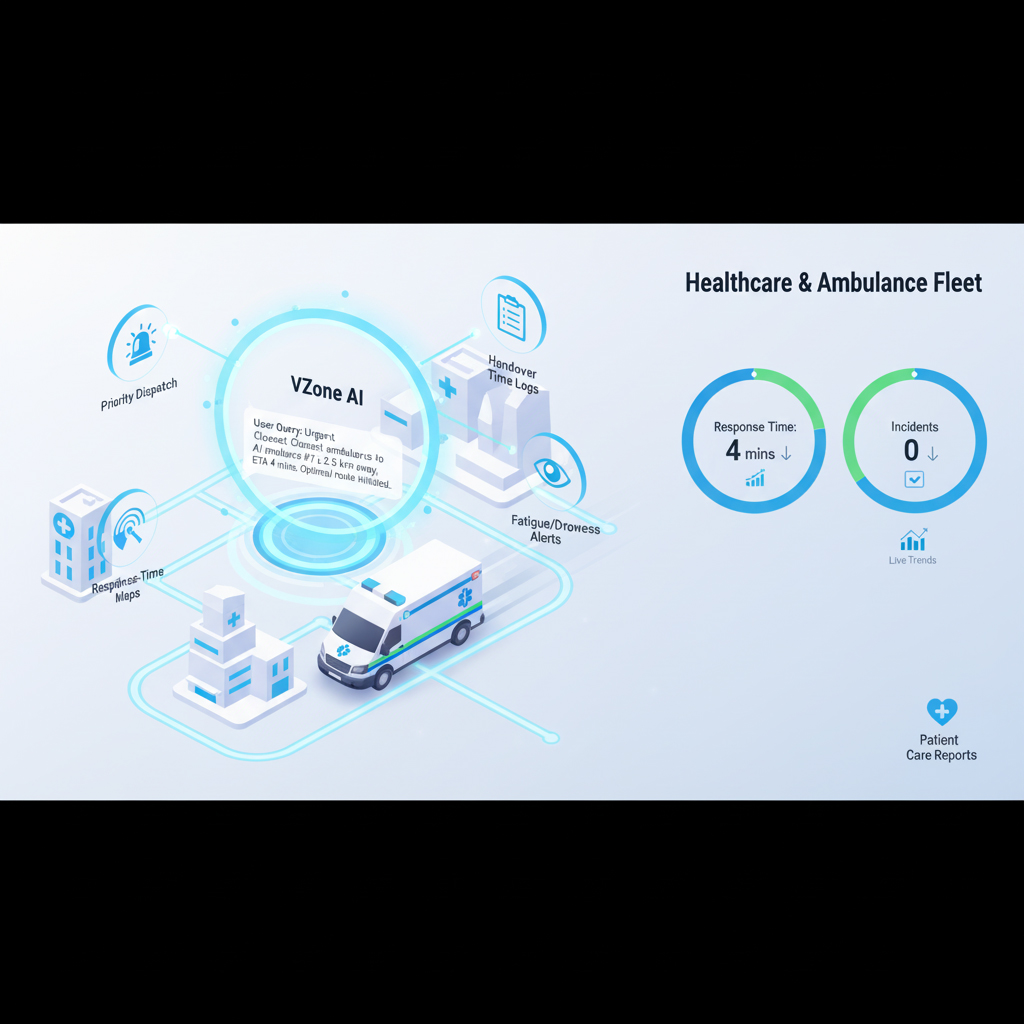
For healthcare and ambulance fleets, every second counts and V Zone International gives UAE emergency services the real-time coordination that saves lives. The platform combines live GPS with emergency-response prioritisation, smart dispatching to the nearest available ambulance, traffic- and weather-aware ETA prediction, driver safety scoring, and direct integration with hospital ER dashboards.
Services running V Zone cut average dispatch time by 40%, hit 93% on-time arrival rate for critical calls, keep 100% audit-ready transport logs per patient, see 25% fewer breakdowns due to predictive maintenance, and improve safety scores across ambulance drivers.
🚨 Critical Challenges in Healthcare & Ambulance Fleets
Healthcare fleet operations carry the highest stakes of any industry a delayed ambulance can mean the difference between life and death. Yet most emergency services still rely on manual phone-based dispatch, lack real-time vehicle location data, and have no system to automatically identify the nearest available unit. When every minute costs outcomes, these gaps are unacceptable:
- Dispatch delays during medical emergencies
- Inability to track real-time ambulance location
- No route optimization for traffic-prone zones
- Missing trip documentation for compliance or insurance
- Difficulty ensuring driver safety under pressure
- Lack of integration with hospital or command centers
🔍 Why Healthcare Fleets Need Advanced Technology
When lives are on the line, you need more than a vehicle you need a smart, connected command system that ensures every second and every route counts. Manual dispatch wastes precious minutes. Paper-based trip records don’t survive audits. And without real-time ETA sharing with the ER, the receiving team can’t prepare for what’s arriving.
When dispatch relies on phone calls and guesswork, the patient pays the price in minutes and minutes save lives.
🎯 How V Zone Supports Healthcare Response
V Zone gives emergency services, hospital networks, and patient-transport operators a single platform built for speed, accountability, and compliance:
- Live GPS tracking with emergency response prioritization
- Smart dispatching based on nearest available ambulance
- Smart ETA prediction considering traffic, weather, and zones
- Driver behavior tracking with emergency mode alerts
- Trip logs with timestamps, route paths, and arrival verification
- Integration with hospital ER dashboards and alert systems
🤖 AI in Emergency Fleet Operations
V Zone’s AI is trained on emergency-response patterns peak incident hours, hospital proximity, traffic corridors during emergencies, and driver fatigue on extended shifts. It doesn’t just track; it makes split-second recommendations:
- Auto-selects fastest route based on live data
- Alerts if ambulance deviates from critical path
- Predicts congestion zones to suggest detours
- Assigns performance scores to drivers & dispatch teams
- Triggers alerts for risky driving patterns under pressure
🛠️ Key Features for Healthcare Logistics
Healthcare fleet operations have life-critical requirements that general fleet management doesn’t cover. V Zone maps each emergency-specific need to a purpose-built solution:
| Requirement | V Zone Solution |
|---|---|
| Fast Response | Live dispatch & traffic-optimized routing |
| Real-Time Oversight | Centralized fleet dashboard |
| Patient Safety | Driver scoring + alerting |
| Hospital Integration | API & real-time ER notifications |
| Compliance Logs | Digital records for every trip |
| Round-the-Clock Support | Round-the-Clock Support |
📈 Life-Saving Results You Can Measure
V Zone delivers measurable improvements from the first month improvements that translate directly into better patient outcomes:
- 40% faster average dispatch time
- 95% on-time arrival rate for critical calls
- 100% audit-ready transport logs per patient
- 25% fewer breakdowns due to predictive maintenance
- Improved safety scores across ambulance drivers
📈 Before vs. After V Zone
| Area | Before | With V Zone |
|---|---|---|
| Ambulance Location | Unclear or delayed updates | Live map with exact coordinates |
| Dispatch Flow | Manual phone calls | Automated AI dispatch alerts |
| Trip Records | Incomplete or paper-based | Digital logs with timestamps & GPS |
| Response Time | Manual or delayed dispatch | AI-prioritized & fastest route selection |
| Compliance & Safety | Hard to validate | Auto-generated reports & AI scoring |
💬 What Healthcare Leaders Say
🔌 Integration & Compatibility
V Zone connects to the hospital systems, dispatch platforms, and medical-fleet hardware you already operate:
- Compatible with ER dashboards and hospital CRMs
- Android/iOS apps for field teams and dispatch
- GPS, BLE, fuel & engine diagnostics sensors supported
- Real-time connection with emergency command centers
- API for insurance, compliance, and healthcare platforms
🏭 V Zone in Action: Real-World Medical Impact
A major city hospital group deployed V Zone across its ambulance fleet and patient-transport vehicles. Within 90 days, average response time dropped from 14 minutes to 8 minutes with 100% trip verification for insurance and compliance teams. The dispatch centre replaced phone-based coordination with AI-assisted nearest-unit selection, and the ER team now receives real-time ETA alerts so they can prepare before the ambulance arrives.
🎯 Drive Faster. Respond Smarter. Save More Lives.
💬 FAQs
How does V Zone reduce ambulance response times?
V Zone reduces response times through AI-powered nearest-unit dispatch when an emergency call comes in, the system instantly identifies the closest available ambulance, calculates the fastest route based on real-time traffic and road conditions, and dispatches the unit automatically. The driver receives turn-by-turn navigation optimised for emergency driving, and the system reroutes dynamically if traffic conditions change en route. Hospital ER teams receive a real-time ETA so they can prepare before the ambulance arrives. Services typically see a 30–40% reduction in average response time within the first quarter.
Can V Zone integrate with hospital ER systems?
Yes. V Zone connects to hospital ER dashboards and command centres via API. When an ambulance is dispatched, the receiving hospital gets a real-time notification with the unit ID, ETA, and where configured patient-type classification so the ER team can prepare the appropriate resources. Trip completion data, including arrival time and route taken, feeds back into the hospital’s records automatically. This integration eliminates the phone calls between dispatch and ER that waste precious minutes during critical transfers.
How does V Zone ensure driver safety during emergency runs?
V Zone monitors driving behaviour continuously even during emergency runs. The system distinguishes between normal and emergency driving modes, applying appropriate thresholds for speed, acceleration, and braking. In emergency mode, the AI adjusts its alerts to flag genuinely dangerous behaviour (e.g., excessive speed on residential streets, running through school zones) while allowing the urgency the situation demands. Driver safety scores factor in emergency vs. routine trips separately, so drivers aren’t penalised for appropriate emergency response driving.
Does V Zone support non-emergency patient transport?
Yes. V Zone manages both emergency ambulance dispatch and scheduled non-emergency patient transport (NEPT) — dialysis runs, inter-hospital transfers, discharge transport, and outpatient appointments. For NEPT, the system optimises scheduling and routing to minimise patient wait times and maximise vehicle utilisation across the day. Trip logs include pickup/drop timestamps, patient ID (anonymised), and compliance documentation required by healthcare regulators and insurance providers.
What compliance and audit features does V Zone provide for healthcare fleets?
V Zone generates audit-ready records for every trip including dispatch timestamp, response time, route taken, arrival time, driver ID, vehicle condition, and any incidents or deviations. These records are stored digitally with tamper-evident timestamps and exportable in formats required by healthcare regulators, insurance companies, and accreditation bodies. For organisations subject to healthcare transport compliance standards, V Zone provides the documentation layer that proves response-time SLAs, driver qualifications, and vehicle safety standards are being met consistently.