
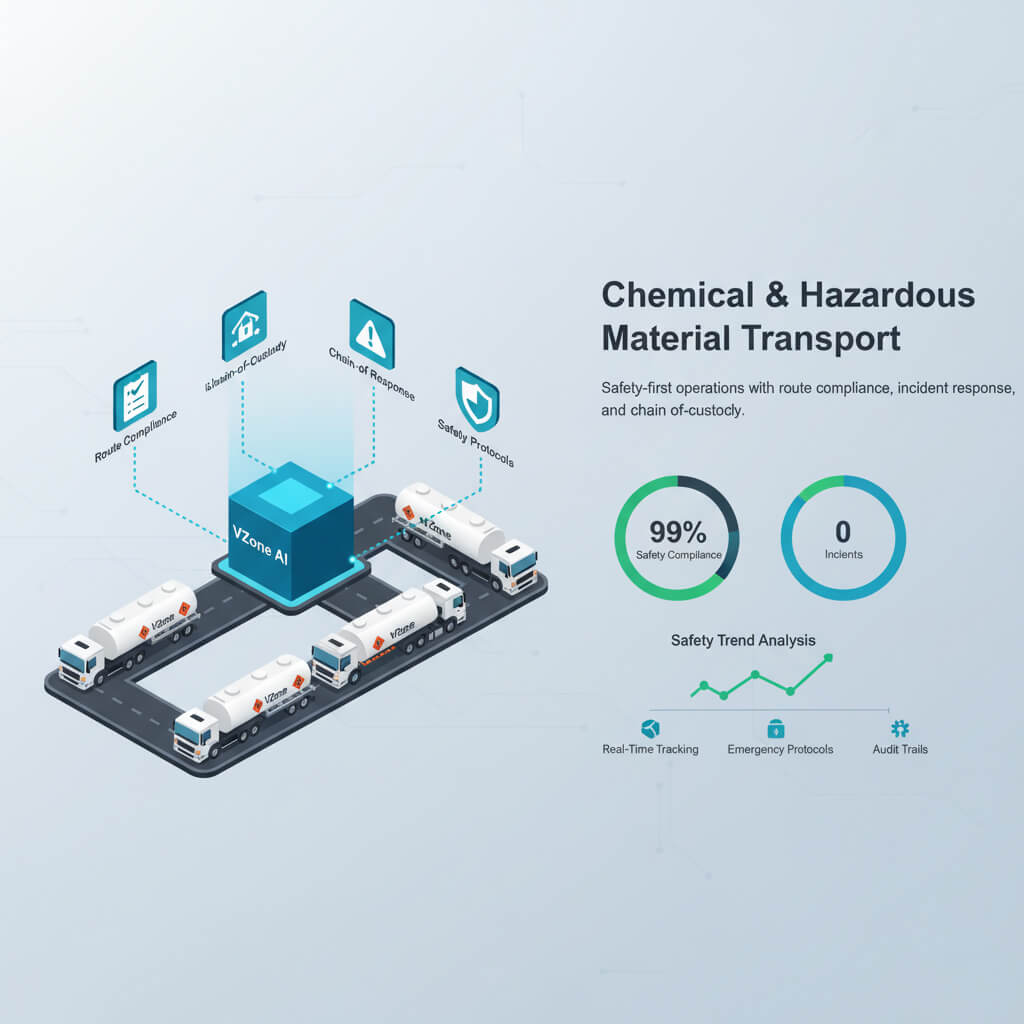
Chemical & Hazardous Material Transport
Compliant corridors. Tamper-proof custody. Incident-ready.
In chemical and hazardous material transport, one unmonitored detour can become a public safety incident. V Zone International gives UAE DG fleets a safety-first system built for compliance. The platform enforces ADR/DG-compliant corridor-only routing with geofencing, captures real-time seal and valve tamper events, triggers SOS workflows with automated call trees, and auto-generates digital chain-of-custody and compliance packs for every trip.
Tanker and DG container fleets running V Zone keep 100% regulatory logs, cut incident risk by 40%, lift dispatch efficiency by 25%, and back every vehicle on a second’s notice with corridor geofencing alone cutting non-compliant stops by 70%.
🚨 Top Challenges in Hazmat Transport
Chemical and hazardous material transport operates under the most scrutinised regulatory environment of any fleet sector. A tanker on the wrong road isn’t just a compliance issue it’s a public safety risk. A broken seal that goes undetected becomes an environmental liability. And when an incident occurs, the first question isn’t “what happened” it’s “where’s the documentation?” Here’s where hazmat transport breaks down:
- Leak/spill risk during transit
- Unauthorised stops or detours off approved DG corridors
- Regulatory paperwork burden
- Driver fatigue on long-haul routes
- High-value cargo security
- Emergency response coordination
🔍 The Blind Spots That Create Liability
Without tamper and route-proof data, compliance becomes manual and reactive relying on driver logs that can be incomplete, paper binders that get lost, and incident reports filed after the fact. When your DG compliance depends on documentation you can’t verify in real time, every trip carries unquantified risk.
If an auditor asks for proof that TNK-12 stayed on the approved DG corridor last Tuesday and you can’t produce it in 60 seconds you have a compliance gap, not a filing problem.
🎯 How V Zone Secures Hazmat Transport
V Zone gives chemical and DG transport operators a single platform built for the unique safety, security, and compliance requirements of hazardous cargo:
- Corridor-only routing & geo-fence enforcement for DG-approved routes
- Sealed-container tamper alerts via sensors
- Panic/SOS with automated call tree and emergency workflow
- Driver fatigue & hours-of-service analytics
- Digital chain-of-custody logs for every trip
- Border/customs document pack triggers
🤖 AI-Powered Hazmat Intelligence
V Zone’s AI is trained on hazmat-specific patterns DG corridor traffic, border-crossing timing, driver fatigue thresholds, seasonal temperature impact on chemical cargo, and incident-response protocols. It doesn’t just track; it anticipates risk:
- Predicts detour risk and flags route deviations before they happen
- Recommends safer alternates during closures
- Summarises compliance packs automatically per trip
- Highlights driver fatigue risk based on shift patterns
- Answers "Any tamper events today?" in real time
🛠️ Key Functionalities for DG Transport
Hazmat transport has safety and compliance requirements that no general fleet tool covers. V Zone maps each DG-specific challenge to a purpose-built solution:
| Problem | V Zone Solution |
|---|---|
| Route Deviations | Corridor enforcement + alerts |
| Tamper Events | Seal/valve inputs + video |
| Paperwork Load | Auto-generated compliance pack |
| Fatigue | HoS analytics + coaching |
| Emergency Response | SOS + live location sharing |
| Border Delays | Prepped docs + ETA updates |
| Compliance | Auto digital packs per trip |
| Security | Tamper + route proof |
📈 Measurable Business Impact
V Zone delivers measurable improvements from the first month improvements that reduce risk exposure, speed up audits, and lower insurance premiums:
- Zero-tolerance compliance posture 100% regulatory logs
- 40% reduction in incident risk
- 70% fewer non-compliant stops with corridor geofencing
- 25% faster dispatch efficiency
- Lower risk premiums with auditable custody records
- Faster border crossings with pre-generated documentation
📈 Before vs. After V Zone
| Feature | Before V Zone | With V Zone |
|---|---|---|
| Compliance | Manual binders | Auto digital packs |
| Security | Unknown events | Tamper + route proof |
| Incident Handling | Delayed | SOS workflows live |
| Visibility | Periodic calls | 5-sec tracking |
💬 Real Feedback from DG Operators
🔌 Integrations & Compatible Hardware
V Zone connects to the sensors, cameras, and compliance systems hazmat operators already use:
- Container/tanker APIs + digital seals & sensors + dashcams
- CANbus + ERP/TMS + emergency hotlines
- Android/iOS apps for drivers and compliance officers
- API for border, customs, and insurance platforms
🏭 V Zone in Action: Real DG Results
A regional chemicals carrier cut non-compliant stops by 70% after corridor geofencing, reduced audit preparation time from 2 days to 15 minutes with auto-generated compliance packs, and achieved zero tamper incidents over 6 months. The compliance team now runs real-time corridor-adherence reports instead of reviewing driver paperwork, and insurance reviewers receive digital chain-of-custody packs directly from the platform.
💬 FAQs
How does V Zone enforce DG-approved corridor routing?
V Zone uses geofencing to define approved DG corridors the specific roads and routes that hazardous material vehicles are permitted to use. When a tanker or DG container deviates from its approved corridor, the system sends an instant alert to the driver, dispatcher, and compliance officer with the vehicle’s exact location and the nature of the deviation. The driver receives rerouting instructions back to the approved corridor, and the event is logged with timestamp, GPS coordinates, and duration for audit purposes. Corridor definitions are configurable per cargo class, per jurisdiction, and per customer requirement.
Can V Zone detect seal and valve tampering in real time?
Yes. V Zone integrates with digital seal sensors and valve-position monitors installed on tankers and containers. If a seal is broken, a valve opens, or a sensor detects a tamper event while the vehicle is in transit, the system sends an instant alert with vehicle ID, GPS location, timestamp, and sensor data. The event is logged in the trip’s chain-of-custody record and flagged for investigation. For scheduled offloads, the system distinguishes between authorised and unauthorised events based on geofenced delivery points and pre-approved stop schedules.
How does V Zone handle emergency response for hazmat incidents?
V Zone includes an SOS workflow built for hazmat scenarios. When an emergency is triggered by the driver via panic button, by the system via sensor alert, or by the dispatcher the platform activates an automated call tree (emergency services, site safety officer, customer, insurance) and shares the vehicle’s live GPS location with all parties. The system also generates an incident pack with the vehicle’s cargo manifest, route history, driver ID, and all sensor data leading up to the event available immediately for first responders and investigators.
Does V Zone generate compliance documentation automatically?
Yes. V Zone auto-generates a digital compliance pack for every trip including route taken (with corridor-adherence verification), chain-of-custody log, seal/valve status throughout transit, driver hours-of-service record, and any incidents or deviations. These packs are exportable in PDF or API format and can be shared directly with regulators, customs, insurance providers, or customers. For cross-border DG transport, the system also pre-generates border documentation based on the cargo class and destination country requirements.
How does V Zone monitor driver fatigue on long-haul DG routes?
V Zone tracks hours of service (HoS) for every driver monitoring continuous driving time, rest periods, and shift duration against configurable thresholds based on UAE and GCC DG transport regulations. When a driver approaches their maximum continuous driving time, the system alerts the driver and dispatcher with a mandatory rest reminder. The AI also analyses driving-behaviour patterns lane drift indicators, reaction-time changes, and speed variability that may indicate fatigue before the HoS limit is reached. All fatigue events are logged in the driver’s safety record and the trip’s compliance pack.