
Specialized & Other Fleets
Custom telematics for fleets that don’t fit the shelf.
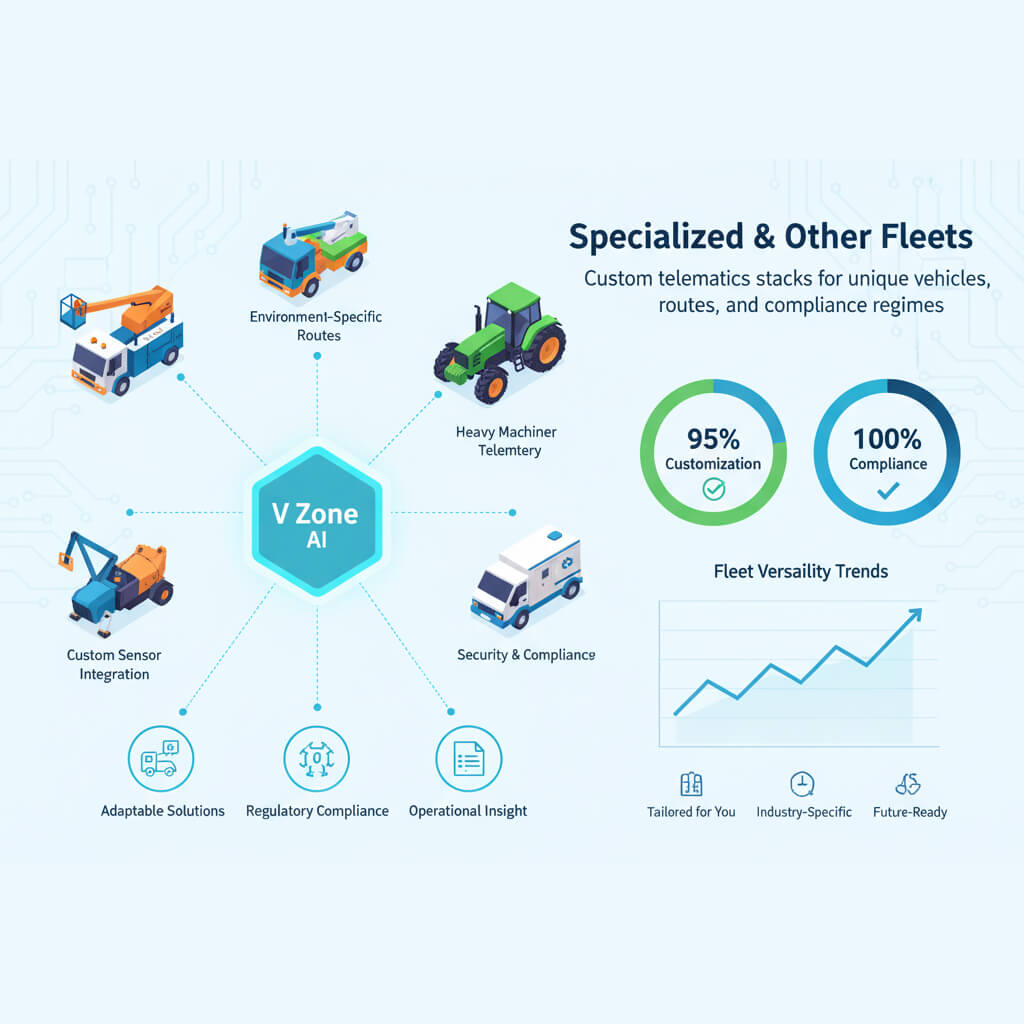
Specialised and other fleets don’t fit off-the-shelf software and V Zone International builds custom telematics stacks for UAE operators running unique vehicles, routes, and compliance regimes. From utility bucket trucks to cash-in-transit, the platform tailors certified hardware, custom workflows and forms, advanced alerting and escalations, dashcams with computer vision, and immobilise-audit-ready logs bridged to legacy systems via APIs and webhooks with 24/7 rollout and role-based training.
Operators running V Zone reach time-to-value fast and stay audit-clean: one utilities fleet rolled out niche workflows in just 30 days and passed audits cleanly across the UAE.
🚨 Top Challenges in Specialised Fleets
Specialised fleets operate vehicles and equipment that generic telematics platforms simply don’t account for utility bucket trucks, cash-in-transit vans, broadcast vehicles, mobile medical units, armoured carriers, water tankers, and custom-built service rigs. Each has unique safety rules, compliance requirements, sensor needs, and operational workflows that off-the-shelf solutions miss or force you to work around. Here’s where it breaks down:
- Niche safety/compliance requirements no standard platform covers
- Mixed asset types & sensors in one fleet
- Legacy system integration barriers
- Operator training & adoption challenges
- Harsh or unique operating environments
- Auditable records with custom data fields
🔍 The Blind Spots in Generic Platforms
Generic platforms miss the edge cases that matter in specialised fleets. When your utility truck needs boom-extension alerts, your CIT van needs vault-lock sensors, or your water tanker needs fill-level monitoring and the platform doesn’t support it you end up with spreadsheets, manual workarounds, and audit gaps.
If your fleet doesn’t fit the standard categories, your telematics shouldn’t be standard either. V Zone builds around your operations not the other way around.
🎯 How V Zone Builds for Unique Fleets
V Zone doesn’t force specialised fleets into a generic template. Instead, the platform is configured around your vehicles, sensors, workflows, and compliance requirements:
- Solution design workshops to map your exact needs
- Certified hardware for niche vehicle types and environments
- Custom workflows & forms built into the platform
- Advanced alerting & escalations for unique safety rules
- Dashcams & computer vision tailored to your risk profile
- 24/7 rollout and role-based training for your teams
🤖 AI Tuned to Your Fleet’s Patterns
V Zone’s AI doesn’t assume your fleet works like a logistics company or a construction site. It learns your fleet’s unique patterns operating cycles, sensor baselines, compliance thresholds, and anomaly signatures and builds intelligence around what matters to you:
- Rapid custom KPI creation for niche metrics
- Pattern detection across rare events and niche hardware
- Natural-language insights for ops teams without data skills
- Anomaly alerts tuned to your specific asset baselines
- Answers "What's unusual today?" based on your fleet's normal
🛠️ Key Functionalities for Specialised Operations
Specialised fleets need capabilities that generic platforms don’t offer. V Zone maps each niche requirement to a configurable solution:
| Problem | Smart Solution |
|---|---|
| Compliance Nuances | Custom forms + reports |
| Mixed Assets | Profiles + sensor packs |
| Legacy Systems | Bridging APIs + webhooks |
| Training Needs | Role-based onboarding |
| Harsh Environments | Ruggedised hardware options |
| Audit Trails | Immutable logs with custom fields |
📈 Measurable Business Impact
V Zone delivers measurable improvements even for fleets that have never had a platform that truly fits their operations:
- Faster time-to-value for unique fleets weeks, not months
- Lower risk with audit-ready trails from day one
- Happier operators with tailored UX, not forced workarounds
- Seamless IT fit through API-bridged legacy integration
📈 Before vs. After V Zone
| Feature | Before V Zone | With V Zone |
|---|---|---|
| Fit-to-Need | One-size | Tailored workflows |
| Integration | Manual | API-driven |
| Risk | Opaque | Anomaly alerts |
| Adoption | Slow | Role-based training |
💬 Real Feedback
🔌 Integrations & Compatibility
V Zone connects to whatever your specialised fleet already runs on:
- ERP/TMS + legacy DBs + sensors & cameras + mobile apps
- API & webhooks for any system no platform lock-in
- Custom hardware profiles for niche vehicle types
- Works with existing OBD, CAN, BLE, RFID, and proprietary sensors
🏭 V Zone in Action: Niche Fleets, Real Results
A UAE utilities company operating bucket trucks, cable-laying rigs, and inspection vans deployed V Zone with custom workflows. Results within 30 days:
- Boom-safety alerts: AI detects boom extension while moving 4 incidents caught and corrected in week one
- Custom inspection forms: Digital checklists replaced paper audit submission time cut 80%
- Legacy SCADA bridge: V Zone API connected to existing infrastructure monitoring no rip-and-replace
- Role-based dashboards: Line workers, supervisors, and safety managers each see what they need adoption hit 95% in 3 weeks
💬 FAQs
What types of specialised fleets does V Zone support?
V Zone supports any fleet type that doesn’t fit standard telematics categories utility bucket trucks, cash-in-transit vehicles, armoured carriers, broadcast/media vans, mobile medical units, water tankers, cable-laying rigs, inspection vehicles, tow trucks, and custom-built service rigs. The platform is configured around your specific vehicles, sensors, and compliance requirements rather than forcing your fleet into a generic template. If it moves and needs tracking, V Zone can build for it.
How does V Zone handle fleets with mixed asset types?
V Zone supports mixed-asset fleets from a single platform. Each asset type gets its own hardware profile, sensor configuration, alert rules, and KPI dashboards so a bucket truck has boom-safety alerts while a CIT van has vault-lock monitoring, all managed from one dashboard. Operators see only the data relevant to their asset type, while fleet managers see the consolidated view. This eliminates the need for multiple tracking platforms for different vehicle categories.
Can V Zone integrate with our legacy systems?
Yes. V Zone integrates with legacy systems via API, webhooks, database connectors, and where needed custom middleware. Whether your fleet data needs to flow into a 15-year-old ERP, a proprietary SCADA system, or a bespoke compliance database, V Zone’s integration layer bridges the gap without requiring you to replace existing infrastructure. The solution design workshop identifies all integration points before deployment begins, so there are no surprises at go-live.
How long does it take to deploy V Zone for a specialised fleet?
V Zone aims for deployment within 30–45 days for most specialised fleets including solution design workshops, hardware installation, custom workflow configuration, legacy integration, and role-based training. The 48-hour setup timeline that applies to standard fleets extends slightly for specialised deployments because of the custom configuration involved, but V Zone’s modular architecture means most customisation is configuration, not custom development. A phased rollout (pilot group first, then full fleet) is standard for complex deployments.
Does V Zone provide custom compliance forms and audit trails?
Yes. V Zone supports custom digital forms inspection checklists, safety checks, incident reports, and compliance documentation built into the driver/operator app. Each form submission is timestamped, GPS-tagged, and linked to the vehicle and operator. All data feeds into immutable audit trails with custom fields that match your specific regulatory or client requirements. Forms are configurable without code, so your compliance team can update them as regulations change without waiting for a development cycle.