
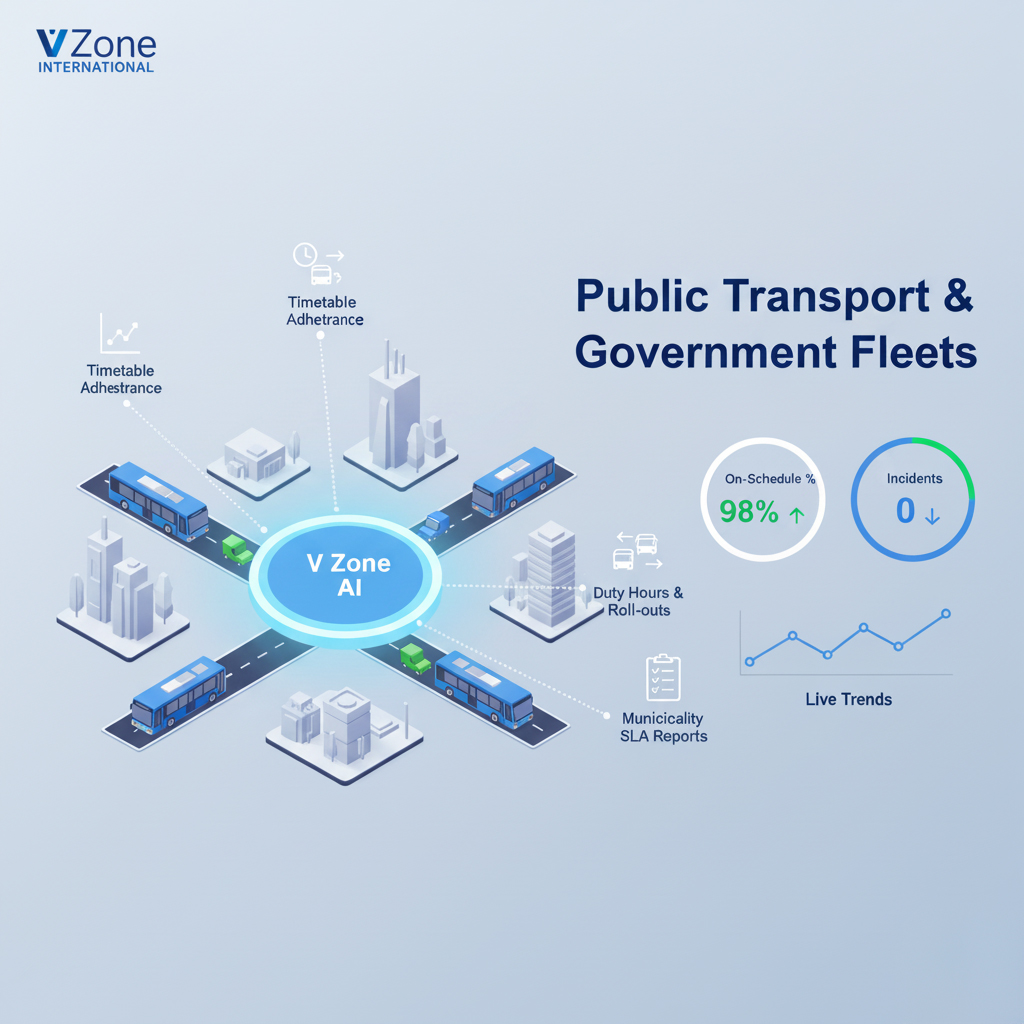
Public Transport & Government Fleets
Efficient Mobility. Accountable Operations. Smarter Cities.
For public transport and government fleets, accountability is non-negotiable and V Zone International gives UAE operators the real-time visibility and compliance automation that public-scrutiny demands. From city buses to municipal vehicles, the platform delivers live GPS and route monitoring, AI-driven safety scorecards, dynamic dispatch and scheduling, and auto-generated audit trails aligned with RTA, MOI, and municipality standards.
Public fleets running V Zone improve on-time performance by 30%, cut fuel overuse by 45%, lower maintenance costs with predictive planning, and reach 100% trip-logging and audit-trail generation delivering safer, more transparent mobility across the UAE.
🚨 Common Challenges in Public Sector Fleets
Public transport and government fleets face a unique combination of operational complexity and public accountability. Every route delay is visible to citizens. Every fuel discrepancy is subject to audit. Every underutilised vehicle represents taxpayer money sitting idle. And unlike commercial fleets, government operations must comply with strict regulatory frameworks while serving diverse departmental needs from city buses and inspection vehicles to municipal services and VIP transport. Here’s where it breaks down:
- Lack of real-time visibility and utilization insights
- Difficulty tracking route performance and on-time delivery
- No digital recordkeeping for fuel or maintenance
- Driver behavior issues impacting public safety
- Manual reporting for regulatory audits and compliance
- Inefficient fleet scheduling and dispatch management
🔍 Why Smart Tech Is Critical for Public Mobility
Public fleets operate under strict regulations and public scrutiny. Intelligent tracking, reporting, and compliance help build transparency, reduce inefficiencies, and deliver reliable public services. Without smart technology, government fleet managers rely on fragmented data, manual logs, and reactive maintenance none of which survive an audit or satisfy the public’s expectation for reliable, safe transport.
When a city bus runs 20 minutes late or a municipal vehicle’s fuel records don’t reconcile, it’s not just an operational gap it’s a public trust issue.
🎯 How V Zone Transforms Public Transport
V Zone gives public transport authorities and government fleet managers a single platform purpose-built for accountability, safety, and compliance:
- Real-time GPS and route monitoring for buses and service vehicles
- AI-based driver behavior alerts and safety scorecards
- Dynamic dispatch and fleet scheduling system
- Digital fuel logs, maintenance reminders & performance reports
- Trip history with SLA metrics and route punctuality tracking
- Compliance automation with RTA, MOI & municipality standards
🤖 AI Capabilities for Public Fleets
V Zone’s AI is trained on public-transport-specific patterns peak-hour passenger demand, route-level punctuality trends, seasonal ridership variation, and multi-departmental fleet allocation. It doesn’t just track; it optimises and predicts:
- Predicts delays based on traffic, weather, and route conditions
- AI alerting on unscheduled stops, speeding, or route deviation
- Automated fleet efficiency benchmarking and optimization
- Detects underutilized vehicles to redeploy smartly
- AI-driven resource allocation and shift planning
🛠️ Key Features for Public Sector Success
Government and public transport fleets have accountability and compliance requirements that commercial fleet tools don’t address. V Zone maps each public-sector challenge to a purpose-built solution:
| Challenge | Challenge |
|---|---|
| Delays in Service | Real-time tracking + delay alerts |
| Driver Oversight | AI-based behavior scoring & alerts |
| Compliance Issues | Auto reporting + SLA tracking |
| Resource Wastage | Fleet utilization & efficiency insights |
| Poor Maintenance | Predictive alerts & service logs |
| Manual Processes | Fully digital dashboards & reports |
📈 Real Government Outcomes
V Zone delivers measurable improvements from the first quarter and the gains compound as the AI learns your fleet’s patterns across departments and routes:
- 35% improvement in on-time performance for city buses
- 45% reduction in fuel overuse through AI monitoring
- 100% trip logging and audit trail generation
- 30% lower maintenance costs with predictive planning
- Increased public satisfaction through transparent reporting
📉 Before vs. 📈 After V Zone
| Feature | Before V Zone | With V Zone |
|---|---|---|
| Vehicle Tracking | Fragmented or manual | Unified GPS dashboard with live maps |
| Driver Behavior | No visibility | AI alerts for speed, stops, and harsh events |
| Compliance | Manual reports | Auto-generated audit-ready data |
| Fleet Scheduling | Paper-based or static | Dynamic AI-powered scheduling |
💬 What Government Clients Say
🔌 Integration & Compatibility
V Zone connects to the government ERP, transport systems, and Smart City platforms you already operate:
- Ready for government ERP & transport systems
- Android/iOS apps for managers and drivers
- API-ready for RTA, MOI, Smart City platforms
- Integrates with GPS, fuel sensors, and dashcams
- Customized dashboard access by department/unit
🏭 V Zone in Action: Smarter Public Fleet Operations
A public bus operator across 3 cities deployed V Zone and achieved 98.1% trip accuracy, 22% route optimisation savings, and full compliance with RTA reporting requirements within 90 days. The operations team replaced paper scheduling with AI-powered dispatch, fuel discrepancies dropped by 40%, and the transport authority now uses V Zone’s SLA dashboards for quarterly performance reviews replacing a manual process that previously took 3 weeks to compile.
🎯 Empower Smarter Public Mobility
Modernize your fleet for safer, smarter, and more accountable transport services.
💬 FAQs
Can V Zone manage multiple government departments on one platform?
Yes. V Zone supports multi-department deployments from a single platform transport, municipal services, inspection, VIP, sanitation, and emergency vehicles each get their own dashboard view with department-specific KPIs, while a central admin sees consolidated data across all departments. Access is role-based, so each department head sees only their fleet while senior leadership sees the full picture. This eliminates the need for separate tracking systems per department and enables cross-department vehicle reallocation when utilisation is uneven.
How does V Zone support RTA and MOI compliance?
V Zone automates compliance with RTA, MOI, and municipality fleet regulations by continuously generating the trip logs, driver behaviour records, vehicle inspection status, and fuel consumption reports that regulators require. Reports are exportable in audit-ready formats and timestamped for evidentiary value. The platform also tracks vehicle registration renewals, insurance expiry, and driver-licence validity alerting fleet managers before deadlines are missed. For public transport operators, V Zone generates SLA performance reports aligned to the metrics RTA monitors.
Does V Zone track SLA performance for public bus routes?
Yes. V Zone tracks on-time departure, route adherence, dwell times at stops, and trip completion metrics for every bus route and compares them against your defined SLA thresholds. When a route consistently underperforms (e.g., Route 12 falling below 90% on-time), the system flags it with root-cause data traffic patterns, driver delays, scheduling conflicts so you can fix the issue, not just report it. SLA dashboards are designed for quarterly reviews with transport authorities.
Can V Zone detect and reduce fleet underutilisation?
Yes. V Zone monitors utilisation across every vehicle and department tracking engine hours, trip frequency, idle time, and days-since-last-use. Vehicles that sit idle for more than a configurable threshold (e.g., 3 days) are flagged for reallocation, maintenance review, or decommission consideration. The AI also recommends optimal fleet sizing by department based on historical usage patterns, helping government fleet managers justify procurement decisions with data rather than estimates.
How does V Zone handle Smart City and digital-government integration?
V Zone offers API access that connects to Smart City platforms, government ERP systems, and digital-government dashboards. Fleet data vehicle locations, route performance, fuel consumption, compliance status can feed into city-level transport dashboards, open-data portals, or inter-agency coordination systems. For municipalities working on Smart City initiatives, V Zone provides the real-time fleet intelligence layer that sits between vehicle-level telemetry and city-level transport planning without requiring a custom integration project.