
Marine & Port Operations
Yard-to-gate visibility. Faster turnarounds. Safer ports.
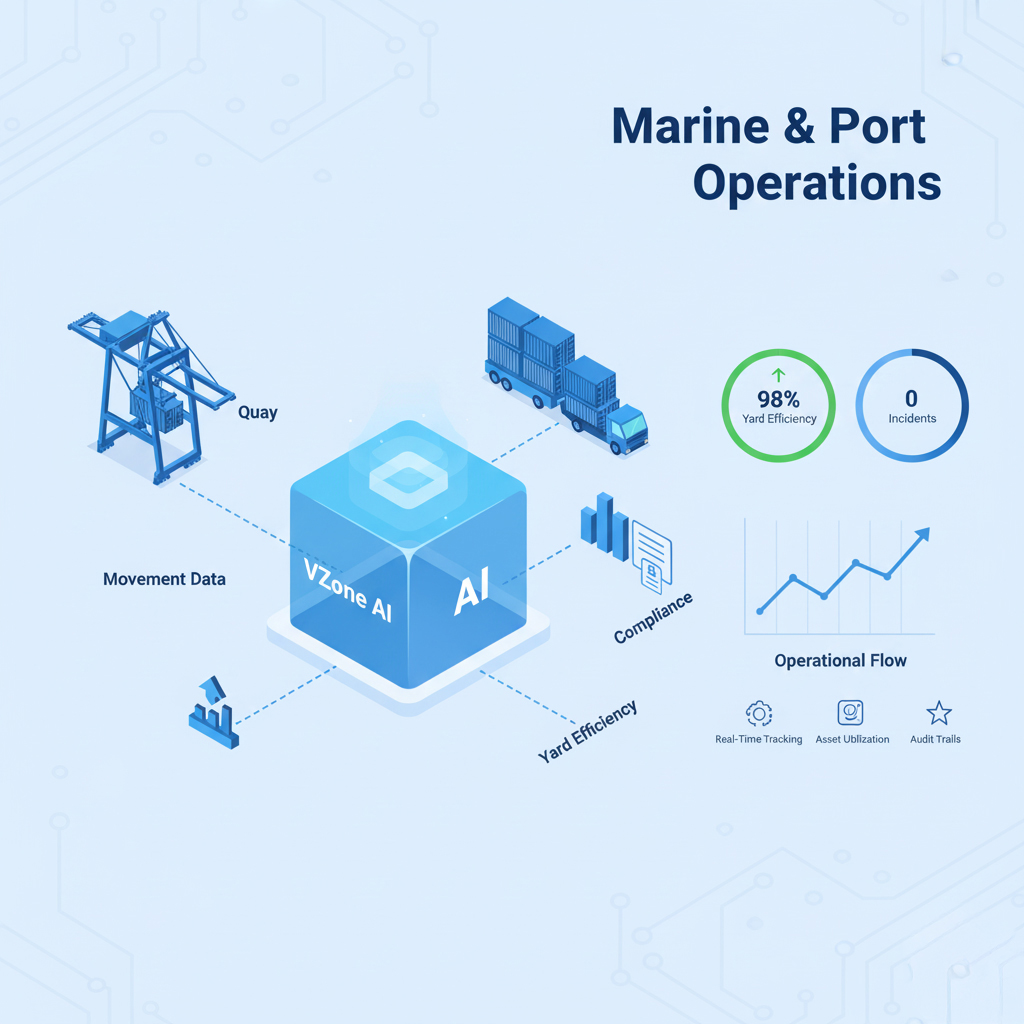
For marine and port operations, every hour a container sits idle is money lost and V Zone International gives UAE terminals yard-to-waterside visibility that turns yard chaos into data-led flow. The platform tracks terminal tractors, trailers, and launches with gate, yard, and berth geofencing, automates gate-in/out, builds dwell-time heatmaps for smart restotting, governs speeds and restricted zones, and monitors cold chain container probes integrated with Terminal OS, WMS, and RFID/BLE systems.
Ports running V Zone lift yard throughput by 15%, cut dwell time by 30%, keep 100% container trip trace, and one GCC port trimmed average dwell 27% in eight weeks.
- +15% yard throughput
- −30% dwell time
- 100% container trip trace
- 24/7 port-safe routing
🚨 Top Challenges in Marine & Port Fleets
Port operations are among the most complex fleet environments hundreds of assets moving within a confined, high-traffic yard where every minute of dwell time costs money and every unauthorised movement creates a safety risk. Tractors queue at berths while trailers sit idle in the wrong zone. Containers get lost between yard slots. And when a reefer container’s temperature probe goes unmonitored, the cargo owner files a claim before the vessel sails. Here’s where it breaks down:
- Berth/yard congestion and throughput bottlenecks
- Lost containers/trailers in sprawling yards
- Unauthorised movements in restricted zones
- Safety incidents in yards with mixed vehicle/pedestrian traffic
- Manual compliance logs that lag behind operations
- Poor handoff visibility between shifts
🔍 The Blind Spots Slowing Your Port
Without unified yard timelines, containers and MHE lose hours in invisible dwell sitting in the wrong zone, waiting for a tractor that’s queued at another berth, or missing a gate slot because nobody knew the trailer was ready. When your yard planner’s view of reality is 30 minutes behind the yard itself, every decision is reactive.
When a yard planner can’t tell you where 12 trailers are right now or how long they’ve been there you don’t have a visibility problem, you have a throughput problem.
🎯 How V Zone Transforms Port Operations
V Zone gives terminal operators and port logistics teams a single platform built for the unique density, speed, and compliance demands of marine environments:
- Gate-in/out automation with RFID/BLE and camera integration
- Yard slotting & dwell-time heatmaps for smart restotting
- Speed/zone governance within yard boundaries
- Digital handoff & chain-of-custody logs per container
- SOS & incident video for yard safety events
- Cold chain container probes with temperature alerts
🤖 AI-Powered Port Intelligence
V Zone’s AI is trained on port-specific patterns berth scheduling, crane allocation cycles, gate queue dynamics, tractor routing within yard blocks, and shift-change handoff gaps. It doesn’t just track; it optimises throughput:
- Predicts yard bottlenecks and recommends restotting
- Recommends tractor reallocation between berths
- Flags risky zones after dark or during shift changes
- Auto-builds yard KPIs by shift for operations reviews
- Answers "Which trailers stuck >2h?" instantly
🛠️ Key Functionalities for Port Operations
Marine and port fleets have density, safety, and throughput requirements that general fleet tools can’t address. V Zone maps each port-specific challenge to a purpose-built solution:
| Problem | Smart Solution |
|---|---|
| Yard Congestion | Heatmaps + restotting recommendations |
| Lost Assets | Geo-fences + last-seen tracking |
| Unauthorized Moves | Zone governance + alerts |
| Safety Incidents | Speed caps + video |
| Compliance Logs | Automated timestamps |
| Cold Chain Boxes | Probe monitoring + alerts |
📈 Measurable Business Impact
V Zone delivers measurable improvements from the first month improvements that translate directly into higher throughput and lower demurrage:
- 15% higher yard throughput
- 30% reduction in average dwell time
- 100% container end-to-end trip trace
- Fewer safety incidents with proactive zone caps
- Audit-ready trails for every gate, yard, and berth move
📈 Before vs. After V Zone
| Feature | Before V Zone | With V Zone |
|---|---|---|
| Throughput | Unplanned | Data-led reslotting |
| Traceability | Fragmented | End-to-end trip trace |
| Safety | Reactive | Proactive zone caps |
| Compliance | Manual | Automated |
💬 Real Feedback from Port Operators
🔌 Integrations & Compatible Hardware
V Zone connects to the terminal systems, sensors, and yard equipment port operators already use:
- Terminal OS + WMS + RFID/BLE + dashcams + CANbus + API
- Gate camera & OCR integration for container ID capture
- Cold chain probe feeds for reefer monitoring
- Android/iOS apps for yard drivers and supervisors
🏭 V Zone in Action: Faster Turnarounds
A GCC port operating 200+ yard tractors and handling 1,800 TEU/day deployed V Zone across its container terminal. Within eight weeks, average yard dwell dropped 27% through heatmap-led restotting, gate throughput lifted 12% after eliminating a scanner bottleneck identified by V Zone’s shift analytics, and the operations team replaced end-of-shift paper handoffs with real-time digital dashboards cutting shift-change information gaps from 45 minutes to zero.
💬 FAQs
How does V Zone reduce container dwell time in the yard?
V Zone builds real-time dwell-time heatmaps across every yard zone showing exactly where trailers and containers are sitting and for how long. When a zone exceeds its target dwell time, the system recommends restotting (moving containers to less congested zones) and alerts the yard planner. The AI also identifies patterns specific berths, shifts, or cargo types that consistently cause dwell spikes so operations managers can fix root causes, not just symptoms. Ports typically see a 20–30% reduction in average dwell time within the first quarter.
Can V Zone automate gate-in and gate-out tracking?
Yes. V Zone integrates with gate cameras, OCR systems, RFID readers, and BLE beacons to automate container and vehicle identification at gate entry and exit. When a truck arrives, the system captures the container ID, vehicle registration, timestamp, and driver ID logging the gate event automatically without manual data entry. Gate throughput analytics show queue times, processing speed per lane, and bottlenecks by time of day, so terminal operators can optimise gate staffing and lane allocation.
Does V Zone monitor reefer containers for temperature compliance?
Yes. V Zone integrates with reefer container temperature probes to monitor cold chain integrity while containers are in the yard, on a trailer, or being moved between berth and stack. If temperature drifts outside the configured range, the system sends an instant alert with container ID, location, temperature, and duration. This protects perishable and pharmaceutical cargo from spoilage claims and provides documented proof of temperature compliance for cargo owners and insurance.
How does V Zone improve yard safety?
V Zone enforces speed limits within yard zones, flags unauthorised vehicle movements in restricted areas (berth-side, pedestrian zones, crane operating areas), and integrates with video AI for incident detection. When a tractor exceeds the yard speed limit or enters a restricted zone, the driver and yard supervisor receive instant alerts. Safety events are logged with GPS, timestamp, and video for investigation. The system also flags risky zones during shift changes and after dark when visibility drops and incident rates historically spike.
Does V Zone integrate with Terminal Operating Systems?
Yes. V Zone integrates with Terminal Operating Systems (TOS), Warehouse Management Systems (WMS), and port community systems via API. Container movements tracked by V Zone gate in/out, yard slot, berth delivery, reefer status flow into the TOS automatically, and planning instructions from the TOS flow back to V Zone’s yard dispatching layer. This eliminates the data gap between what the TOS thinks is happening and what’s actually happening in the yard which is where most throughput is lost.