
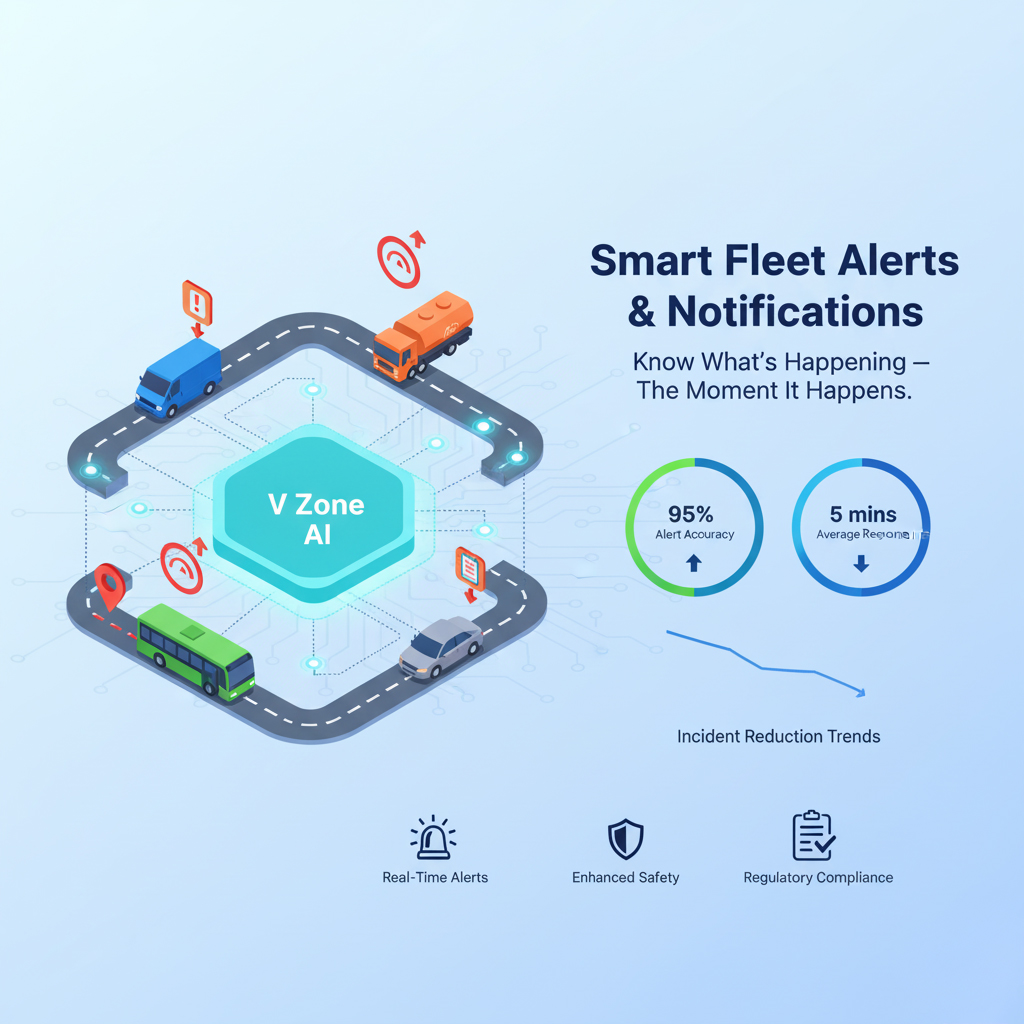
Smart Fleet Alerts & Notifications
Know What’s Happening The Moment It Happens.
Your vehicles are on the move and your drivers are making hundreds of decisions every day. Without real-time alerts, critical incidents overspeed, fuel theft, route deviations, unauthorised use go unnoticed until they become losses on a report you read the next morning.
V Zone’s Smart Alert System delivers real-time, configurable notifications across vehicles, drivers, fuel, routes, and compliance catching 90% of fleet incidents the moment they happen. Alerts are filtered to eliminate noise, routed to the right person, and logged with full audit trails for investigation and coaching.
❗ Why Traditional Fleets Struggle
Without smart alerts, fleet data is just post-mortem you learn about problems after the damage is done. Overspeed goes unchecked, fuel theft goes unnoticed for days, and unauthorised vehicle use happens without anyone knowing until it shows up in an expense report:
- Missed overspeed or route violations no one sees them in real time
- Fuel theft unnoticed for hours or days sudden drops buried in data
- Unplanned vehicle misuse after working hours no off-hours monitoring
- Fatigued or distracted drivers on duty no behavioural triggers
- No pattern detection on recurring issues same problems repeat
🔔 What We Monitor (Live & Smart)
V Zone’s alert engine monitors six categories of fleet activity in real time from driver behaviour and vehicle misuse to fuel events, route compliance, safety violations, and maintenance flags:
| Alert Category | Examples Tracked in Real Time |
|---|---|
| Driver Behavior | Overspeed, harsh braking, sharp turns, mobile use, fatigue detection |
| Vehicle Misuse | After-hours driving, unauthorised ignition, geofence breach |
| Fuel Events | Sudden fuel drops, low levels, theft attempts, overfill alerts |
| Route & Trip | Route deviation, skipped POIs, excessive stop duration |
| Safety & Compliance | No seatbelt, dashcam off, toll zone crossing during off-hours |
| Maintenance Flags | High engine temp, excessive idling, service overdue |
🛠️ How It Works – Real-Time Precision
V Zone’s alert system follows a five-step pipeline from sensor data collection to smart filtering, multi-channel delivery, escalation, and auto-linked reporting:
Sensors + AI
collect real-time data from GPS, fuel sensors, CAN bus, AI dashcams, and external devices
Smart Filtering
only trigger alerts when parameters exceed configured thresholds, eliminating noise
Multi-Channel Delivery
receive alerts via app, SMS, email, WhatsApp, or V Zone Control Centre
Escalation Chain
critical events trigger sequential alerts to supervisors, safety managers, and control room
Auto-Linked Reports
every alert is logged, timestamped, and linked to the trip, driver, and vehicle
🏭 Industry Use Cases
V Zone’s alert system adapts to the specific risk profile of each industry different thresholds, different escalation chains, different priorities:
Last-Mile Delivery Fleet
- Trigger alert if driver delays at a delivery POI for more than 7 mins.
- Escalate if vehicle skips a scheduled POI entirely.
Cold Chain Logistics
- Instant alert if temperature drops below 2°C during sensitive pharma delivery.
Oil & Gas Fleet
- Fuel tank cap opens in unauthorized zone? Alert + live video snapshot.
Construction & Equipment
- Alert if heavy machinery operates beyond permitted hours or location.
📈 Measurable Business Impact
Fleets that deploy V Zone’s smart alert system see measurable improvements across unauthorised use, fuel theft detection, delivery compliance, driver performance, and safety incidents:
| Metric | Result with V Zone Alerts |
|---|---|
| Unauthorized trip reduction | ⬇️ 60% in first 2 weeks |
| Fuel theft detection rate | ⬆️ 90% of incidents caught instantly |
| Delivery SLA improvement | ⬆️ 35% on-time compliance |
| Driver performance coaching success | ⬆️ 70% improvement with alert logs |
| Safety incident reduction | 45% accident-linked violations |
Results based on V Zone client deployments. Actual outcomes vary by fleet size and alert configuration. All claims should be verified with V Zone.
🧠 Smarter Alerts = Smarter Decisions
V Zone’s alert system isn’t just reactive it’s configurable, predictive, and integrated with your operational workflows so alerts drive action, not just awareness:
- ✅ Configure thresholds per vehicle group, route, or driver tier
- ✅ Tailor alerts to business hours different rules for day vs night operations
- ✅ Integrate with your ERP, HR, or compliance system for automated follow-up
- ✅ See driver score changes based on alert frequency and severity
- ✅ Link alerts to incident workflows, fleet audits, and coaching records
💬 What Our Clients Say
📊 Visualize & Analyze
V Zone’s alert analytics turn raw alert data into operational intelligence showing where incidents cluster, which drivers need coaching, and how fast your team responds:
- Alert heatmaps across routes see where incidents concentrate
- Most frequent alert types by vehicle or driver
- Escalation logs and time-to-respond tracking
- Driver behaviour trend reports based on alert history
💪 Why V Zone?
V Zone’s alert engine is integrated into the fleet platform alongside GPS, fuel, driver behaviour, dashcam, and compliance modules so every alert carries full operational context and links directly to the data that triggered it:
- 15+ years of fleet intelligence across the UAE and GCC
- Configurable thresholds, escalation chains, and delivery channels
- Seamless integration with GPS, dashcam, fuel, maintenance and ERP
- Proven deployment across 20+ industries
🔐 Security, Accountability, Control In Real-Time
Fleet alerting isn’t optional it’s mission critical.
Let V Zone help you turn real-time awareness into long-term savings and safety.
🎯 Ready to Get Started?
💬 FAQs
What types of alerts can V Zone send?
V Zone supports alerts across six categories: driver behaviour (overspeed, harsh braking, sharp turns, mobile use, fatigue), vehicle misuse (after-hours driving, unauthorised ignition, geofence breach), fuel events (sudden drops, low levels, theft attempts, overfill), route and trip (deviation, skipped POIs, excessive stops), safety and compliance (no seatbelt, dashcam off, toll zone during off-hours), and maintenance flags (high engine temp, excessive idle, service overdue). Each alert type is independently configurable with custom thresholds, delivery channels, and escalation rules. You only receive alerts that matter to your operation.
How does V Zone prevent alert fatigue?
V Zone uses smart filtering to eliminate noise. Instead of alerting on every minor event, you set thresholds that reflect your operational reality for example, overspeed alerts only fire above 120 km/h (not 81 km/h on an 80 km/h road), or idle alerts only trigger after 15 minutes (not 2 minutes at a traffic light). You can also configure alert suppression during known conditions (e.g., no geofence alerts during Ramadan shift changes) and group low-priority alerts into daily digest emails instead of instant notifications. The result: fewer, more meaningful alerts that your team actually acts on.
How are alerts delivered?
V Zone delivers alerts through five channels: in-app push notifications (on the V Zone mobile app and dashboard), SMS, email, WhatsApp, and the V Zone Control Centre for centralised monitoring teams. Each alert type can be configured to use different channels based on severity for example, a minor idle alert goes to the dashboard only, a fuel theft suspicion goes via SMS and WhatsApp to the fleet manager, and a critical safety event triggers an escalation chain to the safety officer and control room simultaneously. Delivery preferences are configured per user role.
Can I set different alert rules for different vehicle groups?
Yes. V Zone supports per-group alert configuration. You can define separate thresholds, delivery channels, and escalation rules for different vehicle groups for example, heavy trucks may have a speed threshold of 100 km/h while delivery vans are set to 120 km/h. Cold chain vehicles can have temperature alerts enabled while dry cargo vehicles don’t. Night-shift vehicles can have after-hours geofence rules that differ from day-shift vehicles. Each group’s rules are managed independently through the admin console, and changes take effect immediately without requiring a system restart or device update.
Are alerts logged and available for audits?
Yes. Every alert V Zone generates is automatically logged with a timestamp, the vehicle and driver involved, the GPS location at the time of the event, the sensor data that triggered it, who received the notification, and whether it was acknowledged or escalated. Alert logs are searchable by date range, driver, vehicle, alert type, or severity level, and can be exported as PDF or Excel reports for audits, insurance claims, HR investigations, or compliance reviews. Logs are immutable they cannot be edited or deleted ensuring the data is admissible for regulatory and legal purposes.