
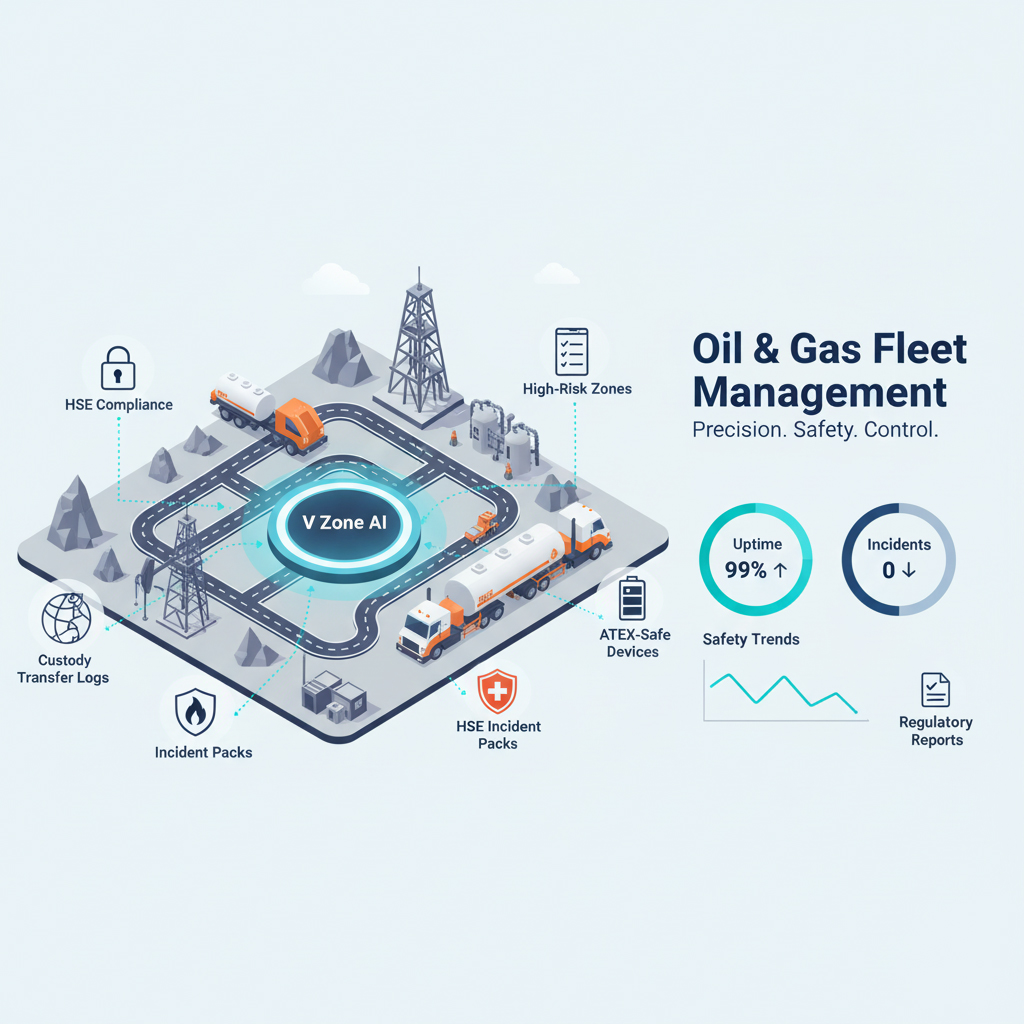
Oil & Gas Fleet Management
Precision. Safety. Control. Across Harsh Environments.
Oil and gas fleet management runs on safety and compliance and V Zone International gives UAE operators precision control across tankers, pickups, and remote-rig fleets in the harshest conditions. The platform combines real-time tracking that works in off-grid zones, fuel sensors with live theft and leakage alerts, AI-driven risk detection near hazardous areas, predictive maintenance, and automated no-stop zones with compliance-ready logs for RTA, ADNOC, and safety audits.
Fleets running V Zone cut fuel misuse by 40%, reduce compliance reporting time by 70%, cut maintenance-related delays by 30%, and improve safety violation rates by 50% across the UAE.
🚨 Key Challenges in Oil & Gas Fleets
Oil and gas fleet operations span some of the most demanding environments on earth remote desert rigs, offshore platforms, pipeline corridors, and urban refineries all under intense safety and regulatory scrutiny. A fuel theft on a remote site goes undetected for weeks. A driver exceeding speed limits near a wellhead creates a catastrophic risk. And when ADNOC or HSE auditors ask for trip logs from last month, paper records don’t survive the question. Here’s where it breaks down:
- High risk of accidents, hazardous material handling
- Limited visibility in remote or off-grid operations
- Fuel pilferage and inaccurate consumption logs
- Difficult compliance with safety & transport regulations
- Breakdown in harsh climates or terrain
- Complex coordination between multiple fleet types (tankers, pickups, crew buses, maintenance rigs)
🔍 Why Intelligent Fleet Tracking Is Critical
In a high-risk, high-cost industry, every delay, theft, or accident can mean millions lost or lives at risk. V Zone ensures your fleet stays connected, compliant, and controlled 24/7. Without intelligent tracking, oil and gas operators are managing by radio calls and spreadsheets neither of which survive an audit or prevent an incident.
When a tanker goes off-route in a restricted zone and nobody knows for 4 hours, it’s not a tracking gap it’s an HSE incident waiting to happen.
🎯 How V Zone Supports Oil & Gas Operations
V Zone gives oil and gas operators a single platform built for the unique safety, compliance, and environmental demands of energy-sector fleet management:
- Real-time vehicle tracking even in remote zones with satellite fallback
- Fuel sensor integration with live alerts for leakage or theft
- Driver behaviour monitoring in hazardous zones
- Predictive maintenance to avoid breakdowns in harsh conditions
- Route and stop control with geofencing for restricted areas
- Compliance-ready logs for RTA, ADNOC, and safety audits
🤖 Built-In AI Safety & Compliance Tools
V Zone’s AI is trained on oil and gas-specific patterns desert driving conditions, rig-site shift rotations, tanker route compliance, fuel-burn profiles by vehicle and terrain, and HSE incident precursors. It doesn’t just track; it protects:
- AI detects driving risks: harsh braking, cornering, speeding
- Sends alerts for idling near danger zones
- Predicts service needs based on terrain and load
- Analyzes fuel use across vehicle type, terrain, and job role
- AI-driven safety scores for driver retraining
🛠️ Specialised Features for Oil & Gas Fleets
Oil and gas fleets have safety, compliance, and environmental requirements that no general fleet tool covers. V Zone maps each energy-sector challenge to a purpose-built solution:
| Industry Need | V Zone Solution |
|---|---|
| Hazardous Transport | Real-time tracking + route alerts |
| Fuel Theft | Fuel level sensors + drop alerts |
| Compliance | Automated digital logs |
| Breakdowns | Predictive maintenance |
| Safety Monitoring | AI dashcam & driver alerts |
| Remote Access | Offline tracking + satellite sync |
| Driver Oversight | AI-based risk detection |
📈 Measurable Impact Delivered
V Zone delivers measurable improvements from the first month improvements that reduce risk, cut costs, and satisfy the most demanding safety audits:
- 40% drop in fuel misuse across heavy transport
- Compliance reporting time reduced by 70%
- Maintenance-related delays cut by 35%
- AI-driven driver retraining recommendations
📈 Before vs. After V Zone
| Area | Before V Zone | After V Zone |
|---|---|---|
| Fuel Tracking | Manual logs | Real-time sensors & theft alerts |
| Maintenance | Reactive | AI-predictive & preventive |
| Compliance | Manual reports | Auto-compliance dashboards |
| Driver Oversight | Unmonitored | AI-based risk detection |
| Remote Ops | No visibility | Satellite/mesh-based tracking |
💬 Real Feedback from Oil and Gas Leaders
🔌 Integrations & Hardware
V Zone connects to the rugged hardware, safety systems, and enterprise platforms oil and gas operators already use:
- Compatible with fuel sensors, dashcams, BLE, and satellite modems
- Integration-ready with ADNOC, ADNOC Distribution, and RTA portals
- iOS & Android apps for vehicle and field teams
- APIs available for ERP, HSE compliance, and dispatch systems
🏭 V Zone in Action: Safety in Every Mile
An upstream operator managing 120 vehicles across 3 desert concessions and 2 coastal facilities deployed V Zone. Results within 90 days:
- 🛢 Fuel Tankers monitored for route deviations, theft alerts, and harsh handling
- 🚨 Explosive Material Carriers geo-fenced with no-stop zones + AI dashcam supervision
- 🛠 Maintenance Fleets dispatched to desert or offshore rigs with real-time ETA and terrain warnings
- 📉 Downtime Analytics show where delays happen and how to fix them
🚀 Be Compliant. Be Safe. Be Efficient.
💬 FAQs
Does V Zone work in remote desert and offshore locations?
Yes. V Zone supports satellite-based tracking and mesh connectivity for remote desert concessions and offshore platforms where cellular coverage is unavailable. Devices cache data locally when connectivity drops and sync automatically when the connection is restored ensuring zero data loss. This means you get complete trip logs, fuel data, and driver behaviour records for every vehicle, even those operating 200 km from the nearest cell tower.
How does V Zone detect fuel theft on oil and gas sites?
V Zone uses fuel-level sensors that monitor tank levels continuously. If fuel drops while the engine is off indicating a siphon event the system sends an instant alert with vehicle ID, GPS location, timestamp, and volume lost. The AI also flags vehicles with consumption patterns significantly above their baseline for the same route and load, catching slower theft patterns. For tanker fleets, V Zone correlates loading receipts with delivery volumes and flags discrepancies automatically.
Can V Zone enforce restricted zones and no-stop areas?
Yes. V Zone uses geofencing to define restricted zones, no-stop areas, and approved corridors. When a vehicle enters a restricted zone, stops in a no-stop area, or deviates from an approved route, the system sends an instant alert to the driver, dispatcher, and HSE manager. All zone violations are logged with GPS coordinates, timestamp, and duration for compliance reporting. This is especially critical near wellheads, pipeline corridors, storage facilities, and explosive-material zones.
How does V Zone support ADNOC and HSE compliance?
V Zone auto-generates compliance-ready logs covering trip history, driver behaviour, fuel consumption, vehicle inspection status, and incident records. Reports are exportable in formats required by ADNOC, ADNOC Distribution, RTA, and HSE auditors. The platform also tracks driver licence validity, vehicle permit expiry, and safety-equipment inspection dates alerting fleet managers before deadlines are missed. For operators with ADNOC contractor requirements, V Zone provides the fleet documentation layer that proves safety and compliance standards are being met.
Does V Zone support multiple fleet types in oil and gas operations?
Yes. V Zone manages all fleet types in a single platform fuel tankers, explosive-material carriers, crew transport buses, light vehicles (pickups/SUVs), maintenance rigs, and heavy equipment. Each fleet type can have its own dashboards, alert rules, compliance requirements, and KPIs while sharing a centralised view for operations management. This is essential for upstream, midstream, and downstream operators who manage 5–10 vehicle categories with different safety profiles, driver requirements, and regulatory obligations.