
Tyre Pressure Monitoring
Stay on Track with Optimal Tyre Health & Safety
Improper tyre pressure isn’t a minor issue it’s a compounding risk. Under-inflated tyres waste fuel, overheat faster, and fail without warning. Over-inflated tyres reduce grip and accelerate centre wear. In UAE conditions, where road surface temperatures regularly exceed 60°C, even a 10% deviation from optimal pressure accelerates wear and increases blowout probability.
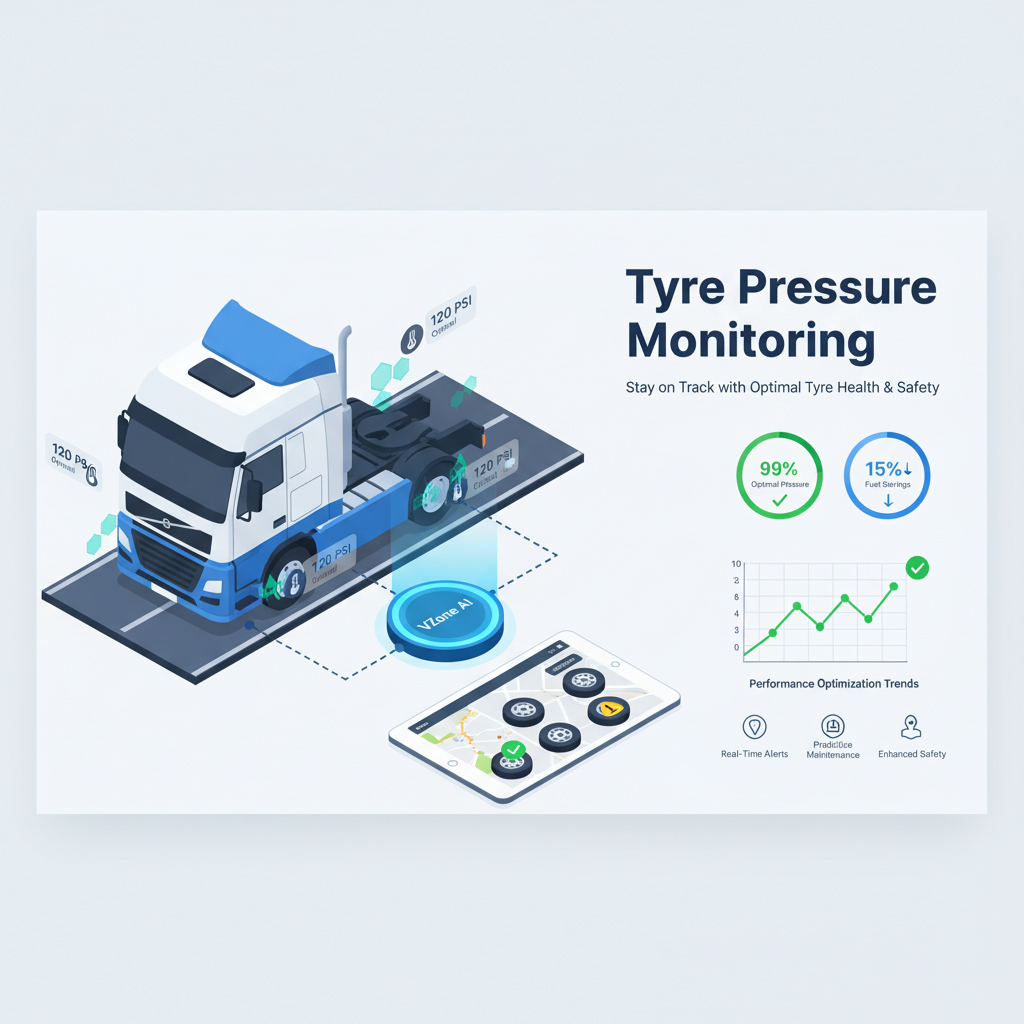
V Zone’s Tyre Pressure Monitoring System (TPMS) delivers real-time pressure and temperature readings for every wheel on every vehicle with instant alerts when any tyre deviates from safe thresholds. The result: 25% fewer tyre-related breakdowns, up to 10% longer tyre lifespan, and 3% fuel savings from optimised inflation across the fleet.
📌 Why Tyre Pressure Monitoring Matters
Tyre pressure directly impacts four critical areas of fleet performance safety, fuel efficiency, tyre lifespan, and maintenance cost. Without real-time TPMS data, pressure problems go undetected until they become blowouts, fuel spikes, or roadside breakdowns:
💥 Prevent Blowouts
- Real-time pressure monitoring catches dangerous drops before they cause a tyre failure on the road.
⛽️ Save Fuel
- Under-inflated tyres waste up to 3% more fuel. Optimal pressure across the fleet reduces drag and consumption.
🕒 Extend Tyre Life
- Catch slow leaks and uneven inflation early reducing premature replacements by up to 10%.
💵 Cut Maintenance Costs
- Prevent suspension and chassis damage caused by prolonged driving on improperly inflated tyres.
🛠️ What V Zone’s TPMS Offers
V Zone’s TPMS module delivers five core capabilities from per-wheel live pressure readings and instant alerts to temperature monitoring, sensor health diagnostics, and historical trend analytics:
📡 Real-Time Tyre Pressure Readings
- Live, vehicle-wise updates on tyre pressure for all wheels via onboard sensors.
🚨 Instant Low/High Pressure Alerts
- instant notification the moment pressure deviates from safe thresholds
🌡️ Temperature Monitoring
- detect overheating from brake drag, under-inflation, or bearing failure.
🛠️ Sensor Health Diagnostics
- automatic detection of faulty, disconnected, or low-battery sensors.
📊 Historical Reports & Analytics
- pressure trends, maintenance history, and cost-saving insights over time.
⚙️ How It Works
V Zone’s TPMS follows a four-step process from sensor installation to live data transmission, configurable alert thresholds, and integration with maintenance workflows:
Sensor Installation
- Pressure and temperature sensors installed in each tyre internal or valve-based
Live Data Transmission
- Data sent wirelessly to the onboard telematics unit and your V Zone dashboard
Thresholds & Alerts
- Custom pressure ranges per tyre type; alerts via SMS, email, app, or WhatsApp
Integration with Maintenance
- Pressure issues auto-trigger service reminders or fault logs in the service tracker
🔒 Safety That Moves with You
V Zone’s TPMS works across every vehicle class in your fleet and integrates with other safety modules to create a connected safety net around tyre health:
- Works across heavy-duty trucks, buses, trailers, delivery vans, and light commercial vehicles
- Integrates with brake diagnostics, ABS, and load sensor modules
- Reduces risk of downtime from unexpected blowouts especially critical on UAE highways
- Supports multi-axle configurations with per-wheel visibility
📈 Business Impact
Fleets that deploy V Zone’s TPMS see measurable improvements in breakdown prevention, tyre lifespan, roadside incidents, and compliance scores:
✅ 25% fewer tyre-related breakdowns
✅ Up to 10% increase in tyre lifespan with balanced inflation
✅ 3% fuel savings from optimised pressure fleet-wide
✅ Significant drop in roadside emergency calls
✅ Improved safety and compliance scores in regulated markets
Results based on V Zone client deployments. Actual outcomes vary by fleet size and operating conditions. All claims should be verified with V Zone.
👥 Ideal For
V Zone’s TPMS is designed for fleets where tyre safety, fuel efficiency, and blowout prevention are operational priorities especially in high-temperature and long-distance environments:
- Long-haul logistics and trucking fleets
- School and staff transportation vehicles
- Cold chain and refrigerated transport
- Rental, leasing, and intercity bus operators
- Construction and heavy equipment fleets
🧠 Why V Zone?
V Zone’s TPMS isn’t a standalone sensor display it’s integrated into the fleet platform alongside GPS, fuel, driver behaviour, and maintenance modules. That means pressure data connects to driving patterns, load conditions, and route history for a complete tyre safety picture:
- ✅ AI algorithms to predict pressure anomalies before they cause failures
- ✅ 15+ years of fleet intelligence
- ✅ Global hardware compatibility works with all major TPMS sensor brands
- ✅ Fully customisable dashboards and alert thresholds
- ✅ Scalable from 5 vehicles to 10,000+
🔧 Optional Add-Ons
For fleets with advanced tyre safety requirements, V Zone offers configurable add-ons that extend TPMS into vehicle health reporting, cold chain analytics, and driver behaviour correlation:
- TPMS health reports integrated with Vehicle Health Report
- Temperature-pressure combined analytics for cold chain fleets
- Driver-wise tyre handling behaviour reports cornering, braking, overloading
- Battery status alerts for wireless tyre sensors
- Predictive tyre failure scoring based on pressure trend analysis
🚀 Stay Safe. Drive Efficient.
Don’t let tyre pressure be a blind spot in your fleet safety.
With V Zone’s Tyre Pressure Monitoring System, you’re always in control.
💬 FAQs
What types of TPMS sensors does V Zone support?
V Zone supports two types of TPMS sensors: internal sensors (mounted inside the tyre on the rim, providing the most accurate and durable readings) and valve-cap sensors (mounted externally on the tyre valve stem, easier to install and transfer between vehicles). Both types transmit pressure and temperature data wirelessly to the onboard telematics unit. V Zone is compatible with all major TPMS sensor brands and can support mixed sensor types across a single fleet. For heavy-duty trucks and trailers, internal sensors are recommended for durability; for light commercial vehicles, valve-cap sensors offer a faster, lower-cost installation option.
How does TPMS help prevent blowouts in UAE conditions?
In the UAE, road surface temperatures regularly exceed 60°C during summer, which accelerates tyre heat buildup especially when tyres are under-inflated. Under-inflation increases sidewall flex, generates more heat, and weakens the tyre structure until it fails. V Zone’s TPMS detects pressure drops in real time and sends alerts before the tyre reaches a dangerous threshold. Temperature monitoring adds a second layer if a tyre is overheating due to brake drag, bearing failure, or prolonged under-inflation, the system flags it before a blowout occurs. This dual monitoring (pressure + temperature) is particularly critical for long-haul routes on E11, E311, and desert highways where roadside assistance response times are longer.
Can I set different pressure thresholds for different vehicle types?
Yes. V Zone supports per-vehicle and per-group pressure threshold configuration. Heavy trucks may have a target range of 90–110 PSI, while delivery vans operate at 35–45 PSI and buses at 75–95 PSI. You can also set different thresholds for steer axle vs drive axle vs trailer tyres on the same vehicle. Each threshold triggers independent alerts so a steer tyre dropping below 85 PSI on a truck generates a high-priority alert, while a drive tyre at the same pressure may still be within range. Thresholds are configured in the admin console and take effect immediately.
How is this different from the Tyre Management System page?
The Tyre Management System page covers the full tyre lifecycle management module inventory tracking, cost-per-km analysis, rotation scheduling, wear pattern detection, brand comparison, and replacement forecasting. This Tyre Pressure Monitoring page covers the TPMS hardware and sensor module specifically how pressure and temperature sensors work, how data is transmitted, how alerts are configured, and how sensor health is monitored. TPMS is the real-time sensor layer; tyre management is the analytics and lifecycle layer. Both modules work together, but each page focuses on its specific mechanics.
What happens when a TPMS sensor fails or loses battery?
V Zone’s sensor health diagnostics automatically detect when a TPMS sensor stops transmitting data whether due to a dead battery, physical damage, or disconnection. The system flags the affected wheel on the dashboard, sends an alert to the fleet manager, and logs the event for the maintenance team. For wireless valve-cap sensors, battery life is typically 2–5 years depending on transmission frequency. V Zone tracks battery levels and sends advance alerts when a sensor is approaching end-of-life, so replacements can be planned before the sensor goes offline ensuring continuous pressure visibility across the fleet.