
Mining & Quarry Operations
Rugged tracking. Real-time control. Remote-site ready.
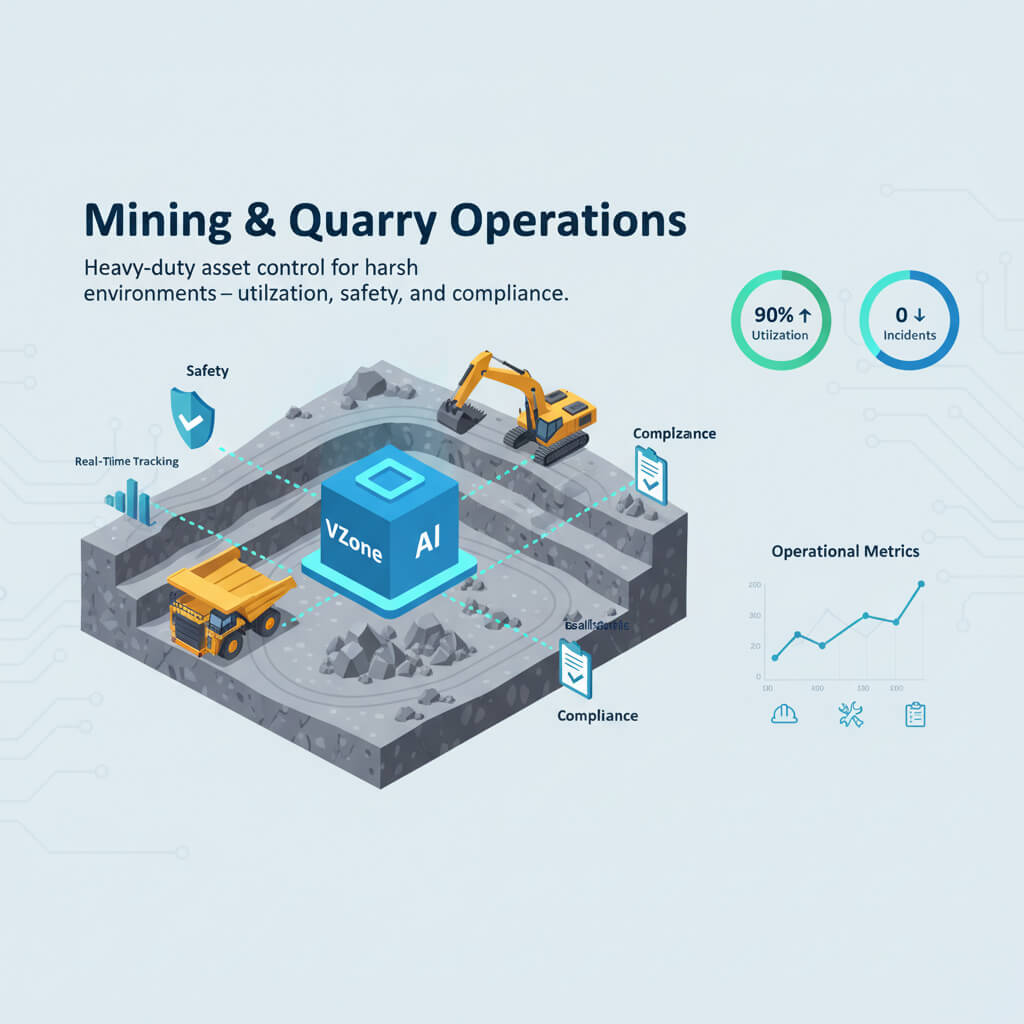
Mining and quarry operations run on heavy assets in harsh, remote conditions and V Zone International gives UAE mining operators rugged, real-time control over every one. Track dumpers, excavators, dozers, and tippers with geofenced pits, weightbridge and loading zones, capture cycle-time KPIs per shift, enforce no-go zones, flag fuel pilferage and prevent collisions with AI proximity cameras all on rugged GPS with offline caching for low-network sites.
Fleets running V Zone lift asset utilisation by 15–28%, cut idle and unauthorised use by 28–36%, reduce speeding incidents by 30%, and hold 99.8% uptime visibility into quarry-to-road daily tonnage all within two months.
🚨 Top Challenges in Mining & Quarry Fleets
Mining and quarry operations push fleet management to its limits harsh terrain, extreme heat, dust, low network coverage, and assets worth millions operating around the clock. A dumper stuck at a crusher queue for an extra 15 minutes per cycle costs thousands over a shift. Fuel siphoned after hours goes undetected for weeks. And when an excavator near a blasting zone has no proximity alert, safety is at risk. Here’s where it breaks down:
- Harsh driving & speeding on haul roads
- Unauthorised use after hours
- Breakdowns due to missed service intervals
- Fuel pilferage at site bowers
- Operator safety & proximity risks
- Limited network at remote sites
🔍 The Operational Blind Spots Costing You Tonnage
Paper logs can’t capture cycle times and safety breaches in real time leading to lost tonnage and incidents. When you don’t know which dumper is queuing at the crusher, which excavator ran unauthorised last night, or which operator consistently exceeds haul-road speed limits, you’re managing by assumption. In mining, assumptions cost money and sometimes lives.
If your pit supervisor learns about a cycle-time bottleneck at the end of the shift instead of during it, you’ve already lost the tonnage.
🎯 How V Zone Solves Mining Fleet Challenges
V Zone gives mining and quarry operators a single platform purpose-built for the harshest environments rugged hardware, offline-capable, and designed for the KPIs that matter in extractive industries:
- Rugged GPS with offline caching for low-network sites
- Cycle-time & haul KPIs per pit/shift
- No-go/no-drive zone enforcement with alerts
- Fuel-level sensors with shrink alerts for pilferage detection
- Maintenance scheduler for engine hours, not just calendar dates
- Collision warnings via AI cameras & proximity sensors
🤖 AI-Powered Intelligence for Mining
V Zone’s AI is trained on mining-specific patterns haul-road traffic, crusher queue dynamics, shift-change delays, seasonal temperature impact on equipment, and fuel-burn profiles by machine type. It doesn’t just track; it optimises your pit operations:
- Predicts underperforming haul cycles before shift ends
- Recommends shift/asset redeployments to balance throughput
- Flags risky operators/segments on haul roads
- Forecasts parts and service windows based on usage
- Answers "Which parcels failed bench?" in real time
🛠️ Key Functionalities for Mining Operations
Mining and quarry fleets have requirements that standard fleet management doesn’t address cycle-time tracking, no-go zone enforcement, and equipment operating in environments where cellular coverage is intermittent. V Zone maps each mining-specific challenge to a purpose-built solution:
| Problem | V Zone Solution |
|---|---|
| Speeding on Haul Roads | Geofence alerts + coaching |
| Unauthorized Use | Time-fence + immobilisation |
| Fuel Pilferage | Sensors + reconciliation alerts |
| Breakdowns | Engine-hour-based PM + AI prediction |
| Safety Near Excavators | Proximity alerts / video AI |
| Network Gaps | Store-and-forward telemetry |
📈 Measurable Business Impact
V Zone delivers measurable improvements from the first month and the gains compound as the AI learns your site’s haul patterns, equipment profiles, and operator behaviour:
- 15–28% higher asset utilisation
- 28–36% reduction in idle and unauthorised use
- 30% fewer speeding incidents on haul roads
- 99.8% uptime visibility on quarry-to-road tonnage
- Reduced incidents and downtime
- Better compliance with HSE rules
- Lower TCO via planned maintenance
📈 Before vs. After V Zone
| Feature | Before V Zone | With V Zone |
|---|---|---|
| Utilization | Guesswork per shift | Live cycle-time KPIs |
| Fuel Control | Manual dip checks | Sensor analytics + shrink alerts |
| Safety | Reactive | Proactive with proximity/video |
| Maintenance | Run‑to‑failure | Predictive scheduling |
💬 Real Feedback from Mining Leaders
🔌 Integrations & Compatible Hardware
V Zone connects to the rugged hardware, weighbridge systems, and mine-planning platforms you already operate:
- Weighbridge I/O + fuel bowers + HF/VHF radio logging + CANbus
- Rugged cameras + AI proximity sensors
- Offline GPS with store-and-forward for remote pits
- API to mine planning systems and ERP
🏭 V Zone in Action: Real Quarry Results
A quarry operator running 40 heavy assets across 3 pits deployed V Zone and reduced speeding events by 32%, increased daily tonnage by 11%, and cut fuel-reconciliation discrepancies by 60% all within two months. The site manager now uses V Zone’s shift-level dashboard to rebalance dumpers between pits in real time, and the maintenance team schedules service by engine hours instead of guessing from calendar dates.
💬 FAQs
Does V Zone work in areas with poor or no cellular coverage?
Yes. V Zone’s rugged GPS devices include store-and-forward capability they log all telemetry data locally when cellular coverage drops and automatically upload it when the connection is restored. This means you get complete data for every asset, every shift, even in deep pits, remote quarries, or desert mining sites where network coverage is intermittent. The offline caching ensures zero data loss, and the dashboard backfills seamlessly so shift reports are complete.
How does V Zone track cycle times in mining operations?
V Zone tracks cycle times by monitoring each asset’s movement between geofenced zones loading face, haul road, crusher, dump point, and return. The system calculates load time, haul time, queue time, dump time, and return time per cycle, per asset, per shift. When a dumper’s cycle time exceeds the target for example, spending too long queuing at the crusher the system flags it in real time so the pit supervisor can redirect traffic. Cycle-time reports are available per shift, per pit, and per operator for production meetings.
How does V Zone detect fuel pilferage at mining sites?
V Zone uses fuel-level sensors installed in each asset’s tank, combined with bower (fuel-point) reconciliation. If fuel level drops while the engine is off, the system flags a potential siphon event with timestamp, location, and volume. The AI also correlates fuel consumption against engine hours and load data so a dumper burning 20% more than its peers on the same haul route gets flagged for investigation. Bower-level reconciliation catches discrepancies between fuel dispensed and fuel received across the fleet.
Can V Zone enforce no-go zones and speed limits on haul roads?
Yes. V Zone uses geofencing to define no-go zones (blasting areas, maintenance zones, restricted areas) and speed-limit zones on haul roads. When an asset enters a no-go zone or exceeds the speed limit for its current zone, the system sends an instant alert to the operator, site supervisor, and safety manager. Repeat violations are logged against the operator’s safety score. For critical zones near active blasting, V Zone can integrate with proximity sensors and AI cameras to provide collision warnings before vehicles get too close.
Does V Zone support engine-hour-based maintenance scheduling?
Yes. Mining equipment wears based on operating hours, not calendar days or kilometres and V Zone schedules maintenance accordingly. Each asset’s engine hours are logged automatically via GPS and CANbus telemetry, and the system triggers service alerts when configurable thresholds are reached (e.g., 250-hour oil change, 1,000-hour major service). The AI also monitors performance trends declining fuel efficiency, increasing idle time, abnormal vibration patterns and recommends service before a scheduled interval if the data suggests early wear.