
Postal & Courier Services
First attempt. Every parcel. No excuses.
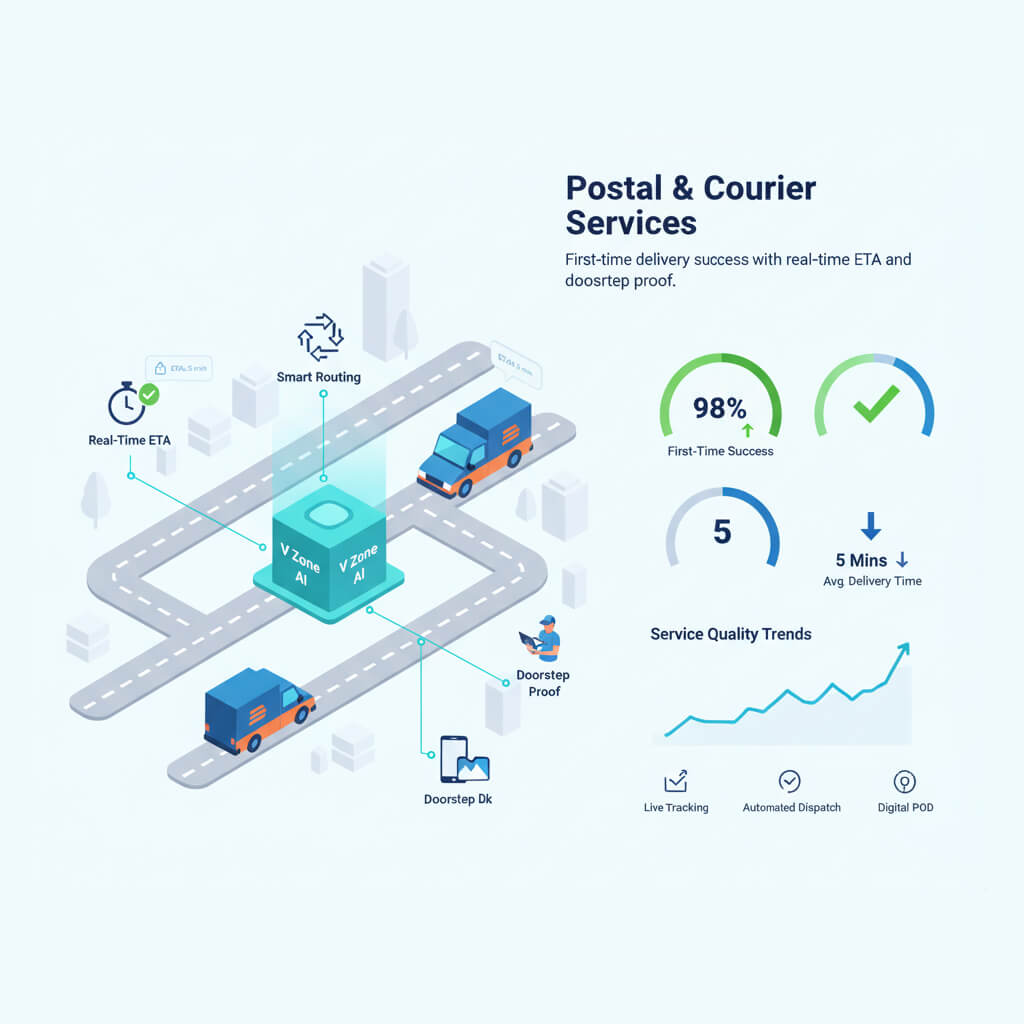
For postal and courier services, a failed first attempt is a doubled cost and V Zone International gives UAE last-mile operators the address intelligence and live visibility to get it right the first time. The platform delivers address validation and geocoding, a courier app with micro-ETAs, photo/OTP proof of delivery, slot-based delivery promises, ride-safety video coaching, and searchable COD reconciliation logs integrated with OMS, ERP, and BLE tag systems.
Networks running V Zone lift first-attempt success, cut failed-attempt costs, reduce rider costs, and one courier network reduced failed attempts by 28% and improved SLA payouts within 60 days across the UAE.
🚨 Top Challenges in Postal & Courier Fleets
Courier and postal operations run on volume, speed, and first-attempt success and every failed delivery doubles the cost. A wrong address wastes 15 minutes and a reattempt. A missing POD turns into a dispute. And when peak-load spikes hit during Ramadan or sale events, manual routing collapses under volume. Here’s where it breaks down:
- Failed first attempts due to bad addresses
- Inaccurate addresses in UAE's evolving urban landscape
- Lost proof of delivery
- Traffic variability across dense urban zones
- Unsafe riding/driving behaviour
- Peak-load spikes overwhelming manual dispatch
🔍 The Blind Spots Costing You Per Parcel
Paper slips and manual calls create blind alleys in last-mile courier operations. When your dispatcher doesn’t know a rider has been circling the wrong building for 10 minutes, or that 6 parcels on today’s run have unvalidated addresses, the cost per parcel climbs invisibly and so does your failed-attempt rate.
When 3% of your daily parcels fail on first attempt and each reattempt costs AED 12–18, the maths is simple: at 1,000 parcels/day, that’s AED 360–540 wasted daily on preventable failures.
🎯 How V Zone Powers Smarter Courier Operations
V Zone gives postal and courier networks a single platform that tackles the root causes of failed deliveries bad addresses, blind routing, and missing proof:
- Address validation & geocoding before dispatch
- Courier app with micro-ETAs and turn-by-turn navigation
- Photo/OTP POD & video capture for high-value parcels
- Slot-based delivery promises with customer notifications
- Rider safety video & coaching scorecards
- Auto COD reconciliation logs searchable by rider/date
🤖 AI That Cuts Failed Deliveries
V Zone’s AI is trained on courier-specific patterns address quality by area, failed-delivery hotspots, rider efficiency by route type, COD collection patterns, and peak-volume forecasting. It doesn’t just track; it prevents failures before they happen:
- Predicts failed deliveries by area and flags risky addresses
- Suggests address corrections using geocoding intelligence
- Optimises rider-route clusters for hub efficiency
- Auto-builds daily KPIs for hubs and riders
- Answers "Which parcels failed twice?" instantly
🛠️ Key Functionalities for Courier Operations
Postal and courier operations have address-accuracy, POD, and COD requirements that general fleet tools don’t cover. V Zone maps each courier-specific challenge to a purpose-built solution:
| Problem | Smart Solution |
|---|---|
| Failed Attempts | Micro-ETAs + address validation |
| POD Issues | Photo/OTP + geo tags |
| Traffic Variability | Dynamic routing + buffers |
| Safety | Scorecards + video coaching |
| COD Reconciliation | Auto logs per rider |
| Peak Spikes | AI load balancing |
📈 Measurable Business Impact
V Zone delivers measurable improvements from the first month and the gains compound as the AI learns your network’s address patterns and rider profiles:
- Higher first-attempt success rates
- Lower rider costs per delivery
- Happier customers with live tracking and accurate ETAs
- Clean COD trails reconciled daily
📈 Before vs. After V Zone
| Feature | Before V Zone | With V Zone |
|---|---|---|
| POD | Lost slips | Digital, searchable |
| Address Quality | Manual | AI-corrected geocoding |
| Throughput | Unplanned | Forecasted routes |
| Safety | Ad-hoc | Coaching with video |
| COD | End-of-day cash count | Real-time reconciliation |
💬 Real Feedback
🔌 Integrations & Compatibility
V Zone connects to the OMS, ERP, and courier-tech systems you already operate:
- OMS + ERP + mobile apps + dashcams + BLE tags + API
- Courier rider app for Android & iOS
- Barcode/QR scanning for parcel tracking
- COD payment gateway integration
- Webhooks for real-time status push to shipper platforms
🏭 V Zone in Action: Courier Results
A UAE courier network operating 320 riders across 5 hubs deployed V Zone. Within 60 days, failed first attempts dropped 28% after address validation and geocoding went live, COD reconciliation gaps fell from AED 8,000/week to under AED 500, and SLA payout performance improved by 15% earning back a penalty clause that had cost the network AED 45,000/month. Hub managers now start each day with AI-optimised route clusters instead of manual WhatsApp dispatch.
💬 FAQs
How does V Zone reduce failed first-attempt deliveries?
V Zone reduces failed first attempts through three layers: address validation and geocoding before the parcel is dispatched (catching wrong or incomplete addresses before the rider leaves the hub), micro-ETAs sent to the recipient so they know exactly when to expect delivery, and AI-flagging of addresses with a history of failed attempts so those parcels get extra verification or a customer call before dispatch. Courier networks typically see failed-attempt rates drop by 25–35% within the first two months.
How does V Zone handle COD reconciliation?
V Zone logs every COD collection against the parcel ID, rider ID, timestamp, and GPS location creating a real-time trail of cash collected throughout the day. At end of shift, the system generates a reconciliation report showing total collected, total deposited, and any discrepancies by rider. If a rider hasn’t submitted COD by a configurable deadline, the system sends an auto-escalation alert. This eliminates the end-of-day cash-counting chaos and catches discrepancies within hours instead of days.
Can V Zone handle peak-volume spikes like Ramadan or sale events?
Yes. V Zone’s AI forecasts volume spikes based on historical patterns Ramadan delivery surges, Black Friday peaks, 11.11 sales, and seasonal trends. When incoming parcel volume exceeds hub capacity, the system dynamically rebalances route clusters, suggests rider augmentation, and adjusts delivery-slot promises to maintain first-attempt success rates. Hub managers get capacity alerts before the spike overwhelms operations, not during it.
Does V Zone provide proof of delivery for dispute resolution?
Yes. V Zone captures photo, OTP, signature, or barcode-scan POD through the rider’s app geo-tagged with GPS coordinates and timestamped. For high-value parcels or COD deliveries, video capture is also available. When a recipient claims non-delivery, the hub manager pulls the POD record photo of the parcel at the doorstep, OTP confirmed by the recipient’s phone, GPS proving the rider was at the address and the dispute is resolved in minutes. POD records are searchable by parcel ID, rider, date, or hub.
How does address validation work in UAE's evolving urban landscape?
V Zone uses geocoding and address-intelligence layers to validate delivery addresses before dispatch. In the UAE, where building names, community names, and Makani numbers are more reliable than street addresses, V Zone cross-references multiple address formats and flags entries that don’t resolve to a valid location. The system also learns from successful deliveries when a rider successfully delivers to a previously unresolvable address, the corrected GPS pin is stored and applied to future deliveries at that location. Over time, the network builds its own address-accuracy layer that improves with every parcel.