
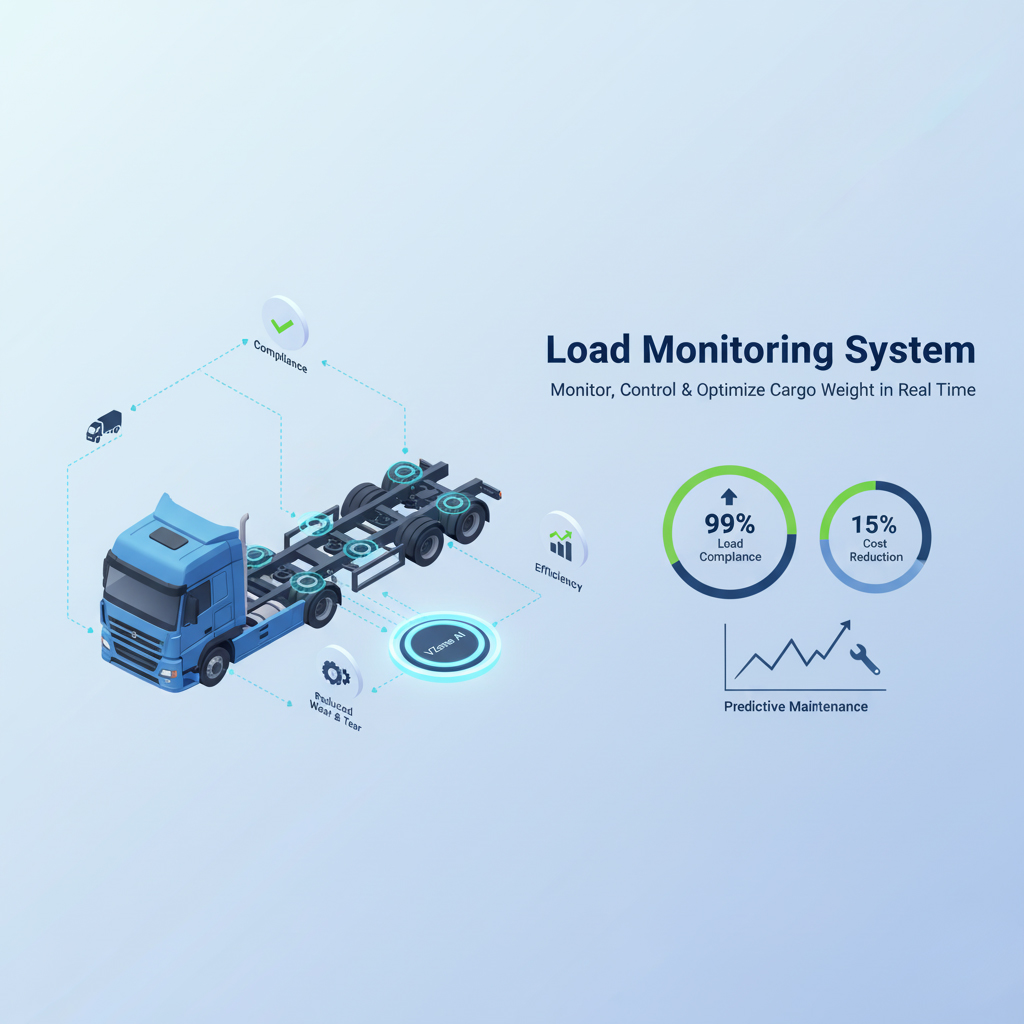
Load Monitoring System
Monitor, Control & Optimise Cargo Weight in Real Time.
When it comes to cargo transport, load matters for safety, compliance, efficiency, and cost. V Zone’s Load Monitoring System uses advanced sensors and smart analytics to give you complete visibility over your fleet’s load conditions helping prevent overloading, reduce wear and tear, and stay compliant.
Whether you operate tippers in Al Quoz, tankers on the E11, or freight trucks between Jebel Ali and Musaffah, every kilogram counts and is accounted for.
🎯 Why Load Monitoring Matters
Overloading is one of the most expensive and dangerous problems in commercial fleet operations. It causes tyre blowouts, brake failures, suspension damage, and road surface deterioration and in the UAE, it triggers regulatory fines that can halt your operations. Underloading wastes fuel and capacity. Without real-time load visibility, fleet managers are guessing and guessing costs money:
⚠️ Avoid Overloading Fines
- Stay within legal axle weight limits and avoid regulatory penalties at checkpoints.
🔧 Prevent Vehicle Damage
- Protect suspension, tyres, and axles from excess strain that accelerates wear.
📈 Monitor Loading Accuracy
- Ensure correct goods are loaded with real-time weight verification at source.
⛽️ Reduce Fuel Wastage
- Overloaded vehicles consume more fuel. Optimised loads reduce operating costs.
🚚 Improve Dispatch Decisions
- Know how much capacity remains for smarter task assignments and load balancing.
📡 Key Features
V Zone’s Load Monitoring System combines hardware sensors with the fleet intelligence platform to give you real-time weight data, threshold alerts, historical trends, and geo-tagged loading events all from a single dashboard:
📈 Real-Time Load Weight Display
- Live data from axle or load sensors, accessible anytime via web or mobile.
🔔 Load Threshold Alerts
- Instant notifications if a vehicle is overloaded or underloaded beyond your limits.
📍 Geo-Based Load Events
- Track where and when loading/unloading happens including unauthorised zones.
📊 Load Trend Analytics
- Visual dashboards showing weight patterns, average loads, and peak performance periods.
🕒 Historical Load Playback
- Review past trips with load weight profiles at each point in the journey.
⚙️ Hardware & Technology
V Zone’s load monitoring hardware is purpose-built for the harsh operating environments of construction sites, quarries, ports, and long-haul freight routes across the UAE and GCC. The sensors integrate seamlessly with V Zone’s telematics platform no separate system required:
- ✅ High-accuracy axle or suspension sensors (wired or wireless)
- ✅ Compatible with trucks, trailers, tankers, tippers, and fuses
- ✅ Seamless integration with CAN bus, OBD, and third-party hardware
- ✅ Ruggedised for dust, heat, vibration, and heavy-duty environments
- ✅ Tamper-resistant mounting with alert on disconnection
🔐 Safety & Compliance Benefits
Load monitoring isn’t just about efficiency it’s a safety and legal requirement. Overloaded vehicles are more likely to cause accidents, fail inspections, and trigger regulatory penalties. V Zone’s system provides the evidence trail that proves compliance at every stage:
- Government-mandated axle weight compliance documented and exportable
- Prevent dangerous rollovers or brake failure due to excess weight
- Documentation for transport audits and insurance claims
- Protect sensitive cargo (pharma, electronics, food) from excess stress and vibration
- Automated alerts to prevent departure when load exceeds safe limits
🏭 Industry Applications
Load monitoring solves different problems for different industries from preventing overloaded tippers at quarries to ensuring pharmaceutical cargo isn’t compressed by excess weight. V Zone’s system adapts to each use case:
- Logistics & Freight Transport: Ensure correct cargo weight and legal limits at every checkpoint
- Construction Fleets: Avoid overloading of tippers and cement mixers reduce breakdowns and fines
- Waste Collection: Track fill levels and optimise bin-route planning for maximum efficiency
- Cold Chain: Monitor sensitive loads without compromising container limits or temp stability
- Fuel & Chemical Transport: Prevent dangerous overload conditions on tankers and hazmat vehicles
🔌 Platform Integration
The Load Monitoring System is fully integrated with V Zone’s fleet platform meaning load data doesn’t sit in a standalone system. It connects to route planning, dispatch, compliance reporting, and maintenance alerts for a complete operational picture:
- 🧠 Smart route planning based on live load data and vehicle capacity
- 🧾 Load-based reports and alerts in your existing V Zone dashboard
- 🧰 Combine with door monitoring, temperature, and fuel sensors for full cargo intelligence
- 📤 Sync with ERP, TMS, or BI platforms via API for enterprise-grade integration
✅ Real-World Use Case
V Zone’s Load Monitoring System delivers measurable impact from the first month here’s a representative deployment from a large construction fleet in the UAE:
Client: Large Construction Fleet
- Problem: Frequent fines and breakdowns due to overloading.
- Solution: Installed Load Monitoring System across 65 tippers
- Deployment: Axle sensors + threshold alerts + dispatch integration
Results:
- 70% reduction in overload incidents
- 25% reduction in tyre and brake-related maintenance
- Improved dispatch load balancing across fleet
👥 Best Suited For
V Zone’s Load Monitoring System is designed for fleets where cargo weight directly impacts safety, compliance, cost, and operational efficiency:
- Freight transport operators and logistics companies
- Cement & building material companies
- Fuel tankers & liquid carriers
- E-commerce logistics fleets with mixed-weight loads
- Public sector waste collection fleets
- Mining, quarry, and heavy equipment haulers
💡 Why V Zone?
V Zone doesn’t treat load monitoring as a bolt-on it’s integrated into the same platform that tracks your vehicles, drivers, fuel, and compliance. That means load data connects to everything else, giving you a single source of truth for fleet operations:
- 15+ years of fleet telematics experience across the UAE and GCC
- Advanced sensor compatibility & calibration for any vehicle type
- Custom load analytics for any industry construction, logistics, waste, tankers
- Proven across 30+ countries with regional expertise
🚀 Ready to Master Load Control?
Eliminate guesswork. Reduce fines. Extend vehicle life.
With V Zone’s Load Monitoring System, every kg counts and is accounted for.
💬 FAQs
How does V Zone's load monitoring system work?
V Zone’s Load Monitoring System uses high-accuracy axle or suspension-mounted sensors that measure the weight being carried by each axle in real time. The sensor data is transmitted to V Zone’s telematics device in the vehicle, which relays it to the cloud platform via cellular connectivity. Fleet managers see live load weight on the dashboard for every equipped vehicle and receive instant alerts if weight exceeds configured thresholds. The system works while the vehicle is stationary (at loading) and in motion (during transit), giving you continuous load visibility.
Can it detect overloading before a vehicle leaves the site?
Yes that’s one of the primary use cases. V Zone’s load monitoring triggers an alert the moment axle weight crosses your configured limit, which typically happens during loading. The driver receives an in-cab notification, and the dispatcher sees the alert on the dashboard both before the vehicle departs. Some fleets configure the system to prevent departure (via integration with immobiliser or dispatch approval workflows) until the load is corrected. This prevents overloaded vehicles from ever reaching a checkpoint or public road.
What types of vehicles are compatible with V Zone's load sensors?
V Zone’s load monitoring hardware is compatible with a wide range of commercial vehicles trucks, trailers, tippers, tankers, cement mixers, flatbeds, and waste collection vehicles. Sensors can be installed on single-axle, tandem-axle, and tri-axle configurations. The system also works with articulated vehicles where the trailer load needs to be monitored independently from the tractor unit. V Zone’s hardware team conducts a vehicle assessment before installation to ensure the right sensor type and mounting position for accurate readings.
Can load data be integrated with our ERP or transport management system?
Yes. V Zone’s platform offers full API access for integrating load data with ERP systems (SAP, Oracle, Odoo, Tally), transport management systems, dispatch platforms, and business intelligence tools. Load weight, loading/unloading events, overload incidents, and compliance logs can all be pushed to your existing systems in real time or via scheduled exports. This means your dispatch team can see available capacity, your finance team can reconcile load-based billing, and your compliance team can pull audit reports — all without switching platforms.
How accurate are V Zone's load sensors?
V Zone uses industrial-grade axle and suspension sensors with accuracy typically within ±2–3% of actual weight under normal operating conditions. Accuracy depends on sensor type, mounting position, vehicle suspension, and road conditions V Zone’s installation team calibrates each sensor to the specific vehicle during setup. For applications requiring higher precision (such as billing-grade weight measurement), V Zone can recommend certified load cells with tighter tolerances. All sensors are recalibrated periodically as part of V Zone’s maintenance support programme.