A fleet management system combines GPS vehicle tracking, driver monitoring, fuel analytics, and maintenance scheduling into one dashboard giving fleet operators in UAE and GCC the real-time visibility and automated reporting that managing vehicles at scale requires. UAE operators running 50 or more vehicles without a fleet management system lose an estimated AED 3,000 to AED 5,000 per vehicle annually in preventable costs: fuel waste from unmonitored idling and inefficient routes, maintenance costs from reactive rather than scheduled servicing, insurance overpayment from the absence of telematics evidence at renewal, and compliance penalty exposure from missing or incomplete GPS data submission to ITC Asateel, ADNOC IVMS, or RTA SecurePath portals.
VZone International’s AI-powered fleet management platform has served 4,000+ UAE and GCC fleets across 20+ years from 10-vehicle SMB operations in Sharjah to 500-vehicle logistics companies serving ADNOC facilities in the Western Region. This guide explains how a fleet management system works, what features matter for UAE conditions, how to choose the right platform for your fleet size and industry, and how to calculate whether investment in a fleet management system makes financial sense for your operation.
Key Takeaways
- A fleet management system is significantly more than a GPS vehicle tracking system it integrates location data with driver behaviour, fuel consumption, maintenance records, compliance reporting, and financial analytics to produce operational intelligence that standalone GPS tracking cannot deliver.
- UAE fleet management has regulatory requirements that most other markets do not: Asateel (ITC Abu Dhabi) mandates continuous GPS data submission for all Abu Dhabi commercial vehicles; ADNOC IVMS adds driver behaviour monitoring requirements for contractor fleets; RTA SecurePath covers Dubai rental cars and school buses. A fleet management system that does not manage these compliance submissions is not sufficient for UAE commercial operations.
- The financial case for a fleet management system in UAE is strongest in three cost categories: fuel (monitoring reduces consumption 10-20%), maintenance (proactive scheduling reduces breakdown cost 30-50%), and insurance (telematics data enables 10-20% premium reduction at renewal) categories that compound annually rather than providing one-time savings.
- Cloud-based fleet management systems are the dominant model for UAE fleet deployments in 2026 eliminating on-premise server maintenance, enabling mobile access for managers and drivers, and providing the automatic compliance portal integration that on-premise systems require additional development to achieve.
- Fleet size determines the appropriate platform tier: basic GPS vehicle tracking systems for 1-10 vehicles, managed fleet platforms for 10-200 vehicles, and enterprise fleet management systems with ERP integration for 200+ vehicle operations.
What Is a Fleet Management System?
A fleet management system is an integrated software platform that combines GPS vehicle tracking, driver behaviour monitoring, fuel consumption analytics, maintenance scheduling, and compliance reporting into a unified operational dashboard enabling fleet managers to monitor, manage, and optimise every aspect of their vehicle operations from a single interface rather than across disconnected tools.
The distinction between a fleet management system and a standalone GPS vehicle tracking system is the difference between knowing where your vehicles are and understanding how they are operating. A GPS vehicle tracking system answers the question: ‘Where is Vehicle 23 right now?’ A fleet management system answers the questions that matter for business performance: ‘Is Vehicle 23 being driven efficiently? Is it due for service? Is its driver’s safety score declining? Is its fuel consumption above baseline? Is it compliant with ITC Asateel data submission requirements?’ These questions cannot be answered from GPS position data alone they require the integration of multiple data streams that a fleet management system unifies.
Core Components of a Fleet Management System
| Component | What It Does | Data Source | Business Output |
| GPS vehicle tracking system | Real-time and historical vehicle location, speed, heading, trip history | GPS device + cellular network | Live map visibility, trip records, route analysis, compliance data submission |
| Driver behaviour monitoring | Harsh braking, acceleration, cornering, speeding, idle time, fatigue, distraction | GPS accelerometer + AI dashcam | Driver safety scores, coaching data, insurance telematics, accident evidence |
| Fuel management | Fuel level, consumption per trip and per driver, idle fuel waste, fill-up reconciliation | Fuel level sensor + GPS + fuel card API | Fuel cost per vehicle, theft detection, eco-driving impact measurement |
| Maintenance management | Service interval tracking, OBD diagnostic monitoring, fault code alerts, maintenance history | GPS mileage + OBD-II interface | Scheduled service alerts, breakdown prevention, warranty compliance, asset life management |
| Compliance and reporting | Asateel data submission, IVMS driver behaviour reports, Salik toll reporting, insurance telematics packages | GPS + driver behaviour + platform API | Regulatory compliance, insurance premium reduction, HSE audit documentation |
| Analytics and ERP integration | Cost per kilometre, per-vehicle operating cost, budget variance, financial reporting | All above + ERP API connection | Finance-ready cost allocation, management reporting, procurement planning |
How a GPS Vehicle Tracking System Powers Fleet Management
The GPS vehicle tracking system is the data foundation on which every other fleet management function is built without accurate, continuous position data from every vehicle, the driver behaviour analysis, route optimisation, ETA calculation, and compliance reporting that distinguish a fleet management system from individual tools are not possible. Position data from the GPS vehicle tracking layer feeds into every downstream function simultaneously.
Real-Time Location as the Operational Foundation
Real-time GPS vehicle tracking position updates every 10 to 60 seconds from every vehicle in the fleet provides the live operational picture that fleet managers need to make time-sensitive decisions: dispatching the nearest vehicle to an urgent job, confirming that a delivery vehicle is approaching a customer site on schedule, verifying that a contractor vehicle has arrived at an ADNOC facility at the documented time, or identifying which vehicle is closest to a breakdown location for recovery dispatch. These decisions require current position data, not the hourly or end-of-day position snapshots that older or less capable tracking systems provide.
How GPS Data Feeds Route Optimisation and ETA
Historical GPS trip data from the vehicle tracking system builds a dataset of actual route times how long a specific route segment actually takes at different times of day, accounting for traffic patterns on Dubai’s arterial roads, Sharjah’s industrial zone congestion, and Abu Dhabi’s construction project traffic variations. Route optimisation algorithms that use actual route time data rather than estimated road-speed data produce ETAs and route recommendations that are calibrated to UAE road conditions rather than generic mapping assumptions. For logistics and delivery fleets, GPS-informed route optimisation consistently reduces kilometres per delivery stop by 15 to 20 percent on multi-stop urban routes a saving that compounds across every operating day.
Geofencing, Alerts, and Dispatch Integration
The GPS vehicle tracking system’s position data enables the geofencing and alert logic that converts passive tracking into active fleet management. Geofences defined around depots, client sites, and restricted zones fire entry and exit alerts automatically, eliminating the manual check-in calls that manual management requires. Dispatch systems that integrate with the GPS vehicle tracking system can assign jobs to vehicles based on actual current position rather than assumed position the nearest available vehicle to an urgent job, not the vehicle whose driver last answered a phone call.
Key Features Every Fleet Management System Must Have
Real-Time Vehicle Tracking System with Live Map
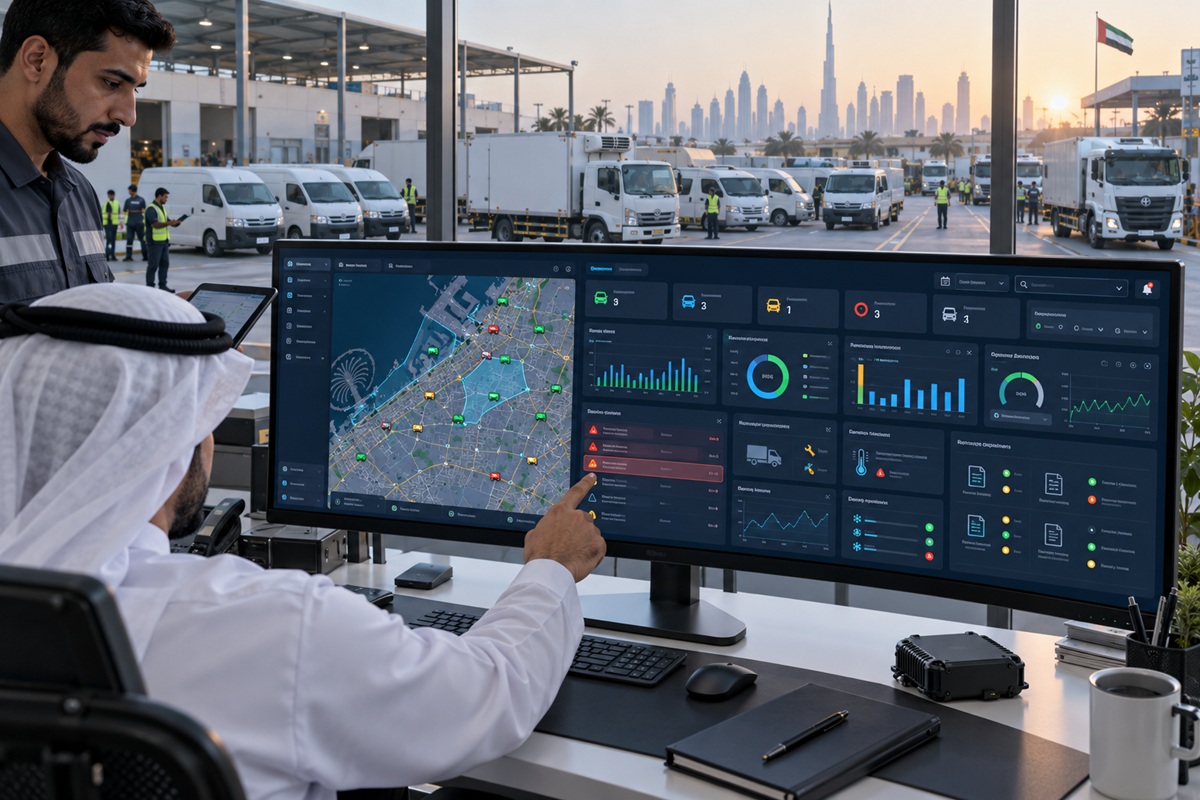
The live map dashboard is the fleet management system’s primary operational interface showing every vehicle’s current position, speed, status (moving, idle, stopped), and alert condition in real time, updated at intervals appropriate to the fleet’s operational intensity. For UAE fleet management, the live map should support: multi-vehicle simultaneous display across all seven emirates and GCC countries without performance degradation; satellite and road map layers with UAE-specific road network accuracy; vehicle clustering for large fleet displays; and instant vehicle detail access (driver identity, current speed, recent trip, active alerts) from a single click on the map icon.
The map should also display active geofences the defined zones that make the GPS vehicle tracking system an active management tool rather than a passive position record. Seeing which vehicles are inside and outside their expected zones in real time, on the same map as their live position, is the visual management capability that reduces the fleet manager’s need to interpret multiple data sources simultaneously.
Driver Behaviour and Safety Scoring
Driver behaviour monitoring from the fleet management system produces per-driver safety scores that enable systematic coaching programmes the primary mechanism through which fleet management systems reduce accident rates and fuel consumption simultaneously. The safety score aggregates harsh braking, harsh acceleration, sharp cornering, speeding events, extended idling, seatbelt compliance, phone use (from AI dashcam), and fatigue indicators (from driver-facing infrared camera) into a composite per-driver score that ranks the fleet’s drivers from safest to highest-risk.
For UAE commercial fleets, driver behaviour data serves three simultaneous management purposes: coaching input (the specific events that individual drivers need to address, identified from their per-event records rather than from supervisory impression); insurance telematics evidence (the structured safety data that UAE commercial vehicle insurers require to apply telematics-based premium reductions at renewal); and ADNOC IVMS compliance (the driver behaviour event format that ADNOC HSE management systems require for contractor vehicle monitoring documentation).
Fuel Monitoring and Idle Alerts
Fuel monitoring in a fleet management system combines GPS distance data with in-tank sensor measurements to track actual consumption per vehicle, per driver, and per route producing the consumption baseline comparison that identifies anomalies (vehicles consuming more than their baseline for a given route distance, indicating potential mechanical issues, driving behaviour problems, or fuel theft). Idle time monitoring is particularly significant for UAE fleet operations: vehicles left running for air-conditioning in UAE summer conditions consume 1.5 to 2.5 litres per hour at zero productive output, and without monitoring, this idle consumption is invisible in the monthly fuel invoice.
Idle alerts fire in real time when a vehicle exceeds a configured idle duration threshold giving the operations supervisor the immediate intervention capability that monthly fuel statement review cannot provide. For a 30-vehicle UAE fleet where each vehicle averages 40 minutes of avoidable daily idle in summer, real-time idle alerts and coaching reduce avoidable idle time by 30 to 50 percent recovering AED 3,000 to AED 6,000 per month in idle fuel cost that the fleet had previously treated as a fixed operating expense.
Automated Maintenance Scheduling
Maintenance scheduling in a fleet management system uses GPS-tracked mileage rather than driver-reported odometer readings to trigger service interval alerts eliminating the systematic underreporting of mileage that manual maintenance tracking creates when drivers enter lower mileage figures to avoid service appointments. The platform generates a service alert when each vehicle’s GPS-verified mileage reaches the configured service interval, with advance warning at 80 and 95 percent of the interval to allow scheduling flexibility.
For UAE fleet operators, OBD-II diagnostic integration adds engine health monitoring to GPS mileage-based scheduling: fault codes (DTCs) from the vehicle’s engine management system are transmitted to the fleet platform when detected, generating a maintenance alert before the fault progresses to a breakdown. The combination of mileage-triggered service scheduling and real-time fault code monitoring reduces unplanned breakdown frequency by 30 to 50 percent in deployed UAE fleet management systems converting reactive, high-cost breakdown events into planned, lower-cost scheduled maintenance.
Compliance and Reporting Dashboard
The compliance dashboard in a UAE fleet management system consolidates the regulatory data submission requirements that commercial vehicle operators must satisfy: Asateel GPS data submission status per vehicle (confirming that each vehicle is actively transmitting to the ITC portal and showing as compliant), ADNOC IVMS driver behaviour report generation (weekly and monthly reports in the format ADNOC HSE management systems require), Salik toll crossing reports (per-vehicle crossing records for finance team allocation), and insurance telematics data packages (12-month driver behaviour summary formatted for insurer submission at renewal).
Automated report generation is the compliance dashboard’s most operationally valuable function replacing the manual data compilation that fleet safety officers would otherwise perform monthly. A UAE fleet management system that requires safety officers to manually extract, format, and submit compliance data is a data collection tool, not a fleet management system. The VZone International platform generates all applicable compliance reports automatically and manages portal submission for Asateel, IVMS, and OPAL without requiring fleet manager intervention.
Mobile App for Drivers and Managers
A fleet management system without a mobile app is a desktop tool that becomes inaccessible the moment a manager or driver is away from a computer. The manager app should provide the live map, vehicle alerts, driver safety score review, and report access from a mobile device enabling fleet management decisions from anywhere without requiring platform login on a laptop. The driver app should provide the job dispatch, navigation, proof of delivery (ePOD), driver safety score feedback, and fatigue awareness tools that make the fleet management system operationally useful to the people operating the vehicles rather than just the people managing the fleet from an office.
Why UAE and GCC Fleets Need a Fleet Management System in 2026
Regulatory Compliance Asateel, IVMS, SecurePath
UAE commercial vehicle GPS compliance is mandatory across multiple programmes with financial and operational penalties for non-compliance. ITC Asateel requires all Abu Dhabi commercial vehicles to submit continuous GPS data a requirement that standalone GPS trackers without portal integration cannot satisfy. ADNOC IVMS adds driver behaviour monitoring requirements for contractor fleets that basic GPS tracking systems do not capture. RTA SecurePath mandates GPS for Dubai rental cars, taxis, and school buses with specific approved hardware and data format requirements. A fleet management system that manages compliance submissions across all applicable programmes simultaneously rather than requiring separate compliance tools per programme is the operational requirement for multi-programme UAE commercial fleets in 2026.
UAE Extreme Heat Vehicle and Driver Impact
UAE summer conditions create fleet management challenges that temperate-market fleet management systems do not address: sustained ambient temperatures above 45°C accelerate tyre degradation, increase engine cooling system load, and amplify the fuel consumption of air-conditioning-dependent idling. A fleet management system calibrated for UAE conditions monitors tyre pressure (through TPMS integration), tracks engine temperature patterns that indicate cooling system stress, and applies idle monitoring thresholds that reflect UAE summer air-conditioning requirements rather than generic global idle standards. Driver fatigue detection from AI dashcam systems is calibrated for UAE desert route conditions recognising that the fatigue onset timeline for drivers on monotonous desert highways in extreme heat is significantly shorter than the temperate-market norms that globally marketed AI systems are trained on.
Fuel Cost Management in the UAE Context
With UAE fuel prices at AED 2.83 per litre (Super 98) in 2026, fuel typically represents 30 to 40 percent of total fleet operating cost for commercial vehicle operators. A fleet management system that reduces fuel consumption by 10 to 15 percent through eco-driving coaching, idle reduction, route optimisation, and fuel theft detection generates AED 1,200 to AED 2,400 per vehicle per year in direct fuel cost saving at current UAE pump prices. For a 50-vehicle logistics fleet with AED 200,000 monthly fuel spend, a 12 percent fleet-wide fuel reduction saves AED 288,000 annually significantly exceeding the annual cost of the fleet management system platform.
Insurance Premium Reduction
UAE commercial vehicle insurance carriers increasingly accept GPS telematics data as evidence of reduced fleet risk, enabling telematics-verified fleets to negotiate premiums 10 to 20 percent below the standard actuarial rate at renewal. A fleet management system that generates structured insurance telematics packages 12-month driver safety score summary, harsh event frequency by driver, accident-free period documentation, and coaching programme records provides the data format that insurance underwriters require for premium review. Fleets without a fleet management system cannot provide this data in the required format and pay the standard actuarial rate regardless of their actual safety performance.
ESG and Sustainability Reporting
UAE corporate sustainability reporting requirements are increasing, driven by COP28 commitments, Abu Dhabi’s Net Zero 2050 target, and the growing ESG reporting expectations of ADNOC, government entity clients, and international corporate partners. Fleet operations are a significant and measurable component of corporate carbon footprint and a fleet management system that tracks fuel consumption, idle time, and route efficiency provides the vehicle-level emissions data that sustainability reports require. VZone International’s platform generates CO2 emissions estimates per vehicle based on actual GPS-tracked fuel consumption data, enabling fleet operators to include verifiable fleet emissions in sustainability reporting rather than using estimated industry averages.
How to Choose the Right Fleet Management System
Fleet Size Tiers
Fleet size determines both the appropriate platform tier and the most critical feature priorities. For fleets of 10 to 50 vehicles, the primary requirements are GPS vehicle tracking system compliance (Asateel registration and portal submission), basic driver behaviour monitoring, fuel monitoring, and automated monthly reports a managed cloud platform with standard features covers these needs without enterprise configuration overhead. For fleets of 50 to 200 vehicles, the feature priorities expand to include systematic driver coaching programmes with per-driver scoring, maintenance management with OBD integration, ERP connectivity for finance cost allocation, and Salik toll monitoring integration. For fleets above 200 vehicles, enterprise requirements include: multi-site user management, custom report configuration, dedicated API integration for ERP and fuel card systems, SLA-backed uptime guarantees, and dedicated account management rather than shared support.
Industry-Specific Needs
| Industry | Primary Fleet Management System Requirement | UAE Compliance Need | Key Feature Priority |
| Logistics and last-mile delivery | Route optimisation, ePOD integration, customer ETA, multi-stop scheduling | Asateel + SecurePath (Dubai routes) | GPS route tracking + ePOD + live customer tracking |
| Construction and contracting | Equipment tracking, site geofencing, maintenance management, ADNOC compliance | Asateel + ADNOC IVMS + OPAL | Geofencing + IVMS reporting + heavy vehicle maintenance |
| Oil and gas (ADNOC) | IVMS driver behaviour, fatigue monitoring, journey management, HSE reporting | ADNOC IVMS mandatory | IVMS compliance + fatigue detection + HSE report generation |
| School and staff transport | Route monitoring, passenger safety, parent ETA notifications, RTA compliance | SecurePath (Dubai) + Asateel (Abu Dhabi) | Route corridor + passenger alerts + SecurePath submission |
| Car rental | Vehicle damage documentation, per-day mileage, SecurePath compliance, damage claim defence | SecurePath mandatory for Dubai rental | GPS trip record + dashcam + mileage reporting |
| Government fleet | Utilisation reporting, cost per vehicle, driver accountability, multi-department allocation | Asateel mandatory | Utilisation analytics + cost centre reporting + driver ID |
Cloud vs On-Premise
Cloud-based fleet management systems are the standard model for UAE fleet deployments in 2026, and for the majority of UAE operators they are the only practical choice. Cloud deployment eliminates the server infrastructure, IT maintenance, and software update management that on-premise systems require operationally significant for UAE fleet companies that do not have dedicated IT departments. Cloud platforms also provide the compliance portal integrations (Asateel, IVMS, OPAL) as managed platform features rather than requiring custom development, and they are accessible from any device without VPN or remote access configuration. On-premise fleet management system deployment is relevant only for large government entities with specific data sovereignty requirements or enterprises with existing on-premise ERP infrastructure that requires native integration rather than API connectivity.
API Integrations ERP, Fuel Cards, and CRM
A fleet management system that cannot share data with the ERP, fuel card system, and financial platforms that the rest of the organisation uses creates a data silo fleet cost data that finance teams cannot access without requesting exports, maintenance records that the maintenance workshop system cannot consume, and trip records that HR or payroll systems cannot read. Native API connectors for SAP, Oracle, Odoo, and Zoho covering the ERP systems that most UAE medium and large enterprises use are the integration requirement that enables fleet data to flow into organisational systems automatically rather than through manual export and re-import cycles.
Fleet Management System vs. Standalone GPS Vehicle Tracking System
| Capability | Standalone GPS Vehicle Tracking System | Full Fleet Management System |
| Real-time vehicle location | Yes | Yes with geofencing, alerts, and dispatch integration |
| Driver behaviour monitoring | Basic speed and harsh events only in most cases | Comprehensive AI safety scoring, fatigue, distraction, coaching reports |
| Fuel monitoring | No (GPS distance estimate only) | Yes sensor-based consumption, idle alerts, theft detection |
| Maintenance scheduling | No | Yes GPS mileage triggers, OBD fault codes, service history |
| Asateel/IVMS compliance submission | Device only platform may not manage portal submission | Yes automated submission to all applicable UAE compliance portals |
| Insurance telematics package | No | Yes automated 12-month safety report in insurer format |
| ERP/finance integration | No | Yes native connectors for SAP, Oracle, Odoo, Zoho |
| Mobile app (driver + manager) | Manager map view only typically | Full driver app (dispatch, ePOD, safety score) + manager app |
| Salik toll monitoring | No | Yes per-vehicle crossing attribution and finance reports |
| Cost per kilometre analytics | No | Yes fuel, maintenance, and utilisation combined |
| Monthly platform cost (50 vehicles) | AED 30-60/vehicle/month | AED 80-150/vehicle/month |
| Best for | 1-10 vehicles, basic visibility, no compliance requirement | 10+ vehicles, UAE compliance, systematic cost management |
The cost difference between a standalone GPS vehicle tracking system and a full fleet management system is approximately AED 50 to AED 90 per vehicle per month AED 2,500 to AED 4,500 per month for a 50-vehicle fleet. Against a conservative fleet management system saving of AED 2,000 to AED 4,000 per vehicle per year from fuel, maintenance, and insurance savings, the additional platform cost is recovered within the first quarter of deployment. The question for UAE fleet operators is not whether a fleet management system costs more than a standalone GPS tracker it does. The question is whether the additional cost is exceeded by the additional saving, which for commercial fleets above 10 vehicles it consistently is.
Free AI Fleet Audit from VZone International
Not sure whether your fleet needs a GPS vehicle tracking system or a full fleet management system? VZone International’s free AI Fleet Audit reviews your fleet size, vehicle categories, UAE compliance obligations, current fuel spend, and operational profile to recommend exactly the right platform configuration with a specific AED saving estimate and payback timeline. 4,000+ UAE fleets trust VZone. Contact our team to book your free audit today.
Frequently Asked Questions
A fleet management system is an integrated software platform that combines GPS vehicle tracking, driver behaviour monitoring, fuel consumption analytics, maintenance scheduling, and compliance reporting into a single dashboard. It works by collecting data from GPS tracking devices installed in each vehicle, processing that data through the platform's analytics engine, and presenting actionable reports and real-time alerts to fleet managers through a web dashboard and mobile app. In UAE, a fleet management system also manages the continuous GPS data submission to government compliance portals ITC Asateel for Abu Dhabi commercial vehicles, ADNOC IVMS for contractor fleets, and RTA SecurePath for Dubai rental cars and school buses that standalone GPS trackers cannot handle without additional integration.
A vehicle tracking system shows where vehicles are real-time GPS position, speed, and basic trip history. A fleet management system integrates vehicle tracking with driver behaviour monitoring (safety scores, harsh event data, fatigue alerts), fuel consumption analytics (sensor-based consumption, idle time, theft detection), maintenance management (GPS mileage-triggered service alerts, OBD fault codes), compliance reporting (Asateel portal submission, IVMS driver behaviour reports, insurance telematics packages), and ERP integration (per-vehicle cost data pushed to SAP, Oracle, or Odoo). The vehicle tracking system tells you where your fleet is; the fleet management system tells you how efficiently, safely, and cost-effectively it is operating.
UAE fleet management system costs have three components: hardware (GPS tracking device AED 400 to AED 1,200 per vehicle depending on capability), installation (AED 150 to AED 350 per vehicle for professional hardwired installation), and monthly platform subscription (AED 60 to AED 150 per vehicle per month for cloud fleet management platform, depending on feature set basic GPS tracking at the lower end, full AI dashcam, IVMS compliance reporting, and ERP integration at the upper end). Total 24-month cost for a standard fleet management system deployment on a 50-vehicle fleet ranges from AED 310,000 to AED 580,000 against typical annual savings of AED 200,000 to AED 400,000 from fuel, maintenance, insurance, and compliance cost reduction, producing payback within 5 to 9 months and positive ROI throughout the remaining 15 months of the evaluation period.
Yes fuel cost reduction is consistently the largest single financial return from fleet management system deployment for UAE fleets. The reduction comes from five mechanisms operating simultaneously: eco-driving coaching from driver behaviour scores (8 to 12 percent fuel saving from reduced aggressive acceleration), idle time monitoring and alerts (3 to 8 percent fuel saving from UAE summer A/C idle reduction), route optimisation from GPS trip data (8 to 15 percent combined fuel and time saving on multi-stop urban routes), fuel theft detection from tank sensor monitoring (2 to 5 percent recovery from siphoning and fill-up fraud prevention), and Salik toll schedule optimisation (routing crossings to off-peak AED 4 windows rather than peak AED 6 windows). For a 50-vehicle UAE fleet spending AED 200,000 per month on fuel, a combined 15 percent reduction saves AED 360,000 annually.
For UAE commercial fleets of 1 to 10 vehicles, a GPS vehicle tracking system provides adequate operational visibility if: the vehicles are not subject to Asateel, IVMS, or SecurePath compliance (which require active portal data submission that standalone trackers may not manage); fuel spend is low enough that monitoring does not produce material savings; and there is no requirement for driver behaviour coaching or insurance telematics data. However, most UAE commercial vehicle operators including small fleets are subject to at least Asateel compliance if vehicles are registered in Abu Dhabi, which means the fleet management system's compliance portal submission capability is a legal requirement rather than an optional enhancement. VZone International's free AI Fleet Audit confirms exactly which compliance requirements apply to your specific vehicles and whether a standalone GPS tracker or a full fleet management system is the appropriate solution.
The best fleet management system for UAE logistics companies combines Asateel and SecurePath compliance (covering Abu Dhabi and Dubai regulatory requirements), route optimisation with actual UAE road time data, ePOD integration for delivery proof, customer-facing ETA tracking for B2B and e-commerce clients, driver behaviour coaching calibrated for UAE urban delivery conditions (distraction detection for multi-stop WhatsApp-dependent routing), Salik toll monitoring for cost allocation and peak-rate scheduling, and ERP integration for per-vehicle cost allocation in the finance system. VZone International's platform satisfies all these requirements for UAE logistics operators across fleet sizes from 10 to 500+ vehicles, with Arabic and English language support, local installation teams in Dubai and Abu Dhabi, and the full UAE compliance certification portfolio Asateel, SecurePath, IVMS, SIRA, and OPAL Oman.