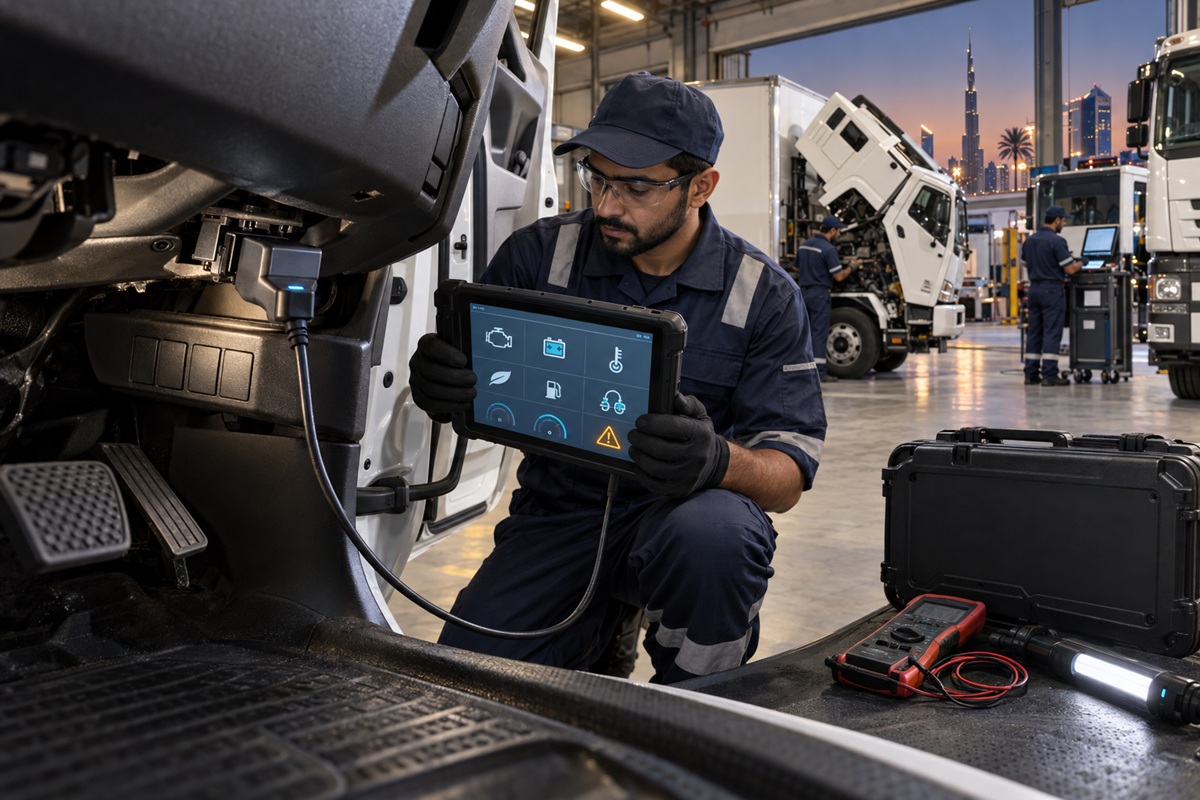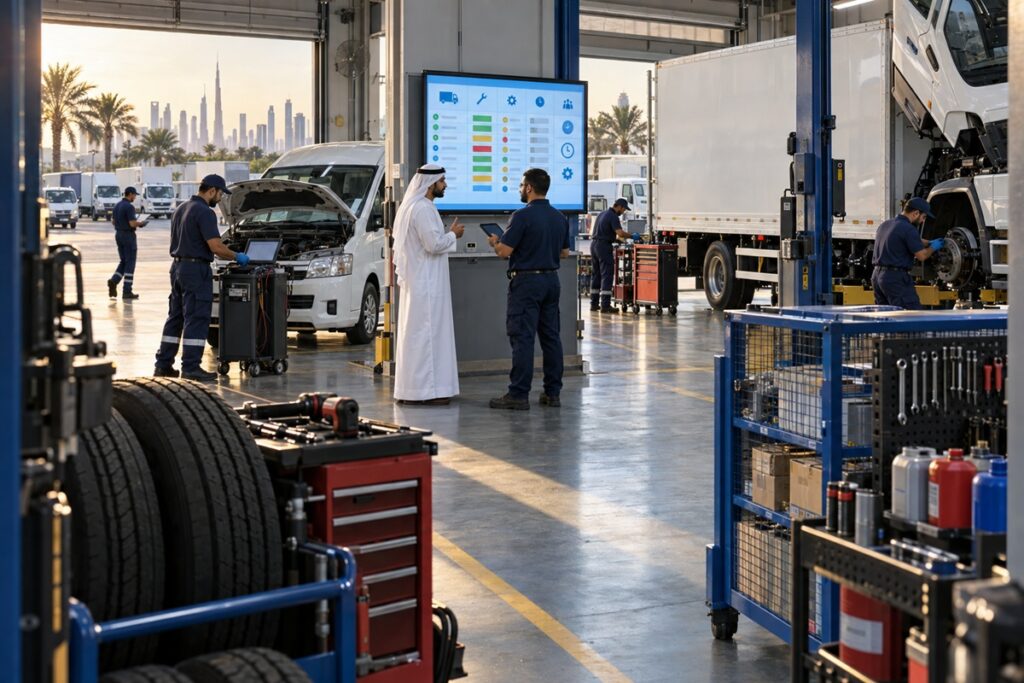
For most UAE commercial fleet operators, the workshop and the operations team live in parallel universes. The operations manager knows which vehicles are due for service because the fleet management dashboard shows GPS mileage approaching the service threshold. The workshop manager knows which vehicles are in the bay because they physically arrive at the workshop. Between these two knowledge bases is a coordination gap that generates the most preventable form of fleet downtime: vehicles that are known to need service but have not been scheduled, defects reported by drivers that have not been routed to the workshop, and parts that should have been ordered in advance sitting as unplanned procurement gaps that extend vehicle downtime after the vehicle arrives.
Workshop management for fleet operators is the practice and the software that closes this coordination gap creating a unified workflow where the fleet management system and the workshop management system share the same vehicle data, the same maintenance calendar, and the same defect record. When a GPS mileage alert fires in the fleet platform, a work order is created in the workshop system. When a driver flags a defect in the inspection app, the workshop receives an alert. When a vehicle arrives for service, the technician opens the work order that was created from the GPS mileage trigger, not from a phone call from the fleet manager. This integration is what transforms fleet workshop management from a reactive, coordination-heavy process into a proactive, data-driven workflow.
Key Takeaways
- Effective fleet workshop management requires integration between the fleet management system (which generates maintenance alerts from GPS mileage, OBD diagnostics, and driver inspection reports) and the workshop management system (which schedules jobs, manages parts, tracks technician time, and records completion). Without integration, the coordination gap between operations and workshop is a persistent source of preventable vehicle downtime.
- Work order management is the central workflow in fleet workshop management every maintenance activity should have a work order that captures: the trigger (GPS mileage alert, OBD diagnostic, driver defect report, scheduled service), the vehicle identity, the required tasks, the parts needed, the technician assigned, the job status, and the actual completion record with parts used and time spent.
- Parts inventory management for UAE fleet workshops requires UAE-specific considerations: lead times for non-standard parts from UAE distributors or direct from manufacturers are typically 3 to 14 days; in-country stock of high-consumption items (oil filters, air filters, brake pads for the fleet’s primary vehicle models) prevents the most common workshop downtime extension from parts unavailability.
- Workshop KPIs mean time to repair (MTTR), vehicle availability rate, first-time fix rate, planned vs unplanned maintenance ratio, cost per maintenance event provide the management visibility that transforms workshop management from a subjective assessment into a measurable, improvable operational function.
- VZone International’s fleet management platform integrates maintenance alert generation with work order creation and workshop scheduling GPS mileage alerts automatically generate pre-populated work orders with the required service tasks and parts list, reducing the workshop manager’s administrative overhead and the operations-workshop coordination time for each planned service.
The Fleet Workshop Management Workflow
Fleet workshop management follows a seven-stage workflow from maintenance trigger to vehicle return to service. Understanding each stage and the coordination point it requires enables fleet operators to identify where their current process generates delays and where integration between fleet management software and workshop management closes those gaps.
| Stage | What Happens | Manual Process Gap | Integrated Software Solution |
| 1. Maintenance trigger | GPS mileage reaches service threshold; OBD fault code detected; driver flags defect in inspection app | Fleet manager receives alert in fleet platform; manually contacts workshop manager to schedule | Work order created automatically in workshop system from fleet platform alert; workshop manager notified |
| 2. Parts check and procurement | Workshop confirms which parts are required for the scheduled service; checks inventory; orders if needed | Workshop manager checks paper stock sheets or separate inventory system; manual order to supplier | Work order links to parts requirements for the service type; inventory system checks stock; auto-generates purchase order if below reorder level |
| 3. Vehicle scheduling | Vehicle and workshop bay scheduled for the appointment; driver notified of appointment time | Operations manager and workshop manager negotiate scheduling by phone or WhatsApp | Fleet platform shows vehicle’s GPS mileage vs service threshold; workshop calendar shows bay availability; scheduling confirmed in shared system |
| 4. Vehicle receipt and job card | Vehicle arrives at workshop; technician receives job briefing; job card issued | Paper job card with handwritten tasks; technician may not have vehicle history context | Digital work order on technician tablet with full vehicle service history, current OBD fault codes, and parts list pre-populated |
| 5. Work execution and parts recording | Technician performs service tasks; records actual parts used and any additional work found | Paper job card updated manually; additional work found requires fleet manager authorisation by phone | Digital work order updated in real time by technician; additional work generates authorisation request to fleet manager with cost estimate |
| 6. Quality check and vehicle release | Supervisor or QC technician verifies work completion; vehicle released to operations | Manual quality checklist; operations notified by phone | Digital sign-off on work order with QC confirmation; operations manager receives vehicle-ready notification in fleet platform |
| 7. Record update and KPI capture | Service record updated with actual work done, parts used, cost, and next service threshold reset | Manual entry to maintenance log or spreadsheet; KPIs calculated monthly by hand | Work order completion automatically updates vehicle service history in fleet platform; maintenance threshold reset; KPIs calculated automatically |
Work Order Management for Fleet Workshops
The work order is the fundamental unit of fleet workshop management a structured record that defines what work needs to be done on which vehicle, tracks the work through execution, and becomes the completion record that updates the vehicle’s maintenance history. A well-designed work order system eliminates the verbal and informal communication that creates misunderstanding, missed tasks, and unrecorded work in workshop operations.
Work Order Structure for Fleet Maintenance
Each work order for fleet vehicle maintenance should capture: the vehicle identity (registration number, VIN, make, model, mileage at intake), the work trigger (GPS mileage service alert, OBD fault code with code description, driver defect report with photo, scheduled periodic inspection), the service tasks required (pre-populated from the vehicle’s service schedule for planned services; manually added for diagnostic work), the parts required and their stock status (in-stock, on order, estimated arrival date), the technician assigned, the scheduled start and completion time, the actual work performed (all tasks completed, parts actually used, additional work found with authorisation status), and the total cost (parts cost from inventory system, labour cost from technician time log). A work order without all these fields is either an incomplete instruction (before work begins) or an incomplete record (after work is completed).
Planned vs Unplanned Work Orders
Fleet workshops should track the ratio of planned (scheduled service) to unplanned (breakdown, urgent defect) work orders this ratio is a primary indicator of fleet maintenance programme quality. A workshop generating 60 to 70 percent planned work orders and 30 to 40 percent unplanned is well-managed; a workshop generating 40 percent planned and 60 percent unplanned has insufficient preventive maintenance catch before failures. In UAE commercial fleet operations, the consequences of unplanned work are amplified by the operational disruption: a vehicle in the workshop for an unplanned emergency repair is typically out of service for longer than a planned service (parts availability, technician scheduling), creates an immediate route gap that the operations manager must fill, and costs more to repair (emergency parts sourcing, overtime labour) than the same component repaired in a planned service.
Parts Inventory Management for UAE Fleet Workshops
Parts inventory management for UAE fleet workshops has two specific challenges that temperate-market workshop guides do not address: UAE distribution network lead times and the high-consumption component categories driven by UAE climate conditions.
UAE Parts Distribution and Lead Times
UAE’s parts distribution network for commercial vehicle components covers the most common vehicle makes and models well Toyota, Mitsubishi, Ford, Isuzu, and the primary European truck brands (Volvo, MAN, Mercedes-Benz, Scania) all have authorised distributor networks in UAE with in-country stock. Non-standard or specialised components specific Teltonika GPS device replacement parts, specialised refrigeration unit components, bespoke hydraulic system parts for specialist construction equipment may require import from the manufacturer or from regional distributors with 5 to 14 day lead times. UAE fleet workshop managers should maintain in-country stock of all high-consumption components for the fleet’s primary vehicle models, and maintain an accurate lead time record for components that require import so that when a part is needed urgently, the team knows immediately whether same-day sourcing is possible or whether a replacement vehicle is required during the procurement wait.
UAE Climate-Driven High-Consumption Components
UAE summer conditions create materially higher consumption rates for specific component categories than European temperate-climate service schedules assume. Engine oil and oil filters are consumed faster due to heat-accelerated oil degradation a fleet that changes oil every 5,000 km in UAE summer conditions rather than every 10,000 km on European default intervals needs double the oil and filter stock for the same fleet size and mileage. Air filters in desert and construction site environments may need replacement at 5,000 km intervals rather than 15,000 to 30,000 km a 3 to 6× higher consumption rate. Battery replacement rates in UAE summer fleets are significantly higher than European norms UAE summer heat is the primary cause of lead-acid battery failure, with peak battery replacement in August and September after the highest sustained heat period. Workshop parts inventory for UAE fleets should maintain significantly higher stock levels for these UAE climate-sensitive components than generic automotive parts inventory recommendations would suggest.
Minimum Stock Level Management
Minimum stock level management setting reorder trigger quantities for each stocked part so that new stock is ordered before the existing stock is fully depleted prevents the most common workshop delay: vehicle arrives for service, required part is out of stock, vehicle sits in the workshop or parking lot while the part is sourced. For high-consumption UAE fleet components (engine oil in bulk, oil filters, air filters, brake pads, batteries), minimum stock levels should reflect both the fleet’s consumption rate and the typical supplier lead time if daily consumption is 2 oil filters and the supplier delivery takes 3 days, the minimum stock level before reorder should be at least 8 filters (3 days × 2 filters + 2 filters safety buffer). Fleet maintenance software with integrated parts inventory management calculates minimum stock levels from actual consumption history and generates purchase orders automatically when stock reaches the reorder trigger eliminating the manual stock monitoring that workshop managers otherwise perform daily.
Workshop KPIs for UAE Fleet Operations
Workshop KPIs quantify the workshop’s performance in terms that operations management can act on they translate the workshop’s technical activity into the operational metrics (vehicle availability, cost per event, speed of return to service) that fleet management cares about. The following KPIs are most operationally relevant for UAE fleet workshop management.
| KPI | Definition | Calculation | UAE Fleet Target | What It Indicates |
| Vehicle Availability Rate | Percentage of scheduled operating time that fleet vehicles are available for service (not in workshop) | ((Total scheduled hours – Workshop hours) / Total scheduled hours) × 100 | >90% for well-managed UAE fleet | Primary measure of workshop efficiency higher is better |
| Mean Time to Repair (MTTR) | Average time from vehicle entering workshop to vehicle returning to service | Total workshop hours across all events / Number of events | <4 hours for planned services; <8 hours for major repairs | Lower MTTR = faster return to service = less operational disruption |
| Planned vs Unplanned Ratio | Percentage of work orders that are planned services vs unplanned (breakdown/urgent) | (Planned work orders / Total work orders) × 100 | >65% planned indicates good preventive maintenance | Higher planned ratio = better maintenance programme discipline |
| First-Time Fix Rate | Percentage of repair events where the vehicle does not return for the same defect within 30 days | (Events without return visit / Total events) × 100 | >90% for skilled UAE fleet workshop | Low FTFR indicates diagnostic quality issue or incorrect parts |
| Cost per Maintenance Event | Average total cost (parts + labour) per completed work order | Total maintenance spend / Total work orders | Baseline in Month 1; target year-on-year reduction of 5-10% | Rising CPE indicates increased unplanned work or parts price inflation |
| Parts Availability Rate | Percentage of work orders where all required parts are available at vehicle arrival | (Work orders with all parts available at intake / Total work orders) × 100 | >85% for well-managed parts inventory | Low PAR indicates inventory management gap extends vehicle downtime |
| Workshop Utilisation Rate | Percentage of available technician hours that are spent on productive work (not waiting for parts, vehicles, or authorisation) | (Productive technician hours / Total available technician hours) × 100 | 70-80% is realistic for UAE fleet workshop | Low utilisation = scheduling inefficiency; high utilisation = capacity constraint |
Integrating Workshop Management with Fleet Management Software
The maximum value from fleet workshop management is achieved when the workshop management system and the fleet management platform share data bidirectionally not when they are separate systems that require manual data transfer between them. The integration points that matter most for UAE fleet operations are:
Maintenance Alert to Work Order Automatic
When a GPS mileage alert fires in the fleet management platform (vehicle reaches 80 percent of service interval threshold), the integrated system automatically creates a draft work order in the workshop management system with the vehicle identity, the service tasks due at this interval, and the parts list pre-populated from the vehicle’s service schedule configuration. The workshop manager receives the draft work order for scheduling they do not need to call or message the fleet manager to find out which vehicle needs service and what tasks are required. The automatic work order creation eliminates the coordination step that is most often delayed in manual fleet workshop management.
OBD Diagnostic Alert to Fault Work Order
When the fleet management platform receives an OBD diagnostic trouble code from a vehicle, it creates a fault work order with the fault code, the code description in operational language, the vehicle’s current GPS location and mileage, and a severity classification (informational, warning, critical). The workshop manager receives the fault work order immediately enabling a triage decision: can the vehicle continue in service until its next planned service (informational fault), does it need a workshop appointment within 48 hours (warning fault), or should it be taken out of service immediately (critical fault)? This OBD-to-work order integration means that the workshop learns of developing faults from the telematics system in real time rather than from the driver’s verbal report when the vehicle eventually arrives for service.
Service History Shared Between Platforms
When a work order is completed in the workshop management system all tasks completed, parts recorded, technician sign-off the completion record updates the vehicle’s service history in the fleet management platform automatically. The fleet manager sees the service history for every vehicle in the fleet platform without requiring a separate query to the workshop system: what work was done, when, at what mileage, what parts were replaced, what the next service threshold is. This bidirectional history sharing eliminates the duplicated record-keeping that separate fleet management and workshop management systems require where the same service event must be recorded in both systems, creating a reconciliation burden and a consistency risk.
In-House Workshop vs Third-Party Maintenance for UAE Fleets
UAE fleet operators have two models for workshop management: operating an in-house workshop with their own technicians and facilities, or using a network of third-party maintenance providers (authorised dealer workshops, independent specialist workshops, or mobile technician services). The choice depends on fleet size, vehicle diversity, and operational footprint.
| Factor | In-House Workshop | Third-Party Network |
| Fixed overhead | High workshop facility, tools, equipment, permanent technician headcount | Low no fixed facility cost; pay per job |
| Variable cost | Lower per job at scale direct labour rates, parts at cost | Higher per job workshop labour rate includes overhead margin; parts at retail |
| Control and responsiveness | High workshop prioritises fleet vehicles on demand; turnaround time directly controlled | Lower fleet vehicles compete with other customers; turnaround time subject to third-party scheduling |
| Specialist capability | Limited to in-house technician skills; complex repairs may require outsourcing regardless | Access to manufacturer-authorised workshops with specialist diagnostic tools and technical training |
| Minimum fleet size for viability | Typically 30-50 vehicles to justify fixed overhead of full-time workshop operation | Viable at any fleet size; cost advantage of in-house increases above 50 vehicles |
| UAE-specific consideration | Technician recruitment in UAE competitive in-house workshop requires ongoing hiring investment; accommodation for technicians adds cost | UAE has extensive authorised dealer and independent workshop network in major cities; remote site access requires mobile technician arrangement |
Most UAE fleet operators above 30 vehicles with a consistent vehicle type profile operate a hybrid model: an in-house workshop for routine preventive maintenance and minor repairs (high volume, manageable in-house), supplemented by authorised dealer relationships for warranty work, complex diagnostics, and specialist repairs that require manufacturer tooling. Fleet management software that manages work order routing sending routine jobs to the in-house workshop and complex jobs to the appropriate external workshop based on required capability enables this hybrid model without requiring the fleet manager to manually route every work order.
VZone International Fleet Workshop Management Integrated with GPS Fleet Tracking
VZone International’s fleet management platform includes integrated workshop management GPS mileage alerts automatically generate work orders, OBD diagnostics create fault work orders in real time, driver inspection defects are routed to the workshop immediately, and completed service records update vehicle maintenance history automatically. Parts inventory integration, workshop KPI dashboards, and technician scheduling are all managed from the same Wialon platform that manages GPS tracking and driver safety. Contact our team for a workshop management integration assessment for your UAE fleet.
Frequently Asked Questions
Workshop management in fleet operations is the organised scheduling, execution, and tracking of all vehicle maintenance and repair work from planned preventive services triggered by GPS mileage thresholds, to OBD-detected fault repairs, to driver-reported defect corrections, to breakdown recovery. It encompasses work order creation and management, parts inventory procurement and control, technician scheduling and time tracking, workshop KPI measurement, and service history recording. For UAE commercial fleet operators, effective workshop management integrates with the fleet management platform so that maintenance alerts from GPS tracking and OBD diagnostics automatically generate work orders in the workshop system, and completed service records automatically update the vehicle's maintenance history in the fleet platform eliminating the coordination gap between operations and workshop that generates preventable vehicle downtime.
Reducing vehicle downtime in UAE fleet workshops requires addressing the three most common downtime sources: parts unavailability, scheduling coordination gaps, and unplanned reactive repairs. Parts unavailability is addressed by minimum stock level management with automatic reorder triggers for high-consumption UAE climate components engine oil, oil filters, air filters, brake pads, and batteries ensuring required parts are available when vehicles arrive for service. Scheduling coordination gaps are addressed by integrating fleet management platform alerts with workshop work order creation GPS mileage alerts automatically generate work orders with tasks and parts lists, enabling workshop scheduling to begin before the vehicle needs to be taken out of service. Unplanned reactive repairs are reduced by the GPS mileage and OBD predictive maintenance that catches developing faults before they cause breakdowns shifting the planned vs unplanned ratio from 40/60 to 70/30 reduces unplanned work significantly and allows the workshop to operate at planned capacity rather than responding to emergencies.
The most operationally relevant KPIs for a UAE fleet workshop are: vehicle availability rate (target above 90 percent of scheduled operating hours), mean time to repair (target under 4 hours for planned services), planned vs unplanned work order ratio (target above 65 percent planned), first-time fix rate (target above 90 percent vehicle does not return for same defect within 30 days), cost per maintenance event (track as baseline and target year-on-year reduction), parts availability rate (target above 85 percent parts available when vehicle arrives), and workshop utilisation rate (70 to 80 percent productive technician hours is a realistic UAE fleet workshop target). These KPIs are calculated automatically in fleet maintenance software from work order data fleet workshop managers who track KPIs consistently improve workshop performance by identifying which specific operational bottleneck is producing the largest gap from target.
The decision depends primarily on fleet size and vehicle type consistency. In-house workshops become cost-effective above approximately 30 to 50 vehicles of a consistent type the fixed overhead of workshop facility, tools, and permanent technician headcount is recovered through lower per-job labour costs and faster turnaround time at that scale. Below 30 vehicles or for fleets with high vehicle type diversity (requiring specialist tooling for different manufacturers), third-party workshop networks are typically more cost-effective. Most UAE fleet operators above 30 vehicles operate a hybrid model: in-house workshop for routine services and minor repairs, with authorised dealer relationships for warranty work and complex diagnostics. Fleet management software that routes work orders to the appropriate workshop based on job type routine maintenance to in-house, specialist repairs to the authorised workshop enables this hybrid model without manual routing decision for every service event.