
Dispatching Best Practices for UAE Fleet Operations Teams
Key Takeaways
- The fundamental problem with WhatsApp dispatching is structural: text messages communicate instructions without structured data validation. A dispatcher who assigns 18 stops to a 3.5-tonne van via WhatsApp has no automatic check that the stops' combined load fits the van the vehicle may depart overloaded, requiring mid-route reloading or leaving stops undelivered.
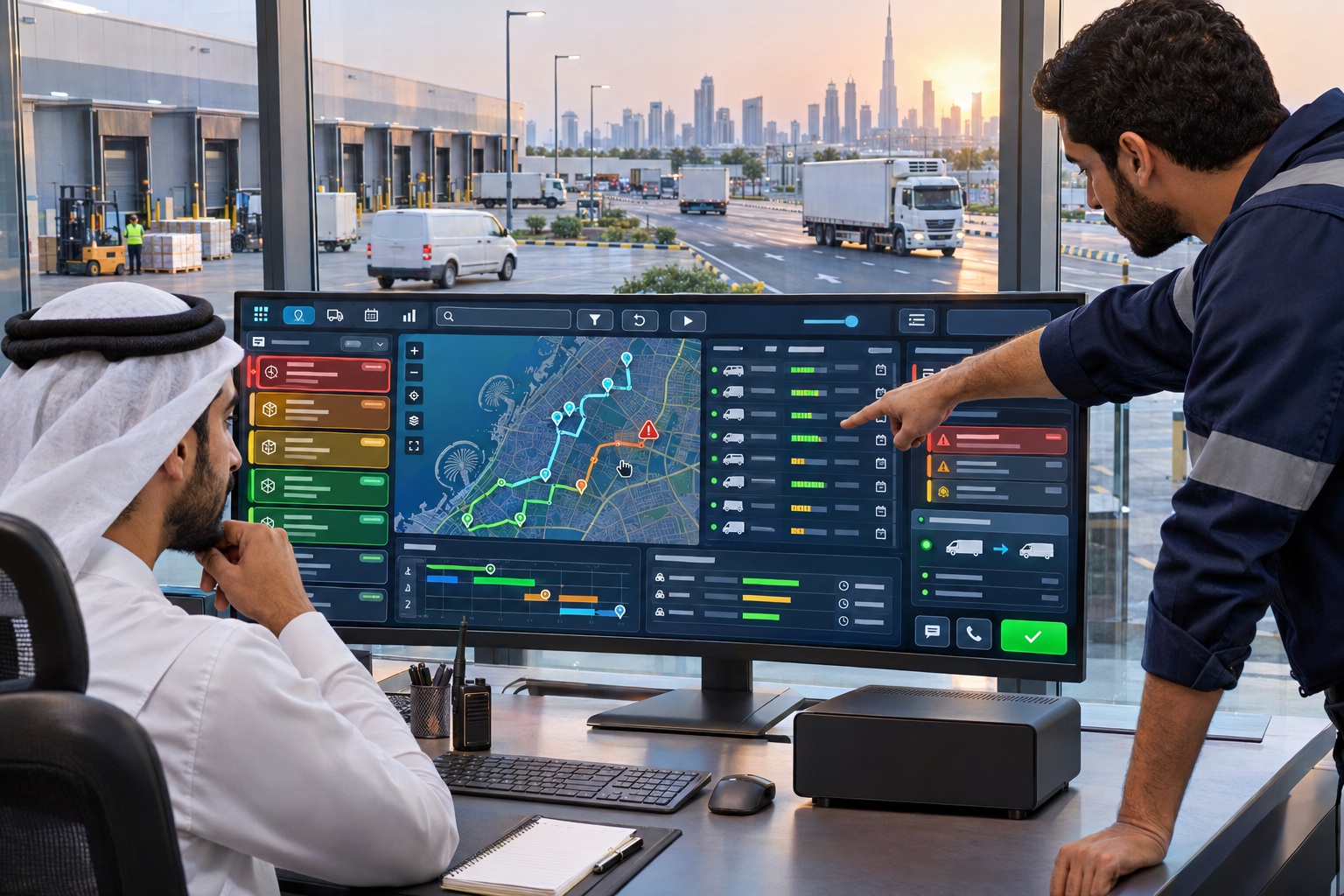
- GPS-integrated dispatch replaces the dispatcher's morning phone-call session with a live map view showing every vehicle's status, position, and delivery progress reducing the dispatcher's reactive communication load by 60 to 70 percent and enabling proactive management of delays before they affect customers.
- UAE-specific dispatch challenges that structured dispatch processes must address: Friday prayer time delivery windows (12:00 to 13:30 urban deliveries may be refused at many UAE commercial premises), Ramadan operating hours (shortened working day affects delivery windows across the fleet simultaneously), construction site access windows (fixed by site contractor schedule, not negotiable at arrival), and ADNOC journey management pre-departure requirements (documentation must be completed before any vehicle departs for ADNOC site routes).
- Driver app dispatch sending structured job cards to drivers through a dedicated app rather than WhatsApp text messages provides three capabilities WhatsApp cannot: load validation before confirmation (the system prevents dispatching more stops than the vehicle can carry), GPS navigation integration (drivers follow the optimised route rather than their own preferred sequence), and ePOD collection (digital delivery confirmation at each stop with GPS timestamp).
- Dispatch KPIs on-time departure rate, on-time delivery rate, load utilisation per vehicle, route adherence rate, and stops per vehicle per day are generated automatically from GPS and ePOD data when structured dispatch is deployed. These KPIs are invisible in WhatsApp-based dispatch operations, where delivery performance data exists only in the dispatcher's memory and paper records.
Fleet dispatching in UAE commercial operations has a characteristic pattern that most operations managers recognise: drivers assembled at the depot at 5:30 or 6:00 AM, the dispatcher working through a combination of yesterday’s plan and today’s urgent additions, assignments communicated through a WhatsApp group or individual messages, drivers departing with varying degrees of clarity about their sequence and time windows, and the dispatcher spending the next 3 to 4 hours fielding calls and messages from drivers asking for clarification, customers asking for ETAs, and the operations manager asking where specific deliveries are.
This pattern is not a failure of the dispatcher or the drivers it is a structural failure of the dispatch process. WhatsApp is a communication tool, not a dispatch system. It communicates text but not structured data; it confirms that a message was sent but not that the driver understood the sequence, load, and time windows; it provides no mechanism for systematic execution monitoring after drivers depart; and it generates no delivery performance data that can be used to improve the dispatch process over time. This guide defines the five-stage dispatch cycle that replaces WhatsApp dispatching with a structured, GPS-integrated dispatch operation improving delivery performance, reducing dispatcher time on reactive management, and generating the data that operations managers need to improve the dispatch process continuously.
The Five-Stage Dispatch Cycle
Pre-Dispatch Preparation (5:00–6:00 AM)
Pre-dispatch preparation is the foundation of a controlled dispatch operation the checks and confirmations that must be complete before any vehicle assignment is made. A dispatcher who assigns jobs before confirming vehicle availability and driver compliance is building a plan on unverified foundations that collapse when the pre-trip inspection reveals a tyre issue, a driver licence expiry blocks assignment, or a vehicle is unavailable due to an overnight workshop event.
Pre-Dispatch Check | What Is Verified | Manual Approach | GPS/Platform Approach |
Vehicle availability | Which vehicles are mechanically ready and not blocked by maintenance | Depot walk-around; call to workshop if vehicles were in overnight | Fleet platform maintenance status: vehicles with open critical OBD faults or overdue service flagged automatically |
Pre-trip inspection completion | Driver has completed the vehicle safety checklist before departure | Paper defect book handed to dispatcher; no systematic tracking | Digital inspection app: inspection completion status visible in platform before vehicle is assigned any job |
Driver compliance status | Driver licence validity; ADNOC defensive driving certificate if applicable; no active suspension | Dispatcher recalls from memory; inconsistent checking | Platform compliance tracker: expired or expiring within 7 days flagged at driver assignment |
Vehicle capacity verification | Confirmed load capacity for today’s plan | Dispatcher estimates from experience | Route optimization load calculator: stops assigned automatically within vehicle capacity; overflow flagged before plan is finalised |
ADNOC journey management (if applicable) | Pre-trip inspection and journey management documentation initiated for ADNOC site routes | Paper form completed; supervisor signature obtained | Digital journey management checklist in driver app: completion confirmed in platform before vehicle departure |
Route Assignment and Optimisation (6:00–6:30 AM)
Route assignment is the stage where today’s jobs are distributed across available vehicles in an optimal sequence. In a structured dispatch operation, this is not a manual matching exercise it is a review and adjustment of the route optimisation software’s output. The dispatcher’s role shifts from building the sequence to validating it: confirming that time-sensitive stops are correctly prioritised, overriding specific assignments where the dispatcher’s knowledge adds value (a customer who has requested a specific driver, a route the software does not know is under construction today), and confirming the plan for driver app dispatch.
UAE-specific route assignment considerations the dispatcher must verify before confirming the optimisation output:
- Friday prayer time: any stop scheduled between 12:00 and 13:30 on Friday must be verified as accessible during prayer time many UAE commercial premises close during this window, and a delivery scheduled for 12:30 Friday will be refused. Either reschedule to before 11:30 or after 14:00, or confirm the specific customer is open during prayer time.
- Ramadan operating hours: during Ramadan, delivery windows shift significantly many UAE commercial premises operate reduced hours with later opening (9:00 rather than 7:00) and earlier closing. The route optimisation must use Ramadan-adjusted time windows during the Ramadan period.
- Construction site access windows: construction site deliveries have fixed access windows set by the site contractor. If a stop’s optimised arrival time falls outside the site’s access window, the assignment must be moved to a vehicle that arrives within the window or the stop deferred to the next available window.
- ADNOC site route vehicles: any vehicle assigned to a route that includes ADNOC facility stops must have ADNOC IVMS registration active, the driver must have a current ADNOC defensive driving certificate, and the journey management pre-departure documentation must be initiated before the vehicle departs.
Driver Briefing and Job Dispatch (6:30–7:00 AM)
Driver briefing in a structured dispatch operation means sending structured job cards to the driver app not a WhatsApp message saying ‘start with Al Quoz, then Jebel Ali, call me if you have questions.’ The job card in the driver app contains: the ordered stop list with addresses, time windows, and contact names; the load manifest with item counts and weights per stop; navigation integration that routes the driver from the current position to the first stop and sequences subsequent stops automatically; the customer contact number for each stop; and any stop-specific instructions (security gate procedure, loading dock number, contact person).
The driver receives this information on their smartphone, confirms receipt in the app, and departs with the full route loaded in the navigation no phone calls required for clarification, no WhatsApp exchanges about which stop to do first, no drivers calling mid-route to ask for the address of stop 7. The dispatcher confirms all driver app receipts are acknowledged before 7:00 AM departure any driver who has not acknowledged their job card by 6:50 AM receives a direct call before departure.
Execution Monitoring (7:00 AM – End of Operational Day)
Execution monitoring is the stage that most UAE dispatch operations currently conduct through a combination of reactive phone calls and WhatsApp status requests ‘where are you?’, ‘have you done Al Quoz yet?’, ‘why haven’t you confirmed the Jebel Ali delivery?’ GPS-integrated dispatch replaces this reactive communication with a live operations view that shows every vehicle’s position and delivery progress without requiring any driver action or dispatcher call.
Monitoring Activity | WhatsApp Dispatch Approach | GPS-Integrated Dispatch Approach | Time Saved |
Check vehicle departure status | Call or message each driver to confirm departure | GPS ignition-on alert confirms vehicle departure; departure time logged automatically | 15-30 min/morning |
Verify first stop arrival | Driver sends WhatsApp when arriving at first stop | GPS geofence arrival alert fires automatically; ETA to first stop visible on live map | 10-20 min |
Monitor route progress | Call drivers periodically; estimate remaining route from last known position | Live map shows each vehicle’s position vs planned route; delivery progress tracker shows stops completed vs remaining | 30-60 min/day |
Handle delivery delay | Customer calls dispatcher; dispatcher calls driver; dispatcher updates customer | GPS progress tracking identifies delay; automated ETA update to customer; dispatcher informed by alert | 15-30 min/incident |
Confirm delivery completions | Driver calls or sends WhatsApp on each delivery; dispatcher records manually | ePOD confirmation fires automatically; timestamped record created in platform without dispatcher involvement | 30-60 min/day |
End-of-day delivery report | Dispatcher compiles from call notes and WhatsApp messages | Auto-generated from ePOD timestamps and GPS data; on-time rate calculated automatically | 20-40 min |
Post-Dispatch Closure and Performance Review
Post-dispatch closure converts the day’s ePOD and GPS data into the delivery performance record and the planning input for tomorrow. In a structured dispatch operation, this happens automatically the platform generates the daily delivery performance report from ePOD timestamps and GPS route data, flagging stops that were late, missed, or required customer rescheduling. The dispatcher’s end-of-day task is to review the exception list, document the reason for each exception (traffic delay, customer closure, access denied), and identify any patterns that should inform tomorrow’s plan.
The dispatcher who reviews yesterday’s late delivery pattern ‘six of the eight late stops were at Al Quoz industrial between 11:00 and 13:00’ adjusts tomorrow’s plan to schedule Al Quoz industrial before 10:30 or after 14:00. This continuous improvement loop is only possible when the delivery performance data exists in structured, reviewable form which WhatsApp message history and paper delivery notes cannot provide.
UAE-Specific Dispatch Protocols
Summer Dispatch Adjustments (June–September)
UAE summer heat requires three specific dispatch adjustments that the dispatcher must implement from June through September. First, vehicle pre-cooling: all fleet vehicles should be started and A/C activated 10 minutes before driver boarding the driver app departure prompt should not appear until 10 minutes after ignition on, giving the vehicle time to cool to a comfortable cab temperature before the driver enters. Second, mandatory hydration provisioning: the dispatcher confirms water and ice are loaded on each vehicle before departure a specific pre-dispatch check item during summer months. Third, peak heat delivery avoidance: where delivery schedules permit, routes are planned to complete outdoor physical work (loading, unloading, manual delivery) before 12:00 and after 16:00, scheduling the vehicle in air-conditioned premises or transit during the 12:00 to 15:00 peak heat window.
Ramadan Dispatch Protocol
Ramadan requires a complete reconfiguration of the dispatch time window schedule the dispatcher cannot simply apply normal delivery windows during Ramadan and expect normal delivery performance. The key Ramadan dispatch adjustments: delivery windows start 1 to 2 hours later for most UAE commercial customers (many premises open at 9:00 or 10:00 rather than 7:00 during Ramadan), route sequences are adjusted to place the earliest-opening customers first, all stops that were previously scheduled in the 14:00 to 16:00 window must be reviewed because many UAE businesses close for iftar preparation from 15:00 during Ramadan, and drivers require a fast-break (iftar) window at sunset all routes must be planned to allow drivers to stop for iftar without this appearing as an unplanned route deviation alert.
Dispatch KPIs for UAE Operations Teams
KPI | Definition | Calculation | UAE Target | Action When Off Target |
On-time departure rate | Percentage of vehicles departing depot within 15 minutes of planned departure time | (Vehicles departing within 15 min of plan ÷ total vehicles) × 100 | Above 90% | Identify pre-dispatch bottleneck: inspection delays, load preparation, driver absence |
On-time delivery rate (OTD) | Percentage of stops completed within customer’s specified time window | (On-time ePOD confirmations ÷ total stops) × 100 | Above 88% for B2B delivery SLAs | Identify late-delivery causes: traffic, access, loading time, route sequence issue |
Load utilisation rate | Average vehicle load as percentage of maximum capacity across all dispatched vehicles | (Actual load weight ÷ vehicle capacity) × 100 averaged across fleet | 70-85% (below 70% indicates under-loading; above 90% risks regulatory overloading) | Re-balance loads; assess whether additional vehicles needed or stops need consolidation |
Route adherence rate | Percentage of vehicles completing routes within 10% of planned kilometres | (Vehicles within 110% of planned km ÷ total vehicles) × 100 | Above 85% | Review deviation alerts; identify systematic detour patterns; driver coaching |
Stops per vehicle per day | Average number of stops completed per deployed vehicle per operating day | Total stops completed ÷ vehicles dispatched | Benchmark against route type; track trend declining SPV indicates efficiency loss | Identify stop duration increases; route quality review; vehicle availability impact |
Dispatcher calls per vehicle per day | Average inbound calls from drivers to dispatcher per vehicle — measures WhatsApp/phone dependency | Total driver-to-dispatcher calls ÷ vehicles dispatched | Below 2 per vehicle per day (structured dispatch) vs 8-12 (WhatsApp dispatch) | Identify what drivers are calling about; address through structured job cards or process improvement |
Transitioning from WhatsApp to Structured Dispatch
Most UAE commercial fleet operations that are currently WhatsApp-based can transition to structured GPS-integrated dispatch within 4 to 8 weeks. The transition has four stages that must happen in sequence rushing through any stage increases the risk of drivers reverting to WhatsApp communication because the new system is not yet embedded:
Transition Stage | What Happens | Timeline | Key Success Factor |
1 GPS and driver app deployment | GPS devices installed on all vehicles; driver app installed on all driver smartphones; dispatcher trained on live map and alert review | Weeks 1-2 | All drivers on the app before any WhatsApp communication is reduced no partial adoption |
2 Parallel running | Job cards sent via driver app AND WhatsApp simultaneously; drivers confirm via app but WhatsApp remains as backup | Weeks 2-4 | Dispatcher reinforces app confirmation over WhatsApp confirmation; any WhatsApp-only response is followed up with app confirmation request |
3 App-primary dispatch | Job cards sent via driver app only; WhatsApp retained for emergency communication and exception flagging only | Weeks 4-6 | Dispatcher does not respond to dispatch queries via WhatsApp redirects driver to app or phone call for genuine exceptions |
4 Full structured dispatch | Complete five-stage dispatch cycle operational; WhatsApp group used for announcements only; all delivery confirmation via ePOD | Weeks 6-8 | Dispatch KPIs tracked from week 6; on-time departure and OTD rates visible for management review |
Conclusion
Effective fleet dispatching is not a talent problem most UAE dispatchers are experienced, knowledgeable, and genuinely skilled at balancing complex operational requirements. It is a systems problem: dispatchers working with WhatsApp and spreadsheets are using tools that were not designed for dispatch management and cannot provide the load validation, execution monitoring, delivery confirmation, and performance data that structured dispatch operations require. The dispatcher’s skill is not the limiting factor; the tool is.
The five-stage dispatch cycle pre-dispatch preparation, route assignment and optimisation, driver app job dispatch, GPS execution monitoring, and post-dispatch performance review converts the dispatcher’s expertise from an emergency firefighting resource into a structured operational management function. The KPI visibility that structured dispatch generates, the delivery performance data that ePOD creates, and the execution visibility that GPS tracking provides collectively give the UAE operations team what WhatsApp cannot: a repeatable, improvable, data-driven dispatch operation. VZone International’s fleet management platform provides the GPS tracking, driver app, ePOD, and dispatch integration that makes this transition from WhatsApp to structured dispatch achievable within 4 to 8 weeks for UAE commercial fleet operations of any size.
VZone International Fleet Dispatch Integration From WhatsApp to Structured Operations
VZone International’s fleet management platform provides GPS-integrated dispatch for UAE operations teams: route optimisation, driver app job cards with ePOD collection, live execution monitoring, delivery progress tracking, and automated dispatch KPI reporting. The transition from WhatsApp dispatching to structured dispatch takes 4 to 8 weeks with VZone’s onboarding support. Contact our team for a dispatch operations assessment and transition plan for your UAE fleet.
Frequently Asked Questions
What is fleet dispatching and why does it matter for UAE operations?
Fleet dispatching is the process of assigning vehicles and drivers to jobs, communicating those assignments with the information needed to execute them, and monitoring execution progress to manage deviations before they affect customers. It matters for UAE operations because dispatching quality directly determines delivery performance: a well-dispatched route with optimised sequences, enforced time windows, and load-validated assignments produces on-time delivery rates above 88 percent; a WhatsApp-dispatched operation with manual sequencing, unvalidated loads, and no systematic execution monitoring typically produces on-time delivery rates of 65 to 75 percent. The 13 to 23 percentage point difference in delivery performance is the difference between retaining and losing UAE B2B customers who have SLA requirements for delivery reliability.
Why is WhatsApp dispatching a problem for UAE fleets?
WhatsApp dispatching creates four structural problems for UAE commercial fleet operations. No data validation: job assignments sent as text messages cannot automatically verify that the assigned stops fit within the vehicle’s load capacity, that all time windows are achievable in the planned sequence, or that the driver’s compliance credentials are current for the assigned route. No systematic execution monitoring: after drivers depart, the dispatcher has no way to track progress against the plan without calling or messaging each driver individually creating a reactive communication cycle that consumes the dispatcher’s morning. No structured delivery confirmation: WhatsApp delivery confirmations (‘done boss’) are not GPS-timestamped, not customer-verified, and not automatically compiled into delivery performance reports. No performance data: the delivery performance data that should inform tomorrow’s planning which stops were late, which routes are consistently problematic, which drivers complete routes efficiently does not exist in structured, reviewable form in a WhatsApp dispatch operation. These four structural problems produce the 65 to 75 percent on-time delivery rates and 8 to 12 dispatcher calls per vehicle per day that characterise WhatsApp-based UAE dispatch operations.
How does GPS integration improve fleet dispatch in UAE?
GPS integration improves UAE fleet dispatch across all five stages of the dispatch cycle. In pre-dispatch: vehicle availability and pre-trip inspection completion are visible in the platform before assignments are made no depot walk-around required. In route assignment: route optimisation software calculates the optimal stop sequence in 30 to 90 seconds, enforcing time windows, load capacity, and UAE-specific constraints automatically. In driver briefing: structured job cards sent to the driver app replace WhatsApp text messages drivers depart with the full route loaded in the navigation, no clarification calls required. In execution monitoring: the live GPS map shows every vehicle’s position and delivery progress without driver calls deviations and delays are visible as they develop, enabling proactive customer communication before SLA breach. In post-dispatch: ePOD timestamps and GPS route data generate the daily delivery performance report automatically on-time rate, stops per vehicle, route adherence providing the performance data that continuous dispatch improvement requires.
What dispatch KPIs should UAE operations managers track?
UAE operations managers should track six dispatch KPIs. On-time departure rate (above 90 percent vehicles departing within 15 minutes of planned departure) identifies pre-dispatch bottlenecks. On-time delivery rate (above 88 percent for B2B SLAs) is the primary customer-facing performance metric. Load utilisation rate (70 to 85 percent target) identifies under-loading waste and overloading risk. Route adherence rate (above 85 percent of vehicles completing routes within 110 percent of planned kilometres) identifies systematic deviation patterns. Stops per vehicle per day benchmarked against route type identifies efficiency trends. Dispatcher calls per vehicle per day (below 2 for structured dispatch vs 8 to 12 for WhatsApp dispatch) is the best single metric for measuring how much the dispatch operation relies on reactive communication rather than structured information delivery declining calls per vehicle indicates a maturing dispatch system.