At 120 km/h on the Abu Dhabi to Riyadh highway, a driver whose eyes close for 3 seconds covers 100 metres with no control over the vehicle. In those 100 metres, the vehicle crosses lanes, approaches other vehicles at closing speeds that exceed the driver’s reaction time, and creates a collision risk that no safety system downstream of the fatigue event ABS, lane departure warning, emergency braking can reliably prevent. The only effective intervention is the one that occurs before the driver’s eyes close: a fatigue detection system that identifies the precursor pattern and fires an alert while the driver is still capable of responding to it.
Driver fatigue is a leading cause of serious commercial vehicle accidents in UAE and the specific conditions of UAE long-haul fleet operations create a fatigue risk profile that is more acute than in most other markets. Desert highway monotony, extreme heat, long shift durations, and the absence of the environmental variation cues (topography, weather, traffic complexity) that keep drivers stimulated on shorter or more varied routes all compound the physiological fatigue accumulation that long-distance driving produces. A driver who would remain adequately alert on a 3-hour European motorway route may be dangerously impaired by hour 4 on the Dubai to Dammam highway under July conditions.
This guide explains how AI fatigue detection technology works, what specific physiological signals it detects and why those signals matter, how UAE operating conditions amplify the fatigue risk that makes AI detection more valuable here than global benchmarks suggest, what ADNOC and other UAE regulatory frameworks require for fatigue monitoring, and how VZone International’s AI fatigue detection deployment is configured for UAE fleet operations specifically.
Key Takeaways
- AI fatigue detection uses an onboard infrared driver-monitoring camera and neural network to detect the specific physiological precursors of fatigue-induced impairment eye closure duration, blink frequency decline, head position change, and microsleep pattern and alerts the driver in real time, within 2 to 3 seconds of detection, before impairment reaches the level that creates accident risk.
- Microsleep involuntary sleep episodes of 0.5 to 5 seconds that the driver typically cannot detect in themselves is the specific fatigue event that causes the majority of fatigue-related serious road accidents. AI fatigue detection is designed specifically to catch microsleep onset patterns before the sleep episode occurs, not to record the episode after it has happened.
- UAE desert highway routes create fatigue onset conditions that accelerate the timeline to impairment by 30 to 50 percent compared to European highway benchmarks: high ambient temperature, monotonous road environment, limited stopping infrastructure, and the circadian disruption of early start times combine to produce earlier and more severe fatigue than equivalent driving duration in cooler, more varied road environments.
- ADNOC’s HSE management system for long-haul contractor vehicle routes increasingly expects active fatigue monitoring evidence not driver hour logs and rest break attestations, but verified real-time monitoring data confirming that driver fatigue was being actively detected during the route. AI dashcam fatigue detection provides this evidence directly.
- The distinction between passive monitoring (recording whether fatigue events occurred) and active prevention (alerting the driver and operations centre before an incident occurs) is the difference between a fatigue audit trail and a fatigue safety system. Only real-time in-cab alerts create the prevention window that reduces accident risk.
How AI Fatigue Detection Works
The Driver Monitoring System Hardware and Processing
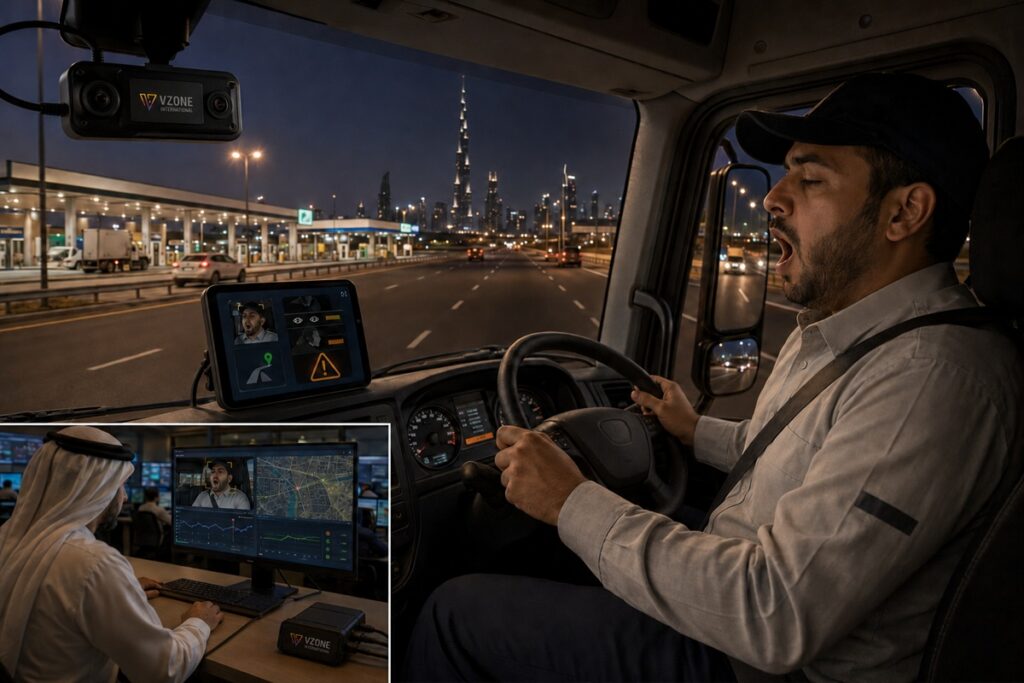
AI fatigue detection is implemented through a Driver Monitoring System (DMS) a driver-facing infrared camera mounted on the vehicle’s dashboard or A-pillar, pointed at the driver’s face, connected to an onboard processor running a trained neural network fatigue detection model. The infrared illumination ensures consistent image capture regardless of ambient lighting day, night, direct sunlight entering the cab from the driver’s side, or driving through dark tunnels conditions that would degrade visible-spectrum camera performance but have no effect on IR imaging.
The camera captures the driver’s face at 30 to 60 frames per second, feeding each frame through the neural network inference pipeline. The model processes each frame against the trained fatigue indicator patterns in 50 to 150 milliseconds faster than the physiological events it is detecting and maintains a continuous fatigue risk score that integrates eye state, blink frequency, head position, and facial landmark geometry over a rolling time window. When the integrated score crosses a configured alert threshold, the system fires an in-cab alert: an audio tone, voice message, or vibration alert in the driver’s seat, depending on configuration designed to be intrusive enough to interrupt drowsiness but not so disruptive that it startles the driver dangerously.
What the AI Detects The Five Fatigue Signals
AI fatigue detection models are trained on the five physiological signals that research has established as reliable precursors of fatigue-induced impairment. Each signal is detected independently and integrated into the composite fatigue risk score.
Fatigue Signal | What the AI Detects | Why It Indicates Fatigue | Alert Threshold |
Eye closure duration (PERCLOS) | Percentage of time in a rolling window (typically 60-90 seconds) that the driver’s eyes are closed or nearly closed | PERCLOS above 15-20% is strongly correlated with impaired alertness in driving research; normal alert driving is below 5% eye closure time | Alert typically fires at PERCLOS above 12-15% over the monitoring window |
Blink frequency and duration | Number of blinks per minute and duration of each blink; slow blink rate with extended blink duration indicates declining vigilance | Alert drivers blink 15-20 times per minute at 150-400ms duration; fatigued drivers show fewer, longer blinks indicating reduced vigilance maintenance | Alert fires when blink rate drops significantly or blink duration extends beyond 500ms threshold |
Microsleep onset pattern | Series of extended eye closures (1.5-5 seconds each) in rapid succession indicating microsleep episode beginning | Microsleep is an involuntary sleep episode the driver cannot control or detect the precursor pattern of multiple extended closures is the earliest detectable signal | Immediate alert on first extended closure exceeding configured threshold (typically 2-3 seconds) |
Head position and nodding | Head dropping below normal upright driving position; repeated head-snapping recovery movements indicating the driver is fighting sleep | Head droop is the visible manifestation of postural control loss that accompanies advanced fatigue; snapping recovery indicates microsleep has already begun | Alert fires on head position deviation exceeding configured angle threshold |
Gaze direction and fixation | Extended forward fixation without normal scanning eye movements; glazed-eye appearance with reduced gaze variation | Alert drivers scan the road with frequent small eye movements; fatigued drivers fixate rigidly forward with reduced processing of peripheral information | Alert fires on sustained abnormal fixation pattern exceeding defined duration |
The Alert-to-Response Window Why Real-Time Matters
The value of AI fatigue detection is entirely contained in the window between alert and incident. An alert that fires before the driver’s eyes close triggered by the PERCLOS trend approaching the threshold, not after a microsleep has completed gives the driver 3 to 10 seconds of warning during which they can: respond to the alert by increasing alertness; apply physical countermeasures (window down, radio on, face splash); or, most importantly on a remote route, begin the process of safely pulling over for a rest break. An alert system that records fatigue events after they have occurred but does not alert the driver in real time is a fatigue audit trail, not a fatigue safety system it documents incidents that could have been prevented.
At 120 km/h, 3 seconds of warning represents 100 metres of distance. At 100 km/h, 5 seconds represents 138 metres. This is the physical reality that gives real-time AI fatigue detection its safety value on UAE highways the alert fires when the margin still exists to respond safely, rather than triggering when the margin has been exhausted by a completed microsleep event.
Why UAE Conditions Make Fatigue Detection More Critical
Desert Highway Monotony The Stimulus Deprivation Problem
Human alertness during driving is maintained partly by the environmental stimulation that road variation provides: changing traffic density, topographical variation, weather variation, junction complexity, urban transitions. Desert highway driving the primary route environment for UAE long-haul fleet operations removes most of these stimulation inputs. The Abu Dhabi to Al Ghuwaifat stretch of the E11 highway, the Western Region supply routes to ADNOC oilfield sites, and the Dubai to Muscat highway through the Hajar corridor all share the same fatigue-accelerating characteristic: long, straight road with minimal environmental variation that provides insufficient stimulation to maintain vigilance at the same level as more varied road environments.
Research into motorway driving fatigue has established that stimulus-deprived driving environments accelerate fatigue onset by approximately 25 to 40 percent compared to varied road environments of equivalent duration. For a driver with a natural fatigue onset (without AI monitoring) at 4 hours of varied highway driving, a similarly conditioned desert highway route may produce equivalent impairment at 2.5 to 3 hours. This compression of the safe driving window is the primary reason that UAE-specific fatigue risk benchmarks and UAE-specific AI detection threshold calibration differ materially from European highway standards.
Extreme Heat The Physiological Amplifier
UAE summer heat amplifies fatigue risk through two distinct physiological mechanisms. The first is direct thermal load: sustained exposure to ambient temperatures above 40°C increases the cardiovascular demand of maintaining normal body temperature, diverting physiological resources from cognitive function including the vigilance maintenance that safe driving requires. Cab air-conditioning reduces but does not eliminate this thermal load because cab temperature in UAE summer conditions, even with functional A/C, typically runs 5 to 10 degrees above ambient for the first 30 to 60 minutes after engine start and remains elevated during high-ambient-temperature conditions.
The second mechanism is the dehydration-fatigue interaction: UAE summer conditions produce perspiration rates in commercial vehicle drivers that exceed typical fluid intake in driving conditions, creating a cumulative dehydration gradient over the driving shift that interacts with cognitive fatigue to accelerate impairment onset. A driver who is mildly dehydrated (1 to 2 percent of body weight, achievable within 2 to 3 hours in summer driving conditions without active hydration) shows measurably reduced vigilance and reaction time that compounds any physiological fatigue from the driving duration itself.
Early Start Times and Circadian Misalignment
UAE construction, logistics, and oil and gas supply fleets frequently operate early departure schedules vehicles departing depots between 3:00 AM and 6:00 AM to reach oilfield sites, construction locations, or cross-border destinations during cooler morning hours or to satisfy site start-time requirements. These early departures align with the circadian trough the period between approximately 2:00 AM and 6:00 AM when the human body’s biological clock produces the strongest sleep drive and the deepest performance impairment in terms of reaction time, vigilance, and decision quality.
A driver departing at 4:00 AM is operating at peak circadian disadvantage within the first hour of their route the period that should, by circadian physiology, be their deepest sleep. The combination of circadian trough, early departure, and the subsequent progressive fatigue accumulation over the following 4 to 6 hours of driving produces a fatigue risk profile that does not map to the hour-based driving time limits that most safety frameworks use as their primary control measure. AI fatigue detection that monitors physiological state rather than clock hours is the monitoring approach that addresses this circadian-compounded risk profile.
ADNOC and UAE Regulatory Fatigue Monitoring Requirements
ADNOC Contractor Fleet HSE Expectations
ADNOC’s HSE management system for contractor fleets applies specifically to vehicles operating on ADNOC site access routes including the long-haul routes to Abu Dhabi Western Region oilfields, offshore support facilities, and Ruwais industrial complex that represent some of the highest-fatigue-risk routes in UAE commercial fleet operations. ADNOC HSE documentation and contractor HSE audits increasingly reference active fatigue monitoring as an expected control measure for contractor vehicles on routes exceeding 2 hours of driving time distinguishing between paper-based fatigue management systems (driver hour logs, rest break attestations, journey management plans) and verified real-time monitoring systems that provide evidence that the driver’s fatigue state was actively monitored during the route.
Contractors whose fatigue management programme consists entirely of journey management plans and driver hour compliance documentation without a real-time monitoring component are increasingly finding that ADNOC HSE auditors flag the absence of active monitoring as a programme gap. AI dashcam fatigue detection provides the verified monitoring evidence that closes this gap: timestamped fatigue event records, route-mapped alert occurrences, and management review reports that demonstrate the driver’s fatigue state was monitored throughout the route and that alerts were responded to.
General UAE Road Safety Framework
UAE’s National Road Safety Strategy and the Ministry of Interior’s road safety programme identify driver fatigue as one of the primary factors in serious commercial vehicle accidents alongside speeding and distraction. While there is no UAE federal regulation mandating AI fatigue detection for specific fleet categories at the time of writing, the regulatory direction is clearly toward active monitoring requirements, and several major UAE employers of commercial drivers beyond ADNOC have implemented AI fatigue detection as part of their own HSE standards in advance of any regulatory requirement.
For UAE fleet operators considering the regulatory trajectory, AI fatigue detection deployment now positions the fleet ahead of the likely future mandatory standard rather than behind it a strategic position that has both operational safety value and compliance planning value.
AI Fatigue Detection vs Alternative Fatigue Management Approaches
Approach | How It Works | What It Catches | What It Misses | UAE Applicability |
Journey management plan (JMP) | Pre-route documentation of planned rest breaks and maximum continuous driving hours | Compliance with planned schedule verifiable after the fact | Actual driver condition; circadian factors; environmental fatigue amplifiers; early sleep debt | Standard requirement does not provide active monitoring evidence for ADNOC HSE audits |
Driver hour log (manual) | Driver records departure, arrival, and rest break times | Post-hoc compliance with hour limits | Actual fatigue state; circadian disadvantage; early-onset fatigue in demanding conditions | Easily falsified; no real-time monitoring capability; insufficient for active monitoring standard |
Mandatory rest break schedule | Fixed rest break intervals regardless of driver fatigue state | Minimum rest exposure may reduce fatigue accumulation | Fatigue that onset before the break interval; circadian-trough driving in the scheduled hours | Better than nothing but does not address early-onset fatigue or circadian disadvantage windows |
Fatigue risk management system (FRMS) | Systematic fatigue risk assessment including roster design, sleep science, and monitoring | Systemic fatigue risk at fleet programme level | Individual driver state during a specific journey still requires real-time monitoring layer | Best practice framework requires real-time monitoring to complete the system |
AI dashcam fatigue detection | Real-time physiological state monitoring from driver-facing infrared camera; in-cab alert on detection | Microsleep onset, PERCLOS elevation, head drooping, reduced blink rate all in real time | Fatigue that has not yet produced measurable physiological signals (early accumulation phase) | UAE-specific IR configuration; desert route calibration; ADNOC monitoring evidence output |
How VZone International’s AI Fatigue Detection Works in UAE Fleets
UAE-Calibrated Detection Thresholds
VZone International’s AI fatigue detection deployment uses detection thresholds calibrated for UAE operating conditions rather than the generic European or North American benchmarks that most DMS vendors supply as default configurations. The calibration differences reflect the fatigue-accelerating factors specific to UAE: PERCLOS alert thresholds are set more conservatively (triggering at lower eye-closure percentage) for routes beginning before 6:00 AM and for routes exceeding 3 hours duration, reflecting the heightened fatigue risk in these operating profiles; head position alert sensitivity is increased for desert highway segments where stimulus deprivation amplifies the significance of early head-droop signals; and the fatigue risk score weighting is adjusted for UAE summer months where thermal load compounds the physiological fatigue burden.
These UAE-specific calibrations are not cosmetic adjustments they reflect the difference between a system configured to catch fatigue at the level European highway research defines as impairment and a system configured to catch fatigue at the level that UAE desert highway conditions produce impairment. The calibration is what converts a globally marketed fatigue detection product into a system that works for the environment UAE fleet drivers actually operate in.
In-Cab Alert Hierarchy Graduated Response
VZone’s fatigue detection alert hierarchy uses a graduated response that escalates with increasing fatigue severity rather than applying a single alert type regardless of the fatigue event’s urgency. The first-level alert triggered by early PERCLOS elevation or blink rate decline is an audible tone that is intrusive enough to increase alertness without startling the driver. The second-level alert triggered by a sustained PERCLOS elevation or first head droop is a voice message that explicitly names the fatigue condition: ‘Fatigue detected please stop for a rest break’ in Arabic and English, delivered at a volume that requires conscious response. The third-level alert triggered by multiple events in a short window or a clear microsleep onset pattern simultaneously alerts the driver, notifies the operations centre dispatcher in real time, and recommends immediate route suspension.
The operations centre alert is the element that distinguishes AI fatigue monitoring from a passive in-cab warning system. A driver on a remote desert route who has received a third-level fatigue alert, whose operations centre has been simultaneously notified, and who has not confirmed that they have stopped and rested faces an active management response not a dashboard statistic that the fleet manager reviews on Monday morning.
Integration with GPS Route Data and ADNOC HSE Reporting
Every fatigue alert generated by VZone’s system is GPS-location-stamped, route-segment-referenced, and driver-identity-linked on the fleet management platform. The fatigue event record shows: the route segment where the event occurred (enabling identification of the specific road and time-of-day pattern associated with highest event frequency); the driver whose physiological state triggered the alert; the alert level (first, second, or third level); and whether the alert was responded to (driver compliance with alert, confirmed stop, or continued route). This structured event record generates the management review reports and ADNOC HSE fatigue monitoring evidence that contractor fleet programmes require not as a manual compilation exercise but as an automated output from the monitoring system.
Conclusion: Fatigue Cannot Be Managed by Paperwork Alone
Driver fatigue management in UAE long-haul fleet operations has historically been a paper-based discipline: journey management plans, rest break schedules, driver hour logs, and fatigue awareness training. These administrative controls reduce the systemic fatigue risk from inadequate rostering and journey planning but they do not address the in-journey physiological reality that a driver on a desert highway route in July, departing at 4:00 AM, carrying progressive fatigue from accumulated sleep debt and circadian disadvantage, may reach dangerous impairment levels regardless of whether the journey management plan was correctly completed before departure.
AI fatigue detection is the monitoring layer that addresses what paper-based fatigue management cannot: the specific, immediate, physiological state of this driver, on this route, at this moment. The PERCLOS score does not care whether the journey management form was completed. The microsleep onset pattern does not respond to fatigue awareness training. It responds to an in-cab alert that fires in real time and gives the driver the 3 to 10 seconds of warning that, at UAE highway speeds, is the difference between an incident and a safe rest stop.
VZone International’s AI fatigue detection deployment brings this real-time monitoring capability to UAE fleet operations with the specific calibration that UAE conditions require IR camera performance across desert lighting conditions, UAE-calibrated detection thresholds, Arabic and English alert messaging, and ADNOC HSE evidence output as an integrated component of the fleet management platform that serves every other monitoring function the fleet needs from a single provider.
Protect your drivers on UAE desert routes with AI fatigue detection calibrated for UAE conditions.
VZone International deploys AI fatigue detection for UAE fleet vehicles on long-haul desert routes, ADNOC contractor operations, and high-risk fleet profiles with UAE-calibrated IR dashcams, real-time operations centre alerts, and ADNOC HSE fatigue monitoring evidence output. Contact our team for a free fatigue risk assessment for your fleet.
Frequently Asked Questions
AI fatigue detection in fleet vehicles uses an infrared driver-facing camera and an onboard neural network processor to continuously analyse the driver's face for the physiological signs of fatigue. The system monitors five signals simultaneously: eye closure percentage (PERCLOS), blink frequency and duration, microsleep onset patterns (multiple extended eye closures in rapid succession), head position and nodding, and gaze direction anomalies. When the composite fatigue risk score crosses a configured threshold typically calibrated for the specific fleet's route profile and operating conditions the system fires an in-cab audio alert within 2 to 3 seconds of detection, while simultaneously transmitting an event notification to the fleet management platform with GPS location, driver identity, and alert level. The entire detection-to-alert cycle occurs on the device, without cloud upload latency, enabling real-time intervention before the detected fatigue pattern progresses to a microsleep event.
Yes onboard AI fatigue detection systems fire alerts in real time (within 2 to 3 seconds of event detection) because the neural network inference runs on a processor embedded in the camera unit itself, not in the cloud. Cloud-dependent systems introduce 30 to 90 seconds of processing latency that eliminates the real-time intervention capability. At 120 km/h, 30 seconds of latency means the vehicle has already travelled 1 kilometre from the detection point by the time an alert is generated beyond the point where alerting the driver provides any safety benefit. Onboard processing is the architectural requirement for genuine real-time fatigue detection, not a premium feature.
ADNOC's HSE management system for contractor vehicles on long-haul routes increasingly expects active fatigue monitoring evidence with HSE audit documentation and contractor assessments distinguishing between paper-based journey management (which does not demonstrate real-time monitoring) and verified active monitoring systems that provide timestamped fatigue event records. While there is no single formal ADNOC regulation mandating AI dashcam fatigue detection specifically, contractors whose fatigue management programme lacks a real-time monitoring component are increasingly finding this flagged as a programme gap in HSE audits. AI dashcam fatigue detection provides the active monitoring evidence that closes this gap and satisfies the monitoring expectation that ADNOC HSE auditors apply to long-haul contractor vehicle routes.
UAE summer heat amplifies driver fatigue risk through two mechanisms: thermal load (ambient temperatures above 40°C increase the cardiovascular demand of body temperature regulation, diverting physiological resources from cognitive function and reducing vigilance maintenance capacity) and dehydration-fatigue interaction (perspiration rates in UAE summer conditions can produce 1 to 2 percent body weight dehydration within 2 to 3 hours of driving without active hydration, with this level of dehydration producing measurably reduced vigilance and reaction time that compounds physiological driving fatigue). The combined effect means that a UAE driver operating in summer conditions reaches the same level of impairment in 2.5 to 3 hours that an equivalent driver in temperate conditions may not reach until 4 to 5 hours making UAE-calibrated detection thresholds more sensitive than global standard configurations.