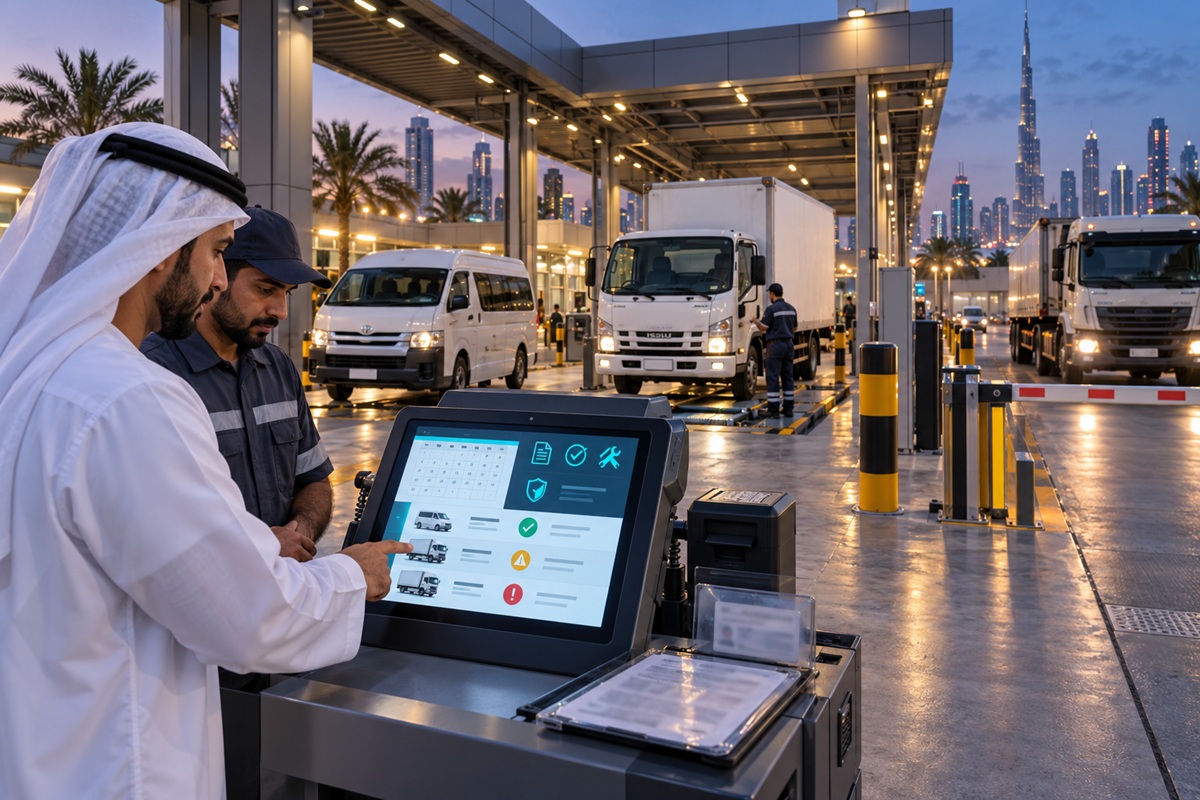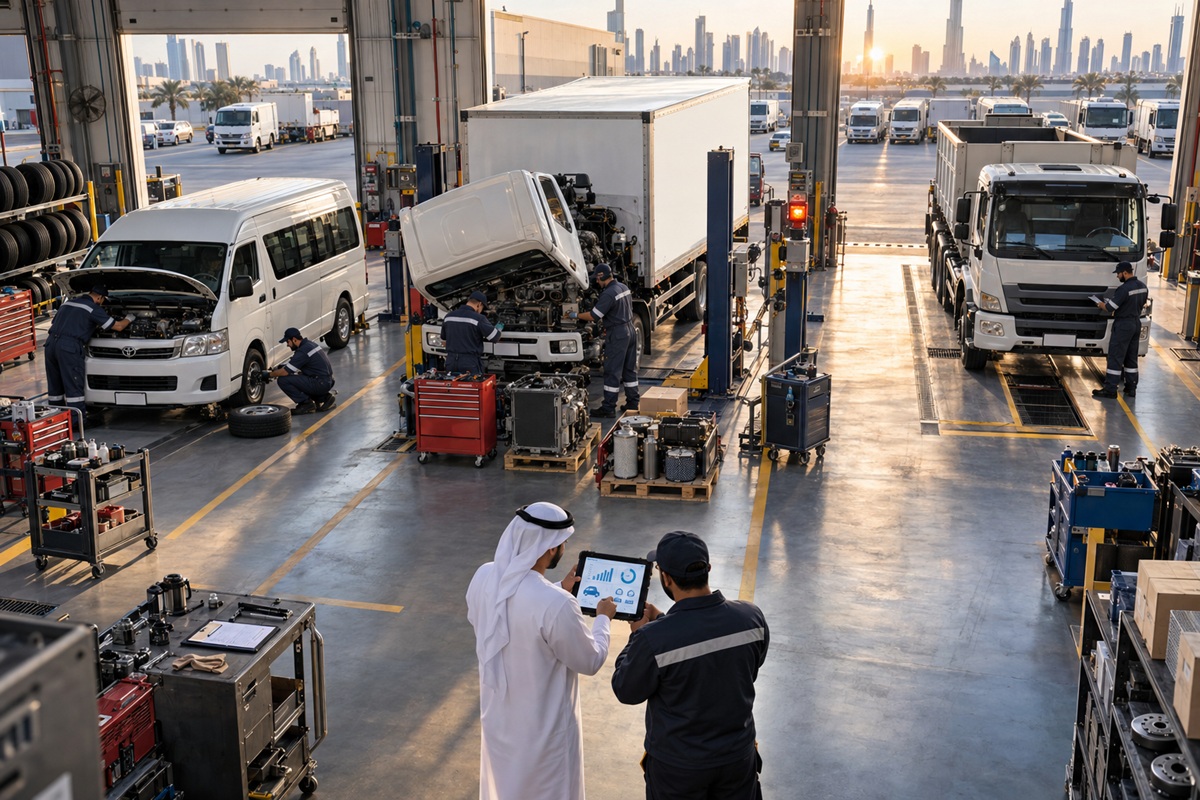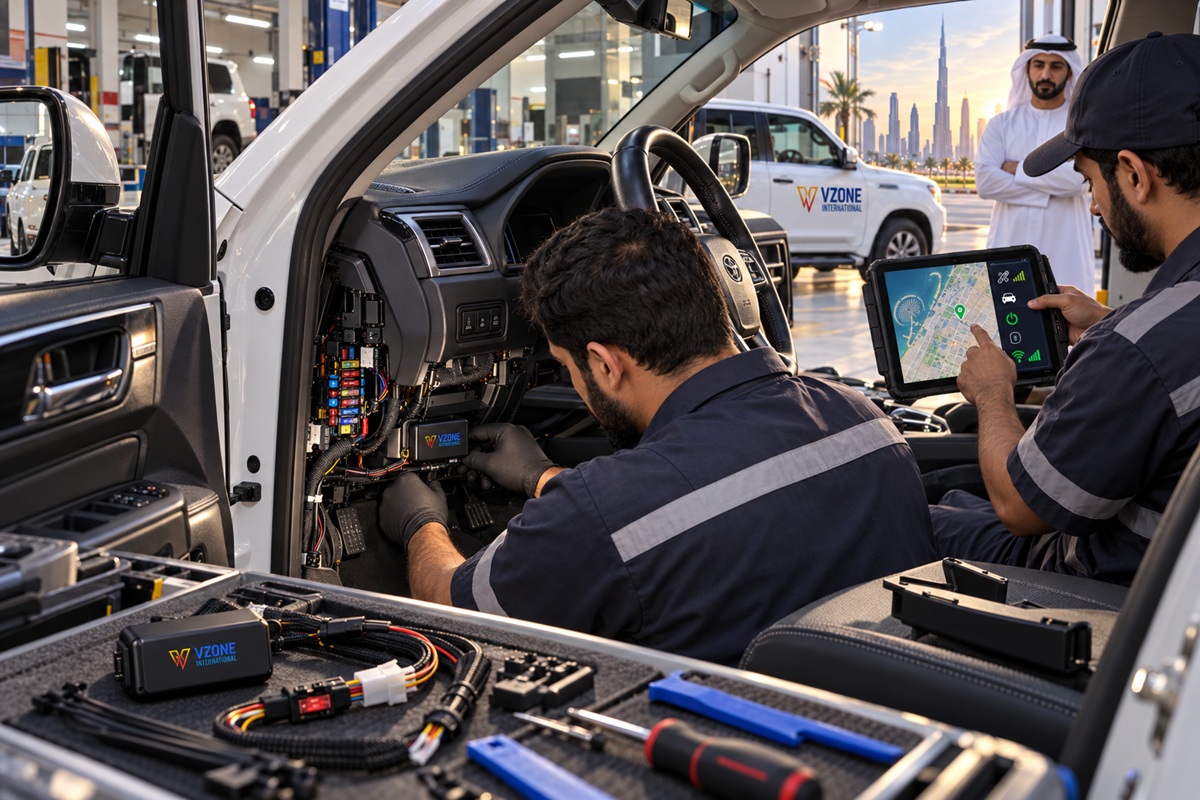
Fleet management is the discipline of operating a commercial vehicle fleet efficiently, safely, and in compliance with applicable regulations managing the vehicles themselves, the drivers who operate them, the costs they generate, and the data they produce. A fleet of five vehicles creates more operational complexity than most non-fleet businesses realise; a fleet of fifty creates a full-time management role; a fleet of five hundred requires a team, systems, and processes that rival any other operational function in the company.
A fleet management system is the technology infrastructure that makes this complexity manageable replacing the phone calls, WhatsApp messages, spreadsheets, and paper logs that most UAE fleets currently use with a unified platform that monitors every vehicle in real time, alerts managers to problems before they become crises, and produces the reports that finance teams, operations directors, and compliance officers need without requiring hours of manual data extraction.
This guide covers what fleet management is, what a fleet management system does, which features matter most for different UAE fleet types, and how to evaluate and choose a platform. It links to twelve supporting articles that go deeper on each component use the Related Resources section at the end to navigate to the specific topic you need.
Key Takeaways
- Fleet management encompasses six domains: vehicle tracking (where are the vehicles), driver management (who is driving and how), maintenance management (vehicle condition and service scheduling), fuel management (consumption monitoring and cost control), compliance management (UAE regulatory requirements including Asateel and IVMS), and cost management (operating cost tracking and budget control).
- A fleet management system integrates all six domains into a single software platform replacing the fragmented tools (separate GPS tracker app, paper service log, Excel fuel spreadsheet, manual compliance calendar) that most UAE fleet operators currently use with a unified dashboard where all fleet data is visible and cross-referenced.
- The financial case for fleet management is direct and measurable: fuel cost reduction (20–30%), maintenance breakdown prevention (35–50% fewer unplanned repairs), incident rate reduction (30–40%), insurance premium reduction (10–20% from telematics safety data), and compliance violation avoidance. For a 50-vehicle fleet spending AED 2.5 million per year on operating costs, a 25% reduction saves AED 625,000 annually.
- UAE fleet management has specific requirements that differentiate it from European or North American fleet management: Asateel and IVMS GPS compliance certification, extreme summer heat effects on vehicle maintenance intervals, Arabic language support for driver interfaces, Salik toll management, and cross-border GCC compliance (OPAL for Oman routes).
- VZone International delivers fleet management for UAE commercial fleets through the Wialon platform supporting 3,400+ GPS device types, 20+ years of UAE operations, 4,000+ UAE fleet clients, and native integrations with SAP, Oracle, Odoo, and Zoho for automated cost reporting.
What Is Fleet Management?
Fleet management is the set of processes, systems, and decisions that keep a commercial vehicle fleet operating productively, safely, and within budget. It encompasses everything from the daily dispatch of vehicles to routes, through the coaching of drivers on safety performance, the scheduling of maintenance before vehicles break down, the monitoring of fuel consumption and cost, and the maintenance of compliance with UAE transport regulations.
The scope of fleet management expands with fleet size, but the domains are consistent regardless of whether a fleet has 5 vehicles or 500. Every fleet manager whether dedicated to fleet management as their primary role or managing fleet operations alongside other responsibilities must address the same six management domains:
| Domain | What It Covers | Without System | With Fleet Management System |
| Vehicle Tracking | Real-time location of all vehicles; route history; geofencing; after-hours monitoring | Phone calls to drivers; no after-hours visibility | Live map dashboard; geofence alerts; after-hours monitoring active 24/7 |
| Driver Management | Safety performance scoring; incident investigation; coaching; driver licence compliance | Subjective assessment; reactive (after incidents occur) | Weekly GPS safety scores; event-based coaching data; proactive licence expiry alerts |
| Maintenance Management | Service scheduling; OBD fault monitoring; workshop coordination; vehicle inspection | Paper service log; missed services; breakdown response | GPS mileage alerts; OBD real-time fault detection; digital inspection app |
| Fuel Management | Consumption monitoring; idle reduction; theft detection; fuel card reconciliation | Monthly card statement total; no per-vehicle visibility; theft undetected | Real-time per-vehicle consumption; siphoning alerts; card-GPS reconciliation |
| Compliance Management | Asateel/IVMS data submission; Mulkia renewals; driver licence tracking; HSE reporting | Manual compliance calendar; reactive when expired | Automated compliance alerts; 30-day advance expiry warning; auto-generated ADNOC HSE reports |
| Cost Management | Operating cost tracking; budget vs actual; cost centre allocation; ERP reporting | Monthly manual reconciliation; 30-day data lag; approximate allocations | Real-time per-vehicle cost; automated ERP posting; daily budget tracking |
What Is a Fleet Management System?
A fleet management system (FMS) is a software platform that integrates GPS vehicle tracking data with driver, maintenance, fuel, and compliance management tools providing a unified operational view of the entire fleet from a single dashboard. The FMS receives data from GPS devices installed in every fleet vehicle, processes it in real time, and makes it available to fleet managers, supervisors, drivers, and finance teams through web browsers and mobile apps.
The distinction between a GPS tracker and a fleet management system is the software layer that transforms location data into fleet management intelligence. A GPS tracker shows a vehicle’s position on a map. A fleet management system uses that position data alongside OBD diagnostics, fuel sensor readings, driver behaviour accelerometer data, and compliance records to answer the questions that matter to fleet management: which drivers need coaching this week, which vehicles are due for service, which fuel card transactions don’t match the vehicle’s GPS location, and which Mulkia renewals need to be initiated before the vehicles become non-compliant.
Fleet Management Tracking System Core Components
| Component | Function | Data Source | Output |
| GPS Tracking Hardware | Installs in vehicle; determines position and collects vehicle data | GNSS satellites + vehicle sensors (OBD, fuel sensor, accelerometer) | Real-time position, speed, ignition status, harsh events, fuel level, fault codes |
| Cellular Communication | Transmits vehicle data to cloud server | SIM card on UAE cellular network (du/Etisalat 4G LTE) | Data packets every 10-30 seconds; store-and-forward for remote coverage areas |
| Fleet Management Platform | Central software that receives, stores, and processes all vehicle data | All GPS devices across the fleet | Live map; route history; driver scores; maintenance alerts; fuel reports; compliance dashboards |
| Manager Web Dashboard | Fleet manager’s primary interface for monitoring and reporting | Fleet management platform API | Real-time fleet overview; configurable reports; alert management; driver coaching data |
| Manager Mobile App | Real-time fleet visibility and push alert delivery for on-the-go management | Fleet management platform API | Live map; push notifications; driver scores; key reports |
| Driver App | Driver-facing interface for job dispatch, ePOD, safety score, daily vehicle check | Fleet management platform + driver input | Job cards; delivery confirmation; pre-trip inspection; own safety score view |
| ERP Integration | Automatic cost posting to finance system from fleet data | Fleet management platform cost data → SAP/Oracle/Odoo/Zoho API | Per-vehicle cost allocation; automated cost centre posting; fuel cost reporting |
Fleet Management Platform Features to Expect
A complete fleet management platform provides capabilities across all six management domains. The depth and configuration of each capability varies between platforms and between deployment configurations. The following features represent what a UAE commercial fleet management platform should provide:
GPS Tracking and Live Operations
- Live fleet map with all vehicle positions updating every 10 to 30 seconds vehicle identity, speed, heading, driver, and last event visible without clicking into individual vehicles
- Geofencing configurable virtual boundaries with entry/exit alerts for depots, customer sites, restricted zones, and UAE-specific locations (ADNOC facility perimeters, school bus approved routes)
- Route optimisation and dispatch integration assigning jobs to drivers through the platform and tracking delivery progress against planned routes
- After-hours monitoring geofence exit alerts during configurable non-operating hours for unauthorised vehicle use and theft detection
Driver Safety and Behaviour Management
- Distance-normalised weekly driver safety scores (per 100 km, not raw event counts) enabling fair comparison between high-mileage and low-mileage drivers
- GPS harsh event detection: harsh braking, rapid acceleration, sharp cornering, and speed-vs-posted-limit monitoring on every trip
- AI dashcam integration fatigue detection, distraction monitoring, phone-use detection with in-cab alerts and cloud footage storage
- Driver leaderboard and self-access app drivers see their own safety score and event history, enabling self-directed improvement between coaching conversations
- ADNOC IVMS compliance driver behaviour event data formatted and submitted to ADNOC HSE portal automatically for contractor fleet compliance
Vehicle Maintenance Management
- GPS mileage-triggered service alerts at configurable thresholds 80% and 95% of service interval with advance parts notification to workshop
- OBD-II and CAN bus diagnostic monitoring real-time fault code alerts classified by severity (informational, warning, critical) in plain operational language
- Digital vehicle inspection app driver completes pre-trip checklist on smartphone with GPS location verification and photo capture for defects
- Mulkia, insurance, and vehicle inspection certificate expiry tracking with 30-day and 7-day advance alerts
Fuel Management
- Per-vehicle fuel consumption tracking from GPS distance and fuel card / vehicle sensor data
- Idling detection and cost calculation alerts when idling exceeds configured threshold; daily and weekly idling cost reports per vehicle
- Fuel card API integration automatic reconciliation of card transactions against vehicle GPS location; card misuse alerts for location mismatches
- Vehicle fuel sensor integration calibrated tank level sensors for siphoning detection (rapid level drop without ignition-on event)
- Bulk depot tank monitoring IoT sensors on storage tanks with delivery reconciliation, theft detection, and reorder alerts
Compliance and Regulatory Management
- Asateel (ITC Abu Dhabi) continuous data submission for all Abu Dhabi commercial vehicles managed automatically by VZone without driver or manager action
- ADNOC IVMS data submission and weekly HSE driver behaviour reports in ADNOC-specified format
- SecurePath (RTA Dubai) compliance for school buses, rental cars, and other RTA-mandated categories
- OPAL (Oman) data submission for UAE-Oman cross-border fleet operations
- Driver licence expiry alerts at 90-day advance sufficient lead time for UAE licence renewal process including medical examination
Cost Reporting and ERP Integration
- Per-vehicle operating cost dashboard: fuel cost, maintenance cost, Salik tolls, and insurance all per vehicle per month
- Automated ERP integration (SAP, Oracle, Odoo, Zoho) fuel and maintenance costs automatically posted to correct cost centres without manual extraction
- Fleet budget tracking actual vs budget per vehicle category with early warning alerts when vehicles track above baseline
- Client billing support GPS-verified per-client vehicle usage for accurate fuel and operating cost pass-through billing
Benefits of Fleet Management
| Benefit Category | Mechanism | Typical UAE Fleet Result | Measurement Method |
| Fuel cost reduction | Idling reduction + eco-driving coaching + theft elimination + route optimisation | 20-30% reduction in annual fuel spend | Per-vehicle fuel cost per km before vs after telematics deployment |
| Maintenance cost reduction | GPS mileage service scheduling + OBD predictive fault detection + digital vehicle inspections | 35-50% fewer unplanned breakdowns; 10-20% lower total maintenance cost | Planned vs unplanned maintenance ratio; cost per maintenance event |
| Incident rate reduction | Driver safety scoring + specific event coaching + fatigue detection + incident reconstruction | 30-40% reduction in at-fault incident rate within 12 months | At-fault incidents per 100 vehicles per year before vs after |
| Insurance premium reduction | Telematics safety data presentation at renewal; lower claims history from reduced incidents | 10-20% insurance premium reduction at first renewal with telematics data package | Insurance premium per vehicle before vs after |
| Compliance assurance | Automated Asateel/IVMS data submission; advance Mulkia expiry alerts; driver licence tracking | Zero compliance violations from missed renewals or failed data submission | Compliance violations per year before vs after |
| Operational efficiency | Live dispatch visibility; route optimisation; reduced driver idle time and detours | 10-15% reduction in total fleet kilometres; faster delivery confirmation | Average delivery time; fleet utilisation rate |
| Driver accountability | GPS route record; driver identity per trip; coaching programme with data-specific conversations | Reduced unauthorised vehicle use; improved driver retention through recognition | Unauthorised use events per month; driver turnover rate |
| Management time saving | Automated alerts replace manual checks; auto-generated reports replace spreadsheet compilation | 4-5 hours per day recovered for fleet manager from operational information gathering | Fleet manager time allocation before vs after |
Fleet Management by Industry
Logistics and Distribution
Logistics and distribution fleets from last-mile e-commerce delivery vans to long-haul GCC semi-trailers are the highest-mileage, highest-fuel-cost fleet category and the sector where fleet management ROI is typically achieved fastest. The live map dispatch capability that confirms delivery vehicle locations in real time, the ePOD (electronic proof of delivery) that replaces paper waybills and resolves ‘not delivered’ disputes with GPS-verified delivery confirmation, and the route optimisation that reduces total kilometres driven per delivery cycle are the three capabilities that logistics operators prioritise. For UAE long-haul trucking on UAE-Oman-Saudi Arabia corridors, cross-border compliance management (OPAL for Oman, dual-SIM for Oman cellular) and border crossing fuel cost tracking add UAE-specific value. → See: GPS Fuel Monitoring for Trucks UAE, Automated Fuel Management System UAE
Construction and Infrastructure
Construction fleet management addresses the highest-theft-risk and highest-maintenance-cost fleet category in UAE operations. Construction site vehicles operate in high-dust environments that accelerate air filter consumption, on rough access roads that create higher suspension and tyre wear, and on unmanned sites overnight where fuel siphoning and equipment theft are consistent risks. After-hours geofence alerts for construction equipment, bulk tank fuel monitoring for site diesel storage, and construction site-specific maintenance intervals (air filter inspection at 5,000 km rather than standard 15,000 km) are the capabilities that construction fleet managers prioritise. ADNOC IVMS compliance is mandatory for ADNOC contractor vehicles automated IVMS data submission and HSE report generation eliminate the manual reporting that would otherwise require a dedicated safety officer role. → See: Bulk Fuel Tank Monitoring UAE, Fleet Safety Management Software UAE
Oil and Gas (ADNOC Contractor Fleets)
ADNOC contractor fleet management is the most compliance-intensive fleet management context in UAE with mandatory IVMS driver behaviour monitoring, journey management documentation, daily vehicle inspection requirements, and ADNOC HSE incident reporting obligations that generate 10 to 15 separate compliance data requirements per vehicle per week. A fleet management system that automates all ADNOC compliance obligations IVMS data submission, weekly HSE reports, journey management pre-trip inspection records, and incident documentation removes the compliance overhead that would otherwise require multiple administrative staff to manage manually. VZone International’s Wialon platform manages ADNOC IVMS compliance for contractor fleets operating in the Western Region, onshore ADNOC facilities, and offshore support logistics. → See: GPS Tracking Commercial Vehicles UAE Compliance, Fleet Safety Management Software UAE
Cold Chain and Temperature-Controlled Logistics
Cold chain fleet management adds temperature monitoring and pharmaceutical compliance to the standard fleet management capability set. Refrigerated vehicles carry cargo with strict temperature requirements fresh produce (2°C to 8°C), frozen food (−18°C to −22°C), pharmaceuticals (2°C to 8°C for standard, −20°C for cold-store medications, 15°C to 25°C for ambient pharma) and temperature excursions create cargo loss, regulatory violation, and customer penalty liability. Fleet management platforms with cold chain integration monitor cargo temperature in real time via probes installed in the refrigerated compartment, generating alerts when temperature deviates from the acceptable range and creating the continuous temperature log that pharmaceutical GDP (Good Distribution Practice) compliance requires. → See: Cold Chain Monitoring System UAE
Government and Municipality Fleets
Government and municipality fleet management faces the dual challenge of public accountability and operational complexity large mixed fleets (passenger vehicles, utilities vehicles, specialist equipment) serving multiple departments with different operational requirements, all subject to public expenditure scrutiny that commercial fleets do not face. The cost reporting capability of fleet management systems per-vehicle operating cost by department, automated cost centre allocation, fuel spend per ministry or directorate provides the financial accountability that government fleet management requires. Vehicle utilisation tracking (which vehicles are being used, how much, and by which department) enables rightsizing decisions that eliminate under-utilised vehicles from the fleet a significant cost saving for fleets where political considerations historically prevented vehicle disposal. → See: Fleet Maintenance Cost Analytics UAE
How to Choose a Fleet Management System
The fleet management system selection process for UAE fleet operators should evaluate five dimensions. A platform that performs well on all five is the correct choice; a platform that excels on one or two at the expense of others creates gaps that generate operational problems, compliance failures, or cost overruns.
| Evaluation Dimension | Key Questions | UAE-Specific Requirement | VZone / Wialon Position |
| UAE Compliance Coverage | Does the platform manage Asateel, IVMS, SecurePath, OPAL, and Mulkia compliance automatically? Are the specific GPS device models on the certified lists for the applicable UAE compliance programmes? | Non-negotiable operating commercial vehicles in UAE without applicable compliance certification exposes the fleet to fines, site access suspension, and operating licence risk | VZone manages all UAE compliance certifications; Teltonika devices on Asateel and OPAL certified lists; IVMS, SecurePath, and SIRA compliance supported |
| Hardware Ecosystem | How many device types does the platform support? Can it accommodate existing devices already installed in some vehicles? Can it support future vehicle types (EVs, heavy trucks, specialist equipment)? | UAE fleet vehicle diversity is high most fleets include light vans, pickups, heavy trucks, and specialist equipment, often from different manufacturers requiring different device types | Wialon supports 3,400+ device types the broadest hardware ecosystem of any fleet platform; existing device migration supported |
| Software Depth | Does the platform go beyond GPS tracking to cover maintenance scheduling, fuel management, compliance reporting, and ERP integration? Is the Arabic language interface complete or partial? | UAE fleet management requires all six domains (tracking, driver, maintenance, fuel, compliance, cost) a GPS-only platform requires additional tools for other domains, creating data fragmentation | Full six-domain fleet management on Wialon; complete Arabic and English interface; SAP, Oracle, Odoo, Zoho native ERP connectors |
| Scalability and Support | Can the platform scale from current fleet size to planned growth without system replacement? Is local UAE support available for installation, configuration, and troubleshooting? | UAE fleet operators need UAE-based technical support who understand local compliance requirements, Arabic language support for driver-facing interfaces, and on-site installation capability | VZone International: UAE-based operations; Teltonika certified installer; 20+ years UAE operations; 4,000+ UAE fleet clients |
| Total Cost of Ownership | What is the all-in cost per vehicle per month including hardware, SIM, platform subscription, installation, and support? What is the payback period against fuel and maintenance savings? | UAE fleet management ROI is typically 2 to 4 months total platform cost should be assessed against the fuel, maintenance, and compliance savings rather than as a standalone technology cost | Platform cost AED 80 to AED 180 per vehicle per month depending on features; typical UAE fleet payback 2 to 4 months against 20-30% fuel and maintenance reduction |
Conclusion
Fleet management is not optional for UAE commercial fleets above a certain size it is a compliance obligation (Asateel, IVMS, SecurePath) for many vehicle categories and an operational necessity for any fleet where fuel, maintenance, safety, and cost performance matter. The question for UAE fleet operators is not whether to implement fleet management but which system to deploy and how quickly to achieve the financial returns that a well-deployed platform delivers.
The five evaluation dimensions above provide a structured framework for platform selection. For most UAE commercial fleet operators particularly those with ADNOC compliance obligations, mixed vehicle fleets, GCC cross-border operations, or ERP integration requirements a platform with comprehensive UAE compliance coverage, broad hardware support, full six-domain fleet management capability, and UAE-based implementation support is the correct specification. VZone International’s deployment of Wialon for 4,000+ UAE fleet clients, with 20+ years of UAE operational experience and Teltonika certified installer status, provides that specification for UAE commercial fleets of all sizes and sectors.
VZone International Fleet Management Platform Free Demo for UAE Fleets
VZone International provides fleet management for UAE commercial fleets through the Wialon platform GPS tracking, driver safety scoring, predictive maintenance, fuel monitoring, Asateel/IVMS compliance, and ERP integration in a single deployment. 4,000+ UAE fleets served. 20+ years UAE operations. Teltonika certified installer. Contact our team for a live platform demo tailored to your fleet size, vehicle types, and compliance requirements.
Frequently Asked Questions
A fleet management system integrates six operational domains into a single software platform: GPS vehicle tracking (real-time location, geofencing, route history), driver management (safety behaviour scoring, coaching data, incident investigation), maintenance management (service scheduling from GPS mileage, OBD fault monitoring, digital vehicle inspections), fuel management (consumption monitoring, idling alerts, fuel card reconciliation, theft detection), compliance management (Asateel and IVMS data submission, Mulkia expiry alerts, driver licence tracking), and cost management (per-vehicle operating cost reporting, ERP integration, budget tracking). The system receives data continuously from GPS devices installed in every fleet vehicle, processes it in real time on a cloud platform, and delivers the alerts, dashboards, and reports that fleet managers need to manage operations proactively rather than reactively. For UAE commercial fleets, a fleet management system also serves as the technology backbone of regulatory compliance automating the Asateel, IVMS, SecurePath, and OPAL data submissions that are legal obligations for specific vehicle categories.
Fleet management system costs for UAE commercial fleets are typically structured as a monthly per-vehicle subscription covering the platform licence, with separate one-time costs for GPS hardware and installation. As a reference range: GPS hardware (Teltonika device) AED 350 to AED 950 per vehicle depending on device capability (basic tracking vs OBD integration vs CAN bus for heavy trucks); installation AED 150 to AED 400 per vehicle for professional certified installation; cellular SIM AED 15 to AED 50 per vehicle per month; platform subscription AED 50 to AED 130 per vehicle per month depending on features enabled. Total ongoing cost (SIM + platform) is typically AED 65 to AED 180 per vehicle per month, with Year 1 including hardware and installation adding AED 500 to AED 1,350 per vehicle. For a 50-vehicle fleet, total Year 1 investment is approximately AED 60,000 to AED 130,000 recovered within 2 to 4 months against the 20 to 30 percent fuel and maintenance savings that the system delivers.
Every industry that operates commercial vehicles benefits from fleet management, but the ROI and compliance urgency vary by sector. The highest-priority industries in UAE are: ADNOC and oil and gas contractor fleets (mandatory IVMS compliance; high-consequence incident risk; remote route operations; highest compliance penalty exposure); construction and infrastructure (high fuel theft risk on unmanned sites; high maintenance cost from harsh operating conditions; equipment tracking requirement); logistics and distribution (largest UAE fleet category by vehicle count; highest fuel cost exposure; delivery performance SLA requirements); cold chain and pharmaceutical (temperature compliance regulatory requirement; cargo loss risk from temperature excursion; GDP documentation obligation); and government and municipality fleets (public expenditure accountability; large mixed vehicle fleets requiring cost allocation across departments). The minimum fleet size where a professional fleet management system delivers clear positive ROI is approximately 10 vehicles for most industries below that, the management overhead is manageable without automation; above 10, the savings from systematic fuel management and maintenance scheduling consistently exceed the platform cost within the first quarter.
GPS tracking is one component of fleet management the location data layer that tells you where your vehicles are. Fleet management is the complete operational discipline that uses that location data alongside driver behaviour data, maintenance data, fuel data, and compliance data to manage a commercial vehicle fleet efficiently. The practical difference: GPS tracking alone shows you a dot on a map and tells you a vehicle went from A to B; fleet management tells you that the vehicle went from A to B, the driver made 6 harsh braking events on the route (coaching needed), consumed 15 percent more fuel than the vehicle's baseline for that route (potential inefficiency or fault developing), the vehicle is 400 km from its next service (schedule the workshop appointment), the Mulkia expires in 22 days (initiate renewal), and the total trip cost was AED 87 including fuel and Salik tolls (allocated to the client contract automatically). Fleet management transforms GPS location data into the operational intelligence that enables the management decisions, coaching conversations, maintenance actions, compliance initiations, and cost allocations that a commercial fleet requires.