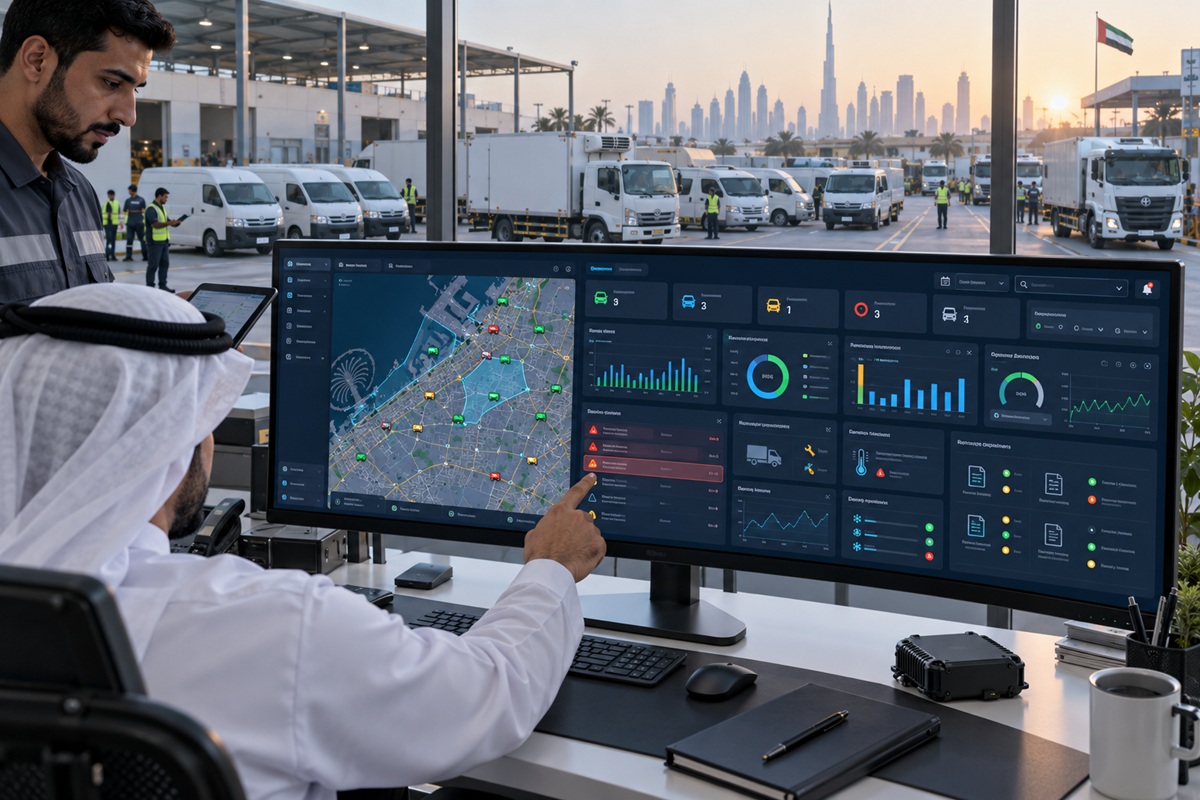
In UAE’s extreme heat, maintaining an unbroken cold chain is one of the hardest logistics challenges any operator faces. Ambient temperatures regularly exceeding 45°C in summer months create thermal pressure on every link of the cold chain from refrigerated vehicle compartments to the brief exposure periods at loading docks and delivery handover points. A single temperature excursion during pharmaceutical delivery can result in product spoilage, regulatory investigation, and significant financial liability. A food temperature breach at a restaurant supply delivery triggers a Dubai Municipality food safety finding that can affect an operator’s licence.
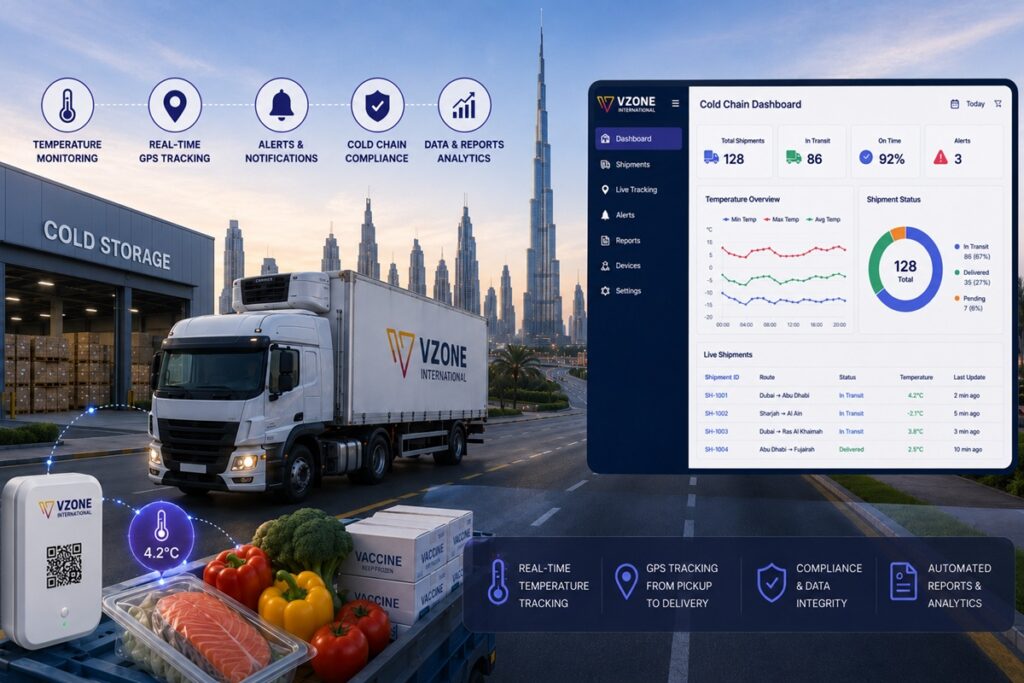
GPS-integrated cold chain monitoring systems provide real-time temperature visibility, instant excursion alerts, and automated compliance documentation the three capabilities that UAE operators across pharmaceuticals, food distribution, catering supply, and chemical logistics need to protect their cargo, satisfy their regulators, and demonstrate quality management to their customers.
This guide covers what a cold chain monitoring system is, how GPS and IoT sensors work together in the UAE fleet context, which specific industries are regulated and what their temperature requirements are, and what the compliance documentation standards that MOHAP and Dubai Municipality inspectors actually examine look like in practice.
Key Takeaways
- A cold chain monitoring system combines IoT temperature sensors with GPS tracking to provide simultaneous visibility over cargo location and cargo condition the integration that transforms location-only fleet tracking into temperature compliance infrastructure.
- UAE cold chain temperature requirements vary significantly by cargo category pharmaceutical cold chain at +2°C to +8°C, fresh food at 0°C to +5°C, frozen food at -18°C and below each with different regulatory bodies enforcing compliance.
- MOHAP guidelines for pharmaceutical cold chain require more than temperature monitoring they mandate calibrated instruments with traceable calibration certificates, documented alarm management, and GDP-formatted audit trails that food cold chain standards do not require.
- Dubai Municipality and the Abu Dhabi FSRA both require food transport operators to demonstrate temperature control documentation as part of their food safety management systems paper-based logging is increasingly scrutinised in favour of automated electronic records.
- Multi-zone temperature monitoring independent sensors per compartment zone is essential for vehicles carrying different cargo categories simultaneously, and for detecting warm spots within large compartments that single-sensor monitoring misses.
- Automated compliance reports generated directly from GPS and IoT platform data eliminate the manual compilation overhead that makes rigorous cold chain documentation impractical at operational scale.
What Is a Cold Chain Monitoring System?
A cold chain monitoring system is an integrated combination of IoT temperature sensors, GPS tracking hardware, and a cloud-based management platform that maintains continuous visibility over the temperature conditions experienced by cargo throughout its supply chain journey. The ‘system’ designation is important it describes not a single device but an end-to-end capability: sensors that measure temperature continuously, a communication layer that transmits that data in real time to a cloud platform, and a management interface that presents the temperature record alongside GPS location data and generates the compliance documentation that regulators require.
The critical operational characteristic of a cold chain monitoring system is continuity the temperature record must be unbroken from cargo loading through all transit and handling stages to final delivery. A system that monitors the vehicle compartment but not the loading dock, or that records data locally on a logger but uploads it only at trip completion, creates gaps in the temperature record that represent compliance vulnerabilities when inspectors examine documentation or when a dispute arises about when a temperature excursion occurred.
The Cold Chain Defined From Origin to Last Mile
The cold chain is the unbroken sequence of temperature-controlled environments through which temperature-sensitive cargo passes from its point of origin to its point of use or consumption. For a pharmaceutical product manufactured in Europe and delivered to a hospital in Abu Dhabi, the cold chain includes: the manufacturer’s cold storage, temperature-controlled air freight, Jebel Ali port cold room handling, a UAE pharmaceutical distributor’s temperature-controlled warehouse, a GPS-monitored refrigerated delivery vehicle, and the hospital pharmacy’s cold storage. A failure at any of these links invalidates the product the chain is only as strong as its weakest link.
Cold chain monitoring systems in the UAE logistics context typically focus on the transport links the refrigerated vehicle and the short-term handling periods at loading and delivery points because these are the links that are most exposed to UAE’s extreme ambient temperatures and where monitoring has previously been most limited. Storage facility monitoring (cold rooms and pharmaceutical refrigerators) is a separate but related application that many of the same IoT sensor platforms support.
Why UAE’s Climate Makes Cold Chain Monitoring Critical
UAE’s climate creates cold chain conditions that are significantly more demanding than those in European or North American logistics environments where many cold chain standards and benchmark figures originate. Ambient temperatures of 40°C to 47°C in summer mean that cargo exposed to the outside air during loading and unloading reaches equilibrium with ambient temperature rapidly a refrigerated compartment at +4°C can rise to +15°C within 15 minutes of door opening in full summer heat. A delivery vehicle parked in direct sun on a Dubai distribution run can reach interior temperatures of 65°C to 75°C within 20 minutes of engine shutdown and air conditioning cut-off.
These conditions mean that the standard operating procedures designed for cold chain transport in cooler climates the same loading dock protocols, the same door-open time tolerances, the same pre-cooling procedures are often insufficient in the UAE context without adjustment. GPS cold chain monitoring provides the real-time data visibility that enables UAE operators to detect when standard procedures are creating temperature pressure and to adjust operational practices to the specific thermal challenges of the UAE environment.
How GPS Integrates with Temperature Monitoring
The integration of GPS vehicle tracking with IoT temperature sensors is what distinguishes an enterprise cold chain monitoring system from a standalone temperature data logger. GPS tracking tells you where the vehicle is. Temperature monitoring tells you what condition the cargo is in. When both data streams are combined in a single platform with a shared timeline, you know where the vehicle was and what temperature the cargo was experiencing at every moment the combination that enables both real-time operational response and retrospective compliance documentation.
IoT Temperature Sensors in Refrigerated Vehicles
IoT temperature sensors for refrigerated vehicle monitoring are probe devices installed inside the cargo compartment mounted away from the evaporator unit to capture representative cargo-zone temperature rather than air supply temperature. The sensor transmits readings at configured intervals typically every one to five minutes during active cold chain monitoring via a wired or Bluetooth connection to the GPS telematics device installed in the vehicle cab. The GPS device pairs each temperature reading with the vehicle’s GPS coordinates, speed, and engine status, and transmits the combined data package to the cloud platform.
Sensor accuracy and calibration are the critical quality attributes for pharmaceutical applications. IoT sensors for medical and pharmaceutical cold chain monitoring must demonstrate measurement accuracy of ±0.5°C or better within the monitored temperature range, must have current calibration certificates traceable to national metrology standards, and must be recalibrated at defined intervals typically annually or after any repair or modification. For food cold chain monitoring, calibration requirements are less formally specified but electronic sensor accuracy remains the foundation of trustworthy temperature records.
Multi-Zone Monitoring Different Compartments, Different Temperatures
Multi-zone temperature monitoring configures independent sensors in different areas of a vehicle’s refrigerated space most commonly when the vehicle carries multiple cargo categories at different temperature setpoints, or when the compartment size is large enough that temperature gradients between zones are operationally significant. A common UAE logistics scenario is a chilled van with a main compartment at +4°C for fresh food and a frozen section at -18°C for frozen products each zone needs its own independent sensor with its own alert threshold configuration.
Even in single-category vehicles, multi-zone monitoring improves compliance documentation quality. A single sensor near the evaporator records the coldest point in the compartment but the warmest point, typically near the door seal or at the highest stacking position furthest from the air supply, may be three to five degrees warmer. For pharmaceutical cargo where the allowable temperature range is +2°C to +8°C, a sensor measuring +4°C at the evaporator does not confirm that cargo at the door end of the compartment is within the +8°C upper limit. Multi-sensor configurations that verify temperature at the warmest and coldest zones create a more defensible compliance record.
Data Logging Intervals and Alert Thresholds
Data logging interval how frequently the sensor records and transmits a temperature reading determines both the resolution of the temperature record and the speed with which excursions are detected. A five-minute logging interval creates 288 data points per 24-hour period, providing a detailed temperature profile that shows the shape of any excursion event. A 30-minute interval creates only 48 data points sufficient for trend analysis but potentially missing short-duration excursion spikes that a more frequent interval would capture.
For pharmaceutical cold chain monitoring under GDP guidelines, five-minute logging intervals are standard during vehicle operation, with some regulatory frameworks specifying even shorter intervals for high-risk cargo categories. For food cold chain monitoring, 10-minute intervals are generally accepted for compliance documentation purposes. The logging interval should be configurable per vehicle or per cargo category on the fleet platform, rather than a fixed system-wide setting.
Alert threshold configuration defines when the platform fires a notification that an excursion is developing or has occurred. A best-practice configuration for pharmaceutical cold chain uses two threshold tiers: an advisory alert at 80 to 85 percent of the allowable range limit giving the operations team a response window before a compliance event occurs and a confirmed excursion alert when the temperature crosses the regulatory limit. This graduated alerting gives the dispatch team time to redirect the vehicle to the nearest cold storage facility if the compartment temperature is trending upward, potentially preventing a compliance event before it occurs.
Industries That Rely on Cold Chain Monitoring in UAE
| Industry | Required Temperature Range | Key Regulatory Body in UAE | Consequence of Breach | Documentation Standard |
| Pharmaceutical cold chain medicines | +2°C to +8°C | MOHAP / DHA / HAAD (SEHA) | Product recall, investigation, supply agreement risk | WHO GDP audit trail + calibration records |
| Vaccines and blood products | +2°C to +8°C (strict) | MOHAP / DHA / Ministry of Health | Batch destruction, patient safety investigation | WHO GDP + chain of custody documentation |
| Ambient pharmaceutical (controlled temp) | +15°C to +25°C | MOHAP | Product degradation, regulatory non-conformance | Temperature monitoring record + GDP compliance |
| Fresh produce (fruits, vegetables) | +2°C to +8°C | FSRA Abu Dhabi / Dubai Municipality | Product seizure, licence inspection, fine | HACCP temperature log electronic preferred |
| Chilled dairy and meat products | 0°C to +5°C | FSRA / Dubai Municipality Food Safety | Product recall, microbial risk finding | HACCP CCP temperature documentation |
| Frozen food and ice cream | -18°C and below | FSRA / Dubai Municipality Food Safety | Product seizure, fine, operator suspension | Temperature log covering full supply chain |
| Catering and restaurant supply | +2°C to +8°C (chilled) / -18°C (frozen) | Dubai Municipality / Abu Dhabi DM | Supply contract cancellation, food safety finding | Delivery temperature record at point of receipt |
| Temperature-sensitive chemicals | Manufacturer-specified range | Environment Agency UAE / manufacturer spec | Safety incident, product degradation, regulatory action | Supplier specification + transport record |
| Medical device and laboratory supplies | +2°C to +25°C depending on item | DHA / HAAD / MOHAP | Device failure, test invalidity, clinical risk | Manufacturer cold chain guidelines + delivery record |
Regulatory Requirements for Cold Chain in UAE
UAE cold chain regulation is distributed across multiple authorities depending on cargo category and emirate. Understanding the specific requirements of the authority relevant to your cargo type is the foundation for configuring a monitoring system that generates the right documentation in the right format for your compliance obligations.
MOHAP Guidelines for Pharmaceutical Cold Chain
The UAE Ministry of Health and Prevention (MOHAP) oversees pharmaceutical distribution standards, aligned with WHO Good Distribution Practice guidelines. For cold chain pharmaceutical operations, MOHAP’s requirements extend well beyond temperature monitoring to encompass the full GDP compliance framework: vehicle qualification documentation demonstrating that refrigerated vehicles maintain temperature within specification under defined test conditions; calibrated monitoring instruments with documented calibration records; alarm management procedures specifying required response times and escalation paths; and complete audit trails covering every temperature excursion event from detection through investigation to resolution.
A practical point for UAE pharmaceutical distributors: MOHAP GDP audits are conducted by both MOHAP inspectors and by international pharmaceutical manufacturer quality teams who audit their UAE distribution partners against GDP standards. The monitoring system documentation that satisfies a MOHAP inspection must also satisfy a rigorous manufacturer audit meaning that documentation quality standards are effectively set by the more demanding of the two inspection frameworks. Automated GDP-formatted reports that present calibration records, alarm events, and excursion investigations in the structured format that auditors are trained to review are the appropriate standard for pharmaceutical cold chain operations in the UAE.
Dubai Municipality Food Safety Requirements
Dubai Municipality’s Food Safety Department regulates food transport temperature requirements for operators delivering into Dubai. Cold chain food transport operators must implement food safety management systems typically HACCP-based that include temperature control documentation for transport operations as a Critical Control Point. Temperature records for food deliveries must be available for Dubai Municipality inspections, and the direction of regulatory expectation is clearly toward electronic, automated records rather than paper temperature logs.
Dubai Municipality food safety inspections examine temperature compliance documentation during audits of food businesses not just food transport operators. A restaurant or food retailer whose suppliers cannot produce temperature records for delivered products may face findings related to food safety management system gaps even though the transport operator is the party failing the documentation standard. This creates downstream pressure on food logistics companies from their customer base: food service clients increasingly specify electronic temperature monitoring as a supplier qualification requirement rather than simply meeting the regulatory minimum.
Documentation Standards What Reports Must Show
Cold chain compliance reports must demonstrate specific information to satisfy both regulatory inspection and customer documentation requests. At minimum, a compliant temperature report for UAE food or pharmaceutical cold chain operations must show: the vehicle identifier and route covered; the date and time of each temperature reading; the temperature value at each reading point; the GPS location of the vehicle at the time of each reading (for pharmaceutical GDP compliance specifically); any excursion events temperature threshold crossings with precise start time, duration, magnitude, and GPS location; and the final delivery temperature at handover.
For pharmaceutical cargo, the report must additionally reference the calibration certificate identifier for the monitoring instrument used and confirm the calibration validity date. Some GDP audit frameworks also require the report to reference the vehicle qualification document that confirmed the refrigerated vehicle’s temperature performance characteristics. Automated cold chain monitoring platforms that generate reports including all of these elements rather than basic temperature graphs requiring manual annotation are the appropriate standard for UAE pharmaceutical distribution operations.
Key Features in Cold Chain GPS Monitoring Software
Real-Time Temperature Dashboard Live Vehicle Data
The fleet manager’s cold chain dashboard presents the temperature status of every monitored vehicle simultaneously current compartment temperature, trend direction (rising, stable, falling), and any active alerts in a single real-time view. For a pharmaceutical distribution fleet running 30 delivery routes simultaneously on a given day, the dashboard provides immediate awareness of any vehicle whose compartment temperature is trending toward an excursion threshold enabling the dispatch team to contact the driver and investigate before a compliance event occurs, rather than discovering it on the automated end-of-trip report.
Dashboard views should be filterable by product type, customer, route, and alert status a pharmaceutical delivery manager needs to see only pharmaceutical vehicles, while a food distribution manager needs the food fleet view. Role-based access that presents each user with the relevant temperature data for their operational responsibility, without requiring them to navigate the full fleet view, significantly improves the practical usability of the monitoring system across a multi-category distribution operation.
Excursion Alerts SMS, Email, and Push Notifications
Alert delivery channels should match the operational reality of UAE distribution operations. SMS alerts for critical excursion events ensure that operations managers receive notifications even when they are not actively monitoring the platform dashboard SMS delivery does not depend on an internet connection or an open app. Push notifications to mobile apps are appropriate for supervisors actively monitoring routes during operational hours. Email alerts are appropriate for quality managers and compliance teams who need a written record of each alert event for investigation documentation.
Alert routing should be configurable by cargo category and severity: a pharmaceutical excursion alert routes to both the dispatch supervisor (for immediate vehicle intervention) and the pharmaceutical quality manager (for GDP-required excursion investigation documentation). A food temperature alert routes to the route supervisor and the food safety manager. Mixing alert recipients across all cargo categories everyone receives all alerts creates notification fatigue that results in critical alerts being missed in high-volume operations.
Automated Temperature Reports for Compliance Audits
The compliance report is the output that regulators, customers, and quality auditors examine and its quality determines whether the monitoring investment satisfies the compliance requirement or merely creates data that requires further work to convert into usable documentation. An effective automated temperature report for UAE cold chain operations is generated at trip completion without requiring manual data extraction, contains all of the regulatory-required data fields (temperature readings, GPS locations, excursion events, calibration reference), and is formatted for the specific regulatory context HACCP format for food, GDP format for pharmaceutical.
Automated report generation at the end of each delivery trip means that compliance documentation is available to quality managers within minutes of delivery completion not reconstructed from data exports the following day. For pharmaceutical operations where GDP requires excursion investigations to be initiated within a defined time of event detection, same-day report availability is not administrative convenience but a compliance requirement.
Reefer Unit Status On/Off Monitoring
Reefer unit operational status monitoring confirming that the refrigeration compressor is running and maintaining temperature rather than the vehicle’s cargo compartment simply retaining residual cold from the previous operational period is a critical but often overlooked feature in cold chain monitoring systems. A GPS temperature sensor that records a compliant temperature in a compartment where the reefer unit has actually failed is providing false assurance: the compliant reading reflects the thermal mass of the cargo, but the temperature will rise to an excursion level within 30 to 90 minutes depending on ambient conditions and loading density.
Reefer on/off monitoring provides early warning that is distinct from the temperature excursion alert: a reefer unit that has shut down due to fuel exhaustion, compressor fault, or driver error is flagged immediately before the compartment temperature reflects the failure. Combined with the temperature trend data that shows the compartment beginning to warm, reefer status monitoring enables a response to a refrigeration failure at the earliest possible point in the developing excursion.
VZone International’s Cold Chain Monitoring Solution
VZone International provides GPS-integrated cold chain monitoring for UAE pharmaceutical distributors, food logistics operators, catering supply chains, and healthcare logistics companies combining calibrated IoT temperature sensors with the Wialon enterprise fleet management platform to deliver real-time temperature visibility, automated compliance reporting, and reefer unit health monitoring from a single operational interface.
Sensor Specifications and Calibration Management
VZone deploys temperature sensors rated for UAE operating conditions accuracy of ±0.3°C to ±0.5°C within the monitored temperature range, operating temperature rated to -30°C to +70°C ambient, and IP67 protection for vehicle installation environments. For pharmaceutical clients, VZone provides calibration management as part of the monitoring service: sensors are deployed with current calibration certificates traceable to UAE national metrology standards, calibration renewal is tracked against the required interval, and replacement sensors are pre-calibrated before deployment so there is no gap in the calibrated monitoring record during sensor maintenance cycles.
GDP Compliance Reporting for Pharmaceutical Clients
VZone’s platform generates GDP-formatted temperature reports for each pharmaceutical delivery trip including calibration certificate references, alarm event records with GPS location, and excursion investigation documentation fields that meet MOHAP audit requirements and international pharmaceutical manufacturer GDP audit standards. The report format is configurable to match specific customer or regulatory documentation templates, ensuring that the automated report does not require reformatting before submission to quality teams or regulatory bodies.
HACCP-Compatible Reporting for Food Distribution
For food distribution clients subject to Dubai Municipality and FSRA HACCP requirements, VZone’s platform generates automated temperature journey reports in HACCP-compatible format showing temperature at defined intervals for each delivery route, CCP threshold status throughout the journey, and any excursion events with timestamps and GPS location evidence. These reports satisfy the temperature documentation requirements that Dubai Municipality food safety inspections examine, and are increasingly specified by major UAE food retail and foodservice clients as a supplier documentation standard.
Conclusion: Cold Chain Monitoring Is Regulatory Compliance and Commercial Quality Infrastructure
Cold chain monitoring in UAE serves two simultaneous purposes that are inseparable in practice: it satisfies the regulatory requirements that MOHAP, Dubai Municipality, and FSRA impose on temperature-sensitive cargo transport, and it protects the commercial value of cargo that can be destroyed by a single temperature excursion. In the UAE’s extreme heat, where the thermal pressure on cold chain operations is more demanding than almost anywhere else in the world, the monitoring system is not a compliance add-on but operational infrastructure that determines whether the cold chain can function reliably at all.
The specific requirements of different UAE cargo categories pharmaceutical GDP compliance with calibrated instruments and excursion investigation audit trails, food HACCP documentation with CCP temperature records, catering supply chain delivery temperature evidence mean that no single generic cold chain monitoring configuration satisfies all applications. The monitoring system needs to be specified for the regulatory framework and documentation standard of each cargo type it serves, with alert thresholds, logging intervals, and report formats configured to match.
VZone International’s cold chain monitoring platform provides this configuration flexibility serving pharmaceutical distributors with GDP-formatted audit trails alongside food logistics operators with HACCP-compatible reports, from the same underlying GPS and IoT sensor infrastructure. The unified platform means that operators managing multiple cargo categories do not need separate monitoring systems for pharmaceuticals and food the same platform, with appropriate configuration per cargo type, satisfies both regulatory environments.
Protect your cold chain cargo across UAE with real-time GPS temperature monitoring.
VZone International’s solution is trusted by pharmaceutical, food, and medical logistics operators across UAE and GCC with calibrated IoT sensors, automated MOHAP and HACCP-compliant reports, reefer unit monitoring, and UAE-based compliance support. Get a compliance-ready demo and see your cold chain performance in real time before you commit to any investment.
Frequently Asked Questions
IoT temperature sensors installed in refrigerated vehicles transmit real-time temperature readings to the GPS telematics device in the vehicle cab, which pairs each temperature value with the vehicle's GPS coordinates, speed, and engine status and transmits the combined data to a cloud platform. Fleet managers see both where the cargo is and what temperature it is simultaneously on a unified dashboard, with instant alerts for any excursion event. The GPS-temperature pairing also creates the location-specific temperature record that GDP pharmaceutical audits and HACCP food safety inspections require.
UAE cold chain temperature requirements vary by cargo category and regulatory body. Pharmaceutical cold chain (MOHAP) requires +2°C to +8°C for cold chain medicines and vaccines, and +15°C to +25°C for controlled-temperature ambient products. Fresh food and chilled dairy (Dubai Municipality, FSRA) require 0°C to +5°C. Frozen food requires -18°C and below. Catering supply chains must maintain delivered product temperatures consistent with the applicable food category standard. Chemical cold chain requirements are defined by manufacturer specification and may vary significantly by product. Monitoring systems must be configured to the specific temperature limits for each cargo type rather than a generic fleet-wide setting.
MOHAP pharmaceutical cold chain guidelines require: calibrated monitoring instruments with traceable calibration certificates; vehicle qualification documentation; documented alarm management procedures with specified response times; GDP-formatted temperature records for all cold chain deliveries; excursion investigation documentation for any temperature threshold breach; and management review evidence showing that monitoring data drives corrective action. These requirements are audited by MOHAP inspectors and by international pharmaceutical manufacturers who audit UAE distribution partners against WHO GDP standards as a condition of supply agreement.
A cold chain monitoring system for UAE operations should include: multi-zone IoT temperature sensors rated for UAE desert heat conditions; GPS vehicle location paired with temperature data in a unified platform; pre-alert configuration at 80 to 85 percent of the allowable limit before excursion threshold is reached; reefer unit on/off status monitoring for early failure detection; automated compliance reports in HACCP or GDP format depending on cargo category; calibration management for pharmaceutical applications; configurable alert routing by cargo type and recipient role; and an offline data logging capability that buffers readings during cellular connectivity gaps and uploads on reconnection.
Automated temperature compliance reports are generated by GPS cold chain monitoring platforms at the end of each delivery trip combining GPS location data with the temperature sensor record to produce a structured report showing temperature at configured intervals, any excursion events with timestamps and location, and delivery confirmation. VZone International's platform generates HACCP-compatible reports for food distribution clients and GDP-formatted reports for pharmaceutical clients, available immediately after trip completion without manual data extraction. Reports can be emailed automatically to quality managers and customers as part of the post-delivery documentation workflow.
VZone International provides GPS-integrated cold chain monitoring for UAE logistics operators across pharmaceutical distribution, food supply chain, catering logistics, and healthcare transport. VZone's solution includes calibrated IoT temperature sensors, reefer unit status monitoring, automated GDP and HACCP compliance reports, and pharmaceutical calibration management with UAE-based implementation and support for distributors subject to MOHAP, Dubai Municipality, FSRA, and DHA regulatory requirements.