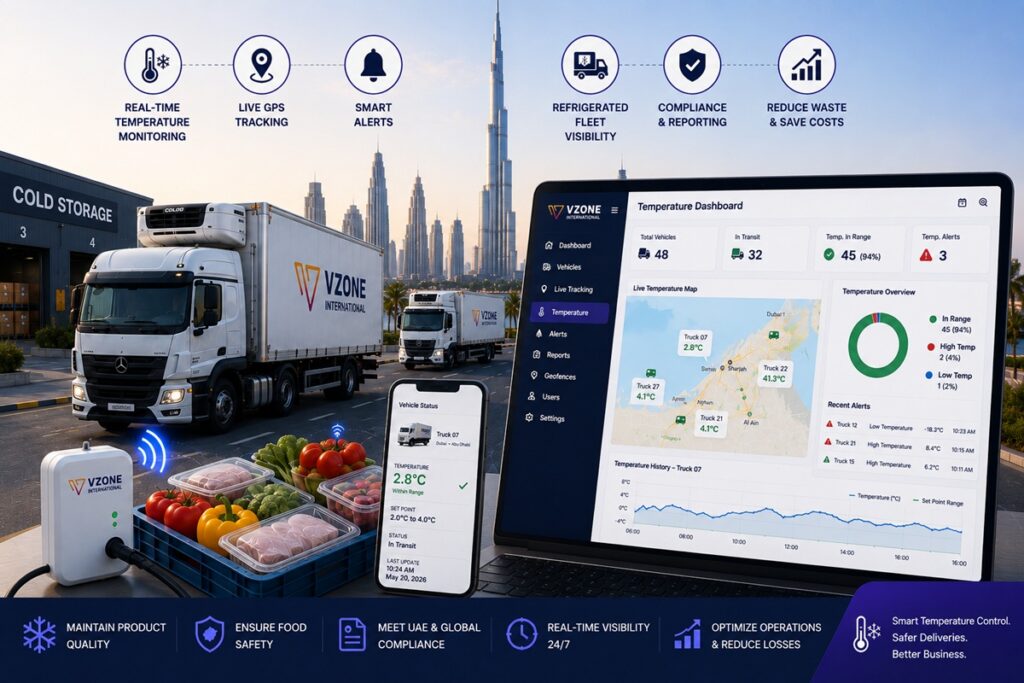
Every refrigerated vehicle in your fleet is running a temperature experiment in real time. Cargo at +4°C in a compartment exposed to 45°C ambient heat during a loading stop, a reefer unit compressor that starts underperforming at kilometre 120 of a 180-kilometre route, a door seal that is not closing fully in a van that has been in service for three years these are the conditions that determine whether your perishable cargo arrives in compliant condition or has to be destroyed.
Fleet temperature monitoring gives operations managers visibility over all of this in real time, across every vehicle in the fleet simultaneously. Not a reading taken at departure and another at arrival. Not a data logger downloaded after the fact. Continuous temperature data, transmitted every few minutes, paired with GPS location so that every reading tells you not just what temperature the cargo is experiencing but where the vehicle is, whether it is moving, and what the likely cause of any deviation is.
This guide covers how fleet temperature monitoring works specifically for refrigerated vehicles in UAE operations, what features a cold storage fleet monitoring system requires, how GPS integration transforms temperature data into operational intelligence, which vehicle types and cargo categories most need real-time monitoring, and what the monitoring record that HACCP and GDP compliance requires actually looks like in practice.
Key Takeaways
- Fleet temperature monitoring is distinct from cold storage facility monitoring: it addresses the dynamic thermal environment of moving vehicles, where reefer unit performance, door events, ambient heat exposure, and route conditions all affect cargo temperature in ways that fixed-facility monitoring does not encounter.
- GPS integration is the feature that converts fleet temperature monitoring from a data recording tool into an operational response tool: knowing the vehicle’s location, speed, and movement status when a temperature alert fires determines whether the cause is a door event, a reefer failure, or route-specific exposure and determines the appropriate operational response.
- Pre-cooling ensuring the vehicle compartment is at temperature before loading begins is the single most impactful procedural measure in UAE fleet cold chain management and is directly verifiable through temperature monitoring data before the departure record shows the vehicle leaving depot.
- Reefer unit health monitoring tracking compressor status, fuel level, return air temperature, and power draw provides early warning of developing mechanical failures before the cargo temperature reflects the problem, enabling preventive intervention on routes where a breakdown would cause significant cargo loss.
- Multi-zone sensor configurations are required for vehicles carrying mixed cargo categories at different temperature setpoints or for large compartments where single-sensor monitoring creates regulatory compliance blind spots in the warmest zones.
- GDP vehicle qualification the documented demonstration that a refrigerated vehicle maintains temperature within specification under defined test conditions is required for pharmaceutical cold chain fleet operations and must be renewed periodically and after significant vehicle modifications.
What Is Fleet Temperature Monitoring?
Fleet temperature monitoring is the continuous measurement and real-time transmission of temperature data from inside refrigerated vehicle compartments during transit. It uses IoT temperature sensors installed in vehicle cargo compartments typically one or more probe sensors connected to or communicating wirelessly with the GPS telematics device installed in the vehicle cab to create a continuous temperature record that is transmitted to a cloud platform and made available to fleet managers and operations teams in real time.
The ‘fleet’ aspect of fleet temperature monitoring distinguishes it from monitoring a single vehicle or a fixed facility: a fleet cold chain monitoring system provides simultaneous visibility over the temperature conditions in every refrigerated vehicle in operation, presented in a unified dashboard that allows operations managers to identify any vehicle with a developing temperature issue across the entire fleet without requiring manual checks or driver reports.
How Fleet Temperature Monitoring Differs from Cold Storage Monitoring
Fleet and facility monitoring share the same foundational technology IoT sensors transmitting to cloud platforms but face fundamentally different operational challenges. Cold storage facility monitoring addresses a fixed environment where the temperature is controlled by a single refrigeration system, the location is known and constant, and connectivity is stable over a fixed internet connection. Fleet temperature monitoring addresses a dynamic environment where the temperature is affected by vehicle movement, ambient heat exposure during stops, door events at multiple delivery points, reefer unit performance under varying load conditions, and cellular connectivity that changes with geographic location.
The operational consequence of this difference is that fleet monitoring requires faster response capability, more contextual alert intelligence (GPS location at the moment of the alert), and more sophisticated reefer unit monitoring to distinguish causes of temperature deviations that the same event signature can produce from different underlying failures. A temperature rise in a cold room is almost always caused by refrigeration failure or door opening. A temperature rise in a vehicle in transit could be caused by a reefer failure, a door event at a delivery stop, ambient heat infiltration at a specific route segment, or a cargo loading configuration that is blocking airflow and the response to each is different.
Cold Storage Fleet Monitoring Vehicle Types and Applications
Refrigerated fleet vehicles span a wide range of vehicle types and cargo applications, each with different temperature requirements, different reefer system configurations, and different monitoring priorities.
| Vehicle Type | Typical Temperature Range | Primary Cargo | Key Monitoring Priority | UAE Compliance Requirement |
| Refrigerated heavy truck (18-tonne+) | +2°C to +8°C / -18°C (frozen) | Large food distribution, pharmaceutical bulk | Reefer health monitoring, multi-zone, GDP vehicle qualification | HACCP (food) / WHO GDP (pharma) |
| Refrigerated light commercial van | +2°C to +8°C | Food retail delivery, catering supply, pharma last-mile | Pre-cooling verification, door-open duration, multi-stop route | HACCP / food safety compliance |
| Multi-temperature truck (chilled + frozen zones) | +2°C to +8°C and -18°C simultaneously | Mixed fresh and frozen food distribution | Independent zone monitoring, cross-zone temperature isolation | HACCP separate CCP documentation per zone |
| Insulated reefer van (urban delivery) | +2°C to +8°C | E-commerce grocery, meal kit delivery, pharmacy | Last-mile urban route temperature, high delivery frequency | FSRA / Dubai Municipality food safety |
| Refrigerated tanker (bulk liquid) | +2°C to +8°C or controlled temp | Liquid food, pharmaceutical bulk liquids | Continuous liquid product temperature, flow monitoring | Food / pharmaceutical depending on product |
| Specialist pharma cold chain vehicle | +2°C to +8°C (strict) | Pharmaceutical distribution, vaccine delivery | GPS-paired temp record, calibrated sensors, GDP vehicle qualification | MOHAP WHO GDP vehicle qualification required |
| Crew transport / specimen collection vehicle | +4°C to +8°C (cool box monitoring) | Medical specimens, blood samples, lab materials | Specimen-level custody record, temperature at collection and delivery | DHA / HAAD chain-of-custody + temperature |
How GPS Integration Transforms Fleet Temperature Data
Temperature data without GPS location context is operationally limited. A temperature alert that says ‘Vehicle 17 compartment temperature has risen to +7.2°C’ requires a follow-up phone call to the driver to establish where the vehicle is, what they are doing, and what might have caused the temperature rise. GPS integration eliminates that follow-up: the alert says ‘Vehicle 17 compartment temperature +7.2°C and rising vehicle stationary at delivery address for 22 minutes, door likely open’. The operations manager can contact the driver with specific guidance rather than a general enquiry.
Reading Temperature Events from GPS-Location Context
Experienced cold chain operations managers know that the cause of a temperature event can often be identified from the pattern of GPS and temperature data together, without any information from the driver. Temperature rising while the vehicle is stationary at a known delivery point during a delivery window: door-open event, most likely. Temperature rising gradually while the vehicle is in continuous motion on a highway route: reefer unit performance degradation, most likely. Temperature rising rapidly while the vehicle is stationary at an unexpected location outside normal delivery zones: breakdown or unauthorised stop with engine off, most likely.
Each pattern has a different response priority and a different operational intervention. The door-open event requires driver contact and expedited delivery completion. The reefer performance degradation requires route re-evaluation and potentially early return to depot for maintenance. The breakdown scenario requires recovery dispatch to the GPS-confirmed location. None of these responses can be calibrated correctly from temperature data alone the GPS context is what makes the intervention specific and proportionate.
Pre-Departure Temperature Verification via Fleet Monitoring
One of the most underutilised capabilities of Fleet temperature monitoring is pre-departure verification confirming that the vehicle compartment has reached the required temperature setpoint before loading begins. In UAE operations, where vehicles may have been parked in exposed depot yards at ambient temperatures of 40°C to 50°C, the reefer unit requires significant run-ahead time to bring the compartment down to operating temperature before cargo is loaded. Standard operations often skip or shorten this pre-cooling period under schedule pressure loading cargo into a compartment that has not yet reached temperature, creating an immediate temperature compliance risk from the first minute of the route.
Fleet temperature monitoring allows depot supervisors to verify pre-cooling completion before authorising loading: the platform shows the compartment temperature in real time, and a loading release can be made conditional on the temperature reaching the required setpoint. This simple procedural step with monitoring data as the enforcement mechanism eliminates one of the most common causes of UAE cold chain failures at its origin rather than detecting it after it has already compromised the cargo.
Reefer Unit Monitoring Beyond Cargo Temperature
The refrigeration unit in a cold chain vehicle is the mechanical foundation of the entire cold chain operation. A reefer unit that fails silently while the vehicle is on a remote UAE route, carrying pharmaceutical cargo worth hundreds of thousands of dirhams, creates a cargo loss scenario that the cargo temperature sensor will not detect until the compartment has already been warming for 30 to 90 minutes, potentially too late for any intervention. Reefer unit health monitoring goes beyond cargo temperature to monitor the mechanical system itself.
Compressor Status and Return Air Temperature
The compressor is the heart of the reefer unit. Monitoring compressor operational status running vs stopped, not just cargo compartment temperature provides earlier failure detection than temperature monitoring alone. A reefer compressor that has stopped due to a thermal overload or mechanical fault may take 45 to 60 minutes to produce a detectable cargo temperature rise, depending on the compartment insulation quality and ambient temperature. A compressor status alert fires within seconds of the compressor stopping.
Return air temperature the temperature of air returning to the reefer unit from the cargo zone, before it is re-cooled is a sensitive indicator of both the reefer unit’s performance and the thermal load it is managing. Return air temperature that is rising faster than the setpoint adjustment can compensate for indicates a developing reefer failure or an unusually high thermal load (cargo loaded warmer than specified, or excessive door-open time). Monitoring return air temperature alongside cargo zone temperature and compressor status provides a three-layer view of reefer unit health.
Reefer Fuel Level Preventing Fuel Exhaustion En Route
Reefer units have their own dedicated fuel tanks, separate from the vehicle’s traction fuel system. A reefer unit that runs out of fuel shuts down completely and the reefer fuel level is invisible to the driver unless they physically check it before departure, which operational pressure often prevents. IoT fuel level sensors for the reefer fuel tank transmitting level readings to the fleet monitoring platform alongside temperature data provide the advance warning that prevents reefer fuel exhaustion from becoming a cargo loss event.
For UAE fleets operating long-haul routes Dubai to Abu Dhabi, or UAE to Saudi Arabia where a reefer fuel exhaustion event would strand the vehicle and cargo on a remote highway in peak summer heat, reefer fuel monitoring is not a convenience feature. It is the operational safeguard that prevents a preventable catastrophic cargo loss from an entirely avoidable cause.
Multi-Zone Fleet Temperature Monitoring
Multi-zone temperature monitoring independent sensors in different areas of a refrigerated compartment is required in two distinct operational contexts: vehicles carrying different cargo categories at different temperature setpoints simultaneously, and large single-temperature compartments where temperature gradients between zones create compliance exposure that single-sensor monitoring misses.
Dual-Temperature Vehicles Chilled and Frozen Zones
Multi-temperature trucks vehicles with a physical partition between a chilled compartment (+2°C to +8°C) and a frozen compartment (-18°C or below) are common in UAE food distribution operations where retailers require simultaneous delivery of fresh and frozen products on the same route. Each zone requires its own independent temperature sensor with its own alert configuration, reporting to the same fleet monitoring platform but generating separate compliance records for each zone.
The compliance documentation requirement for dual-temperature vehicles under HACCP is particularly important: the two zones represent two separate Critical Control Points, each requiring its own continuous temperature record and separate corrective action documentation for any excursion in either zone. A single-sensor monitoring configuration cannot satisfy both HACCP CCP records simultaneously multi-zone monitoring is not optional for dual-temperature vehicle compliance.
Single-Temperature Compartment Zone Gradients
Even in single-temperature compartments, temperature gradients between the area near the evaporator unit (coldest) and the area near the door seal or at the top of the load (warmest) can reach 3°C to 6°C in large refrigerated trucks operating in UAE summer conditions. For pharmaceutical cargo with a +2°C to +8°C range, a 4°C gradient means a sensor at +3°C near the evaporator provides no assurance that cargo near the door seal is below +8°C. A minimum two-sensor configuration one near the evaporator and one at the warmest point identified by observation or temperature survey closes this compliance gap for all pharmaceutical fleet operations.
GDP Vehicle Qualification for Pharmaceutical Fleets
Pharmaceutical fleet operators in UAE must satisfy MOHAP WHO GDP requirements that go beyond temperature monitoring documentation to include vehicle qualification a formal demonstration that the refrigerated vehicle maintains temperature within specification under defined test conditions.
What Vehicle Qualification Involves
GDP vehicle qualification is a structured test process that maps the temperature distribution inside the loaded vehicle under representative operating conditions including summer ambient temperatures, highway driving profiles, and door-open events at delivery stops. The qualification study places multiple calibrated sensors throughout the vehicle compartment and records temperature simultaneously over a defined route and time period, generating a temperature mapping report that demonstrates the vehicle’s temperature performance characteristics.
The qualification document defines: the vehicle’s acceptable operating envelope (the cargo weight, door-open frequency, and ambient temperature conditions under which the vehicle was tested and confirmed compliant); the sensor placement required for routine monitoring (based on the warmest zones identified in the qualification study); and the periodic requalification schedule (typically annually or after any significant vehicle modification such as door seal replacement, refrigeration system overhaul, or compartment insulation repair).
When Requalification Is Required
UAE pharmaceutical fleet operators must perform vehicle requalification when: a vehicle undergoes its annual qualification review; significant maintenance is performed on the refrigeration system, door seals, or compartment insulation; the vehicle is assigned to a significantly different route profile (e.g. from urban last-mile to long-haul cross-border); or after any incident that raises questions about the vehicle’s temperature performance. MOHAP GDP auditors and international pharmaceutical manufacturer auditors examine vehicle qualification records as a standard audit point vehicles without current qualification documentation present a compliance finding regardless of whether the ongoing temperature monitoring records show satisfactory performance.
Fleet Temperature Monitoring for UAE Industry Sectors
Food Distribution HACCP Multi-Stop Compliance
Food distribution fleets making multiple delivery stops per route face the most dynamic temperature management challenge in UAE cold chain logistics. Each delivery stop involves a door-open event that exposes the cargo to ambient heat, a partial unloading that changes the thermal mass and airflow pattern within the compartment, and a restart of reefer unit operation that must stabilise the remaining cargo temperature before the next stop. Fleet temperature monitoring that records temperature continuously throughout these events not just at the start and end of the route creates the HACCP continuous monitoring record that demonstrates compliance through each Critical Control Point event.
Pharmaceutical Last-Mile GDP Documentation at Scale
Pharmaceutical distribution fleets delivering to hospitals, clinics, and pharmacies across UAE face the documentation intensity of GDP compliance at last-mile scale: each delivery creates a trip record that must show calibrated sensor temperature readings, GPS location-stamped throughout the journey, with any alarm events documented and investigated. At 20 to 40 deliveries per vehicle per day, manual documentation is not feasible automated report generation from the monitoring platform is the only operationally sustainable approach. VZone International’s pharmaceutical fleet clients receive GDP-formatted trip reports generated automatically at each delivery completion, available to quality managers within minutes of delivery without any manual data processing.
E-Commerce Grocery Temperature Under Delivery Pressure
UAE e-commerce grocery and quick commerce delivery fleets face a cold chain challenge unique to the sector: compressed delivery windows create delivery frequency and stop density that maximises door-open frequency and minimises route completion time. A vehicle making 25 chilled grocery deliveries in a 4-hour morning window in Dubai will open its compartment door up to 25 times, each time exposing the remaining cargo to ambient heat. Temperature monitoring that tracks the cumulative thermal effect of high door-open frequency allows operations managers to identify routes and vehicle assignments where temperature compliance is consistently marginal enabling operational interventions (route timing, vehicle category, packaging specification) before customer complaints and product returns create commercial damage.
VZone International’s Fleet Temperature Monitoring Solution
VZone International provides GPS-integrated fleet temperature monitoring for UAE refrigerated vehicle fleets IoT sensors, reefer unit health monitoring, multi-zone configurations, GPS-paired temperature records, and automated HACCP and GDP compliance reporting on the Wialon enterprise platform. VZone’s fleet temperature monitoring covers vehicles from pharmaceutical cold chain distribution trucks through e-commerce grocery delivery vans, with hardware specifications appropriate for UAE’s extreme ambient heat conditions and route diversity.
Reefer Unit Integration Compressor, Fuel, and Return Air
VZone deploys reefer unit monitoring alongside cargo temperature sensors tracking compressor operational status, reefer fuel level, and return air temperature in addition to the cargo zone temperature readings. Reefer status alerts and cargo temperature alerts are presented on the same fleet dashboard and transmitted through the same alert channels, giving operations managers a complete view of both cargo condition and equipment health without requiring separate monitoring interfaces.
GDP Vehicle Qualification Support
For pharmaceutical fleet clients requiring GDP vehicle qualification, VZone provides qualification study support deploying temporary multi-sensor configurations for the qualification run, generating the temperature distribution report with identified worst-case zones, configuring permanent monitoring sensor positions based on qualification results, and providing the qualification documentation in the format required by MOHAP audits and pharmaceutical manufacturer GDP reviews. Annual requalification scheduling is managed proactively by VZone’s compliance team, with reminder alerts generated before qualification certificates approach expiry.
Conclusion: Fleet Temperature Monitoring Is the Operational Layer That Makes Cold Chain Compliance Manageable
Cold chain compliance for a UAE refrigerated fleet across pharmaceutical GDP requirements, HACCP food safety standards, and the physical challenges of extreme summer heat is genuinely difficult to manage without real-time visibility. Departure temperature checks and arrival temperature records leave the entire transit period unmonitored, creating a compliance record with gaps that neither regulatory auditors nor pharmaceutical manufacturer GDP reviewers will accept. Manual driver reports create accuracy and completeness risks that compound with fleet size.
Fleet temperature monitoring converts the compliance challenge from a manual documentation task into an automated operational capability: sensors record continuously, GPS integration provides incident context, reefer health monitoring catches equipment failures before they cause cargo loss, and automated reporting generates the HACCP and GDP documentation without manual compilation. The fleet manager’s role shifts from gathering evidence that something happened to intervening to prevent it from happening.
The pre-cooling verification capability alone confirming that compartments are at temperature before loading, rather than discovering on arrival that cargo loaded into an unchilled compartment has been compromised justifies the monitoring investment for many UAE pharmaceutical and premium food distribution operations. Everything else the system provides reefer health monitoring, multi-zone compliance, GDP vehicle qualification support, and automated reporting compounds the return on that foundational investment.
Monitor the temperature in every refrigerated vehicle across your UAE fleet in real time.
VZone International provides GPS-integrated fleet temperature monitoring for UAE food, pharmaceutical, and cold chain logistics operations IoT sensors, reefer unit health monitoring, multi-zone configurations, GPS-paired temperature records, and automated HACCP and GDP compliance reports. Get a free fleet temperature monitoring demo today.
Frequently Asked Questions
Fleet temperature monitoring is the continuous measurement and real-time transmission of temperature data from inside refrigerated vehicle compartments during transit. IoT temperature sensors installed in vehicle cargo compartments transmit readings typically every two to five minutes to a GPS telematics device that pairs each temperature reading with the vehicle's current location. The combined data is transmitted to a cloud monitoring platform that generates real-time alerts, provides a live fleet temperature dashboard for operations managers, and produces automated compliance reports for HACCP and GDP regulatory requirements.
A cold storage fleet monitoring system combines GPS vehicle tracking with IoT temperature sensors to provide simultaneous real-time visibility over the temperature conditions in every refrigerated vehicle in a fleet. When a temperature event occurs compartment temperature approaching an alert threshold the system simultaneously shows the fleet manager where the vehicle is, what the temperature trend is, and whether the vehicle is stationary or moving, enabling identification of the likely cause (door event, reefer failure, or route exposure) and the appropriate operational response. Automated reports generate HACCP or GDP compliance documentation at each trip completion.
GDP vehicle qualification is a documented study demonstrating that a refrigerated vehicle maintains temperature within the required range under defined operating conditions. It is required for pharmaceutical cold chain vehicles under UAE MOHAP WHO GDP guidelines. The study maps temperature distribution inside the vehicle under representative load, route, and ambient conditions, identifies worst-case zones, defines permanent monitoring sensor placement, and creates the qualification document that MOHAP auditors and pharmaceutical manufacturer auditors review. Without current vehicle qualification documentation, a pharmaceutical fleet fails GDP compliance regardless of how good its ongoing temperature monitoring records are.
Pre-cooling is the process of running the vehicle's refrigeration unit before loading begins, to bring the cargo compartment down to the required temperature setpoint before any temperature-sensitive cargo is placed inside. In UAE, where vehicles parked in outdoor depot yards can reach interior temperatures of 50°C to 60°C, loading cargo into an uncomported compartment creates an immediate cold chain compliance risk. Fleet temperature monitoring verifies pre-cooling completion: the platform shows the compartment temperature in real time, and loading can be made conditional on reaching the setpoint, eliminating one of the most common causes of cold chain failure at its source.
The best fleet temperature monitoring system for UAE refrigerated vehicles integrates GPS-paired IoT sensors with reefer unit health monitoring (compressor status, fuel level, return air temperature), multi-zone sensor capability for dual-temperature or large single-compartment vehicles, automated HACCP and GDP compliance report generation, pre-departure temperature verification, and UAE-rated hardware specifications for extreme ambient heat conditions. VZone International provides this complete fleet temperature monitoring solution for UAE food distribution, pharmaceutical delivery, and e-commerce cold chain operations.