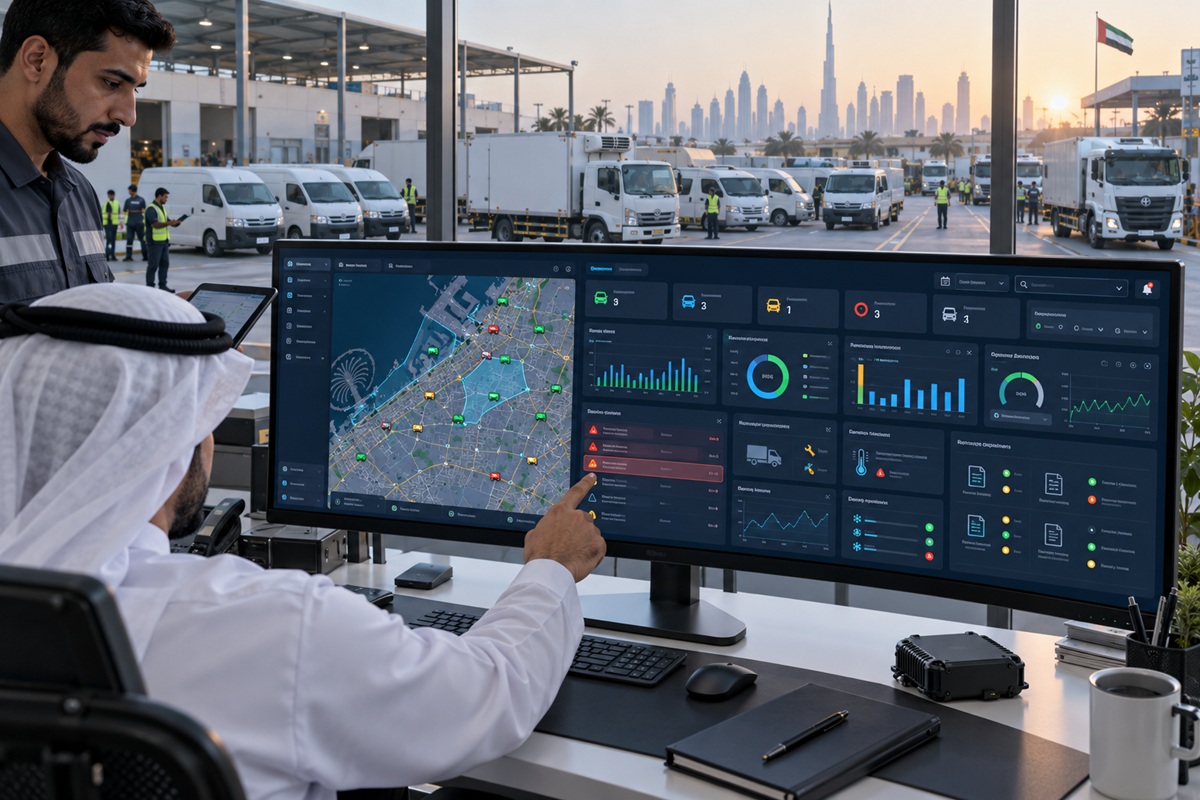
A cold storage facility that loses power at 2am on a Friday night in Dubai’s summer heat faces a race against time. Without a monitoring system, no one knows the temperature is rising until the first person arrives on Monday morning by which point a pharmaceutical refrigerator containing AED 200,000 in vaccines may have been at ambient temperature for more than 60 hours, and every product in it is destroyed. With a monitoring system that has a battery-backed sensor and a 24/7 alert chain configured, the duty manager receives a push notification within minutes of the power failure, a backup generator is activated or a contingency transfer is initiated, and the cargo is saved.
That scenario is not hypothetical. Power outages however brief are among the most common causes of cold storage temperature excursions in UAE pharmaceutical and food facilities. They occur outside business hours, when staffing is minimal and manual checks are not being performed. A cold room temperature monitoring system designed specifically for this environment is the operational infrastructure that converts the power outage from a silent, catastrophic cargo loss into a managed, documented, resolved incident.
This guide covers what cold storage temperature monitoring systems include, the specific facility types and regulatory requirements they address in the UAE, how to configure them correctly for different cold storage applications, and what differentiates a system adequate for basic food compliance from one that meets MOHAP pharmaceutical GDP standards.
Key Takeaways
- Cold storage temperature monitoring systems differ from fleet monitoring systems in their connectivity approach (fixed network rather than cellular), power supply requirements (battery backup mandatory for unattended facilities), and sensor placement methodology (temperature mapping studies define placement for pharmaceutical applications).
- UAE pharmaceutical cold storage facilities must satisfy MOHAP WHO GDP requirements: calibrated monitoring instruments with traceable certificates, documented alarm management with defined response times, and evidence that power failures trigger immediate notifications not just post-event records.
- Power outages are the most common cause of UAE cold storage temperature excursions and the most preventable a monitoring system with battery-backed sensors and an alert chain reaching an on-call contact outside business hours eliminates the silent failure scenario entirely.
- Cold room temperature gradients the difference between the monitored point and the warmest location in the room can be 2°C to 6°C in large walk-in cold rooms, making sensor placement based on temperature mapping studies essential for pharmaceutical compliance applications.
- Freezer temperature monitoring is a distinct application from chilled cold room monitoring: sensors must be rated for temperatures down to -30°C or lower, battery backup life is reduced at freezer temperatures, and defrost cycle filtering is required to prevent normal defrost events from generating false excursion alerts.
- Integrating cold storage facility monitoring with vehicle fleet temperature monitoring on a single platform creates unified supply chain temperature visibility the foundation for end-to-end cold chain documentation that satisfies regulatory and customer audit requirements.
Types of Cold Storage Facilities Requiring Temperature Monitoring
Cold storage temperature monitoring in UAE addresses several distinct facility types, each with different temperature ranges, different regulatory requirements, and different operational monitoring challenges.
| Facility Type | Temperature Range | Primary Use | UAE Regulatory Requirement | Key Monitoring Challenge |
| Pharmaceutical cold room (+2°C to +8°C) | +2°C to +8°C | Vaccine and cold-chain medicine storage | MOHAP WHO GDP calibrated instruments, alarm management, temperature mapping | Calibration management, power outage response, GDP audit trail |
| Chilled food cold room | 0°C to +5°C | Fresh produce, dairy, meat storage | FSRA / Dubai Municipality HACCP | Door frequency monitoring, defrost cycle management, compliance logging |
| Walk-in freezer | -18°C to -25°C | Frozen food storage, ice cream | FSRA / Dubai Municipality food safety | Defrost cycle filtering, battery performance at low temp, rapid recovery monitoring |
| Deep freeze / blast freezer | -30°C and below | Long-term frozen storage, IQF products | FSRA / food safety regulations | Sensor rated for extreme low temp, extended recovery time monitoring |
| Pharmacy refrigerator (small) | +2°C to +8°C | Hospital / retail pharmacy medicine storage | DHA / HAAD / MOHAP | Compact space, door access frequency, compliance reporting per unit |
| Laboratory specimen storage | +4°C to +8°C (most) / -20°C (frozen) | Pathology, blood, diagnostic samples | DHA / HAAD lab standards | Chain of custody integration, calibrated monitoring, power backup |
| Controlled temperature warehouse zone | +15°C to +25°C | Ambient pharmaceutical, cosmetics, certain food | MOHAP (pharma) / food regulations | Ambient vs outside temperature differential, seasonal variation management |
| Distribution centre cold dock | +2°C to +8°C (product temp) | Cross-docking and staging for refrigerated cargo | FSRA / Dubai Municipality HACCP | High door frequency, brief staging periods, cargo transfer temperature |
How Cold Room and Freezer Temperature Monitoring Systems Work
Wireless IoT Sensors Fixed Installation in Cold Storage
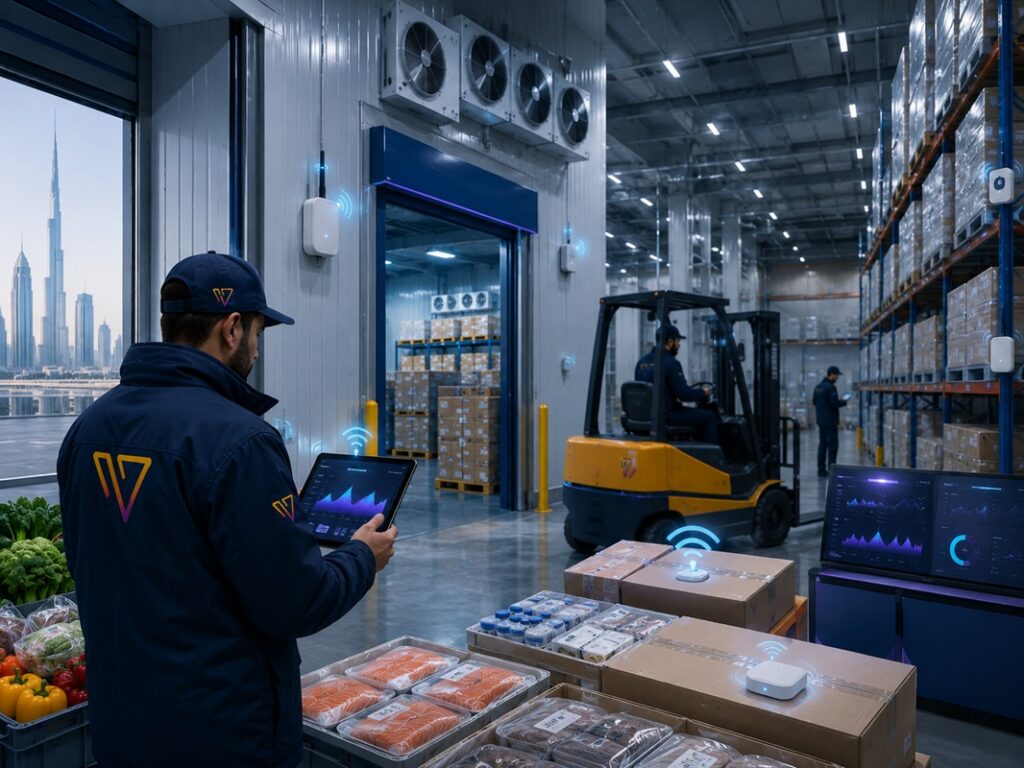
Cold room temperature monitoring uses wireless IoT sensors installed at defined positions within the cold storage space transmitting readings via Bluetooth, Wi-Fi, or a sub-GHz wireless protocol to a gateway device installed outside the cold room (protecting the gateway from the cold environment while maintaining wireless range through the insulated walls). The gateway connects to the facility’s internet infrastructure and transmits the temperature data to the cloud monitoring platform.
Sensor selection for cold room and freezer applications must account for the operating temperature range. Standard commercial IoT sensors are often rated to -20°C minimum adequate for standard freezers but insufficient for blast freezers or ultra-low temperature storage. Sensors for pharmaceutical cold rooms must carry calibration certificates with accuracy demonstrated at the monitored temperature range, not just at ambient temperature.
Battery life is a specific operational concern for cold storage sensor deployment. Lithium batteries standard in most IoT sensors perform reasonably well in chilled environments but lose capacity progressively in freezer temperatures: a sensor with a 2-year battery life rating at ambient temperature may achieve only 12 to 18 months in a -20°C environment. Battery performance data at the actual operating temperature, not just the rated shelf life at ambient conditions, is essential information for planning sensor maintenance cycles.
Alert Types Temperature, Power, Door, and Humidity
A comprehensive cold storage monitoring system provides four distinct alert categories, each addressing a different cause of temperature compromise:
- Temperature threshold alerts: fires when the measured temperature approaches or exceeds the configured safe range limit. Two-tier configuration pre-alert at 80 to 90 percent of the allowable range, confirmed excursion at the regulatory limit provides an intervention window before compliance is lost.
- Power failure alerts: fires when the sensor detects loss of mains power to the cold storage unit. This is the most critical alert type for unattended overnight and weekend operations and it must be transmitted via a communication channel that does not depend on the facility’s mains-powered internet connection. Battery-backed sensors with cellular SIM capability maintain communication during power failures; sensors that rely solely on Wi-Fi go silent when the router loses power.
- Door open duration alerts: fires when a door remains open beyond a configured duration threshold. In cold storage distribution operations, extended door-open periods during loading and unloading are a primary cause of temperature excursions monitoring door state provides the visibility to flag problematic loading practices before they create compliance events.
- Humidity threshold alerts: relevant for cold storage facilities handling cargo sensitive to moisture pharmaceutical raw materials, certain electronics components, and some food categories. High humidity in a cold room creates condensation risk when products are moved to ambient environments; low humidity can cause product desiccation in long-term storage. Combined temperature and humidity monitoring provides the complete environmental picture for humidity-sensitive cargo.
Battery Backup Why It Is Non-Negotiable for UAE Cold Storage
The most operationally critical feature of a UAE cold storage monitoring system is battery-backed operation that maintains both sensor measurement and alert transmission during power failures. In UAE, power interruptions however brief are among the most common triggers of cold storage excursions. DEWA and ADDC supply reliability in urban areas is generally good, but voltage fluctuations, distribution network maintenance, and occasional transformer failures create brief or extended outages that are sufficient to trigger temperature rises in pharmaceutical cold storage before staff are aware.
A cold storage sensor without battery backup goes silent during a power failure. It records no readings, transmits no alerts, and provides no documentation of what happened during the outage. From a GDP pharmaceutical audit perspective, a gap in the temperature record corresponds to a monitoring failure even if the temperature never actually left the acceptable range during the outage. Battery-backed sensors with cellular SIM communication maintain continuous monitoring and alerting during power failures, creating an unbroken record regardless of what happens to the facility’s electrical supply.
For pharmaceutical cold storage facilities subject to MOHAP GDP requirements, battery backup is not optional GDP alarm management documentation requirements specify that monitoring systems must generate alarms for power failures, and an alarm that requires mains power to be transmitted cannot satisfy this requirement. VZone International deploys cold storage sensors with minimum 72-hour battery backup and cellular SIM fallback communication for all pharmaceutical facility applications.
Temperature Mapping for Pharmaceutical Cold Storage
Temperature mapping is the study that defines how temperature is distributed throughout a cold storage space under representative operating conditions and it is a mandatory GDP requirement for pharmaceutical cold storage facilities in UAE. The study identifies the warmest and coldest zones within the storage space, confirms that all areas remain within the acceptable temperature range under normal operating conditions, and defines the number and placement of monitoring sensors required to demonstrate adequate coverage.
Why Temperature Mapping Matters Room Gradients
Cold rooms are not uniform temperature environments. The area near the cooling unit is the coldest point; areas near the door, near the ceiling, and furthest from the air supply are typically the warmest. In a standard pharmaceutical cold room, the temperature differential between the coldest and warmest zones can be 2°C to 4°C under normal operating conditions and up to 6°C during door-open periods or high-ambient-temperature exposure through the door.
For pharmaceutical cold storage where the acceptable range is +2°C to +8°C, a 4°C room gradient means that a sensor placed at the coldest point recording +3°C provides no assurance that the warmest zone is below +8°C. Without temperature mapping to define where the warmest zone is and confirm that sensor placement covers it, the monitoring record cannot demonstrate that all stored product was within the acceptable range regardless of what the sensor data shows.
Temperature mapping studies are typically conducted before a pharmaceutical cold room is placed into service, after any structural modification, after major equipment replacement, and at defined periodic intervals (usually annually). The study involves placing multiple calibrated sensors throughout the room and recording temperature simultaneously over a defined period at minimum 24 hours under representative loading conditions. The mapping report identifies the worst-case locations and defines the permanent monitoring sensor placement based on the study results.
GDP Cold Storage Requirements in UAE MOHAP Standards
MOHAP’s pharmaceutical cold storage requirements, aligned with WHO GDP guidelines, specify the following for temperature monitoring systems: monitoring instruments must have current calibration certificates traceable to national or international measurement standards; sensors must be placed at defined positions determined by a temperature mapping study; alarm thresholds must be configured with defined response time requirements typically 30 minutes from alarm activation to investigation; alarm events must be documented with the investigation findings and corrective actions taken; and evidence of management review must demonstrate that alarm data drives corrective action, not just creates a record.
The documentation requirements are as important as the hardware requirements. A pharmaceutical cold storage facility can have perfectly calibrated sensors correctly placed according to a mapping study, and still fail a GDP audit if the alarm management documentation is incomplete if alarm events were not investigated and documented, if response times exceeded the specified limit, or if management review records do not demonstrate that the monitoring data drove corrective action. VZone International provides a complete pharmaceutical cold storage monitoring solution that addresses both the hardware and documentation requirements, with automated alarm event logs and management review report generation built into the platform.
Freezer Temperature Monitoring Specific Considerations
Freezer temperature monitoring introduces operational challenges that chilled cold room monitoring does not face primarily around defrost cycles, battery performance at low temperatures, and the sensor specifications required for deep freeze applications.
Defrost Cycle Filtering Avoiding False Alarms
Most commercial freezers run automated defrost cycles periods where the cooling compressor temporarily stops and heating elements activate to melt ice accumulation on the evaporator coils. During a defrost cycle, the air temperature near the evaporator can rise significantly potentially triggering temperature alerts that are not indicative of any actual product safety risk. Freezer monitoring systems without defrost cycle awareness generate false alarms at every defrost cycle, which at typical defrost frequencies of two to four cycles per day creates alert fatigue that can result in real excursion alerts being ignored or dismissed.
Effective freezer monitoring systems handle defrost cycles through one of two approaches: scheduled defrost suppression (alerts are suppressed during known defrost periods, with the suppression window documented in the compliance record) or algorithmic defrost detection (the system identifies defrost cycle patterns from the temperature trend signature and differentiates them from genuine excursions). The latter is more operationally robust for facilities where defrost timing varies, but requires a monitoring platform with the analytical capability to apply this distinction reliably.
Blast Freezer and Ultra-Low Temperature Monitoring
Blast freezers operating at -30°C to -40°C and ultra-low temperature freezers at -70°C or below for specific pharmaceutical and research applications require sensor specifications well beyond standard commercial IoT devices. Sensors must be rated for the operating temperature range with accuracy maintained at those extremes, battery chemistry must be appropriate for extreme cold (standard lithium batteries fail rapidly below -20°C), and wireless communication performance must be verified at low temperatures where signal characteristics change.
For UAE pharmaceutical and healthcare facilities operating ultra-low temperature storage for vaccines or research samples, the sensor specification review must include actual operating temperature performance data from the manufacturer not just the product’s lower operating limit rating. A sensor rated to -70°C that loses Bluetooth connectivity below -50°C is unsuitable for blast freezer applications where uninterrupted monitoring is a compliance requirement.
UAE Regulatory Requirements for Cold Storage Monitoring
Cold storage temperature monitoring in UAE is regulated differently depending on the facility type and emirate of operation. The following requirements apply to the most common cold storage facility categories in UAE.
| Regulatory Requirement | Applicable Facility | Key Specification | Documentation Required |
| MOHAP WHO GDP pharmaceutical cold storage | Pharmaceutical warehouses, hospital pharmacies, clinical labs | Calibrated instruments, temperature mapping, alarm management, management review | GDP audit trail, calibration certs, alarm event logs, management review records |
| FSRA Abu Dhabi food cold storage | Food warehouses, distribution centres, retail cold rooms (Abu Dhabi) | HACCP CCP temperature monitoring, continuous records | Electronic temperature logs, HACCP CCP documentation |
| Dubai Municipality food cold storage | Food warehouses, distribution, catering cold rooms (Dubai) | Food safety management system including storage temperature | Temperature records available for inspection; electronic preferred |
| DHA/HAAD healthcare facility cold storage | Hospital pharmacies, clinical labs, blood storage | Aligned with MOHAP GDP for pharmaceutical; clinical standards for specimens | Chain of custody + temperature records + calibration evidence |
| KHDA/ADEK school cold storage | School kitchens, canteen cold rooms | Dubai Municipality / Abu Dhabi food safety standards as applicable | Basic temperature records; inspection ready |
Common Cold Storage Monitoring Failures and How to Prevent Them
Failure 1 Sensors Without Battery Backup Going Silent at Night
The most costly cold storage monitoring failure in UAE facilities is the sensor that goes offline when mains power fails creating a silent temperature rise that goes undetected until the following morning. Prevention requires battery-backed sensors with cellular SIM communication that operates independently of the facility’s power supply. Any monitoring system that relies exclusively on Wi-Fi for sensor communication cannot alert during a power failure, because the router is on the same electrical circuit as the equipment it is supposed to be monitoring.
Failure 2 Single-Sensor Coverage Missing Warm Zones
A single sensor in a large cold room records the temperature at one point typically where it was conveniently installed rather than where the mapping study indicated the warmest zone is. Product stored in an unmonitored warm zone may be outside the acceptable temperature range for hours or days while the monitored sensor reads within specification. Prevention requires temperature mapping studies before sensor placement and multi-sensor configurations that cover both the coolest and warmest monitored zones.
Failure 3 Alert Routing to an Unavailable Contact
A monitoring system that sends excursion alerts exclusively to email addresses that are not monitored outside business hours provides no after-hours response capability. Prevention requires alert routing to mobile push notifications and SMS as primary channels for after-hours alerts, with an on-call escalation chain that reaches a person with authority and capability to respond not just a notification queue reviewed the next morning.
Failure 4 Expired Calibration Certificates
For pharmaceutical cold storage under GDP requirements, a monitoring sensor whose calibration certificate has expired is a non-compliance finding even if the sensor is functioning correctly and the temperature record shows no excursions. The monitoring record produced by an uncalibrated instrument cannot be used for GDP compliance documentation. Prevention requires automated calibration expiry tracking with advance notification, and a supplier relationship that provides pre-calibrated replacement sensors so there is no gap in the calibrated monitoring record during sensor changeover.
Failure 5 No Integration with Fleet Monitoring
A cold storage facility monitoring system that operates entirely separately from the vehicle fleet temperature monitoring system creates a documentation gap at the most commercially critical point: the transfer between storage and transport. When product leaves the cold room and is loaded onto a vehicle, there is typically a 10 to 30 minute window of transition product staged at ambient dock temperature or in a brief holding area that neither the facility system nor the vehicle system covers, because the former ends when the product leaves the cold room and the latter begins when the vehicle departs. Integration of facility and fleet monitoring on a unified platform with GPS-linked timestamps at loading events bridges this gap.
VZone International’s Cold Storage Monitoring Solution
VZone International provides cold storage temperature monitoring for UAE pharmaceutical facilities, food warehouses, distribution centres, and healthcare cold storage deploying wireless IoT sensors with battery backup and cellular SIM fallback, integrated into the Wialon enterprise platform alongside fleet vehicle monitoring for unified cold chain visibility from cold room to delivery.
Hardware Specifications for UAE Facility Monitoring
VZone’s facility sensors are rated for cold room (+2°C to +8°C), standard freezer (-18°C to -25°C), and blast freezer applications (-30°C and below) with operating temperature accuracy maintained across the monitored range. All pharmaceutical facility deployments use sensors with calibration certificates traceable to UAE national metrology standards. Battery backup provides a minimum of 72 hours of continuous operation during power failures, with cellular SIM communication maintained independently of facility Wi-Fi infrastructure.
Temperature Mapping Support for Pharmaceutical Applications
For pharmaceutical cold storage facilities requiring GDP temperature mapping studies, VZone provides mapping study support deploying temporary multi-sensor configurations for the mapping period, generating the temperature distribution report that defines permanent sensor placement, and installing the final sensor configuration at the positions specified by the mapping results. The mapping study report and sensor placement documentation are provided as GDP qualification records for inclusion in the facility’s validation documentation.
Unified Fleet and Facility Platform
VZone’s cold storage monitoring integrates with the fleet vehicle temperature monitoring on the Wialon platform giving quality managers and operations teams a single dashboard showing cold room temperatures, vehicle compartment temperatures, and the complete temperature record from storage through transit to delivery on the same interface. This unified view eliminates the documentation gap between facility and fleet monitoring and provides the end-to-end cold chain temperature record that pharmaceutical manufacturer GDP audits and major food retailer supply chain audits increasingly require.
Conclusion: Cold Storage Monitoring Must Be Designed for the Failure Scenarios It Prevents
An effective cold storage temperature monitoring system for UAE facilities is not designed for the scenarios that occur during normal business hours when staff are present and refrigeration systems are functioning. It is designed for the Friday night power failure, the defrost cycle that triggers at 3am, the door left open after a Saturday loading run, and the sensor placement that misses the warm zone where product accumulates at the end of the storage cycle. These are the scenarios that create the most costly cold storage excursions and they are precisely the ones that standard monitoring systems without battery backup, defrost cycle filtering, and multi-zone coverage fail to address.
For UAE pharmaceutical facilities subject to MOHAP GDP requirements, the bar is higher still: the monitoring system must not only prevent excursions but produce the documentation that proves compliance throughout every storage period, including during any abnormal events. Temperature mapping defining sensor placement, calibration certificates for every instrument, alarm event logs with documented response times, and management review records demonstrating that the data drives corrective action these documentation requirements exist because the consequences of pharmaceutical cold chain failure extend beyond financial loss to patient safety risk.
Cold storage monitoring that satisfies all of these requirements is not technically complex, but it requires hardware specification appropriate for UAE conditions, configuration calibrated for the specific facility type and regulatory framework, and a platform that generates the documentation without requiring the manual compilation overhead that makes rigorous cold storage compliance unsustainable at scale.
Protect your cold rooms, freezers, and pharmaceutical refrigerators 24/7.
VZone International provides cold storage temperature monitoring for UAE pharmaceutical facilities, food warehouses, and healthcare cold storage battery-backed sensors with cellular fallback, temperature mapping support, GDP compliance documentation, and unified fleet and facility monitoring on a single platform. Get a free cold storage monitoring assessment today.
Frequently Asked Questions
A cold storage temperature monitoring system uses wireless IoT sensors installed inside cold rooms, walk-in freezers, and pharmaceutical refrigerators to continuously record and transmit temperature readings to a cloud monitoring platform. It generates real-time alerts when temperature approaches or exceeds safe limits including during power failures, if battery-backed sensors with cellular communication are deployed and produces automated compliance records for regulatory requirements including FSRA, Dubai Municipality, and MOHAP GDP pharmaceutical standards.
Required temperatures vary by facility type and cargo. Pharmaceutical cold rooms must maintain +2°C to +8°C under MOHAP WHO GDP requirements. Chilled food cold rooms for fresh produce and dairy require 0°C to +5°C under FSRA and Dubai Municipality food safety standards. Standard freezers must maintain -18°C and below for frozen food. Walk-in freezers for deep frozen storage operate at -25°C or lower. Controlled temperature pharmaceutical warehouse zones require +15°C to +25°C. Monitoring systems must be configured to the specific limits for each facility type rather than a generic setting.
Wireless IoT sensors installed at defined positions within the cold room measure temperature every one to five minutes and transmit readings via Bluetooth or cellular to a gateway device connected to a cloud monitoring platform. The platform evaluates each reading against configured alert thresholds a pre-alert at 80 to 90 percent of the allowable limit and a confirmed excursion alert at the regulatory threshold and sends notifications via push notification, SMS, or email to configured alert recipients. Automated compliance reports are generated for HACCP or GDP documentation purposes without manual data extraction.
Pharmaceutical cold storage monitoring under UAE MOHAP WHO GDP requirements involves: conducting a temperature mapping study to identify the warmest and coldest zones and define sensor placement; installing calibrated sensors with traceable certification at mapping-defined positions; configuring alarm management with defined response time requirements; maintaining battery-backed monitoring with cellular communication for power failure continuity; documenting all alarm events with investigation findings; and maintaining management review records. VZone International provides complete pharmaceutical cold storage monitoring support including mapping study services, calibration management, and GDP-formatted compliance documentation.
The most common causes of cold storage temperature excursions in UAE are: power failures, particularly overnight and during public holidays when cooling systems stop and no one is present to respond; extended door-open periods during loading and unloading at distribution facilities; refrigeration equipment failure (compressor faults, refrigerant leaks); high ambient heat infiltration from the door during UAE summer conditions when the temperature differential between the cold room and the outside is 50°C or more; and sensor placement in cooler zones that miss temperature rises in the room's warm zones. Battery-backed monitoring with door sensors and multi-zone coverage addresses all five causes.