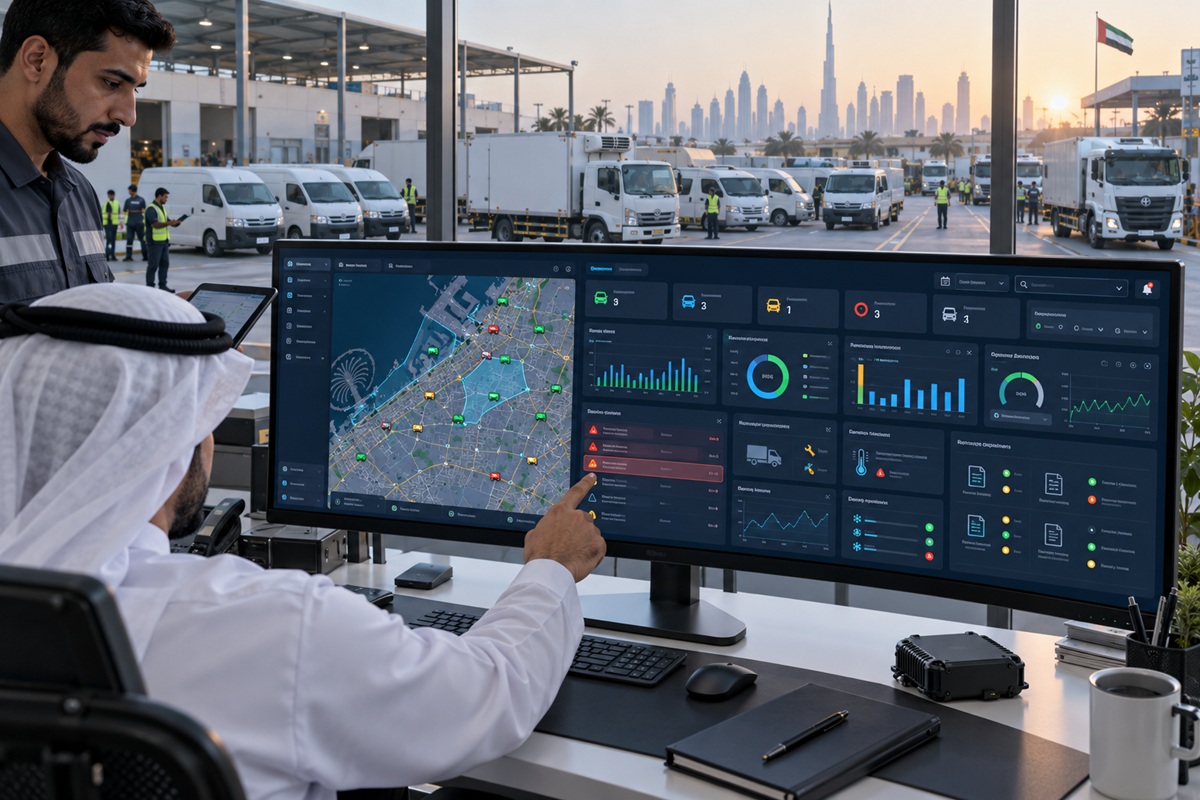
The UAE handles more temperature-sensitive cargo per capita than almost any market in the world. As a net importer of food and a regional hub for pharmaceutical distribution, the country’s cold chain infrastructure handles billions of dirhams in perishable value every single day from Jebel Ali’s reefer container terminals to the last-metre handover at a hospital pharmacy or a supermarket loading dock. And in a country where summer ambient temperatures regularly exceed 45°C, the margin between a functioning cold chain and a catastrophic temperature failure is measured in minutes, not hours.
For fleet managers responsible for refrigerated vehicles, cold chain compliance is no longer a back-office quality management concern. It is a daily operational discipline: pre-cooling vehicles before loading, monitoring compartment temperatures in real time throughout each route, responding to reefer unit alerts before excursions become compliance events, and generating the automated documentation that MOHAP, the FSRA, and Dubai Municipality increasingly require as proof of temperature-controlled handling throughout the supply chain.
This guide covers the complete cold chain logistics picture for UAE fleet managers in 2026 from temperature requirements by cargo category, through monitoring technology, to the regulatory frameworks that govern compliance, the operational failures that most frequently cause cold chain breakdowns, and the implementation steps that convert a reactive cold chain operation into a proactive one.
Key Takeaways
- Cold chain logistics in UAE is governed by multiple regulatory authorities MOHAP for pharmaceuticals, FSRA and Dubai Municipality for food each with distinct temperature documentation requirements that fleet operators must satisfy simultaneously.
- UAE’s extreme heat creates cold chain challenges that are more severe than in any comparable logistics market: a compartment at +4°C can rise above the maximum safe temperature in under 15 minutes of door-open exposure at 45°C ambient making real-time monitoring and pre-alert configurations operationally critical, not optional.
- The five most common causes of UAE cold chain failure loading dock exposure, reefer unit failure, last-mile handover gaps, single-sensor blind spots, and manual documentation gaps are all addressable with GPS-integrated IoT monitoring.
- Cold chain tracking and monitoring requires integration of GPS location data with IoT temperature sensors location alone is insufficient, and temperature data alone lacks the operational context to enable effective incident response.
- Automated compliance documentation HACCP-compatible reports for food, GDP-formatted audit trails for pharmaceuticals is no longer a manual compilation task; enterprise cold chain platforms generate it automatically at trip completion.
- The ROI on cold chain monitoring technology is primarily calculated through cargo loss prevention, regulatory fine avoidance, and client contract retention not cost savings alone.
What Is Cold Chain Logistics?
Cold chain logistics is the end-to-end management of temperature-sensitive goods through a supply chain that maintains controlled temperature conditions at every stage from production or import through storage, transportation, distribution, and final delivery. The ‘chain’ is the critical concept: temperature integrity is only as reliable as the weakest link in the sequence, and a product that was perfectly maintained throughout primary transport can be rendered unsafe or non-compliant by a single unmonitored loading dock exposure or a last-mile vehicle with inadequate refrigeration.
In the UAE context, cold chain logistics covers an unusually broad range of cargo categories pharmaceutical products and vaccines, fresh produce and chilled dairy, frozen foods, healthcare specimens and biologics, temperature-sensitive chemicals, and premium packaged goods all handled by a logistics market that is simultaneously the regional hub for GCC import distribution and one of the most demanding operating environments for refrigerated transport anywhere in the world.
Cold Chain Tracking and Monitoring What These Terms Mean
Cold chain tracking and cold chain monitoring are often used interchangeably but describe distinct capabilities. Cold chain tracking is the location dimension: knowing where temperature-sensitive cargo is at every point in its journey which vehicle, which depot, which cross-dock zone, which delivery address. Cold chain monitoring is the condition dimension: knowing what temperature the cargo has been experiencing at every point in its journey.
Both are necessary, and the operational value of combining them in a single integrated system GPS location paired with IoT temperature data in real time is greater than either capability alone. When a temperature excursion alert fires, knowing the vehicle’s exact GPS location, speed, and route context transforms the alert from a notification that something has gone wrong into actionable intelligence about what can be done about it. A temperature rising in a moving vehicle on a highway suggests a reefer failure; the same temperature rise while the vehicle is stationary at a delivery point suggests a door-open event. Different problems, different responses, different urgency all distinguishable only when location and temperature data are integrated.
The Cold Chain in UAE Scale and Significance
UAE imports approximately 90 percent of its food supply one of the highest import-dependency ratios in the world. Jebel Ali Port handles millions of container movements per year, a significant proportion of which are reefer containers carrying temperature-sensitive cargo destined for UAE consumption or GCC transhipment. The pharmaceutical distribution sector supplies hospitals, pharmacies, and clinics across all seven emirates from central distribution operations predominantly located in Dubai and Abu Dhabi industrial zones. The healthcare logistics sector delivers medical specimens between hospitals, clinics, and central laboratories on daily collection routes that must maintain chain-of-custody and temperature integrity simultaneously.
The scale of UAE cold chain logistics means that even small improvement rates in temperature compliance translate into significant financial and public health value. A one percent reduction in cargo loss across the UAE food cold chain represents hundreds of millions of dirhams in preserved product value annually. A measurable improvement in pharmaceutical cold chain compliance reduces the risk of compromised medicines reaching patients an outcome with public health implications that go beyond financial metrics.
Temperature Requirements by Cargo Category
Understanding the specific temperature requirements for different cargo categories is the foundation of cold chain fleet management. Different categories have different requirements, different regulatory frameworks, and different consequences for temperature excursion and a fleet management platform must be configured to the specific limits for each cargo type rather than applying a single generic setting across all refrigerated vehicles.
| Cargo Category | Required Temperature Range | Primary UAE Regulator | Consequence of Excursion | Documentation Standard |
| Fresh fruits and vegetables | +2°C to +8°C | FSRA (Abu Dhabi) / Dubai Municipality | Product spoilage, regulatory seizure | HACCP temperature log electronic preferred |
| Chilled dairy and meat | 0°C to +5°C | FSRA / Dubai Municipality Food Safety | Microbial risk, product recall, licence risk | HACCP CCP temperature record |
| Frozen food and ice cream | -18°C and below | FSRA / Dubai Municipality | Defrost, product recall, regulatory fine | Temperature log covering full supply chain |
| Pharmaceutical cold chain (medicines) | +2°C to +8°C | MOHAP / DHA / HAAD | Product recall, patient safety risk | WHO GDP audit trail + calibration records |
| Vaccines and biologics | +2°C to +8°C (strict) | MOHAP / Ministry of Health | Batch destruction, regulatory investigation | WHO GDP + chain of custody |
| Ambient pharmaceutical (controlled) | +15°C to +25°C | MOHAP | Product degradation, non-conformance | Temperature monitoring record + GDP compliance |
| Medical specimens (pathology) | +4°C to +8°C (most types) | DHA / HAAD / MOHAP | Sample invalidity, repeat collection | Chain of custody + calibrated temperature log |
| Catering supply (hospitality) | +2°C to +8°C (chilled) / -18°C (frozen) | Dubai Municipality / ADCD | Contract cancellation, food safety finding | Delivery temperature record |
| Temperature-sensitive chemicals | Manufacturer-specified | Environment Agency UAE | Safety risk, degradation, regulatory action | Supplier specification + transport record |
| Premium food (luxury retail) | +2°C to +8°C | FSRA / Dubai Municipality | Quality degradation, customer returns | Delivery temperature record |
Why UAE-Specific Temperature Thresholds Matter
Standard cold chain temperature specifications were developed for logistics environments significantly cooler than the UAE. A +8°C upper limit for fresh produce was calibrated against European warehousing and transport environments where ambient temperatures rarely exceed 30°C. In a UAE summer environment where a loading dock can reach 47°C and a vehicle interior parked in direct sun reaches 75°C within 20 minutes of engine shutdown, the thermal pressure on every link in the cold chain is substantially greater than the standard specifications account for.
Fleet managers operating cold chain logistics in UAE need to apply more conservative operational thresholds than the regulatory minimum in some cases particularly for pharmaceutical cargo where the +2°C to +8°C range provides very limited margin against UAE thermal stress and to configure pre-alert thresholds in their monitoring systems at 80 to 85 percent of the allowable range to create an intervention window before a compliance event occurs.
How Cold Chain Monitoring Technology Works
Cold chain monitoring technology has three functional layers that together create the real-time visibility and automated documentation capability that effective cold chain management requires. Each layer is necessary; none is sufficient alone.
Layer 1 IoT Temperature Sensors
IoT temperature sensors are probe devices installed inside refrigerated vehicle compartments, cold storage rooms, or cargo containers. They measure temperature at configured intervals typically every one to five minutes for active monitoring and transmit readings via wired connection, Bluetooth, or cellular to the GPS telematics device or a dedicated IoT gateway. Multi-probe configurations place sensors at multiple points within a compartment typically near the evaporator unit (coldest point) and near the door seal (warmest point) to detect temperature gradients that single-point monitoring misses.
Sensor accuracy and calibration are critical quality attributes, particularly for pharmaceutical applications. Sensors must demonstrate measurement accuracy of ±0.3°C to ±0.5°C across the monitored range, must carry current calibration certificates traceable to national metrology standards, and must be recalibrated at defined intervals. For food cold chain monitoring, calibration requirements are less formally specified, but electronic sensor accuracy remains the foundation of trustworthy compliance records.
Layer 2 GPS Integration
GPS integration pairs every temperature reading with the vehicle’s real-time geographic coordinates, speed, and engine status. This pairing is what transforms temperature data from a passive record into actionable operational intelligence. When a temperature alert fires, the simultaneous availability of GPS location tells the operations manager whether the vehicle is moving (reefer failure more likely), stationary at a delivery point (door-open event more likely), or stationary in an unexpected location (breakdown or unauthorised stop). Each scenario requires a different response with different urgency.
The GPS integration also creates the location-stamped temperature record that regulatory documentation requires. MOHAP GDP audits for pharmaceutical distribution specifically require that temperature records show the vehicle’s location at each monitoring point confirming that the monitoring covered the full journey, including any stops, rather than just recording start and end temperatures. This location-specific documentation is only possible through GPS integration with the temperature sensor data stream.
Layer 3 Cloud Platform and Automated Reporting
The cloud platform receives, stores, and processes the combined GPS-temperature data stream in real time. Alert configurations define the thresholds that trigger notifications pre-alerts at 80 to 85 percent of the allowable range for early intervention, confirmed excursion alerts when the regulatory threshold is crossed. Alert routing sends notifications to the right people at the right time: dispatch supervisors for immediate vehicle intervention, quality managers for GDP excursion documentation, customers for proactive delivery status communication.
Automated compliance reporting generates the documentation that regulators and customers require, without manual data extraction or compilation. HACCP-compatible temperature journey reports for food distribution, GDP-formatted audit trails for pharmaceutical delivery, and chain-of-custody records for specimen transport are all generated automatically from the platform data at trip completion available to quality teams within minutes of delivery without requiring analyst time to produce.
The Five Most Common Causes of Cold Chain Failure in UAE
Understanding the specific operational scenarios that most frequently cause cold chain failures in UAE logistics is more useful than generic best-practice lists. These five failure patterns account for the majority of temperature excursion events in UAE refrigerated fleet operations and they are all preventable with the right monitoring configuration and operational procedures.
1. Loading Dock Exposure The Highest-Risk Window
The loading and unloading phase is consistently the highest-risk period in UAE cold chain transport. Refrigerated compartment doors are open, the compartment is exposed to ambient temperature, and at 45°C ambient in summer, a compartment at +4°C can rise above +8°C in under 15 minutes of door-open time. In standard UAE commercial logistics operations, loading and unloading often takes 20 to 45 minutes per stop significantly exceeding the safe exposure window for pharmaceutical and chilled food cargo.
Effective mitigation requires both monitoring (door-open duration alerts that trigger when door-open time exceeds a defined threshold) and procedural standards (pre-cooling requirements, minimum dock temperature specifications for pharmaceutical loading facilities, training on minimising door-open time). Monitoring alone creates awareness; procedure creates prevention.
2. Reefer Unit Failures Silent and Fast
Reefer unit mechanical failures compressor faults, refrigerant leaks, fuel exhaustion in the reefer’s dedicated tank create temperature excursions that begin silently and accelerate as the thermal mass of the cargo depletes. A reefer unit that fails at 8am on a summer highway route may not produce a temperature alert until 9am, by which point the cargo has been experiencing rising temperatures for an hour without any operational awareness.
Reefer unit health monitoring tracking compressor status, reefer fuel level, return air temperature, and power consumption trends provides the earliest possible warning of developing mechanical issues. A compressor that is running but underperforming shows a characteristic temperature trend: the compartment temperature drifts upward slowly rather than dropping sharply as in a complete failure. Trend-based alerting that fires when the compartment temperature is rising above normal even while the reefer is running catches this partial-failure pattern before it becomes a full excursion.
3. Last-Mile Handover Gaps
A persistent cold chain gap in UAE urban logistics is the last-mile handover where products correctly maintained throughout primary distribution are transferred to a non-refrigerated or inadequately refrigerated vehicle, carried by a courier in a standard cool box, or left at a reception desk before being moved to appropriate cold storage. E-commerce grocery delivery, pharmacy courier services, hospital supply logistics, and catering delivery all face this challenge.
Monitoring solutions for last-mile cold chain require either extending vehicle monitoring to last-mile vehicles (if they are company-operated) or specifying minimum packaging standards for products that will undergo unmonitored last-mile handling. For pharmaceutical and high-risk food categories, passive temperature indicators time-temperature labels that change colour when a temperature threshold is exceeded provide a low-cost monitoring layer for the unmonitored last-mile segment.
4. Single-Sensor Blind Spots
A single temperature sensor positioned near the evaporator unit records the coldest point in a refrigerated compartment not the temperature experienced by cargo stored at the warmest point, typically near the door seal or at the top of the load furthest from the air supply. In large refrigerated vehicles, the temperature differential between the evaporator zone and the door zone can be 4°C to 8°C a range that can place door-zone cargo outside the acceptable temperature range while the single sensor at the evaporator still reads within specification.
Multi-probe monitoring configurations independent sensors at the evaporator zone and door zone at minimum, with additional probes for large compartments or multi-category loads eliminate this blind spot. For pharmaceutical cargo under GDP guidelines, temperature mapping studies define the required sensor placement to demonstrate adequate coverage of the full compartment volume.
5. Manual Documentation Gaps
Manual cold chain documentation paper temperature logs, driver-completed records, manually compiled compliance reports creates both accuracy risk and audit vulnerability. Paper records can be completed retrospectively rather than in real time, can be lost or damaged, and require significant administrative time to compile into the format that MOHAP, FSRA, and customer quality audits require. Electronic records that capture temperature automatically at regular intervals are more reliable, more complete, and substantially less labour-intensive to compile into compliance reports.
The regulatory direction in UAE is clearly toward electronic documentation: FSRA and Dubai Municipality food safety inspectors have increasingly scrutinised manual temperature records and indicated preference for automated electronic systems that provide tamper-resistant, timestamped records. MOHAP GDP audits for pharmaceutical distribution routinely examine the calibration status of monitoring instruments and the completeness of alarm management documentation requirements that manual systems struggle to satisfy consistently.
UAE Regulatory Framework for Cold Chain Logistics
UAE cold chain regulation is distributed across multiple authorities by cargo category and emirate and compliance obligations overlap in ways that require fleet operators to understand their specific regulatory profile rather than relying on a single standard.
| Regulatory Body | Jurisdiction | Cargo Scope | Key Cold Chain Requirement | Documentation Standard |
| FSRA (Food Safety and Biosecurity Authority) | Abu Dhabi | All food categories in Abu Dhabi | HACCP implementation including transport CCP | Electronic temperature records preferred |
| Dubai Municipality Food Safety | Dubai | All food transport in Dubai | Food safety management system including transport | Temperature log at delivery; HACCP documentation |
| MOHAP (Ministry of Health and Prevention) | All UAE | Pharmaceutical cold chain | WHO GDP compliance: vehicle qualification, calibrated monitoring, alarm management | GDP audit trail + calibration certificates |
| DHA (Dubai Health Authority) | Dubai | Healthcare and specimen transport | Temperature monitoring for clinical specimens and pharmaceutical delivery | Chain of custody + temperature record |
| HAAD / SEHA | Abu Dhabi | Healthcare supply chain | Temperature monitoring aligned with MOHAP standards | Calibrated temperature records |
| Ministry of Industry (MoIAT) | All UAE | Medical devices, cosmetics | Temperature specifications per product type | Manufacturer specification + transport record |
HACCP and the Cold Chain What UAE Food Operators Must Document
HACCP (Hazard Analysis and Critical Control Points) is the food safety management framework mandated by UAE food safety regulations. For cold chain transport operators, temperature control during transport is a Critical Control Point meaning it requires defined critical limits, continuous monitoring procedures, documented corrective action protocols, verification activities, and complete record-keeping systems. The documentation must demonstrate, for any given shipment, that temperature was maintained within critical limits throughout transit, that any deviations were recorded and investigated, and that corrective actions were documented and implemented.
GPS-integrated cold chain monitoring platforms that generate automated HACCP-compatible journey reports satisfy this requirement as a natural output of normal operations. Manual systems that rely on driver temperature logs at departure and arrival create significant gaps they do not capture temperature during transit, do not record excursion events with timestamps, and do not provide the continuous record that HACCP’s Critical Control Point monitoring requirement specifies.
WHO GDP for Pharmaceutical Cold Chain The UAE Standard
WHO Good Distribution Practice guidelines for pharmaceutical distribution set the most rigorous cold chain standards applicable in the UAE market. GDP requirements for temperature-sensitive pharmaceutical products include: qualification documentation for refrigerated vehicles demonstrating temperature performance under defined test conditions; continuous monitoring with calibrated instruments carrying current calibration certificates; documented alarm management procedures with specified response times and escalation paths; complete audit trails for every excursion event from detection through investigation to resolution; and evidence of management review demonstrating that monitoring data drives corrective action.
UAE pharmaceutical distributors face GDP audits from both MOHAP inspectors and from the international pharmaceutical manufacturers who supply them. Manufacturer GDP audits are often more rigorous than regulatory inspections and non-compliance with manufacturer GDP audit findings can result in loss of supply agreements, which carries commercial consequences that dwarf the regulatory fine exposure. The monitoring system and its documentation are central audit examination points in both contexts.
Implementing Cold Chain Tracking and Monitoring Practical Steps
Converting a cold chain operation from manual or basic monitoring to GPS-integrated IoT cold chain monitoring follows a structured implementation sequence. The steps below represent the practical pathway from current state to compliant, automated cold chain management.
Step 1 Assess Current Cold Chain Profile
Begin with a complete inventory of temperature-sensitive cargo categories handled, the regulatory frameworks applicable to each, and the current monitoring capability in place. Map which vehicles handle which cargo categories, what the current temperature documentation process is for each category, and where the documented cold chain failures and near-misses have occurred over the past 12 months. This baseline assessment identifies the highest-risk gaps and prioritises the monitoring investment where it will have the greatest impact.
Step 2 Select Hardware Appropriate to Each Cargo Category
Hardware specification must match the cargo category’s requirements. Pharmaceutical cold chain requires sensors with ±0.3°C to ±0.5°C accuracy and current calibration certificates. Food cold chain requires sensors rated for the temperature range and humidity environment of the cargo compartment. Multi-zone configurations are required wherever a single compartment carries multiple cargo categories at different temperature setpoints. For UAE deployment, all hardware must be rated for ambient operating temperatures exceeding 60°C.
Step 3 Configure Alert Thresholds and Routing
Configure two-tier alert thresholds: a pre-alert at 80 to 85 percent of the allowable temperature range providing an intervention window before a compliance event and a confirmed excursion alert when the regulatory threshold is crossed. Configure alert routing to send notifications to the right people for each cargo category and alert severity: dispatch supervisor for vehicle intervention, quality manager for documentation and investigation initiation, customer for proactive communication where supply contracts specify notification requirements.
Step 4 Establish Compliance Reporting Templates
Configure the automated reporting templates that will satisfy each applicable regulatory framework. For food distribution: HACCP-compatible temperature journey reports showing temperature at configured intervals, CCP threshold status, and any excursion events with timestamps and GPS coordinates. For pharmaceutical distribution: GDP-formatted reports including calibration certificate references, alarm event records, and excursion investigation documentation fields. Templates should be formatted to satisfy the specific requirements of MOHAP audits and manufacturer GDP review not just internal quality records.
Step 5 Train Operations Teams and Establish Procedures
Monitoring technology is necessary but not sufficient for cold chain compliance. Driver training on loading procedures, door-open time minimisation, pre-cooling requirements, and response to in-cab temperature alerts is the procedural layer that prevents the monitoring system from becoming purely a documentation tool for failures that procedures could have prevented. Operations managers need training on alert interpretation distinguishing reefer failure patterns from loading event patterns and on the escalation processes for excursion events that require investigation documentation.
Cold Chain Monitoring for Different UAE Industry Sectors
Food and Beverage Distribution
UAE food distributors serving major retail chains face supply chain temperature documentation requirements that are increasingly specified in procurement contracts alongside the FSRA and Dubai Municipality regulatory minimums. Retailers including Carrefour, LuLu, and Spinneys have progressively tightened their cold chain documentation requirements for food suppliers cold chain temperature records at delivery are now standard expectations in major retail supply contracts, not premium additions. Distributors who can provide automated, GPS-verified temperature records for every delivery are preferred supply partners in a market where any food safety incident creates immediate reputational risk for the retailer.
Pharmaceutical Distribution
UAE pharmaceutical logistics operates under the most rigorous cold chain standards in the market WHO GDP requirements audited by both MOHAP and international pharmaceutical manufacturers. The commercial stakes are high: a pharmaceutical distributor that fails a manufacturer GDP audit risks losing the distribution agreement for that manufacturer’s product range. Cold chain monitoring that generates GDP-formatted audit trails, maintains calibration certificate management, and creates the excursion investigation documentation that GDP requires is not an operational enhancement but a commercial prerequisite for sustained pharmaceutical distribution contracts.
E-Commerce and Quick Commerce
UAE’s rapid growth in e-commerce grocery and quick commerce delivery same-day and sub-two-hour delivery of temperature-sensitive products creates a specific last-mile cold chain challenge. Delivery timelines that seemed ambitious are now standard consumer expectations, but the compressed delivery windows create pressure on cold chain maintenance that standard ambient delivery vehicles cannot sustain. Cold chain monitoring for e-commerce grocery fleets provides the visibility to identify drivers or routes where temperature compliance is consistently marginal, enabling targeted vehicle upgrades, route timing adjustments, and driver coaching before customer complaints and product returns create commercial damage.
Healthcare and Hospital Supply
UAE hospital supply chains handle blood products, vaccines, diagnostic reagents, and pharmaceutical preparations that require cold chain integrity from manufacturer to point of use. DHA and HAAD regulations require temperature monitoring for clinical cold chain logistics, and procurement requirements for hospital supply contracts increasingly specify cold chain monitoring capability as a supplier qualification criterion. Healthcare logistics companies that provide GPS-verified temperature delivery records and automated chain-of-custody documentation are differentiated from competitors in a procurement environment where temperature integrity directly affects patient care quality.
Conclusion: Cold Chain Logistics in UAE Demands More Than Standard Monitoring
The combination of extreme ambient temperatures, strict regulatory requirements across multiple authorities, high-value pharmaceutical and food cargo, and growing customer documentation expectations makes UAE cold chain logistics one of the most demanding operating environments in the world. Standard cold chain monitoring approaches developed for cooler climates are insufficient UAE fleet managers need monitoring systems calibrated for UAE thermal conditions, alert configurations that provide intervention windows before compliance events rather than after them, and automated documentation that satisfies MOHAP, FSRA, Dubai Municipality, and international pharmaceutical manufacturer audit requirements simultaneously.
The five failure patterns that cause most UAE cold chain incidents loading dock exposure, reefer unit failure, last-mile gaps, single-sensor blind spots, and documentation gaps are all preventable with GPS-integrated IoT monitoring and the operational procedures that monitoring data enables. The ROI from prevention is measurable and substantial: cargo loss avoidance, regulatory fine prevention, client contract retention, and insurance cost reduction together deliver returns that justify cold chain monitoring investment within the first quarter of implementation for most UAE fleet operations.
This guide is the pillar resource in VZone International’s cold chain content series. The linked articles below provide deep-dives into specific aspects of cold chain technology, facility monitoring, pharmaceutical compliance, and fleet-specific applications each building on the framework established here.
Protect your temperature-sensitive cargo across UAE and GCC.
VZone International provides GPS-integrated cold chain monitoring for UAE logistics operators IoT multi-zone temperature sensors, automated HACCP and GDP compliance reports, reefer unit health monitoring, and pharmaceutical calibration management. Contact us for a free cold chain assessment and see where your current operation’s monitoring gaps are.
Frequently Asked Questions
Cold chain logistics is the management of temperature-sensitive goods through a supply chain that maintains controlled temperature conditions at every stage from production through storage, transport, and final delivery. In UAE, it is critically important because the country imports over 90 percent of its food supply, is a regional pharmaceutical distribution hub, and operates in extreme summer heat that creates severe thermal stress on every cold chain link. A temperature excursion at any stage can destroy cargo value, create regulatory non-compliance, and in pharmaceutical contexts, create patient safety risk.
Cold chain tracking and monitoring combines GPS vehicle location tracking with IoT temperature sensors in refrigerated compartments. Temperature sensors record readings every one to five minutes and transmit them to a GPS telematics device that pairs each reading with the vehicle's current location, speed, and engine status. This combined data stream feeds a cloud platform that generates real-time alerts when temperature approaches or exceeds thresholds, provides operations managers with a live temperature and location dashboard, and generates automated compliance reports at trip completion for HACCP, GDP, and other regulatory documentation requirements.
UAE pharmaceutical cold chain requirements are set by MOHAP aligned with WHO GDP guidelines. Standard pharmaceutical cold chain products require +2°C to +8°C continuous monitoring. Ambient-controlled pharmaceutical products require +15°C to +25°C. Vaccines and biologics require strict +2°C to +8°C with no excursions above the upper limit. All pharmaceutical monitoring must use calibrated instruments with current calibration certificates traceable to national metrology standards, and temperature records must satisfy WHO GDP audit trail requirements.
The five most common causes of cold chain failures in UAE are: loading dock exposure (compartment doors open in 45°C ambient heat a compartment at +4°C can rise above +8°C in under 15 minutes); reefer unit mechanical failures (compressor faults, refrigerant leaks, reefer fuel exhaustion); last-mile handover to non-refrigerated vehicles or inadequate packaging; single-sensor blind spots that miss warm zones in large compartments; and manual documentation gaps that create regulatory compliance exposure. All five are addressable with GPS-integrated IoT monitoring and appropriate operational procedures.
The best cold chain monitoring system for UAE fleets integrates IoT temperature sensors with GPS vehicle tracking in a unified cloud platform, generates automated HACCP-compatible reports for food distribution and GDP-formatted audit trails for pharmaceutical distribution, supports multi-zone monitoring for vehicles carrying mixed cargo categories, includes reefer unit health monitoring for early failure detection, and is configured with UAE-appropriate pre-alert thresholds that account for the extreme ambient heat conditions that make standard European cold chain specifications insufficient. VZone International provides this integrated cold chain monitoring solution for UAE logistics, pharmaceutical, and food distribution fleets.
Implementing cold chain temperature monitoring for a UAE fleet follows five steps: (1) assess current cold chain profile cargo categories, regulatory requirements, and current monitoring gaps; (2) select hardware appropriate to each cargo category sensor accuracy, calibration requirements, multi-zone configuration, UAE-rated operating temperatures; (3) configure two-tier alert thresholds pre-alert at 80 to 85 percent of the allowable limit, confirmed excursion alert at the regulatory threshold; (4) establish compliance reporting templates in HACCP or GDP format depending on cargo category; (5) train operations teams on loading procedures, in-cab alert response, and excursion investigation documentation requirements.