UAE fleet operators face a quiet contradiction: one of the most digitized, frictionless toll systems in the world, and one of the least visible cost lines on a fleet’s monthly budget. Salik removes every physical barrier to tolling no booths, no stopping, no cash and in doing so removes the natural checkpoint where a driver or dispatcher might question a charge. The result is a toll system fleets rarely question and even more rarely reconcile.
For UAE fleet managers running vans, trucks, rental cars, or chauffeur services through Dubai, Salik toll monitoring isn’t really about paying the bill it’s about knowing what built it. Since Dubai introduced dynamic peak and off-peak pricing on 31 January 2025, replacing the long-standing flat AED 4 rate, the cost of running an unmonitored fleet has only grown: the same gate, on the same route, can now cost 50% more depending purely on timing. A fleet without vehicle- and driver-level visibility has no way to catch that difference, let alone act on it.
This guide explains what Salik toll monitoring is, why 2026’s pricing structure makes it more valuable than ever, how the monitoring process actually works, and what to look for in a solution built for fleets rather than individual drivers.
Key Takeaways
- Salik toll monitoring attributes every toll charge to a specific vehicle, driver, and trip turning one lump-sum monthly bill into an auditable, per-vehicle cost record.
- Dubai’s move to dynamic pricing on 31 January 2025 means the same gate can cost AED 4 or AED 6 depending purely on time of day, so timing-blind fleets structurally overpay.
- Without monitoring, toll leakage typically comes from three sources: unauthorized personal use, unreconciled charges, and no clear ownership of which vehicle or driver generated a cost.
- Monitoring works by matching Salik’s own gate-crossing data against GPS trip logs and driver records most fleets already collect no new hardware required.
- The same matched data has a second use: identifying which routes and delivery windows generate the highest avoidable toll cost.
- Not every “Salik tracker” does this job a fleet-grade solution needs real-time alerts, vehicle/driver-level reporting, GPS integration, and finance-ready exports, not just a running balance.
What Salik Toll Monitoring Actually Means for a Fleet
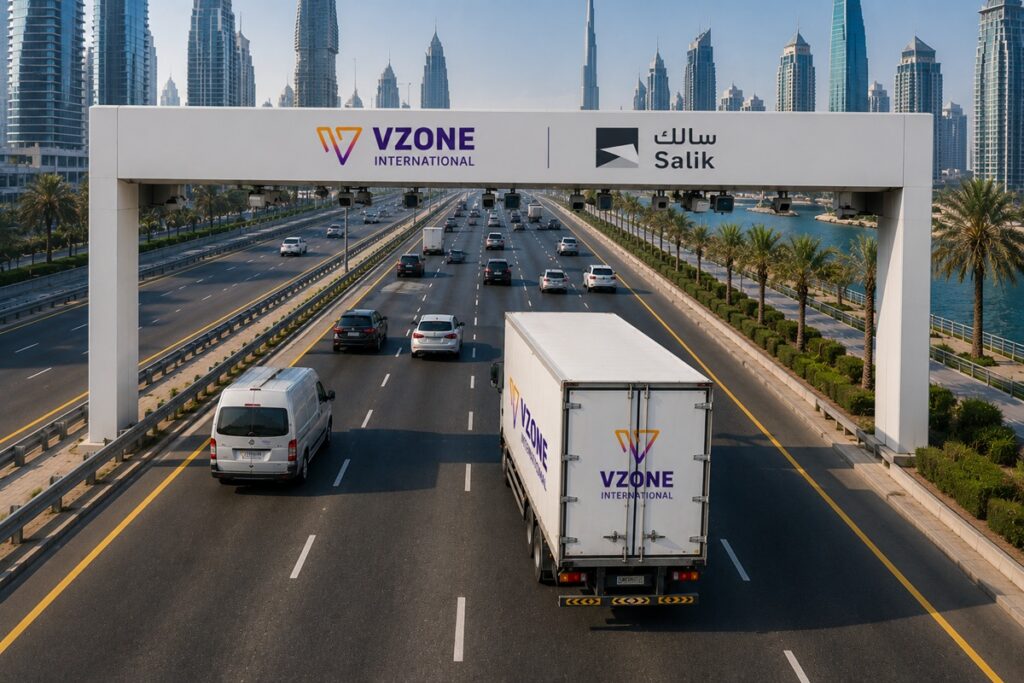
Salik is Dubai’s electronic toll system an RFID tag or number plate is read automatically as a vehicle passes under a gate, and the charge deducts from a prepaid account. For an individual driver, that’s the entire story. For a fleet, it’s only half of it.
Salik toll monitoring is what happens next: matching each of those crossings back to the vehicle, driver, and job that generated it. Without that second step, a fleet manager sees one total at the end of the month with no way to explain why one van cost three times as much in tolls as another, or whether every crossing was even a legitimate business trip.
How the Underlying Salik System Works
Every registered vehicle carries a small RFID tag on the windscreen, linked to a prepaid Salik account. As the vehicle passes under a gate, sensors read the tag or, if the tag is missing or unreadable, an ANPR camera captures the plate as a backup and the toll deducts automatically. There’s no stopping and no manual payment step, which is precisely why fleet-level charges can accumulate for weeks without anyone looking closely.
Why 2026 Pricing Makes Monitoring More Valuable
Since January 31, 2025, Salik has run on dynamic pricing rather than a flat rate, meaning the same trip can cost a different amount purely because of when it happened.
| Time Period | Rate (AED) | Hours |
|---|---|---|
| Peak | AED 6 | 6–10 AM & 4–8 PM (weekdays) |
| Off-Peak | AED 4 | 10 AM–4 PM & 8 PM–1 AM |
| Toll-Free | AED 0 | 1 AM–6 AM daily |
| Sunday / Public Holiday | AED 4 flat | All day (excluding free hours) |
Ten Gates, Ten Opportunities to Overspend
Dubai now runs 10 active Salik gates, including Al Safa North/South, Al Garhoud Bridge, Al Maktoum Bridge, Business Bay Crossing, Al Barsha, Airport Tunnel, Al Mamzar North/South, and Jebel Ali. More gates simply mean more chances for a fleet vehicle to rack up a charge nobody reviews particularly on routes that cross several gates in a single peak-hour trip.
The Problem: Toll Leakage in Unmonitored Fleets
“Toll leakage” is the fleet-management term for Salik spend that isn’t tied to legitimate, authorized business activity and it’s almost invisible without vehicle-level tracking.
Unauthorized Personal Trips on Company Vehicles
A vehicle left with a driver overnight or over a weekend can rack up personal-use toll charges that get folded silently into the company’s Salik bill. Without a way to match crossings to authorized trips, there’s no way to catch this pattern, let alone act on it.
Duplicate or Unreconciled Toll Charges
Billing errors happen. Gate-read glitches, account mix-ups, and timing discrepancies can all produce charges that don’t match actual vehicle movement. Fleets that only look at the total monthly figure have no way to spot these anomalies.
No Visibility Into Which Vehicle or Driver Incurred the Cost
This is the core problem underneath the other two: a monthly Salik statement is just a list of gate names, times, and amounts. Without a system linking that data to a vehicle and driver, every other issue stays hidden inside a single number.
How Salik Toll Monitoring Works for Fleet Management
In practice, Salik monitoring is a data-matching exercise that runs continuously in the background.
Integrating Salik Account Data with Fleet Management Software
The starting point is pulling Salik account transaction data into the same platform that already tracks vehicle location and driver assignment rather than treating tolls as a separate finance-only line item.
Matching Toll Timestamps to GPS Location and Driver ID
Each Salik transaction carries a timestamp and gate location. Fleet management software cross-references that against GPS trip logs from the same window, identifying exactly which vehicle was passing through that gate at that moment and which driver was assigned to it.
Automated Per-Vehicle and Per-Driver Reporting
Once transactions are matched, the system can generate ongoing reports broken down by vehicle, driver, route, or cost center replacing manual, after-the-fact reconciliation with something finance and operations teams can check at any point in the month.
Key Benefits of Salik Toll Monitoring for UAE Fleets
Cost Control and Accurate Budgeting
Per-vehicle toll data lets fleet managers set realistic toll budgets by route or vehicle class, instead of budgeting blind based on last year’s average bill.
Driver Accountability
When every crossing is tied to a driver ID, unauthorized or excessive toll use becomes visible immediately not three months later during an annual cost review.
Faster Finance Reconciliation
Automated, exportable reports mean finance teams stop manually cross-referencing Salik statements against trip logs by hand a process that’s slow and error-prone at any real fleet size.
Route Optimization Insights
Toll data broken down by route highlights which corridors are generating disproportionate charges, informing route planning decisions that a flat monthly bill could never surface.
| Metric | Without Monitoring | With Salik Monitoring |
| Toll cost visibility | Lump-sum monthly bill | Per-vehicle, per-driver breakdown |
| Unauthorized trips | Rarely detected | Flagged in real time |
| Finance reconciliation | Manual, error-prone | Automated monthly export |
| Route decisions | Guesswork | Data-backed gate-avoidance routing |
What to Look for in a Salik Monitoring Solution
Not every fleet platform handles Salik data the same way. A few things separate a genuinely useful monitoring setup from a cosmetic one:
Real-Time Toll Alerts
Alerts flagging unusual crossings after-hours, off-route, or high-frequency as they happen, not at month-end.
Vehicle- and Driver-Level Reporting
Reports that break down toll spend by individual vehicle and driver, not just fleet-wide totals.
Integration with GPS and Telematics Platforms
The ability to cross-reference toll timestamps against live GPS and trip data automatically, without manual data entry.
Exportable Monthly Reports for Finance Teams
Clean, exportable reporting that finance can drop straight into existing reconciliation workflows.
How VZone International Supports Salik Toll Monitoring
VZone International has operated GPS tracking and fleet management platforms across the UAE for more than 20 years, with certifications including Asateel (Abu Dhabi ITC), SIRA (Dubai security transport), and SecurePath (Dubai RTA). Its fleet management platform links Salik toll data directly with GPS and driver-behavior tracking, giving fleet managers a single view of toll cost per vehicle, per driver, and per route with reporting built for native export into SAP, Odoo, Oracle, and Zoho, so finance teams aren’t reconciling toll data by hand.
See exactly where your Salik toll budget is going.
VZone International provides GPS-integrated Salik toll monitoring for UAE fleets automated vehicle and driver-level attribution, real-time unauthorized-crossing alerts, and finance-ready monthly reports, built on 20+ years of UAE fleet data. Get a free toll monitoring assessment today.
Frequently Asked Questions
It's the process of tracking and matching Salik toll charges to the specific vehicle, driver, and trip responsible, rather than relying on a single unbroken-down monthly statement.
Since January 31, 2025, pricing is dynamic: AED 6 during peak hours (6–10 AM and 4–8 PM on weekdays), AED 4 off-peak, and free between 1 AM and 6 AM. Sundays and public holidays are a flat AED 4.
Ten, as of 2026 including Al Safa North/South, Al Garhoud Bridge, Al Maktoum Bridge, Business Bay Crossing, Al Barsha, Airport Tunnel, Al Mamzar North/South, and Jebel Ali.
Yes. Modern fleet platforms match gate-crossing timestamps to GPS trip data, attributing each charge to the right vehicle and driver without manual reconciliation.
Because there's no easy way to separate legitimate business trips from unauthorized use, catch billing errors, or spot which routes are driving up avoidable toll costs.