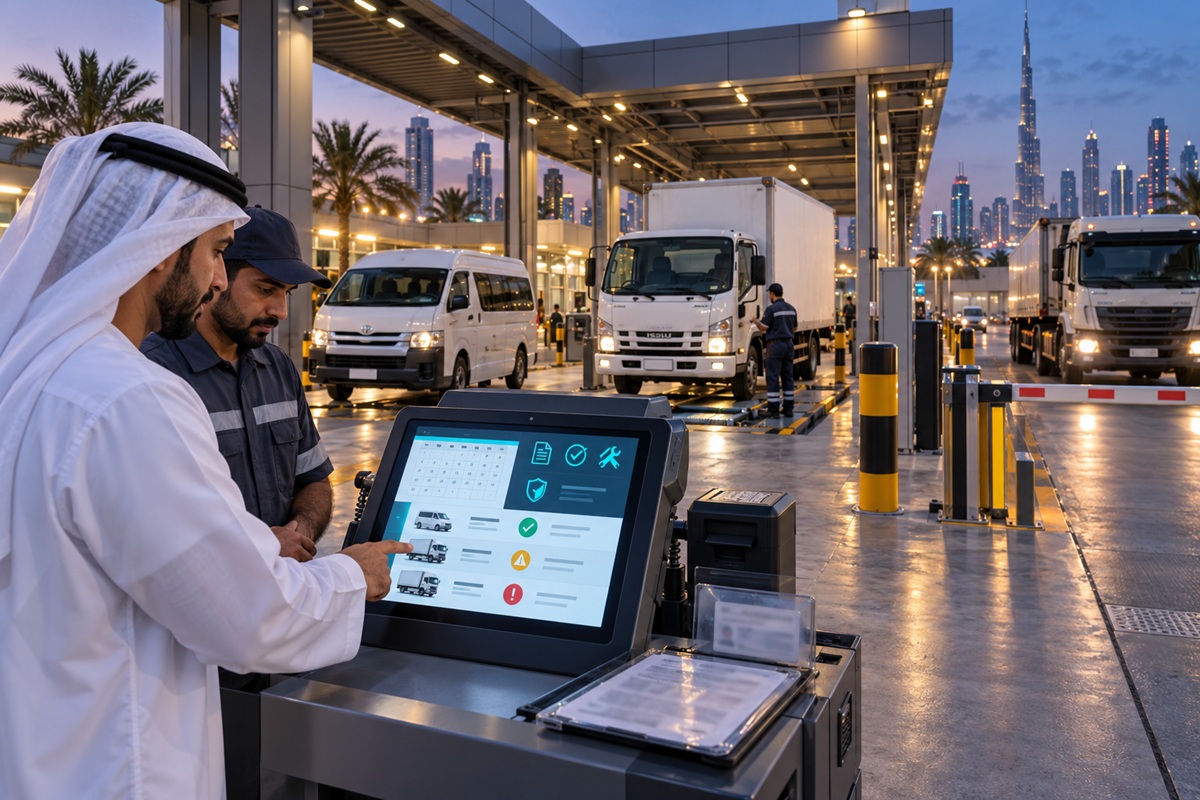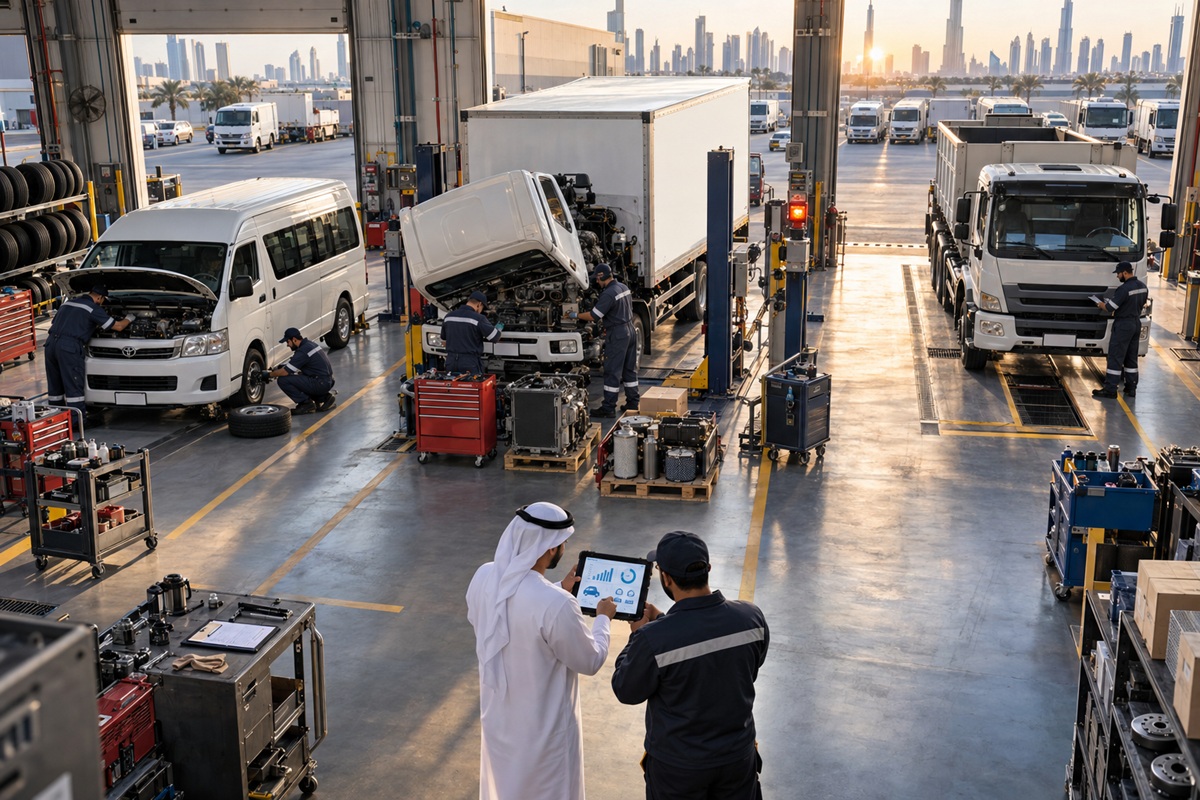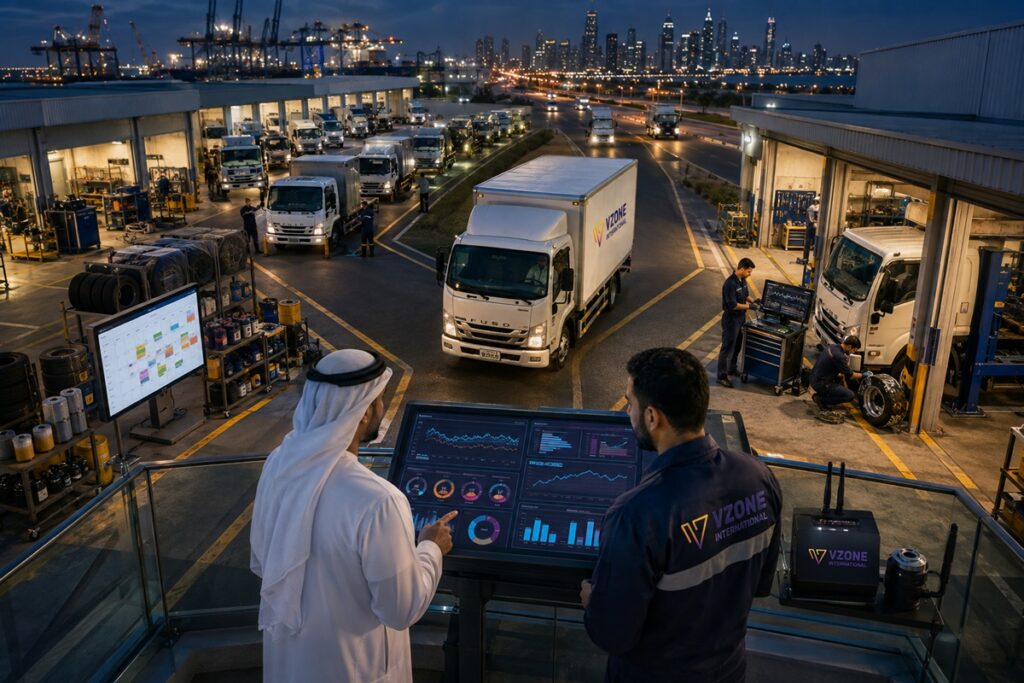
Every commercial vehicle breaks down eventually. The question fleet maintenance management answers is not whether breakdowns occur but when they occur at a scheduled workshop appointment with planned parts availability and standard labour rates, or at the side of an Abu Dhabi highway at 2:00 PM on a Tuesday with emergency call-out charges, a replacement vehicle needed, a delivery missed, and a customer notified. The financial difference between these two scenarios is AED 3,000 to AED 15,000 per breakdown event, depending on the vehicle type and the operational disruption caused.
Preventive maintenance reduces breakdown probability by replacing components before they fail. Predictive maintenance reduces it further by using telematics data to identify which specific components are showing failure indicators before the failure occurs enabling targeted, evidence-based maintenance decisions rather than calendar-based replacements that may happen too early (unnecessary cost) or too late (the failure occurs between scheduled intervals). Fleet maintenance software for UAE fleets implements both approaches simultaneously GPS-tracked mileage and time triggers for preventive intervals, OBD diagnostic data and sensor monitoring for predictive indicators. This guide explains how each approach works, what each costs, and how fleet maintenance software integrates both to maximise maintenance savings for UAE commercial fleet operators.
Key Takeaways
- Preventive maintenance schedules service at fixed intervals (time or mileage) regardless of actual vehicle condition it prevents most failures by replacing components before their expected failure point, but it cannot detect developing faults between intervals and it sometimes replaces components that still have useful life remaining.
- Predictive maintenance uses real-time telematics data OBD diagnostic trouble codes, GPS mileage, engine temperature patterns, fuel consumption anomalies to detect developing faults and forecast component failure before it occurs, enabling service to be scheduled specifically for the vehicles and components that actually need attention.
- UAE’s extreme summer heat accelerates component degradation beyond standard service interval assumptions: engine cooling systems, tyres, and air-conditioning components reach failure points 15 to 30 percent faster in sustained 45°C+ ambient conditions than in temperate climates. UAE fleet maintenance intervals should be calibrated for local conditions, not adopted from European or North American manufacturer specifications.
- Fleet maintenance software reduces total maintenance cost through three simultaneous mechanisms: eliminating reactive breakdown repair cost premiums (emergency call-out, priority parts, replacement vehicle hire), reducing premature component replacement from over-servicing, and extending vehicle asset life through consistent, data-driven maintenance discipline.
- VZone International’s fleet management platform integrates GPS mileage-triggered maintenance scheduling with OBD-II diagnostic monitoring generating service alerts based on actual vehicle usage data rather than driver-reported odometer readings, which in unmanaged fleets are consistently understated to avoid service appointments
What Is Preventive Fleet Maintenance?
Preventive fleet maintenance is the practice of scheduling and completing vehicle service at defined intervals typically a combination of time (every 3 months or 6 months) and mileage (every 10,000 km or 20,000 km) regardless of whether any specific fault or symptom has been identified. The logic of preventive maintenance is actuarial: components have known average failure lifespans, and replacing them before their average failure point prevents most failures at the cost of occasionally replacing components that still had remaining life.
Standard preventive maintenance tasks for UAE commercial fleets include: engine oil and filter changes (typically every 5,000 to 10,000 km in UAE summer conditions, shorter than European intervals due to heat-accelerated oil degradation); tyre rotation and replacement (tyre wear is significantly accelerated in UAE summer by heat-softened tarmac and higher tyre pressure variation); air filter replacement (UAE desert dust loads air filters significantly faster than clean-air environments); cooling system inspection (UAE summer heat places continuous high load on cooling systems earlier inspection intervals than European schedules are appropriate); and brake inspection (commercial vehicle brake wear in UAE urban stop-start traffic is higher than highway-dominant markets).
Limitations of Time- and Mileage-Based Preventive Schedules
Preventive maintenance schedules have two structural limitations that fleet maintenance software with predictive capability addresses. The first is between-interval blind spots: a component that is functioning normally at the 10,000 km service but develops a fault at 15,000 km with the next scheduled service at 20,000 km will fail before it is inspected. The preventive schedule cannot detect this fault; only real-time telematics data monitoring can. The second is driver-reported mileage inaccuracy: preventive schedules triggered by odometer readings are only as accurate as the odometer readings, and in unmanaged fleets drivers consistently under-report mileage (to avoid service appointments) or fail to report it at all. GPS-tracked mileage from fleet maintenance software is immune to this distortion service is triggered by verified vehicle usage data regardless of what the driver reports
What Is Predictive Fleet Maintenance?
Predictive fleet maintenance uses real-time data from vehicle telematics system OBD-II diagnostic monitoring, GPS mileage and route data, engine performance sensors, fuel consumption patterns to detect the early indicators of component failure before the failure occurs. Rather than replacing components at a fixed interval, predictive maintenance replaces them when the data indicates they are approaching failure potentially earlier than scheduled if a fault is developing rapidly, or later than scheduled if the data shows the component is still performing within normal parameters.
The data sources for predictive maintenance in a fleet management platform are: OBD-II diagnostic trouble codes (DTCs) from the vehicle’s engine management system fault codes that indicate developing problems in engine, transmission, emissions, braking, or electrical systems; engine performance parameter trends coolant temperature patterns that indicate cooling system degradation, oil pressure patterns that indicate engine wear, fuel consumption increases that indicate injector or engine efficiency issues; GPS route data vehicles consistently operating in high-traffic stop-start conditions accumulate more brake and transmission wear per kilometre than highway-dominant vehicles; and mileage versus condition correlation comparing the component’s actual wear indicators against the expected wear rate for the mileage accumulated, identifying vehicles where wear is accelerating above the expected rate.
How OBD-II Diagnostics Enable Predictive Maintenance
OBD-II (On-Board Diagnostics, second generation) is the standardised diagnostic interface on all commercial vehicles manufactured after 2001, providing real-time access to the vehicle’s engine management computer data. A GPS tracking device with OBD-II interface reads diagnostic data continuously and transmits it to the fleet management platform alongside the GPS position data meaning every position update also includes the vehicle’s current engine health indicators. When the engine management computer generates a diagnostic trouble code (DTC) the same signal that illuminates the dashboard warning light the fleet management platform receives it within seconds, generates a maintenance alert, and logs the fault code with the timestamp and GPS location.
The predictive value of OBD diagnostics is in the ability to detect developing faults before they generate a dashboard warning light some fault conditions generate pending codes (preliminary fault codes that indicate a developing problem) before they generate confirmed codes (the warning light trigger). Fleet maintenance software that monitors both pending and confirmed codes catches developing problems earlier than a driver would notice them, enabling preventive action before the developing fault progresses to a breakdown.
Preventive vs Predictive: Direct Comparison for UAE Fleets
| Dimension | Preventive Maintenance | Predictive Maintenance | UAE-Specific Factor |
| Trigger mechanism | Fixed time or mileage interval calendar or odometer based | Real-time telematics data OBD diagnostics, GPS mileage, sensor anomalies | GPS mileage tracking eliminates driver-reported odometer inaccuracy common in UAE fleet management |
| Fault detection | Detects faults at scheduled inspection only between-interval faults not detected until failure or next service | Continuously monitors for fault indicators detects developing problems before failure and between scheduled intervals | UAE heat causes faster component degradation between-interval predictive monitoring is more valuable than in cooler climates |
| Component replacement timing | Replaces at fixed interval may replace early (wasted life) or too late (failure occurs between intervals) | Replaces when data indicates approaching failure minimises premature replacement and missed failures | UAE heat and dust create higher variability in component life than temperate climates fixed intervals are less accurate |
| Cost profile | Predictable maintenance cost; higher total cost from over-servicing and missed between-interval failures | Lower total cost from targeted replacement; requires telematics infrastructure investment | UAE emergency repair cost premium is high breakdown on remote route adds AED 3,000-8,000 in call-out and delay cost |
| Implementation complexity | Low service intervals in a spreadsheet or basic maintenance log | Higher requires OBD telematics integration and fleet maintenance software | UAE fleets with GPS tracking already have the hardware foundation for predictive maintenance |
| Unplanned breakdown prevention | Moderate prevents most scheduled-component failures; cannot prevent between-interval failures | High detects developing faults between intervals; reduces unplanned breakdowns 35-50% | ADNOC site access disruption from breakdown is a direct revenue loss for contractor fleets |
| Best for | Small fleets without telematics; vehicles with low mileage variability and low breakdown disruption cost | Fleets with GPS telematics; high-mileage commercial vehicles; high breakdown disruption cost operations | Most UAE commercial fleets of 10+ vehicles benefit from predictive capability through existing GPS investment |
UAE-Specific Maintenance Challenges
Heat Acceleration of Component Wear
UAE’s sustained summer temperatures ambient highs of 45°C to 50°C with peak asphalt surface temperatures exceeding 70°C accelerate component degradation beyond the service intervals established by manufacturers for temperate climates. Engine oil viscosity is reduced by sustained high engine bay temperatures, accelerating oxidation and reducing lubrication effectiveness requiring shorter oil change intervals in UAE summer conditions than the manufacturer’s standard interval. Tyre rubber compounds harden and crack faster under sustained heat exposure, and the higher tyre pressure that heat creates increases wear rate and blowout risk. Air-conditioning compressors and drive belts operate near their design limits throughout UAE summer, with compressor failures peaking in July and August when system load is highest and temperatures are most extreme.
Fleet maintenance software that integrates UAE temperature data applying summer condition interval adjustments to standard service schedules for vehicles operating during peak summer months produces maintenance schedules that are calibrated for actual UAE operating conditions rather than European factory defaults. A vehicle serviced on a European 15,000 km oil change interval in UAE summer conditions is being under-maintained relative to its actual operating environment; fleet maintenance software that applies a UAE-appropriate 10,000 km summer interval prevents the accelerated engine wear that results from the interval mismatch.
Dust and Sand Ingestion
UAE desert dust is a significant maintenance variable for air filtration systems across all vehicle types from light commercial vans to heavy construction equipment. Air filter replacement intervals in UAE conditions should be determined by filter differential pressure measurement (a predictive indicator of filter loading) rather than by fixed mileage a vehicle operating on dusty construction site access roads may require air filter replacement at 5,000 km intervals while the same vehicle on paved urban routes may last 15,000 km between changes. Fleet maintenance software that includes filter condition monitoring from the OBD differential pressure sensor (where available) and flags rapid air filter loading as an anomaly enables targeted replacement rather than conservative over-servicing.
Driver Mileage Under-Reporting in UAE Fleets
Manual odometer-based maintenance scheduling in UAE fleets is systematically distorted by driver mileage under-reporting drivers who are aware that odometer reading triggers a service appointment consistently enter lower mileage figures than the actual reading, extending the service interval beyond the intended threshold. In fleets without GPS-verified mileage, maintenance logs show vehicles accumulating significantly less mileage than fuel consumption and operational data would predict the gap is driver-reported odometer distortion rather than genuinely low usage.
GPS-tracked mileage from fleet maintenance software eliminates this distortion entirely: service intervals are triggered by the GPS-verified distance accumulated by the vehicle rather than by driver-reported readings. A vehicle that has driven 10,253 km since its last service triggers the 10,000 km service alert regardless of what the driver has entered in any manual log. For UAE fleet managers who have experienced the consequence of missed service appointments from odometer under-reporting an engine failure at 17,000 km when the maintenance log shows 12,000 km because the driver was under-reporting GPS mileage-triggered service scheduling is the solution with immediate operational impact.
Fleet Maintenance Software: How It Implements Both Approaches
Fleet maintenance software integrates preventive and predictive maintenance into a unified maintenance management system applying interval-based triggers for scheduled services alongside continuous telematics monitoring for fault detection, with all maintenance records, service history, and alert management in a single platform accessible to fleet managers, workshop supervisors, and finance teams.
GPS Mileage-Triggered Service Scheduling
The preventive maintenance layer of fleet maintenance software uses GPS-verified mileage to trigger service alerts at the configured interval thresholds. When a vehicle’s GPS-tracked odometer reaches 80 percent of the next service interval threshold, the platform generates an advance service warning time to schedule the appointment. At 95 percent of the interval, an urgent service alert fires. At 100 percent, an overdue service alert flags the vehicle for immediate attention. Each alert is associated with the specific service tasks due at that interval (oil change, tyre rotation, brake inspection, filter replacement) based on the vehicle’s service schedule configuration, giving the workshop pre-notification of parts requirements and labour planning. Service completion is logged in the platform with the mileage at service, parts replaced, and next service threshold maintaining the complete service history record.
OBD Diagnostic Monitoring and Fault Alerts
The predictive maintenance layer continuously monitors OBD diagnostic data from the vehicle’s engine management computer. When a fault code is detected pending or confirmed the platform generates a maintenance alert categorised by fault severity: informational (no immediate action required, monitor at next service), warning (schedule service within defined period), or critical (take vehicle out of service immediately). The fault code, timestamp, GPS location, vehicle mileage, and driver identity are all logged with the alert, enabling the workshop to prepare for the specific fault condition before the vehicle arrives.
VZone International’s fleet maintenance software on the Wialon platform supports OBD diagnostic monitoring for all vehicles with OBD-II interfaces light commercial vans through to heavy trucks and generates maintenance alerts in Arabic and English with fault code descriptions that explain the issue in operational terms rather than technical codes. A critical engine coolant temperature fault alert describes ‘Engine coolant temperature abnormally high risk of overheating damage, take vehicle out of service’ rather than displaying ‘P0217’ to a fleet manager who may not know the OBD code library.
ROI of Fleet Maintenance Software for UAE Fleets
| Saving Category | Preventive Maintenance Contribution | Predictive (Telematics) Contribution | Annual Saving 50-Vehicle Fleet (AED) |
| Unplanned breakdown elimination | Moderate prevents failures at scheduled component endpoints | High detects between-interval developing faults; 35-50% breakdown reduction | AED 120,000 (12 avoided breakdowns at AED 10,000 average cost) |
| Emergency repair cost premium reduction | None breakdowns still occur between intervals | High breakdowns caught in workshop cost 40-60% less than roadside emergency repair | AED 48,000 (40% cost reduction on remaining 8 breakdowns vs emergency rate) |
| Over-servicing elimination | None interval-based schedules may replace components early | Moderate telematics confirms component condition before replacement decision | AED 18,000 (10% reduction in parts cost from avoiding premature replacements) |
| Odometer under-reporting correction | None manual odometer triggers distorted by under-reporting | High GPS mileage eliminates under-reporting; 2.3 missed services per vehicle per year corrected | AED 34,500 (2.3 services × AED 300 average service cost × 50 vehicles prevented) |
| Vehicle life extension | Moderate consistent service extends asset life vs reactive maintenance | High condition-based maintenance extends vehicle asset life by 12-18% | AED 75,000 (asset value extension at AED 5,000/vehicle for 15 vehicles in fleet) |
| TOTAL ANNUAL SAVING | AED 295,500 |
Fleet Maintenance Software ROI 50-Vehicle UAE Commercial Fleet Platform cost for GPS-integrated fleet maintenance software (included in fleet management platform subscription): AED 0 incremental if GPS tracking already deployedStandalone fleet maintenance software add-on: AED 30-80 per vehicle per monthAnnual saving (conservative, 50 vehicles): AED 295,500Payback on standalone cost: 2-4 monthsNote: For fleets already running VZone International’s fleet management platform with OBD-II device integration, fleet maintenance software is a platform configuration rather than a separate cost ROI is effectively immediate. |
VZone International Fleet Maintenance Software GPS-Integrated, UAE-Calibrated
VZone International’s fleet management platform includes GPS mileage-triggered maintenance scheduling, OBD-II diagnostic alert monitoring, service history management, and workshop integration for UAE commercial fleets from 10 to 500+ vehicles. Fleet maintenance software is included in the standard Wialon platform deployment for fleets already running VZone GPS tracking. Contact our team for a fleet maintenance assessment and ROI calculation for your fleet.
Frequently Asked Questions
Preventive fleet maintenance schedules service at fixed time or mileage intervals for example, an oil change every 10,000 km or every 3 months regardless of whether any fault has been detected. It prevents most failures by replacing components before their expected failure point. Predictive fleet maintenance uses real-time telematics data OBD-II diagnostic codes, GPS mileage, engine performance trends to detect developing faults before they cause failures, scheduling service when the data indicates it is needed rather than when the calendar says it is due. Predictive maintenance reduces total maintenance cost by eliminating premature component replacement and catching between-interval faults that preventive schedules miss. Fleet maintenance software for UAE commercial fleets integrates both approaches: fixed interval triggers for scheduled services and continuous OBD monitoring for predictive fault detection.
Fleet maintenance software reduces breakdown costs in UAE through three mechanisms. First, GPS-verified mileage triggers service alerts at the correct interval regardless of driver-reported odometer readings catching the systematic under-reporting that causes missed services in manually tracked fleets. Second, OBD-II diagnostic monitoring detects developing faults between service appointments a cooling system fault developing at 15,000 km is detected and alerted before the 20,000 km service appointment, enabling a targeted repair before the system fails on a remote route. Third, advance service scheduling from alert-generated workshop notifications means that parts are available when the vehicle arrives reducing workshop turnaround time and eliminating emergency parts premium costs. For UAE fleets where a breakdown on a remote ADNOC route or a missed customer delivery creates both direct repair costs and significant operational disruption costs, the value of early fault detection is multiplied by the consequence severity.
Yes VZone International's fleet maintenance software on the Wialon platform provides API integration with workshop management systems and ERP platforms. Maintenance alerts generated by the fleet platform can be automatically pushed to the workshop job scheduling system, creating a work order without manual re-entry. Completed service records entered in the workshop system can update the fleet platform's service history, resetting the mileage counter and logging the parts replaced. For UAE fleet operators using SAP, Oracle, Odoo, or Zoho as their ERP which includes most mid-market and enterprise fleets the native ERP connectors in VZone International's platform enable maintenance cost data to flow directly into the finance system's vehicle cost ledger without manual export and import.
Fleet maintenance software for UAE commercial fleets monitors four categories of vehicle data: GPS mileage (the verified distance accumulated since last service the trigger for interval-based preventive maintenance alerts); OBD-II diagnostic data (fault codes from the engine management computer, engine temperature, oil pressure, fuel system performance, emissions system status, and transmission data where available via OBD or CAN bus); fuel consumption patterns (consumption per kilometre compared to the vehicle's established baseline a significant consumption increase indicates developing engine efficiency issues or fuel system problems); and sensor data from additional installed sensors (tyre pressure monitoring where TPMS is fitted, coolant temperature sensors, and battery voltage monitoring for electrical system health). The combination of GPS mileage and OBD diagnostics covers the primary maintenance triggers for most UAE commercial vehicle categories; additional sensor integration adds depth for specific vehicle types and operating conditions.