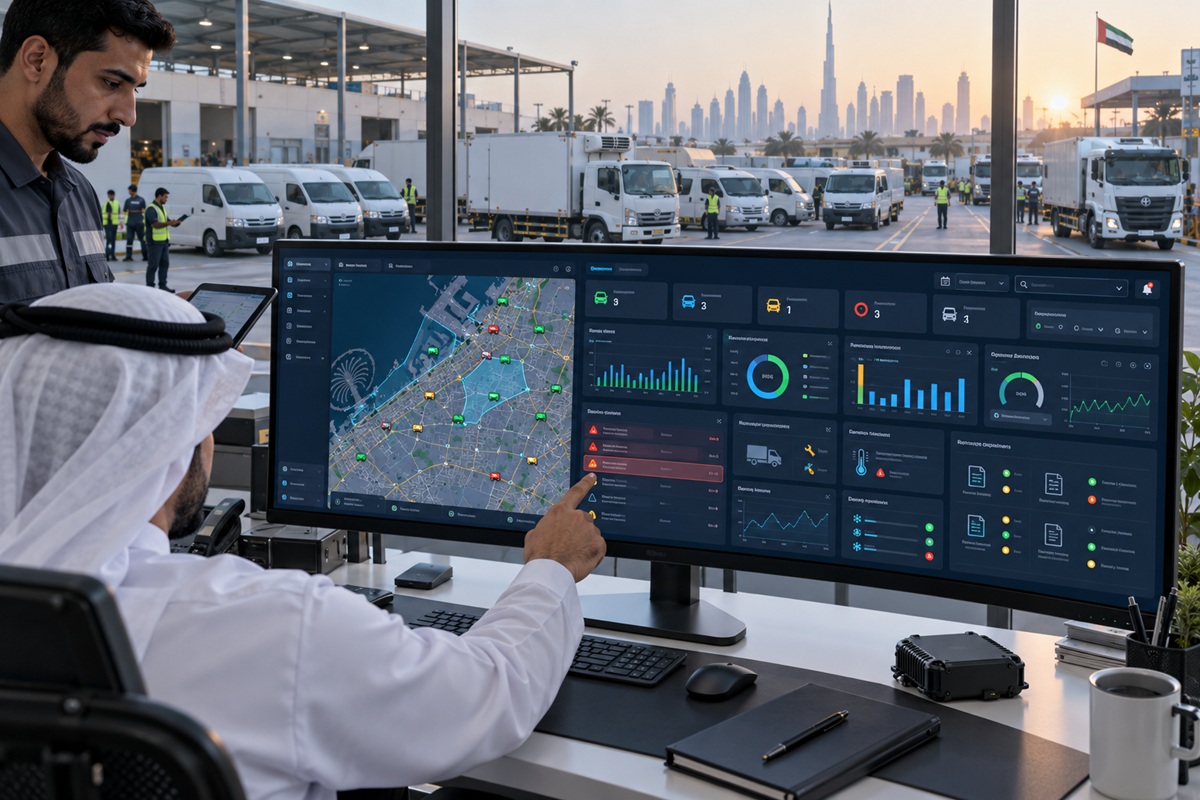
If your fleet operates commercially in Abu Dhabi, Asateel registration is not a procedural formality it is a legal requirement enforced by the Integrated Transport Centre (ITC), the authority responsible for regulating transport infrastructure across the emirate. Vehicles that should be on Asateel but are not carry real operational risk: fines, vehicle impoundment, and the kind of compliance exposure that surfaces at the worst possible moment during a licence renewal or a site access inspection.
What makes Asateel compliance more complex than it first appears is the specificity of its requirements. The ITC does not simply mandate that commercial vehicles carry a GPS device it specifies a list of certified hardware, requires each device to be registered individually on the Asateel portal with verified data transmission, and extends the requirement to trailers as standalone registered assets, separate from the tractor unit pulling them. Many fleet operators with fully compliant trucks are unknowingly running unregistered trailers.
This guide covers everything you need to navigate Asateel confidently: what the platform is, which vehicles must register, what ITC-certified hardware means in practice, the exact registration process step by step, and the most common compliance gaps that create problems for security companies to use approved Abu Dhabi fleet operators.
Key Takeaways
- Asateel is the Abu Dhabi ITC’s mandatory GPS fleet tracking platform all commercial vehicle categories operating in Abu Dhabi must register, with the exception of private passenger cars.
- Registration requires ITC-certified GPS hardware not all GPS devices on the UAE market qualify, and deploying non-certified hardware means portal registration will fail.
- Trailers and semi-trailers must be registered on Asateel with their own dedicated GPS units, separately from the tractor vehicle this is the single most common compliance gap in Abu Dhabi logistics fleets.
- The registration process involves six distinct steps from vehicle category confirmation through to compliance certificate issuance each step has failure points that an experienced provider can anticipate and resolve.
- Asateel and Dubai’s SecurePath are entirely separate compliance frameworks; operating across both emirates requires certifications under both programmes.
- VZone International is ITC Asateel-approved and manages the full registration process hardware installation, portal setup, data verification, and compliance certificate issuance on behalf of client fleets.
What Is the Asateel Platform? (Abu Dhabi Fleet Tracking Explained)
Asateel is the official fleet tracking and management platform operated by Abu Dhabi’s Integrated Transport Centre (ITC). Launched as part of Abu Dhabi’s broader smart transport infrastructure programme, Asateel creates a centralised, real-time visibility layer over all commercial vehicles operating within the emirate. Every registered commercial vehicle transmits live GPS data to the Asateel portal, giving the ITC a complete operational picture of Abu Dhabi’s commercial transport network.
From a fleet operator’s perspective, Asateel functions as both a compliance obligation and a data gateway. The ITC uses the platform data for traffic planning, road safety analysis, and regulatory enforcement. Fleet operators, for their part, must ensure their vehicles remain registered and actively transmitting but those same GPS devices, deployed on an enterprise telematics platform, simultaneously generate operational intelligence that goes far beyond the compliance minimum.
Asateel has been progressively extended in scope since its introduction the trailer tracking mandate being one of the more recent and frequently misunderstood additions. The ITC continues to refine the programme’s technical specifications and enforcement mechanisms, which means working with a provider that actively tracks regulatory updates is more valuable than one that treats Asateel as a set-and-forget installation.
The Role of the Integrated Transport Centre (ITC) in Abu Dhabi
The Integrated Transport Centre is the Abu Dhabi government entity responsible for transport policy, regulation, and infrastructure planning across the emirate. Established under the Abu Dhabi Department of Municipalities and Transport, the ITC oversees public transport, taxi licensing, commercial vehicle regulation, and the Asateel platform. It is the ITC not the federal UAE transport authority that maintains the Asateel certified hardware list and enforces fleet registration requirements.
This distinction matters practically: regulatory guidance, hardware certification queries, and compliance disputes relating to Asateel go through the ITC’s commercial transport division, not through any federal transport body. For fleet operators seeking authoritative guidance on Asateel requirements, the ITC’s official portal at itc.gov.ae is the primary reference source.
What Data Does Asateel Collect from Registered Fleet Vehicles?
At the regulatory compliance level, Asateel collects real-time GPS position, vehicle speed, engine status, and trip data from registered vehicles. This data feeds the ITC’s monitoring portal and creates the audit trail used for compliance verification and enforcement. The frequency and format of data transmission is specified in the ITC’s technical requirements for Asateel-certified devices.
It is important to understand that the data flowing to the ITC portal represents the minimum data subset required for Asateel compliance. The GPS hardware certified for Asateel is typically capable of capturing substantially more data driver behavior events, fuel consumption, CAN bus vehicle health data, and AI dashcam footage which the fleet operator accesses through their own platform without this additional operational data being transmitted to the ITC. Fleet operators therefore have access to comprehensive telematics data for internal operational management while satisfying the regulatory data requirements through the same device.
Which Vehicles Must Register on Asateel?
The Asateel registration requirement covers all commercial vehicle categories operating in Abu Dhabi. The scope is defined by operating category and vehicle type, not by fleet size or company structure. A sole-trader operating a single light commercial van in Abu Dhabi is subject to the same Asateel requirement as a logistics company running 500 trucks the obligation scales with vehicle category, not operator size.
| Vehicle Category | Asateel Registration Mandatory? | ITC Requirement Status | Key Notes |
| Heavy trucks and long-haul vehicles | Yes | Active full enforcement | Includes all GVW categories above light commercial threshold |
| Semi-trailers and trailers | Yes separate registration | Active frequently audited | Each trailer needs its own GPS unit; registered independently from tractor |
| Light commercial vans | Yes | Active enforcement | Applies regardless of fleet size or operator type |
| School buses (Abu Dhabi) | Yes | Active MOE/ITC coordination | Also subject to parent notification module requirements |
| Taxis and hire cars (Abu Dhabi) | Yes | Active enforcement | Separate from Dubai RTA taxi requirements |
| Public buses (Abu Dhabi) | Yes | Active enforcement | Includes contractor-operated routes under ITC licence |
| Construction equipment vehicles | Yes | Active enforcement | On-road construction vehicles; off-road equipment tracked separately |
| Private passenger cars | No | Not required | Voluntary installation available; no ITC mandate |
| Motorcycles and light bikes | No currently | Not required | Subject to change; check current ITC guidance |
The Trailer Registration Requirement Why It Catches Operators Off Guard
The ITC’s trailer tracking mandate is the compliance gap that creates the most problems for Abu Dhabi logistics and construction fleet operators. The requirement is straightforward in principle: every trailer and semi-trailer operating in Abu Dhabi must carry its own ITC-certified GPS device, registered on Asateel as a standalone asset distinct from the tractor that pulls it.
In practice, this means a logistics company with 100 trucks and 150 trailers needs 250 registered Asateel devices, not 100. Companies that have correctly registered their truck fleet but not their trailers are non-compliant despite having invested in a full GPS installation. The trailer GPS unit must remain registered on Asateel whether the trailer is attached to a tractor or sitting at a depot it is an asset registration, not an active-use requirement.
The commercial logic for this requirement is straightforward: trailers are high-value assets frequently parked at third-party depots, customer sites, and roadside locations where the ITC has limited visibility. Standalone trailer GPS tracking enables the ITC to maintain operational picture completeness even when a trailer is decoupled from its tractor, and gives fleet operators meaningful asset protection against theft and unrecorded movement.
What Are ITC-Certified GPS Devices for Asateel?
ITC certification is the technical qualification that distinguishes GPS hardware approved for Asateel registration from the broader commercial GPS market. The ITC evaluates and certifies devices based on data format compatibility with the Asateel platform, transmission frequency specifications, connectivity resilience requirements, and in some cases, physical installation standards. Hardware that is not on the ITC certified list will fail the Asateel portal registration process the device ID will not be recognised during vehicle linkage.
This is not a theoretical distinction. Fleet operators who source GPS hardware independently through grey market channels, from hardware distributors not specialising in UAE compliance solutions, or based on general telematics market reputation without checking Asateel certification status regularly encounter portal registration failures that require full hardware replacement. Working with a provider who supplies certified hardware from the ITC list and takes responsibility for portal registration eliminates this risk entirely.
Approved Hardware Brands and Specifications for Asateel
Enterprise-grade telematics hardware from manufacturers including Teltonika, Queclink, and Concox appears on the ITC’s Asateel certified device list. These devices are selected for their proven connectivity reliability in the UAE’s network environment, their CAN bus integration capability for vehicle health data, their compatibility with enterprise fleet platforms such as Wialon and FMSiTrack, and their ability to support additional modules including security companies to use approved AI dashcam integration and fuel sensor connectivity without requiring hardware replacement as fleet requirements evolve.
When evaluating GPS providers for Asateel compliance, ask specifically for the ITC certification document for the proposed hardware model, not just a general claim of Asateel compatibility. The certification document will reference the specific device model and firmware version that has been tested and approved. Hardware model variants and firmware updates can affect certification status, so device-level specificity matters.
ITC Trailer Tracking Requirements Technical Differences from Truck Units
Trailer GPS units have distinct technical requirements compared to truck-mounted devices. Trailers do not have a consistent power source when decoupled they cannot rely on vehicle ignition power. Trailer tracking devices must therefore operate on internal battery power or harvest energy from the trailer’s existing brake light circuit, with battery life sufficient to maintain periodic position reporting during extended depot storage periods.
The ITC’s technical specification for trailer GPS units addresses this power autonomy requirement. Devices certified for trailer tracking must demonstrate sufficient battery endurance to maintain registration-compliant data transmission during periods when the trailer is decoupled. Fleet operators should confirm with their provider that the trailer GPS units proposed are specifically certified for trailer deployment, not simply the same hardware used on tractors.
Step-by-Step: How to Register Your Fleet on Asateel
The Asateel registration process has six distinct stages. Each stage has specific inputs, verification steps, and potential failure points. Working with a certified provider who manages the full process end-to-end is significantly faster and more reliable than navigating it independently particularly for fleets above 20 vehicles where the volume of device installations and portal linkages creates meaningful coordination complexity.
Step 1 Confirm Which Fleet Vehicles Require Asateel Registration
Begin with a full fleet audit: vehicle type, operating category, and current registration status. Cross-reference your vehicle list against the ITC’s mandatory categories. Include trailers in this audit list them as separate assets alongside trucks. If your fleet has grown through acquisition or you have inherited an existing operation, verify current Asateel registration status for vehicles that may have been registered previously under different device IDs or a previous provider.
This audit also establishes your total device requirement, which determines hardware procurement volume and installation scheduling. A fleet of 80 trucks with 120 trailers requires 200 devices a figure that affects both cost planning and installation timeline significantly if trailers are overlooked at this stage.
Step 2 Select an ITC-Approved GPS Provider
Your GPS provider must be approved to deliver Asateel-certified solutions in Abu Dhabi. Approval means the provider supplies hardware from the ITC certified list and has the technical integration with the Asateel portal configured and operational. When evaluating providers, request the following: confirmation that their proposed hardware model is on the current ITC certified device list (not a previous version), documentation of their Asateel portal integration, and a reference from an existing Abu Dhabi fleet client for whom they have managed the full registration process.
The provider relationship for Asateel compliance is not a hardware transaction it is an ongoing service relationship. Portal registration, device health monitoring, compliance maintenance, and renewal management are all ongoing activities that extend well beyond the installation date.
Step 3 Install ITC-Certified GPS Hardware on Each Vehicle
Hardware installation must be carried out by qualified technicians, with hardwired connection to the vehicle’s power system and correct antenna placement for reliable GPS signal acquisition. For trucks, installation typically involves connection to the vehicle’s ignition and battery circuits, with CAN bus integration where full telematics data capture is required. For trailers, installation uses the brake light circuit or a dedicated battery pack, with external antenna mounted on the trailer roof or frame for unobstructed satellite visibility.
A common installation quality issue is inadequate antenna placement antennas mounted inside metal enclosures or under metal panels experience significant signal degradation that creates data gaps in the Asateel portal. This is rarely visible to the fleet operator until a compliance audit flags intermittent data loss. Professional installation with post-installation signal verification is a non-negotiable quality standard for Asateel compliance.
Step 4 Link Devices to the Asateel Portal
Once hardware is installed and transmitting data, each device must be individually linked to its corresponding vehicle record on the Asateel portal. This involves matching the device’s IMEI number to the vehicle’s plate number and registration details in the ITC system. Portal linkage failures at this stage typically occur because of vehicle registration discrepancies, device IMEI entry errors, or hardware that is not on the current ITC certified list.
An experienced provider’s operations team handles this process in bulk for fleet installations, cross-checking device IMEIs against the vehicle list before submission and resolving portal validation errors without requiring intervention from the fleet operator. For fleets of 50 or more vehicles, the portal linkage stage can take one to three business days depending on ITC system response times.
Step 5 Verify Data Transmission and Confirm Active Status
Portal linkage alone does not confirm Asateel compliance the ITC requires that registered devices demonstrate continuous, valid data transmission to the Asateel portal. After linkage, each device should be verified to be actively transmitting position data at the required frequency. The provider’s platform should show each device’s online status and transmission history, enabling identification of any devices that are registered but not actively transmitting.
Common causes of post-installation transmission failures include SIM activation delays, antenna connection issues identified during post-installation testing, and device firmware mismatches with the Asateel portal’s current data format expectations. These issues are resolvable but require prompt identification a device that appears registered but is not transmitting is a compliance liability that accumulates unnoticed without active monitoring.
Step 6 Obtain Compliance Certificates and Set Up Renewal Monitoring
Once all vehicles are registered and actively transmitting, the provider issues a compliance certificate confirming Asateel registration status across the fleet. This certificate is the documentation you present during licence renewals, site access applications, and any ITC audits. It should list each vehicle plate number, its corresponding device IMEI, and the registration date.
Asateel registration is not a one-time event — it requires active maintenance. Devices that fail and are replaced need to be re-registered under the new device IMEI. Vehicles added to the fleet need individual Asateel registration before they operate commercially in Abu Dhabi. Annual compliance reviews should cross-reference the current fleet roster against active Asateel registrations to identify gaps before they create regulatory exposure.
Common Asateel Registration Mistakes to Avoid
These are the errors that consistently create registration failures, compliance gaps, and cost overruns for Abu Dhabi fleet operators navigating Asateel for the first time or managing compliance without a rigorous process.
Mistake 1 Omitting Trailer Registration
Already covered above, but worth restating as the single most prevalent compliance gap in Abu Dhabi logistics fleets: trailers must be registered on Asateel as individual assets with their own certified GPS units. A fully compliant truck fleet with unregistered trailers is still a non-compliant operation. The trailers are the asset category most frequently overlooked, most frequently targeted in ITC spot audits of logistics operators, and most costly to remediate if the oversight is discovered during a compliance inspection rather than proactively.
Mistake 2 Using Hardware Not on the Current ITC Certified List
The ITC certified hardware list is updated periodically. Devices that were certified under a previous list version may have been superseded by updated specifications, or their certification may have lapsed. Fleet operators who re-use hardware from a previous installation cycle, or who source devices from suppliers without confirming current certification status, encounter portal registration failures that require hardware replacement. Always verify the current certification status of proposed hardware at the time of procurement not based on a previous project’s approved device list.
Mistake 3 Treating Registration as Complete After Portal Linkage
Portal linkage and active data transmission are two different things. A device that has been linked to a vehicle in the Asateel portal but is not transmitting valid data is, from the ITC’s perspective, a non-transmitting registered device which generates the same compliance concern as an unregistered vehicle after a defined grace period. Post-installation transmission verification is a required step in the registration process, not an optional quality check.
Mistake 4 Neglecting New Vehicle Onboarding
Fleet operators who establish a solid Asateel registration process for their initial fleet sometimes fail to maintain the same rigour when adding new vehicles. Each new vehicle added to a Abu Dhabi commercial fleet needs its own Asateel registration hardware installation, portal linkage, and transmission verification before it operates commercially. A systematic vehicle commissioning checklist that includes Asateel registration as a mandatory step prevents this gap.
Mistake 5 Assuming One Provider Covers Both Asateel and SecurePath
Not all GPS providers hold both ITC Asateel certification and RTA SecurePath compatibility. Multi-emirate fleet operators who use a provider certified for one programme but not the other end up with a compliance gap in one emirate. Before committing to a provider, confirm explicitly which programmes they are certified for, request documentation, and verify that the same hardware supports both requirements if your fleet operates across both Dubai and Abu Dhabi.
Asateel vs. SecurePath Which Applies to Your Fleet?
For fleet operators navigating UAE compliance for the first time, the distinction between Asateel and SecurePath is one of the most practically important things to understand. They govern different vehicle categories in different emirates and they have entirely separate regulatory architectures.
| Comparison Factor | Asateel (Abu Dhabi) | SecurePath (Dubai) |
| Governing authority | ITC Integrated Transport Centre, Abu Dhabi | RTA Roads and Transport Authority, Dubai |
| Vehicle scope | All commercial fleet categories (trucks, trailers, vans, buses, taxis) | Rental cars, taxis, e-hail, public transport, school buses |
| Trailer tracking | Mandatory trailers registered separately as standalone assets | Not applicable under SecurePath framework |
| Certified hardware list | ITC-specific certified device list | RTA-specific approved device list |
| Data portal | Asateel Platform (ITC) | SecurePath RTA Portal |
| IVMS requirement | Recommended; mandatory where ADNOC contractor overlap applies | Not mandatory under SecurePath |
| Penalty — non-compliance | Fine + vehicle impoundment + ITC audit exposure | Fine + licence suspension |
| Cross-emirate recognition | Not valid for Dubai compliance | Not valid for Abu Dhabi compliance |
| Provider certification | ITC Asateel approval required | RTA approval required separate process |
The practical decision framework for fleet operators: if your vehicles operate commercially in Abu Dhabi in any commercial category, you need Asateel registration. If your vehicles fall into rental, taxi, or public transport categories in Dubai, you need SecurePath. If your fleet operates across both emirates in qualifying categories, you need both with a provider that holds both certifications and hardware that satisfies both approved lists.
How VZone International Simplifies Asateel Compliance
VZone International has operated in Abu Dhabi’s commercial fleet tracking market for over 20 years a tenure that spans the introduction and evolution of the Asateel platform from its early implementation to its current scope including trailer tracking. That depth of experience translates into registration process efficiency, hardware procurement certainty, and compliance maintenance capability that protects client fleets from the compliance gaps that typically emerge when operators manage Asateel independently.
ITC-Certified Hardware from VZone
VZone supplies GPS hardware from the ITC certified device list for all Asateel deployments both for trucks and trailers. For trailer deployments specifically, VZone provides hardware with the power autonomy and signal performance required for trailer tracking compliance, installed by technicians experienced with trailer-specific installation configurations. Fleet operators do not need to navigate the ITC hardware certification landscape independently VZone’s hardware procurement process starts from the certified list and works backward to the right device specification for each vehicle category.
Managed Onboarding Full Registration Handled by VZone
VZone manages the complete Asateel registration process for client fleets: fleet audit and vehicle categorisation, hardware procurement and installation scheduling, portal linkage for all vehicles and trailers, transmission verification for each device, and compliance certificate issuance. Fleet operators receive a compliance certificate confirming the registered status of every vehicle and trailer in their fleet, with device-level detail that satisfies ITC audit requirements and licence renewal documentation requests.
For large fleet onboarding typically 50 or more vehicles VZone schedules phased installation to minimise operational disruption, with vehicles released back to operations as installation is completed rather than holding the full fleet offline for a multi-day installation cycle.
Ongoing Compliance Monitoring and Renewal Alerts
Asateel compliance is a continuous obligation, not a one-time registration event. VZone’s platform monitors device connectivity and data transmission status in real time across the entire client fleet, sending automated alerts when a device goes offline or transmission failures are detected. Annual compliance reviews cross-reference the current vehicle roster against active registrations to identify new vehicles that require registration, replaced devices that need re-registration, and any transmission anomalies that require remediation.
For fleet operators whose vehicle roster changes frequently rental companies, logistics operators with high vehicle turnover, construction firms cycling equipment between projects this ongoing compliance monitoring layer is what separates maintaining a defensible Asateel compliance record from gradually accumulating registration gaps.
Need Asateel registration for your Abu Dhabi fleet?
VZone International is ITC Asateel-approved and manages the complete onboarding process hardware supply, vehicle and trailer installation, portal registration, transmission verification, and compliance certificate issuance. For multi-emirate operators, VZone also holds RTA SecurePath compatibility for Dubai fleets. Contact our team for a free compliance assessment.
Conclusion: Asateel Compliance Is an Asset, Not Just an Obligation
Asateel registration is a non-negotiable legal requirement for commercial fleet operators in Abu Dhabi but the most effective operators treat it as a baseline infrastructure investment that generates returns far beyond regulatory compliance. The ITC-certified hardware deployed for Asateel purposes is simultaneously the foundation of an enterprise telematics capability: driver behavior monitoring, fuel management, predictive maintenance scheduling, and multi-country visibility for fleets that cross into Saudi Arabia and Oman.
The most costly Asateel compliance failure is not the initial fine it is the operational disruption and remediation cost that follows a compliance audit that identifies years of accumulated registration gaps. Trailers that were never registered, new vehicles added without Asateel onboarding, devices replaced without re-registration these are the patterns that create the largest compliance exposure, and they are all preventable with a systematic compliance maintenance process.
Working with a provider who holds current ITC Asateel certification, manages the full registration lifecycle rather than just the hardware sale, and monitors device health continuously is the difference between a compliance record that withstands scrutiny and one that creates problems precisely when you need operational certainty.
Frequently Asked Questions
Asateel is the Abu Dhabi Integrated Transport Centre's (ITC) official mandatory fleet tracking platform. It requires all commercial vehicles operating in Abu Dhabi including heavy trucks, trailers, light commercial vans, school buses, and taxis to carry ITC-certified GPS devices and maintain continuous real-time data transmission to the Asateel portal. The platform gives the ITC a comprehensive visibility layer over Abu Dhabi's commercial transport network for safety, planning, and regulatory purposes.
VZone International is an ITC Asateel-approved GPS tracking provider in Abu Dhabi, supplying ITC-certified hardware and managing the full Asateel registration process for commercial fleet operators. When evaluating any GPS provider for Asateel compliance, request their ITC certification documentation for the specific hardware model they propose to deploy general claims of Asateel compatibility are insufficient without device-level certification evidence.
Asateel fleet registration requires six steps: confirm which vehicles require registration (including trailers), select an ITC-approved GPS provider, install certified hardware on all qualifying vehicles and trailers, link each device to the corresponding vehicle record on the Asateel portal, verify continuous data transmission for each device, and obtain a compliance certificate. VZone International manages this complete process on behalf of Abu Dhabi fleet clients.
The ITC mandates GPS tracking on all trailers and semi-trailers operating in Abu Dhabi. Each trailer must carry its own ITC-certified GPS device separate from the tractor unit — and must be individually registered on Asateel as a standalone asset. Trailer GPS units must operate on battery or brake-circuit power to maintain tracking when the trailer is decoupled. Trailers are audited separately from trucks; an unregistered trailer is a non-compliance finding regardless of the tractor's registration status.
No Asateel and SecurePath are entirely separate regulatory programmes with no cross-recognition. Asateel is operated by Abu Dhabi's ITC and governs all commercial fleet categories in Abu Dhabi. SecurePath is operated by Dubai's RTA and covers rental cars, taxis, and public transport in Dubai. They have different certified hardware lists, different portals, and different penalty structures. Multi-emirate operators need compliance under both programmes independently.
Unregistered commercial vehicles in categories mandated by Asateel are subject to fines and vehicle impoundment when identified during ITC inspections or licence renewal checks. Persistent non-compliance creates a regulatory record that affects the operator's commercial transport licence standing. The financial and operational cost of remediation including fines, impoundment fees, and expedited hardware installation typically exceeds the cost of proactive compliance by a significant margin.