The UAE’s position as a regional hub for food imports, pharmaceutical distribution, and healthcare logistics makes cold chain integrity one of the most commercially and regulatorily consequential logistics challenges in the country. Temperatures in the UAE regularly exceed 45°C in summer months a climatic reality that creates unforgiving conditions for any cargo that must remain below 8°C, 2°C, or even minus 20°C from origin to final delivery point. A single temperature excursion during last-mile delivery in Dubai or during transhipment at Jebel Ali can destroy an entire pharmaceutical consignment, trigger a food safety recall, or disqualify a shipment from regulatory clearance.
What makes cold chain management in the UAE distinctly challenging is the combination of extreme ambient temperatures, the long distances between distribution centres and delivery points, the high proportion of imported perishable goods requiring strict documentation chains, and the growing regulatory enforcement environment around food safety and pharmaceutical distribution standards. The UAE Food and Safety Authority (FSRA) and the pharmaceutical sector’s WHO Good Distribution Practice (GDP) guidelines both impose temperature documentation requirements that are incompatible with manual monitoring approaches at any meaningful operational scale.
This guide covers the full picture of cold chain monitoring in the UAE: what it is and why it matters, how the technology works, what regulations apply to different cargo categories, the operational gaps that cause most cold chain failures, and what an effective cold chain monitoring implementation looks like for a UAE logistics or distribution fleet.
Key Takeaways
- Cold chain monitoring in the UAE is both a regulatory requirement and a commercial necessity temperature excursions trigger cargo rejection, financial loss, and regulatory non-compliance simultaneously.
- IoT temperature sensors integrated with GPS fleet tracking provide real-time visibility over both vehicle location and cargo temperature in a single operational platform the integration that basic standalone data loggers cannot deliver.
- UAE pharmaceutical cold chain operations must comply with WHO GDP guidelines and UAE Ministry of Health standards, requiring temperature documentation from manufacturer through to final point of dispensing.
- UAE food logistics operators fall under FSRA (Abu Dhabi) and Dubai Municipality food safety regulations, both of which require temperature record documentation as part of food safety management systems.
- Temperature excursions in the UAE logistics environment most frequently occur during vehicle loading and unloading, during reefer unit compressor failures, and at last-mile handover the monitoring gaps that real-time alerting specifically addresses.
- An effective cold chain monitoring system generates automated HACCP-compatible temperature reports without manual data extraction the compliance documentation that regulators and retail customers increasingly require as a condition of supply.
What Is Cold Chain Monitoring?
Cold chain monitoring is the continuous measurement, recording, and real-time reporting of temperature conditions experienced by temperature-sensitive cargo throughout its journey from origin to destination. In the logistics context, it encompasses temperature recording at cold storage facilities, during refrigerated vehicle transit, at cross-dock and transhipment points, and at the final delivery destination.
The ‘chain’ in cold chain is the critical concept: temperature integrity is only as strong as its weakest link. A pharmaceutical shipment that maintains perfect temperature throughout a 12-hour transit route can be compromised in the 20 minutes it spends on a loading dock in 42°C heat. A frozen food pallet that remains at the correct temperature from factory to distribution centre can be lost during last-mile delivery in an improperly sealed vehicle compartment. Cold chain monitoring creates visibility over every link including the ones that were previously invisible.
Cold Chain Monitoring vs. Cold Chain Management What Is the Difference?
Cold chain monitoring is the data collection and alerting layer sensors, loggers, platforms, and automated notifications that record temperature and alert operators when conditions go outside acceptable ranges. Cold chain management is the broader operational discipline that includes monitoring but also encompasses standard operating procedures, driver training, vehicle maintenance protocols, contingency response plans, and supplier quality management.
Effective cold chain management requires effective monitoring as its foundation you cannot manage what you cannot measure but monitoring alone does not constitute management. The most sophisticated temperature sensor network will not prevent a temperature excursion caused by a driver who leaves the reefer compartment open during a delivery if no procedural standard governs that behaviour and no training has been provided.
Temperature-Sensitive Cargo Categories in the UAE Market
The UAE handles a broad range of temperature-sensitive cargo categories, each with different temperature requirements, different regulatory frameworks, and different consequences for temperature excursion. Understanding these distinctions is essential for specifying the right monitoring configuration for a given cargo type.
| Cargo Category | Required Temperature Range | UAE Regulatory Framework | Consequence of Excursion |
| Fresh produce (fruits, vegetables) | +2°C to +8°C | FSRA / Dubai Municipality food safety | Spoilage, financial loss, regulatory notice |
| Chilled dairy and meat products | 0°C to +5°C | FSRA / Dubai Municipality food safety | Microbial risk, product recall, licence risk |
| Frozen food products | -18°C and below | FSRA / Dubai Municipality food safety | Defrost spoilage, regulatory penalty, recall |
| Pharmaceutical products (ambient-cold) | +2°C to +8°C (cold chain) | UAE MoHAP / WHO GDP guidelines | Product destruction, patient safety risk, audit failure |
| Pharmaceutical vaccines and biologics | +2°C to +8°C (strict) | UAE MoHAP / WHO EPI guidelines | Batch destruction, regulatory investigation, recall |
| Temperature-sensitive chemicals | Varies by product | UAE Environment Authority | Product degradation, safety risk, regulatory action |
| Cosmetics and beauty products (heat-sensitive) | +15°C to +25°C | UAE Ministry of Industry | Quality degradation, customer complaints, returns |
| Blood and biological samples (healthcare) | +2°C to +8°C | UAE DHA / HAAD regulations | Sample integrity loss, test invalidity, patient risk |
How Cold Chain Monitoring Works Technology Overview
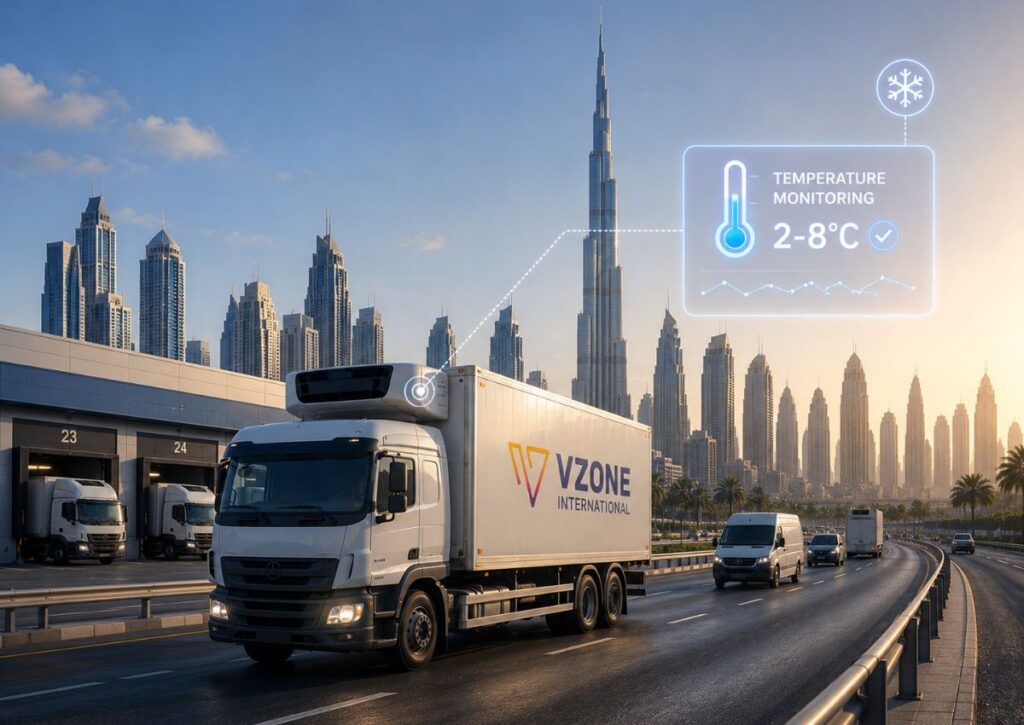
Modern cold chain monitoring in the UAE fleet context integrates three technology layers: IoT temperature sensors in the vehicle compartment, GPS telematics hardware tracking vehicle position and operational status, and a cloud-based fleet management platform that receives, processes, and presents both data streams simultaneously. This integration is what distinguishes enterprise cold chain monitoring from standalone temperature data loggers and it is the integration that enables the real-time alerting and automated documentation that regulatory compliance increasingly demands.
IoT Temperature Sensors How They Work
IoT temperature sensors are compact wireless devices installed inside refrigerated vehicle compartments, cargo containers, or cold storage units. They measure temperature at configured intervals typically every one to five minutes and transmit readings over Bluetooth, cellular, or Wi-Fi connections to the fleet management cloud platform. Multi-probe configurations allow simultaneous monitoring of different compartment zones within a single vehicle essential for vehicles carrying multiple cargo categories at different temperature setpoints, or for detecting cold spots and warm zones within a large compartment that a single sensor would miss.
The sensor hardware used in UAE fleet applications must be rated for the ambient operating conditions sensors designed for European climates may not perform reliably when the vehicle exterior is exposed to 47°C summer temperatures while the compartment interior is maintained at 2°C, creating significant thermal stress on sensor electronics. Hardware selection for UAE cold chain monitoring should include operating temperature specification review, not just sensor accuracy specifications.
GPS-Integrated Cold Chain Monitoring The Operational Advantage
The critical capability that separates GPS-integrated cold chain monitoring from standalone temperature loggers is the combination of location and temperature data in a single real-time alert. When a temperature excursion is detected, the platform simultaneously knows the vehicle’s current GPS position, its speed and movement status, and the trend direction of the temperature deviation. This context transforms a temperature alert from a notification that something has gone wrong into actionable intelligence about what can be done about it.
If a temperature breach alert arrives and the GPS data shows the vehicle is stationary at a delivery point, the operations manager knows the driver may have left the compartment open during offloading. If the alert arrives while the vehicle is in motion on a highway, it likely indicates a reefer unit mechanical issue. If it arrives during a known high-ambient-temperature period and the vehicle is approaching a loading dock, it may indicate a pre-cooling failure at the dock. Each scenario requires a different operational response and only GPS-integrated monitoring provides the context to distinguish between them in real time.
Reefer Unit Monitoring Beyond Cargo Temperature
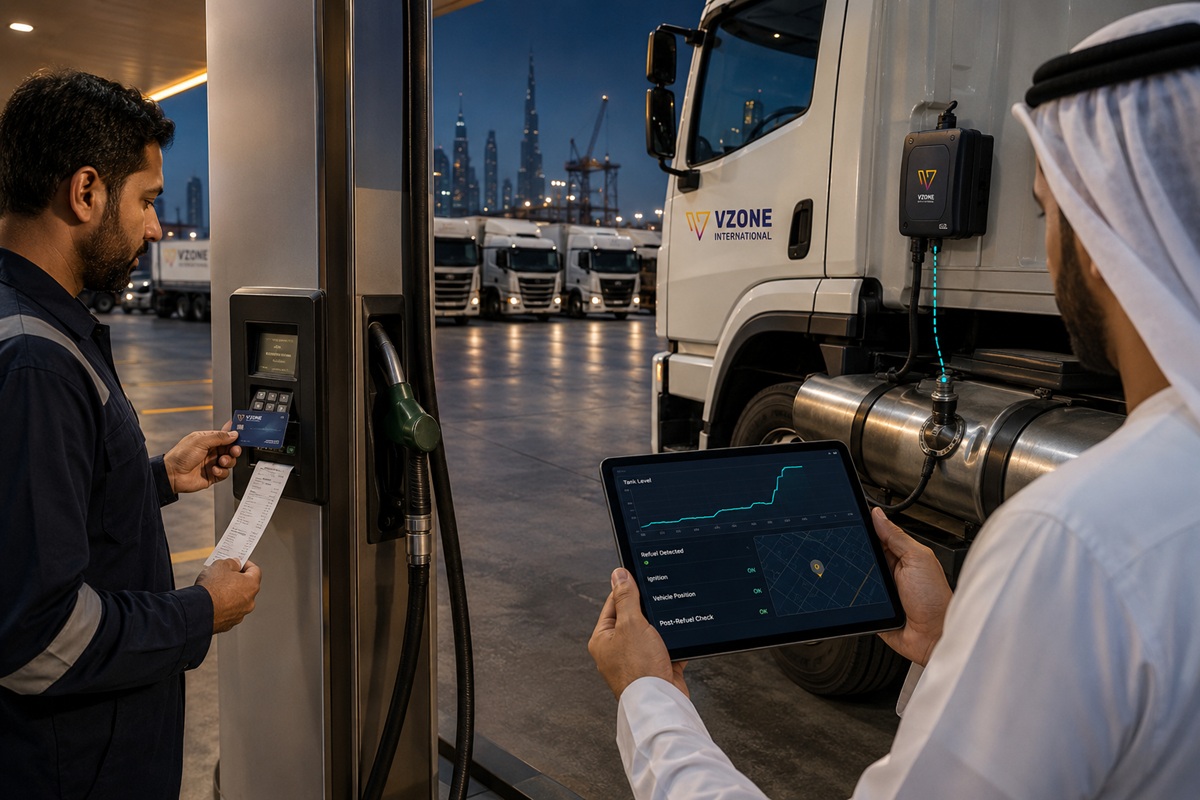
Enterprise cold chain monitoring for refrigerated vehicles extends beyond cargo compartment temperature to include reefer unit operational data compressor status, fuel level in the reefer’s dedicated fuel tank, defrost cycle timing, and return air temperature. This data stream is distinct from cargo temperature: cargo temperature tells you the condition of what is in the vehicle; reefer unit data tells you the condition of the system maintaining that temperature.
Reefer unit health monitoring enables predictive maintenance for refrigeration systems identifying compressor performance degradation, refrigerant level anomalies, and fuel consumption patterns that indicate emerging mechanical issues before they cause a compartment temperature failure. For a fleet operator running high-value pharmaceutical or premium fresh produce cargo, a reefer unit that fails en route is a cargo loss event with financial consequences that dwarf the cost of the refrigeration system maintenance that would have prevented it.
Cloud Platform Alerts, Reporting, and Compliance Documentation
The cloud platform layer is where temperature and GPS data is converted into operational intelligence and compliance documentation. Alert configurations define the temperature thresholds and response windows that trigger notifications typically a pre-alert at 90 percent of the acceptable range to allow corrective action before a breach occurs, and a confirmed breach alert when the threshold is crossed. Alert routing should be configurable by cargo type, vehicle, route, and time of day a pharmaceutical delivery route at 2am needs different alert recipients than a produce delivery route during business hours.
Compliance documentation is the output that regulators, retail customers, and food safety auditors require. Enterprise cold chain platforms generate automated HACCP-compatible temperature reports for each journey showing temperature at configured intervals, any excursion events with timestamps and GPS coordinates, and the duration and magnitude of any breach. These reports are generated automatically from platform data without manual extraction, and can be formatted to meet specific customer or regulatory requirements. The difference between having this documentation and having to reconstruct it manually from a data logger download after the fact is the difference between a robust compliance programme and a reactive one.
UAE Regulatory Requirements for Cold Chain Operations
Cold chain operators in the UAE are subject to regulatory requirements from multiple authorities depending on the cargo category and operating emirate. Understanding which regulations apply and what documentation they require is essential for both compliance programme design and monitoring technology specification.
UAE Food Safety Regulations FSRA and Dubai Municipality
In Abu Dhabi, food safety regulation is governed by the Abu Dhabi Food Safety Authority (now integrated within the FSRA Food Safety and Biosecurity Authority). In Dubai, food safety is regulated by Dubai Municipality’s Food Safety Department. Both authorities require food businesses including logistics and transport operators handling food products to implement food safety management systems that include temperature control documentation throughout the supply chain.
Specifically, food transport operators are required to demonstrate that temperature-controlled vehicles maintain prescribed temperature ranges throughout journeys, that temperature records are available for inspection, and that corrective action procedures exist for temperature excursion events. Paper-based manual temperature logging systems are increasingly scrutinised during inspections regulators in both Abu Dhabi and Dubai have indicated a preference for automated electronic documentation systems that provide tamper-resistant, timestamped records.
Pharmaceutical Cold Chain WHO GDP and UAE MoHAP Requirements
Pharmaceutical cold chain operations in the UAE are subject to the UAE Ministry of Health and Prevention (MoHAP) regulations aligned with WHO Good Distribution Practice (GDP) guidelines. GDP requirements for cold chain pharmaceutical logistics are substantially more rigorous than food cold chain standards they require qualification documentation for refrigerated vehicles, temperature mapping studies for storage areas, continuous monitoring with calibrated instruments, documented alarm management procedures, and a comprehensive audit trail from manufacturer to final dispensing point.
For pharmaceutical distributors operating in the UAE, GDP compliance is not just a regulatory obligation it is a commercial prerequisite. Major pharmaceutical manufacturers and international regulatory authorities routinely conduct GDP audits of UAE distribution partners, and non-compliant distributors risk loss of product supply agreements. The temperature monitoring system is one of the primary audit examination points: calibration records, alert response documentation, and excursion investigation reports are all reviewed during a GDP audit.
HACCP in UAE Cold Chain Logistics What Operators Must Document
HACCP (Hazard Analysis and Critical Control Points) is the internationally recognised food safety management framework that underpins UAE food safety regulation. For cold chain logistics operators, temperature control during transport is a Critical Control Point (CCP) meaning it requires defined critical limits, continuous monitoring procedures, corrective action protocols, verification activities, and record-keeping systems.
The HACCP documentation requirement for cold chain transport is straightforward in principle: you must be able to demonstrate, for any given shipment, that temperature was maintained within the critical limits throughout transport, that any deviations were recorded and investigated, and that corrective actions were taken and documented. A GPS-integrated cold chain monitoring platform that automatically generates journey temperature reports and excursion event logs satisfies this documentation requirement as a natural output of normal operations without requiring manual data extraction, report compilation, or reconstructed records that invite auditor scrutiny.
Where Cold Chain Failures Actually Happen in UAE Logistics
Understanding the actual points of failure in UAE cold chain operations is more useful than a generic list of temperature monitoring best practices. These are the specific operational scenarios where temperature excursions most frequently occur — and where monitoring configuration should be specifically designed to detect them.
Loading and Unloading The Most Vulnerable Window
The loading and unloading phase is consistently the highest-risk period in cold chain transport. Refrigerated compartment doors are opened, the compartment is exposed to ambient temperature, product is moved in or out, and this activity can take anywhere from 5 minutes to 45 minutes depending on the delivery complexity. In UAE summer conditions 42°C to 47°C ambient a compartment that was at 3°C can rise to 15°C within 15 minutes of door opening.
The most effective mitigation is a combination of monitoring and procedure: sensors that alert when door-open duration exceeds a defined threshold, pre-cooling requirements that ensure compartments are at temperature before loading begins, and driver training that emphasises minimising door-open time. Monitoring alone without the procedural standard and training creates awareness of the problem without eliminating it. The alert is not the solution; it is the trigger for a trained response.
Reefer Unit Mechanical Failures En Route
Reefer compressor failures, fuel exhaustion in the reefer’s dedicated tank, and refrigerant leaks are the most common causes of mid-route temperature excursions in UAE fleet operations. These events are distinguishable from loading-related excursions by their temperature trend signature: a slow, steady temperature rise while the vehicle is in motion indicates a reefer system failure rather than a door-open event. GPS-integrated monitoring identifies this pattern and can trigger both a driver alert and a dispatcher notification simultaneously enabling the dispatcher to redirect the vehicle to the nearest cold storage facility for cargo transfer while the driver is still far enough from the delivery point to prevent a full cargo loss.
Last-Mile Delivery in Non-Refrigerated Vehicles
A frequently overlooked cold chain gap in UAE urban logistics is the last-mile handover where products that have been correctly maintained throughout the primary distribution run are transferred to a non-refrigerated or inadequately refrigerated vehicle for urban delivery. E-commerce grocery delivery in Dubai and Abu Dhabi, pharmacy delivery services, and hospital supply logistics all face this challenge. Products may leave a distribution centre in perfect cold chain compliance and arrive at the delivery address having spent 45 minutes in a vehicle with a standard domestic cool box rather than a proper refrigerated compartment.
Addressing last-mile cold chain integrity requires both monitoring technology extended to the last-mile vehicle layer and operational standards that define what constitutes acceptable transit packaging for different product categories and ambient temperature conditions.
Cross-Docking and Transhipment at Ambient Temperature
At multi-stop distribution operations and cross-dock facilities, cargo spends time in intermediate environments staging areas, loading docks, sorting zones that may not be temperature-controlled. In a UAE logistics facility where the warehouse ambient temperature in summer can reach 38°C, even brief exposure during pallet sorting or cargo consolidation can initiate a temperature excursion. Monitoring solutions that extend beyond the vehicle to include fixed sensors at dock doors, staging areas, and cross-dock zones create the complete chain visibility that vehicle-only monitoring misses.
Refrigerated Container Monitoring at Port and Depot
UAE logistics operators receiving imported refrigerated cargo through Jebel Ali or other ports face a specific cold chain challenge: maintaining temperature integrity during the period between container arrival and vehicle loading for onward distribution. Refrigerated containers at port plugged into reefer power points are monitored by the terminal operator, but the handover period container unplugged, moved to a loading dock, opened, and product palletised onto distribution vehicles is a monitoring gap that portable temperature loggers and dock-side sensors together must address.
Key Features of an Effective Cold Chain Monitoring System for UAE Fleets
Not all cold chain monitoring solutions are appropriate for the operational intensity and climatic conditions of UAE logistics. These are the capabilities that define an enterprise-grade cold chain monitoring system in this market.
| Feature | Why It Matters in UAE Context | Without It |
| Multi-zone temperature sensors per compartment | Detects cold spots and warm zones in large compartments; critical for multi-category mixed loads | Single-point readings miss localised excursions that cause partial cargo loss |
| Real-time alerts with GPS context | Identifies excursion cause (door open vs. reefer failure vs. dock exposure) for correct response | Alert without location context delays response and prevents cause identification |
| Pre-alert at 90% of threshold | Enables corrective action before breach is confirmed; particularly critical for pharmaceutical cargo | First alert arrives after the excursion is already a compliance event |
| Reefer unit engine and fuel monitoring | Predictive maintenance for refrigeration systems; fuel exhaustion detection before compartment breach | Reefer failures are discovered only when cargo temperature is already affected |
| Automated HACCP-compatible journey reports | Satisfies FSRA, Dubai Municipality, and WHO GDP documentation requirements without manual extraction | Manual report compilation creates audit risk and administrative overhead |
| Calibration certificate management | GDP pharmaceutical requirement: all monitoring instruments must have current calibration records | GDP audit failure if calibration records are absent or expired |
| Multi-compartment vehicle support | UAE chilled/frozen combined loads in same vehicle; different setpoints per zone require independent monitoring | Single-setpoint monitoring misses excursions in the secondary zone |
| Offline data logging with upload on connectivity restoration | Coverage in areas with cellular dead zones tunnels, remote industrial areas, cross-border routes | Data gaps in records create HACCP documentation deficiencies |
| Integration with fleet management GPS platform | Unified operations dashboard; temperature and location in single interface for dispatcher and manager | Separate systems require cross-referencing two platforms for incident investigation |
Cold Chain Monitoring for Specific UAE Industries
Food and Beverage Distribution
The UAE food distribution sector operates under some of the most demanding cold chain conditions in the region. Import volumes through Jebel Ali represent a substantial proportion of GCC food supply and the distribution chain from port to retailer to consumer involves multiple handoffs each of which is a potential excursion point. UAE food distributors handling fresh produce, chilled dairy, and frozen products for major retail chains are increasingly required by retail customers to provide temperature records as a condition of supply not just as a regulatory compliance exercise but as a commercial quality assurance standard.
The operational implication is that cold chain monitoring documentation has become a commercial differentiator in UAE food distribution: distributors who can provide clean, automated temperature records for every delivery are preferred partners for retailers and foodservice operators who carry their own food safety liability. The monitoring investment pays back not only in cargo loss reduction and regulatory compliance but in supply agreement quality and customer retention.
Pharmaceutical and Healthcare Distribution
UAE pharmaceutical logistics is one of the most documentation-intensive cold chain environments globally. WHO GDP guidelines require pharmaceutical distributors to maintain qualification records for refrigerated vehicles (demonstrating that the vehicle maintains temperature within specification under defined test conditions), continuous monitoring with calibrated instruments, alarm management procedures with documented response records, and periodic requalification when vehicles are modified or repaired.
For pharmaceutical distributors operating in the UAE, GDP compliance is audited by both the MoHAP and by international pharmaceutical manufacturers who require supply chain qualification as a condition of product supply. An automated cold chain monitoring platform that maintains calibration certificates, generates alarm response audit trails, and provides journey temperature records in GDP-formatted reports is not a cost item it is a qualification enabler that determines whether a distributor can access regulated pharmaceutical supply contracts.
E-Commerce Grocery and Meal Kit Delivery
The rapid growth of online grocery and meal kit delivery in Dubai and Abu Dhabi has created a significant cold chain challenge at the last mile. Consumers ordering chilled or frozen groceries through platforms expect delivery that maintains product integrity but the last-mile delivery model, with multiple drops per route and high dwell time in vehicles, creates cold chain conditions that are genuinely difficult to maintain without purpose-built refrigerated delivery vehicles and monitoring systems.
UAE e-commerce grocery operators are investing in temperature-monitored last-mile delivery specifically to address customer complaint rates related to delivered product quality. The monitoring data also enables proactive customer communication when an excursion is detected alerting the customer before delivery and offering replacement rather than responding reactively to complaints. In a market where consumer ratings directly affect platform visibility, proactive quality management enabled by monitoring technology has direct commercial value.
Hospital and Clinical Supply Chain
UAE hospitals and clinical laboratories handle temperature-sensitive products ranging from pharmaceuticals and vaccines to blood products, tissue samples, and diagnostic reagents. The cold chain for these products has zero tolerance for excursion: a blood sample that has been outside prescribed temperature range is invalid; a vaccine that has been temperature-compromised must be destroyed. Hospital supply chain managers need monitoring systems that provide a complete, auditable temperature record from supplier dispatch through hospital receipt to point-of-use storage.
DHA (Dubai Health Authority) and HAAD (Abu Dhabi) regulations for healthcare cold chain align with international standards and require automated temperature monitoring with alert systems and complete audit trails. Hospital procurement departments increasingly specify cold chain monitoring capability as a qualification requirement for logistics suppliers tendering for clinical supply contracts.
Common Cold Chain Monitoring Mistakes UAE Operators Make
Mistake 1 Relying on Single-Point Temperature Sensors
A single temperature sensor positioned in one location within a refrigerated compartment gives you the temperature at that point not the temperature across the entire cargo space. In large refrigerated vehicles or containers, temperature gradients of 4°C to 8°C between sensor location and the worst-performing zone are common, particularly near door seals and in areas furthest from the evaporator. Multi-probe configurations that sample multiple zones within the compartment are the minimum standard for cargo where temperature uniformity matters which is most pharmaceutical and chilled food cargo.
Mistake 2 Treating Monitoring as Separate from Fleet Operations
Cold chain monitoring deployed as a standalone temperature logger system disconnected from the fleet GPS platform creates exactly the operational silo that prevents effective incident response. When a temperature alert fires at 11pm and the operations manager needs to know where the vehicle is, whether it is moving, what the driver’s contact status is, and which depot is nearest with cold storage capacity, they need integrated fleet and temperature data in a single platform. Separate systems for GPS and temperature create critical response delays that convert containable excursion events into full cargo losses.
Mistake 3 No Pre-Alert Configuration
Most cold chain monitoring platforms support pre-alert thresholds notifications sent when temperature reaches a defined percentage of the critical limit, before the limit itself is breached. An alarm set only at the regulatory limit means the first notification arrives when a compliance event has already occurred. A pre-alert at, say, 80 to 90 percent of the limit gives the operations team a response window typically 15 to 30 minutes to intervene before the excursion becomes a documentation event. This configuration is one of the simplest and most valuable tuning adjustments available in a cold chain monitoring system, and it is frequently overlooked in initial platform setup.
Mistake 4 Neglecting Calibration Management for Pharmaceutical Operations
WHO GDP guidelines require that temperature monitoring instruments used in pharmaceutical cold chain operations carry current calibration certificates and are recalibrated at defined intervals. A monitoring sensor that has never been calibrated, or whose calibration certificate has expired, is a GDP non-conformance regardless of how accurately it reads. Managing calibration schedules across a fleet of sensors is an administrative requirement that enterprise monitoring platforms can automate but only if the calibration management module is configured and maintained as part of the initial platform setup.
VZone International’s Cold Chain Monitoring Solution
VZone International provides integrated cold chain monitoring solution for UAE fleet operators combining IoT temperature sensor hardware with GPS vehicle tracking and cloud-based fleet management on a unified Wialon and FMSiTrack platform. The integration delivers real-time temperature and location visibility, automated HACCP-compatible compliance reports, and pre-alert configurations that give operations teams a genuine response window before excursions become compliance events.
Multi-Zone Temperature Monitoring with GPS Integration
VZone deploys multi-probe temperature sensor configurations for UAE refrigerated fleet vehicles monitoring up to four independent compartment zones per vehicle simultaneously, with each zone’s temperature data paired in real time with the vehicle’s GPS position on the fleet management dashboard. Operations managers see vehicle location and compartment temperature in a single interface no platform switching, no data cross-referencing, no delayed response from working across disconnected systems.
HACCP-Compatible Automated Reporting
VZone’s platform generates automated temperature journey reports for every refrigerated vehicle trip showing temperature readings at configured intervals, any excursion events with precise timestamps and GPS coordinates at the moment of the event, and the duration and magnitude of each deviation. These reports are generated automatically at trip completion without requiring manual data extraction or report compilation, and are formatted to satisfy FSRA, Dubai Municipality, and WHO GDP documentation requirements.
Pharmaceutical GDP Compliance Support
For pharmaceutical distribution clients, VZone provides calibration certificate management for deployed sensor hardware, alarm management configuration aligned with GDP response time requirements, and journey report formats designed for MoHAP regulatory submissions and manufacturer GDP audit responses. The platform maintains the audit trail that GDP guidelines require alarm event logs, response records, and excursion investigation documentation as structured data accessible for audit review.
Reefer Unit Health Monitoring and Predictive Maintenance
VZone’s cold chain platform integrates reefer unit engine data alongside cargo temperature monitoring providing operations managers with visibility over compressor operational status, reefer fuel level, and return air temperature trends that indicate emerging mechanical issues before they cause compartment temperature failures. Predictive maintenance alerts triggered by reefer performance trend analysis enable scheduled maintenance interventions that prevent the mid-route failures responsible for the most significant cargo loss events in UAE refrigerated fleet operations.
Conclusion: Cold Chain Monitoring Is the Foundation of Temperature-Sensitive Logistics in UAE
The UAE’s combination of extreme ambient temperatures, high-value temperature-sensitive cargo volumes, and increasingly rigorous regulatory enforcement makes cold chain monitoring not a competitive advantage but an operational foundation. Without real-time temperature visibility and automated compliance documentation, a UAE cold chain logistics operation is exposed to cargo loss, regulatory non-compliance, and commercial consequences that are disproportionate to the cost of the monitoring technology that prevents them.
The evolution from standalone temperature loggers to GPS-integrated, IoT-connected cold chain monitoring platforms has fundamentally changed what is operationally possible: excursions can be detected before they become compliance events, reefer failures can be predicted before they cause cargo loss, and compliance documentation can be generated automatically without the manual overhead that previously made rigorous cold chain documentation impractical at scale.
For UAE food distributors, pharmaceutical logistics operators, e-commerce grocery services, and healthcare supply chain operators, the question is not whether to invest in cold chain monitoring it is whether the system in place provides the real-time alerting, the GPS integration, and the automated compliance documentation that the UAE regulatory environment and customer quality expectations now demand.
Need cold chain monitoring for your UAE refrigerated fleet?
VZone International provides integrated cold chain monitoring solutions IoT multi-zone temperature sensors, GPS fleet integration, automated HACCP-compatible reports, and pharmaceutical GDP compliance support. Our UAE team configures systems for food, pharmaceutical, healthcare, and e-commerce cold chain operations across UAE and GCC. Contact us for a free cold chain monitoring assessment for your fleet.
Frequently Asked Questions
Cold chain monitoring is the continuous measurement and recording of temperature conditions experienced by temperature-sensitive cargo throughout its supply chain journey from storage through transport to final delivery. In logistics, it combines IoT temperature sensors in refrigerated vehicles and storage areas with cloud-based platforms that provide real-time alerts, automated compliance reports, and historical temperature records. In the UAE, it is required for food, pharmaceutical, and healthcare logistics under FSRA, Dubai Municipality, and WHO GDP regulations.
Required temperatures vary by cargo category. Fresh produce and chilled dairy typically require 0°C to +8°C. Frozen food requires -18°C or below. Pharmaceutical cold chain products (vaccines, biologics, temperature-sensitive medicines) generally require +2°C to +8°C under strict continuous monitoring. Ambient pharmaceutical products require +15°C to +25°C. UAE regulatory requirements align with international food safety and WHO GDP standards your monitoring system must be configured to the specific temperature limits for your cargo category, not a generic setting.
HACCP (Hazard Analysis and Critical Control Points) is the internationally recognised food safety management framework mandated by UAE food safety regulations. For cold chain transport operators, temperature control during transit is a Critical Control Point requiring defined critical limits, continuous monitoring, documented corrective action procedures, and complete temperature records. A cold chain monitoring platform that generates automated HACCP-compatible journey reports satisfies this documentation requirement directly, without manual record compilation.
GPS-integrated monitoring combines temperature alert data with real-time vehicle location, movement status, and driver contact capability in a single platform. When a temperature excursion alert fires, the operations manager simultaneously knows the vehicle's precise location, whether it is stationary or moving, and the temperature trend direction context that determines the correct operational response. Without GPS integration, a temperature alert alone cannot distinguish between a door-open event, a reefer failure, or a dock exposure three scenarios that each require different responses with different urgency levels.
In UAE cold chain logistics, the most frequent temperature excursion causes are: prolonged door-open time during loading and unloading in high-ambient-temperature conditions; reefer unit mechanical failures (compressor faults, refrigerant issues, fuel exhaustion in the reefer tank); last-mile delivery in inadequately refrigerated vehicles; staging at ambient-temperature cross-dock facilities; and pre-cooling failures where vehicles are loaded before compartments have reached setpoint temperature. Each has a distinct monitoring detection signature that informs the appropriate operational response.
Yes enterprise cold chain monitoring systems with GCC-wide cellular coverage maintain temperature recording and GPS tracking visibility continuously across UAE, Saudi Arabia, and Oman borders without data gaps. Offline logging capability in devices ensures temperature records are maintained even in the relatively rare cellular dead zones encountered on cross-border routes, with data uploaded to the platform when connectivity is restored. Compliance documentation generated covers the full journey regardless of border crossings.