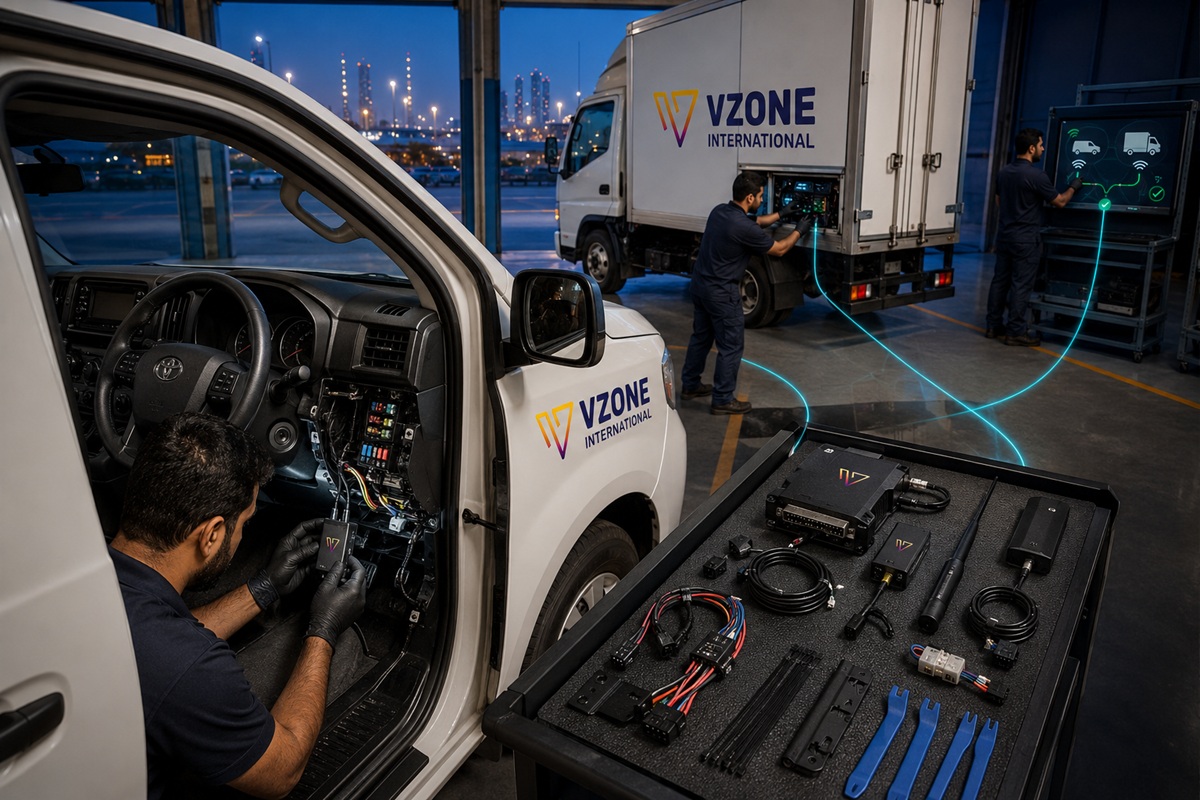
UAE’s construction sector is one of the most active in the world and one of the most demanding for fleet managers. A typical mid-size UAE construction company simultaneously manages light pick-up trucks carrying personnel between sites, heavy delivery trucks bringing materials and equipment, cranes and excavators on active civil works, generators powering site operations and a rotating inventory of portable high-value tools and equipment that moves constantly between locations. Without GPS fleet management, visibility over this mixed asset base is essentially a combination of manual registers, supervisor phone calls and periodic site visits none of which scale with project complexity.
The consequences of poor visibility in construction fleet management are direct and financial. Equipment that is stolen between sites and not recovered promptly costs replacement value plus project delay. Generators that run dry because no one was monitoring fuel levels cause operational downtime that cascades through project schedules.
Vehicles operating on site at speeds above the HSE-specified site limit create accident risk that, when it materialises, generates both human cost and contractor liability. And for EPC contractors working for ADNOC or other regulated clients, failing to demonstrate IVMS compliance for site vehicles creates contract exposure.
This guide covers the full spectrum of GPS and IoT tracking requirements for UAE construction fleet operations from pick-up trucks and heavy vehicles to cranes, excavators, gensets and portable tools and the specific safety and compliance challenges that make construction fleet management distinct from other sectors.
Key Takeaways
- UAE construction fleet management requires tracking solutions for multiple distinct asset categories simultaneously road vehicles, heavy plant, static generators, and portable equipment each with different hardware requirements and monitoring priorities.
- Heavy equipment theft during UAE public holidays and Eid breaks when site security is reduced is a documented and financially significant risk that GPS motion-detection alerts and geofencing specifically address.
- Generator fuel theft on UAE construction sites follows a predictable pattern detectable by IoT fuel sensors: rapid level decline inconsistent with normal consumption rate, typically occurring at night or during reduced-staffing periods.
- Construction site speed limits typically 10 to 20 km/h within active site boundaries require geofenced speed profiles in GPS systems, not standard road speed thresholds, to detect on-site speeding violations correctly.
- EPC contractors working for ADNOC clients must satisfy IVMS requirements for vehicles operating on ADNOC-affiliated project sites the same standard as direct ADNOC contractor fleets.
- Emergency SOS capability for drivers and operators on remote construction sites where cellular coverage may be limited and incident response times are long is a safety requirement that GPS-enabled devices with satellite fallback can address.
Unique Fleet Challenges for Construction Companies in UAE
Multi-Site Operations One Dashboard for All Locations
A construction company running multiple concurrent projects in UAE a residential tower in Dubai Marina, a road infrastructure project in Abu Dhabi, and an industrial facility in Sharjah manages fleet assets spread across geographically separate locations with different site managers, different client HSE requirements, and different vehicle and equipment inventories. Without a unified tracking platform, fleet managers receive information through fragmented channels: phone calls from site supervisors, WhatsApp messages with photos of damaged equipment, and end-of-day reports that are already hours out of date.
A unified GPS fleet dashboard consolidates all site locations into a single operational view every vehicle and piece of tracked equipment visible simultaneously, with the ability to filter by site, asset type, or alert status. The cross-site visibility enables fleet managers to identify where equipment is sitting idle at one site while another site is waiting for the same category, to respond to theft alerts from any site in real time without physical presence, and to review driver behaviour data across the entire fleet regardless of which site the vehicle is assigned to.
Mixed Asset Types Vehicles, Plant, and Portable Equipment
Construction fleet asset categories have fundamentally different tracking requirements that a single hardware solution cannot address. Road vehicles pick-up trucks, delivery lorries, concrete mixers use hardwired GPS telematics devices with OBD or direct power connection, transmitting continuously via cellular. Heavy plant excavators, bulldozers, mobile cranes needs battery-powered GPS asset trackers that operate without a standard ignition circuit, with motion-activated transmission and engine-hour recording from power circuit monitoring. Static assets generators, compressors, water pumps use IoT sensor packages with GPS communication modules, monitoring fuel levels, runtime hours and operational status. Portable tools and equipment use Bluetooth Low Energy tags detected by gateway devices installed in vehicles and site offices.
Managing all four categories in a single platform rather than deploying separate tracking systems for vehicles, equipment, and generators is the operational efficiency that modern construction fleet management achieves. The unified view eliminates the coordination overhead of cross-referencing multiple systems during incident investigation, asset relocation decisions, and maintenance scheduling.
High Theft Risk Equipment Stolen Between Sites
Construction equipment theft is a persistent and financially significant problem across UAE project sites. The theft pattern is well-established: high-value plant excavators, compactors, generators is targeted during periods of reduced security presence, typically at night, during Friday prayers, and over public holidays when skeleton staffing leaves sites lightly supervised. Equipment is loaded onto flatbed transporters and moved off-site within 30 to 60 minutes, making rapid detection and response essential. Without GPS tracking, the equipment may not be confirmed missing until the following working day, by which point it has typically been moved to a secondary location.
GPS asset trackers with motion-detection alerts triggered by any movement outside operational hours or outside the geofenced site boundary detect theft events within two to five minutes of the initial equipment movement. An alert routed to a 24-hour site security contact or operations manager provides an intervention window before the equipment leaves the site perimeter. The response window is the critical factor: equipment that triggers a GPS alert while still on-site has a very high recovery probability; equipment that triggers an alert after it has been loaded and transported off-site has substantially lower recovery odds even with active GPS tracking.
Driver and Operator Safety on Active Construction Sites
Construction sites in UAE are among the most safety-intensive operating environments for vehicle drivers and equipment operators. Congested site access roads, pedestrian workers crossing vehicle routes, low-speed manoeuvring in confined spaces near excavations and scaffolding structures, and the interaction between road vehicles and mobile heavy plant all create collision risk that is directly related to vehicle speed and driver attentiveness. UAE construction HSE plans specify site speed limits typically 10 to 20 km/h on internal site roads that are significantly below road speed thresholds, requiring GPS speed monitoring configurations that apply site-specific limits within the geofenced site boundary.
Driver behaviour monitoring on construction site vehicles reveals patterns that site-speed-only compliance monitoring misses: a driver who respects the 20 km/h site limit but consistently makes harsh turning manoeuvres near pedestrian areas is generating collision risk that speed data alone does not capture. Combined GPS behavioral monitoring speed, harsh braking, cornering, and AI dashcam distraction detection creates the comprehensive safety picture that construction HSE managers need to identify and address risk before incidents occur.
Fuel Management Gensets and Heavy Machinery Consumption
Fuel consumption across a large UAE construction project’s vehicle fleet, heavy plant, and generator inventory represents one of the largest and most opaque operational costs. Heavy equipment running at full load in UAE summer conditions consumes diesel at rates that accumulate quickly an excavator idling for two hours while waiting for material delivery, a generator running at partial load overnight because no one turned it down after peak demand passed, a supply truck making an unoptimised round trip to the wrong depot. Without IoT-connected fuel monitoring, the total waste across these events is absorbed invisibly into the fuel budget with no attribution to specific assets, operators, or operational decisions.
Heavy Equipment GPS Tracking for Construction Sites
Hardwired Trackers for Excavators and Cranes
Excavators, bulldozers, compactors, and motor graders are tracked with hardwired GPS asset trackers connected to the equipment’s battery or auxiliary power circuit. The device records location continuously when the equipment is operational and switches to periodic low-power transmission during stationary periods conserving battery while maintaining a location record for theft detection purposes. Engine-hour recording from the power circuit provides the utilisation data that project managers and plant coordinators need for maintenance scheduling and equipment productivity assessment.
For cranes both tower cranes on high-rise projects and mobile cranes used across multiple sites GPS tracking serves both location monitoring and load compliance purposes in more advanced deployments. Mobile crane GPS data provides the location history that confirms a crane was at the correct site during a specific project activity period useful for contract billing verification and for incident investigation if a crane movement is disputed. Tower crane GPS units provide the continuous position monitoring that confirms the crane has not been tampered with outside operational hours.
Asset Tracking Tags for Tools and Portable Equipment
The portable equipment category specialised survey instruments, vibration analysers, concrete testing equipment, power tools, and temporary site infrastructure components represents significant replacement cost and long lead times if lost or misplaced, but does not warrant the per-item cellular subscription cost of full GPS tracking. Bluetooth Low Energy (BLE) asset tags provide zone-level presence tracking at a cost and complexity level appropriate for this asset category.
BLE tags are small, battery-powered devices (typically lasting one to two years on a coin cell battery) that broadcast their presence to BLE-capable gateway devices installed in site vehicles, site offices, and tool containers. When a tagged item moves into range of a gateway, its presence is logged with timestamp and location. Zone exit alerts triggered when a tagged item is no longer detected by any gateway within a defined site boundary provide the theft or misplacement detection that protects this asset category without requiring the real-time cellular connectivity that full GPS tracking demands.
Unauthorised Movement Alerts After-Hours and Zone Breach
After-hours movement alerts are the primary theft prevention tool for GPS-tracked heavy plant and equipment. Configuration requires defining two parameters: the authorised operating hours for each asset category on each site, and the geofenced boundary within which the asset should remain. Any movement detected outside these parameters triggers an immediate alert. The alert delivery routing is critical: it must reach a person with authority and capability to respond site security, the on-call operations manager, or a direct police contact not just a fleet management system notification that sits unread until the next working day.
Zone breach alerts triggered when tracked equipment moves outside the defined site boundary regardless of time of day catch the rare cases of authorised equipment relocation that was not communicated to the fleet management team, as well as the more serious cases of unauthorised movement. A false alarm from an authorised relocation is resolved with a brief confirmation call; a true alarm from unauthorised movement is addressed with an immediate response. The asymmetry of consequences justifies a low threshold for alert generation in construction equipment tracking.
Generator Tracking on UAE Construction Sites
Remote generators are the power infrastructure backbone of construction sites in UAE locations not connected to the DEWA or ADDC grid which includes most active construction sites during the early project phases before utility connections are established. A major UAE construction project may run 20 to 80 generators simultaneously, with fuel consumption representing a significant and frequently underestimated project operating cost. IoT-connected generator monitoring transforms this opaque cost into a managed, visible, attributable budget line.
Remote Fuel Level Monitoring via IoT Sensors
IoT fuel level sensors installed in generator tanks connected to GPS communication modules that transmit readings to the cloud platform every 15 to 30 minutes provide project managers with a real-time fuel level dashboard for every monitored generator on every site. The practical elimination of unexpected generator failures from fuel exhaustion alone typically justifies the monitoring investment: a generator that shuts down unexpectedly during active concrete pouring, structural welding, or refrigerated material storage causes project delays and material losses that dwarf the fuel monitoring subscription cost for the entire project.
Pre-alert configurations triggered when fuel reaches 25 to 30 percent of tank capacity enable scheduled refuelling that prevents operational disruption. The alert includes the generator’s GPS location and the current fuel level, enabling the fuel logistics team to plan the refuelling run with precise destination information rather than estimated tank sizes from manual checks.
Runtime Tracking Scheduled vs Actual Engine Hours
Generator maintenance is scheduled on engine runtime hours, not calendar time. An IoT monitoring system that records cumulative runtime hours for each generator enables maintenance scheduling that reflects actual utilisation intensity preventing both under-servicing (missing service intervals for high-utilisation generators running continuous base load) and over-servicing (scheduling maintenance prematurely for standby generators with minimal runtime). On a large construction project with mixed-utilisation generators, runtime-based maintenance scheduling typically reduces total maintenance cost and unplanned breakdown frequency simultaneously.
Runtime data also enables utilisation analysis at the project management level: generators that run for only two to four hours per day on a site with 16 hours of active operations are candidates for consolidation or right-sizing. Oversized generators running at low load fractions consume disproportionate fuel relative to their power output a fuel efficiency problem that runtime and load monitoring can identify and that right-sizing resolves.
Preventive Maintenance Alerts for Generators
Generator maintenance alert triggers from IoT monitoring include runtime hour thresholds for oil changes, filter replacements, and full service intervals, as well as operational anomaly detections abnormal oil temperature trends, voltage fluctuations, and load factor deviations that indicate emerging mechanical issues before they cause failure. Preventive maintenance alerts generated automatically from IoT data eliminate the manual tracking burden of monitoring 40 or 80 generators across multiple sites on separate maintenance schedules, and ensure that no generator misses a service interval because it was overlooked in a manual tracking system.
| Asset Type | Tracking Solution | Key Alerts | Primary Benefit | ADNOC / HSE Compliance? |
| Pick-up trucks and light vehicles | Hardwired GPS + IVMS for site vehicles | Speeding (site limit), geofence exit, after-hours movement | Driver safety + fuel savings | IVMS required for ADNOC contractor sites |
| Heavy supply trucks and mixers | GPS + IVMS + AI dashcam | IVMS behavior data + fatigue detection | ADNOC HSE compliance + accident reduction | IVMS required for ADNOC affiliate sites |
| Excavators and bulldozers | Hardwired GPS asset tracker | After-hours movement, zone breach, engine hours | Theft prevention + maintenance scheduling | Site tracking required by EPC HSE plans |
| Mobile cranes | GPS + optional load monitor | Location, after-hours alert, zone breach | Theft prevention + billing verification | Site tracking HSE plan dependent |
| Tower cranes | GPS unit + tamper detection | After-hours alert, tamper event | Security monitoring | HSE plan dependent |
| Generators (gensets) | IoT fuel sensor + GPS communicator | Fuel drain alert, low fuel, runtime hours | Fuel theft prevention + maintenance + continuity | Recommended for all project types |
| Compressors and pumps | Battery GPS asset tracker | Movement detection, zone breach | Theft prevention + location tracking | HSE plan dependent |
| Portable tools and equipment | BLE asset tag + gateway | Zone exit alert, last-seen location | Loss prevention + inventory management | Optional value-proportionate |
Worker and Driver Safety on UAE Construction Sites
Driver Behaviour Monitoring for Site Vehicles
Construction site vehicle drivers operate in an environment with concentrated pedestrian activity, limited sightlines, and the constant movement of heavy plant in close proximity to light vehicles. The safety consequence of a light vehicle collision with a pedestrian or with heavy equipment on an active construction site is severe disproportionately severe compared to the same incident on an open road. Driver behaviour monitoring configured for the site operating context with site-specific speed thresholds, geofenced alert profiles, and AI dashcam distraction monitoring creates the safety data layer that construction HSE managers need to identify and address risk before incidents occur.
Driver behaviour data for construction site vehicles feeds directly into the contractor’s HSE performance record. Contractors whose GPS data shows consistently high harsh event rates on site vehicles, or persistent site speed violations by identified drivers, face HSE audit findings that affect their contractor performance rating with clients like ADNOC, Dubai Municipality, and Abu Dhabi’s major infrastructure developers. Proactive behaviour monitoring with documented coaching responses demonstrates an active safety management programme rather than passive compliance documentation.
Speed Enforcement in Low-Speed Site Zones
Construction site speed limits in UAE are set by the project HSE plan and typically range from 10 to 20 km/h on internal site access roads, with lower limits 5 to 10 km/h in active work zones where pedestrians and heavy plant interact. These limits are significantly below road speed thresholds, and GPS speed monitoring systems configured only for road speeds will not detect on-site speeding violations a vehicle travelling at 35 km/h through a 15 km/h active work zone generates no alert from a GPS system configured with an 80 km/h road threshold.
Correct site speed monitoring requires geofenced site speed profiles: a GPS configuration that applies the site-specific speed limit threshold when the vehicle is within the geofenced site boundary and reverts to road speed thresholds when the vehicle exits the site onto public roads. VZone International configures geofenced site speed profiles for construction contractor clients matching the speed thresholds specified in the project HSE plan to the exact GPS boundary of the site, with the dual-profile switching that ensures both on-site and on-road speed monitoring is correctly calibrated simultaneously.
Emergency SOS Alerts for Remote Site Operators
UAE construction sites in remote locations infrastructure projects in the Western Region, pipeline construction in desert zones, utility installation in developing industrial areas can be hours from the nearest medical facility, with cellular coverage that may be intermittent or absent in specific site areas. Equipment operators working alone in excavation zones, crane operators in elevated positions, and personnel in confined spaces all face scenarios where a rapid distress alert capability is a genuine safety requirement rather than a precautionary feature.
GPS devices with integrated SOS buttons or AI dashcams with panic button functionality in vehicle cabs allow operators and drivers to trigger an immediate alert with their precise GPS coordinates to the site safety officer or emergency response team. For sites in areas with intermittent cellular coverage, devices with satellite fallback capability ensure that SOS alerts are transmitted even when the cellular network is unavailable. The SOS capability works alongside standard GPS tracking rather than replacing it the normal operational tracking record provides the location context that enables emergency responders to understand the victim’s last movement pattern in the event they cannot reach the SOS activation point.
IVMS Requirements for UAE Construction and EPC Contractors
EPC contractors and construction companies working on ADNOC-affiliated projects in UAE are subject to the same IVMS requirements that apply to direct ADNOC contractors IVMS-certified hardware on site vehicles, multi-tier speed event reporting, driver behaviour data in HSE-formatted reports, and management review evidence demonstrating that safety data drives corrective action. The IVMS requirement follows the project contract structure: if you are working on an ADNOC-affiliated project, your site vehicles need IVMS compliance regardless of whether ADNOC is your direct contracting party.
For EPC contractors working across both ADNOC-affiliated and non-ADNOC projects, the practical recommendation is to standardise IVMS-capable hardware across the entire vehicle fleet rather than maintaining separate IVMS and non-IVMS vehicle pools. The operational overhead of managing two hardware standards different devices, different platforms, different report formats across a construction vehicle fleet that moves between project sites is substantially higher than the marginal cost of deploying IVMS-capable devices fleet-wide, even on vehicles that are not currently assigned to ADNOC projects.
Conclusion: Construction Fleet Visibility Is a Safety and Commercial Imperative
The scale and complexity of UAE construction fleet operations mixed asset types across multiple simultaneous project sites, high theft risk, strict HSE compliance requirements, and the fuel management challenge of generator-dependent power infrastructure makes GPS and IoT fleet management not a productivity enhancement but an operational necessity. The alternative is managing a multi-million-dirham asset base with manual registers, supervisor phone calls, and reactive incident response rather than real-time data and proactive alerts.
The technology stack required to address all construction fleet management challenges is layered but accessible: hardwired GPS with IVMS capability for road vehicles, battery GPS asset trackers for heavy plant, IoT fuel sensors for generators, and BLE tags for portable equipment all feeding a unified multi-site dashboard. The investment in this stack pays back through theft prevention, fuel management, maintenance scheduling, compliance documentation, and the HSE audit outcomes that determine a contractor’s access to major project work.
For UAE construction contractors preparing for ADNOC-affiliated project assignments, the IVMS compliance requirement makes fleet technology investment unavoidable. For those without that specific driver, the theft risk on a single excavator recovery or generator replacement event typically exceeds the full annual GPS tracking subscription cost for the entire equipment fleet. The business case is self-evident when the operational reality of UAE construction sites is the starting point.
Managing a construction fleet across UAE project sites?
VZone International tracks everything from pick-up trucks and heavy plant to generators and portable tools in one unified platform. We configure site-specific speed profiles, after-hours theft alerts, IoT fuel monitoring, and ADNOC IVMS-compatible reporting for construction and EPC contractors across UAE and GCC. Get a site-specific fleet demo from our construction fleet specialists.
Frequently Asked Questions
The best GPS tracking for UAE construction fleets covers mixed asset categories: hardwired GPS with IVMS capability for road vehicles, battery-powered GPS asset trackers for heavy plant and equipment, IoT fuel sensors with GPS communicators for generators, and BLE asset tags for portable tools and equipment. All should feed a unified dashboard with geofenced site speed profiles, after-hours movement alerts, and multi-site visibility. VZone International provides this complete construction fleet tracking stack for UAE project operators.
Heavy plant excavators, bulldozers, cranes, compactors is tracked using battery-powered GPS asset trackers connected to the equipment's auxiliary power circuit or running on internal battery. The device records location and engine-on hours, transmits data via cellular with motion-activated updates during stationary periods, and triggers immediate alerts for after-hours movement or zone breach events. BLE asset tags provide lower-cost zone-presence tracking for portable tools and smaller equipment where per-item cellular subscription is disproportionate to asset value.
Remote genset monitoring installs IoT fuel level sensors in generator tanks, connected to GPS communication modules that transmit real-time fuel level readings every 15 to 30 minutes to a cloud platform. Pre-alerts fire when fuel reaches 25 to 30 percent of tank capacity; drain alerts fire when fuel drops at a rate inconsistent with normal generator consumption detecting unauthorised fuel removal within minutes. Runtime hour tracking from the same system enables maintenance scheduling based on actual engine hours rather than calendar time.
GPS after-hours movement alerts are the primary theft prevention tool for tracked construction equipment. Configure each asset with its authorised operating hours and a geofenced site boundary any movement outside these parameters triggers an immediate alert routed to a 24-hour site security or operations contact. The response window is critical: equipment detected moving while still on-site has a very high recovery probability; the alert must route to someone who can respond immediately, not to a notification queue reviewed the next morning.
UAE construction site speed limits are set by the project HSE plan typically 10 to 20 km/h on internal access roads, with lower limits of 5 to 10 km/h in active work zones. GPS enforcement requires geofenced site speed profiles: the system applies the site-specific threshold when a vehicle is inside the site boundary and reverts to road speed thresholds when it exits. Standard GPS configurations with road speed thresholds only will not detect on-site speeding violations geofenced profiles are a mandatory configuration step for construction site speed compliance.
IVMS is mandatory for vehicles operating on ADNOC sites and ADNOC-affiliated project sites in UAE, covering EPC and construction contractors in addition to direct ADNOC contractors. Vehicles on non-ADNOC construction projects are not subject to the IVMS mandate, though many construction companies deploy IVMS-capable devices fleet-wide to avoid managing separate hardware pools for ADNOC and non-ADNOC assignments. VZone International recommends fleet-wide IVMS standardisation for construction contractors who work across multiple project types.