The dashcam market for fleet vehicles has expanded significantly beyond the simple forward-facing camera that most people associate with the category. Fleet operators evaluating dashcam investment in 2026 face a genuinely complex configuration decision: a forward-facing camera records the road ahead but misses the driver; a dual-lens system adds driver-facing AI monitoring but may miss the cargo area and blind spots; a 360-degree system covers everything but creates data management and installation cost overhead that is disproportionate for many fleet types.
The right dashcam configuration is not determined by which one has the most cameras it is determined by what your fleet’s specific operational risks, compliance requirements, and evidence needs actually require. A school bus operator whose primary obligation is student welfare monitoring has completely different camera configuration requirements from an ADNOC contractor operating long-haul desert routes where driver fatigue is the primary safety risk. Both have different requirements from a car rental company whose primary need is damage documentation at vehicle handover.
This guide explains what each camera configuration captures, what it misses, which UAE fleet types benefit most from each, the data and infrastructure implications of each choice, and how to match configuration to operational need rather than defaulting to maximum cameras as a proxy for maximum safety.
Key Takeaways
- The three main fleet dashcam configurations front-facing only, dual-lens (front + driver-facing), and 360-degree differ not just in coverage but in what safety and compliance problems they are designed to solve. Choosing the right one requires matching configuration to specific operational risk rather than maximising camera count.
- Front-facing cameras solve the road documentation problem: they record what happened ahead of the vehicle, provide evidence for accident claims, and can detect forward road events (lane departure, tailgating, forward collision). They do not address driver behaviour, fatigue, phone use, or cargo area monitoring.
- Dual-lens AI dashcams solve the driver behaviour monitoring problem: the driver-facing infrared camera adds fatigue detection, distraction monitoring, phone use detection, and seatbelt compliance the data that ADNOC IVMS fatigue requirements and insurance telematics programmes need. This is the configuration most UAE commercial fleets benefit most from.
- 360-degree cameras solve the blind spot and complete-surround documentation problem: they add side and rear coverage that is most valuable for large vehicles (trucks, buses, coaches) where the driver’s natural visibility is most limited and where reversing and lane-change incidents are most common.
- Data consumption scales with camera count: a dual-lens system uses roughly twice the storage and transmission capacity of a single-lens system; a 360-degree system with four to six cameras uses proportionally more. For UAE fleet deployments where live streaming is considered, this data scaling is a significant cost management factor.
Configuration 1 Front-Facing (Single Lens)
What It Captures
A front-facing dashcam records the road environment ahead of the vehicle the lane the vehicle is travelling in, the vehicles and obstacles ahead, road markings and signals, and the approach to and through junctions, roundabouts, and intersections. In an AI-enabled front-facing system, the forward camera also provides the video feed for road-environment AI detections: forward collision warning (detecting a closing gap to the vehicle ahead), lane departure warning (detecting when the vehicle crosses lane markings without indicating), and traffic sign recognition (detecting posted speed limits and stop signs).
Front-facing cameras provide the road-environment documentation that is most useful for accident claim evidence showing what the road looked like, what other vehicles were doing, and what traffic conditions existed in the seconds before a collision. For the majority of UAE accident claim scenarios where the primary factual dispute is about what happened on the road ahead of the fleet vehicle, forward footage is the most immediately relevant evidence.
What It Misses
A front-facing camera does not record the driver. It cannot detect fatigue, distraction, phone use, or seatbelt non-compliance. It cannot show what the driver was doing in the seconds before an incident only what the road was doing. For ADNOC IVMS fatigue monitoring requirements, insurance telematics premium reduction programmes, and any safety management system where driver behaviour data is needed for coaching, a front-facing-only camera is insufficient. It also provides no visibility into the cargo area, the vehicle sides, or the rear relevant for large vehicle blind spot management and cargo security monitoring.
Best UAE Fleet Applications
- Car rental fleets where forward documentation of road incidents is the primary need and driver behaviour coaching is not operationally relevant (drivers are customers, not employees)
- Small delivery vans on short urban routes where basic road documentation and a modest budget make front-facing an adequate starting point
- Company car fleets with low-risk route profiles where the primary dashcam purpose is incident evidence rather than active safety management
Configuration 2 Dual-Lens (Front + Driver-Facing)
What It Captures
A dual-lens dashcam adds a driver-facing infrared camera to the forward road camera providing simultaneous video of the road environment ahead and the driver’s face, posture, and cab environment. The infrared capability of the driver-facing lens ensures consistent image quality regardless of lighting conditions day, night, direct sunlight, or tunnel conditions enabling reliable AI detection of driver behaviour events at any time during the operating day.
The driver-facing camera feeds the AI behaviour detection engine with the video required for: fatigue detection (eye closure duration, head position, microsleep pattern recognition); distraction detection (eyes off road, phone held to ear, extended gaze direction anomaly); seatbelt compliance monitoring (seatbelt presence or absence visible on driver-facing camera); and smoking detection (hand-to-mouth posture combined with object recognition). Each detected event is tagged in the footage and transmitted as a structured alert to the fleet management platform creating the event-based data record that coaching programmes, IVMS compliance, and insurance telematics require.
Why Dual-Lens Is the Optimal Choice for Most UAE Commercial Fleets
The dual-lens configuration provides the most operationally valuable capability upgrade per unit of additional cost and data overhead for most UAE commercial fleet types. The forward camera handles road documentation; the driver-facing camera handles the driver behaviour monitoring that forward footage alone cannot provide. The combination satisfies: ADNOC IVMS fatigue monitoring expectations for long-haul contractor vehicles; insurance telematics data requirements for premium reduction programmes; driver safety score data for coaching programmes; and the complete incident evidence package (road environment + driver conduct) that is most useful for accident claim defence.
The marginal cost of the dual-lens configuration versus a single-lens system is typically AED 150 to AED 300 per vehicle in hardware, with proportionally higher storage and data transmission from the second camera. Against the operational value of driver behaviour AI detection, the cost differential is recovered within the first insurance premium renewal cycle for most UAE fleet profiles.
Best UAE Fleet Applications
- ADNOC and PDO contractor long-haul vehicles fatigue detection on desert routes is operationally and compliantly required
- Large logistics and delivery fleets driver safety score management across a large driver population requires structured per-driver event data from driver-facing cameras
- School and staff transport buses driver conduct monitoring alongside forward road documentation satisfies operator duty of care and parent / school accountability expectations
- Pharmaceutical and cold chain delivery high-value cargo protection benefits from driver behaviour monitoring alongside road documentation
- Any fleet running an insurance telematics programme the driver-facing camera provides the AI safety event data that insurance underwriters require for premium reduction assessment
Configuration 3 360-Degree (Multi-Camera Surround)
What It Captures
A 360-degree fleet camera system typically uses four to six cameras positioned around the vehicle forward, rear, and both sides to provide complete surround coverage with no blind spots. Some configurations add internal cabin cameras (for passenger vehicles) or cargo area cameras (for refrigerated or high-value cargo vehicles) to extend coverage beyond the vehicle exterior. The combined view from multiple cameras can be stitched into a bird’s-eye surround view on the fleet management platform, showing the vehicle’s complete immediate environment simultaneously.
The primary capability added by 360-degree over dual-lens is blind spot coverage: the side cameras capture what is happening in the zones alongside the vehicle that the driver cannot see in mirrors vehicles undertaking on the left, cyclists in the gutter, pedestrians alongside the vehicle during low-speed manoeuvres. The rear camera adds coverage for reversing manoeuvres and rear collisions. For large vehicles where the driver’s natural visibility is most limited and where side and rear incidents are most common, this additional coverage addresses the most significant documentation gap that front-only or dual-lens systems leave.
When 360-Degree Coverage Is Justified
The additional cost and data overhead of 360-degree camera systems is justified when the operational risk profile specifically includes blind spot, reversing, or rear collision incidents primarily for large vehicles with genuinely limited natural visibility. The incremental benefit of adding side and rear cameras to a vehicle whose driver can already see 270 degrees through windows and mirrors is lower than for a large truck driver whose side and rear visibility is fundamentally constrained by vehicle size.
For most UAE light commercial vehicle fleets delivery vans, SUVs, minibuses the dual-lens configuration provides the highest value per camera. For heavy commercial vehicles, articulated trucks, coaches, and large buses, the 360-degree configuration addresses the blind spot risk that is genuinely elevated by vehicle size.
Best UAE Fleet Applications
- Heavy trucks and articulated vehicles blind spot incidents on UAE highways and urban delivery routes are the primary risk that side cameras address
- Full-size coaches and intercity buses passenger safety during lane changes and reversing at terminals
- Construction site equipment (large vehicles) reversing and manoeuvring in site environments with high pedestrian activity
- Cash-in-transit and high-security vehicles complete external and internal coverage for security audit trails
- Waste collection vehicles reversing incidents in residential streets where pedestrians and cyclists are most at risk
Side-by-Side Comparison Which Configuration for Which UAE Fleet
Fleet Type | Recommended Config | Primary Reason | Key UAE Consideration |
ADNOC / PDO long-haul contractor | Dual-lens AI | Fatigue detection on desert routes; IVMS compliance | IR camera essential for desert dawn/dusk and night driving conditions |
Urban last-mile delivery fleet | Dual-lens AI | Driver behaviour coaching; insurance telematics data | High stop frequency increases distraction risk driver-facing detection most relevant |
School bus | Dual-lens AI + optional cabin | Driver monitoring + passenger welfare | MOE/RTA accountability expectations; parent transparency requires driver monitoring |
Heavy truck / articulated vehicle | Dual-lens AI + 360 side/rear | Blind spot + driver behaviour coverage | UAE highway lane-change incidents most common for heavy vehicles |
Coach / intercity bus | 360-degree | Complete passenger and external coverage | Side and rear coverage addresses lane change and terminal reversing risk |
Car rental fleet | Front-facing only | Damage documentation at handover and during incidents | Driver is customer, not employee behaviour coaching irrelevant |
Pharmaceutical cold chain | Dual-lens AI + cargo camera | Driver monitoring + cargo area security verification | Cargo camera enables remote verification of compartment access during transit |
Construction site heavy vehicles | 360-degree | Reversing in confined site environments with pedestrians | Construction site incident rates highest during reversing manoeuvres |
SIRA security patrol | Dual-lens AI | Driver conduct + road documentation for patrol evidence | SIRA patrol incidents require complete documentation of driver actions |
Government fleet (low risk) | Front-facing or dual-lens | Incident documentation adequate; behaviour monitoring optional | Budget constraint may justify front-only where driver coaching is not a priority |
Practical Considerations Data, Installation, and Cost
Data Storage and Transmission Scaling
Data consumption scales approximately linearly with camera count for continuous recording configurations. A single 1080p forward camera recording continuously uses approximately 15 to 25 GB per day of local SD card storage. A dual-lens system doubles this to 30 to 50 GB per day. A four-camera 360-degree system quadruples it to 60 to 100 GB per day. For most fleet dashcam deployments, the local SD card stores footage on a continuous loop older footage is overwritten as the card fills with cloud upload occurring only for AI-tagged event clips rather than continuous footage. This event-based cloud upload architecture keeps data transmission manageable regardless of camera count: a dual-lens system with AI event detection might upload 200 to 500 MB per vehicle per day in event clips, versus 3 to 9 GB per hour for continuous live streaming.
UAE fleet operators should confirm with their dashcam provider whether the cloud upload architecture is event-based (uploading only tagged clips) or continuous (streaming all footage to cloud storage) because the data cost difference between these architectures is significant and the event-based architecture is operationally superior for most fleet deployments regardless of camera count.
Installation Complexity and Downtime
Installation time and vehicle downtime scales with camera count and vehicle type. A single front-facing dashcam installs in 30 to 60 minutes per vehicle. A dual-lens system installs in 45 to 90 minutes. A four-camera 360-degree system with cable routing to side mirrors and rear requires 2 to 4 hours per vehicle for a clean, professional installation that meets the cable management standards UAE commercial fleet operators expect. For large fleets undertaking full camera system upgrades, the installation schedule and vehicle downtime during installation is a material operational planning consideration.
Hardware Cost by Configuration
Configuration | Hardware Cost per Vehicle (AED) | Installation (AED) | Platform Subscription Add-On (AED/month) | Total 24-Month Cost per Vehicle |
Front-facing only (standard) | 350-600 | 150-250 | 30-60 | 1,220-2,290 |
Front-facing only (AI-enabled) | 500-800 | 150-250 | 50-80 | 1,550-3,170 |
Dual-lens AI (front + driver-facing IR) | 700-1,200 | 200-350 | 80-130 | 2,620-5,470 |
360-degree (4 cameras, AI-enabled) | 1,500-2,500 | 400-800 | 120-200 | 5,380-11,100 |
Dual-lens AI + cargo camera (3 cameras) | 900-1,600 | 250-450 | 100-160 | 3,100-7,490 |
VZone International’s Dashcam Configuration Recommendations
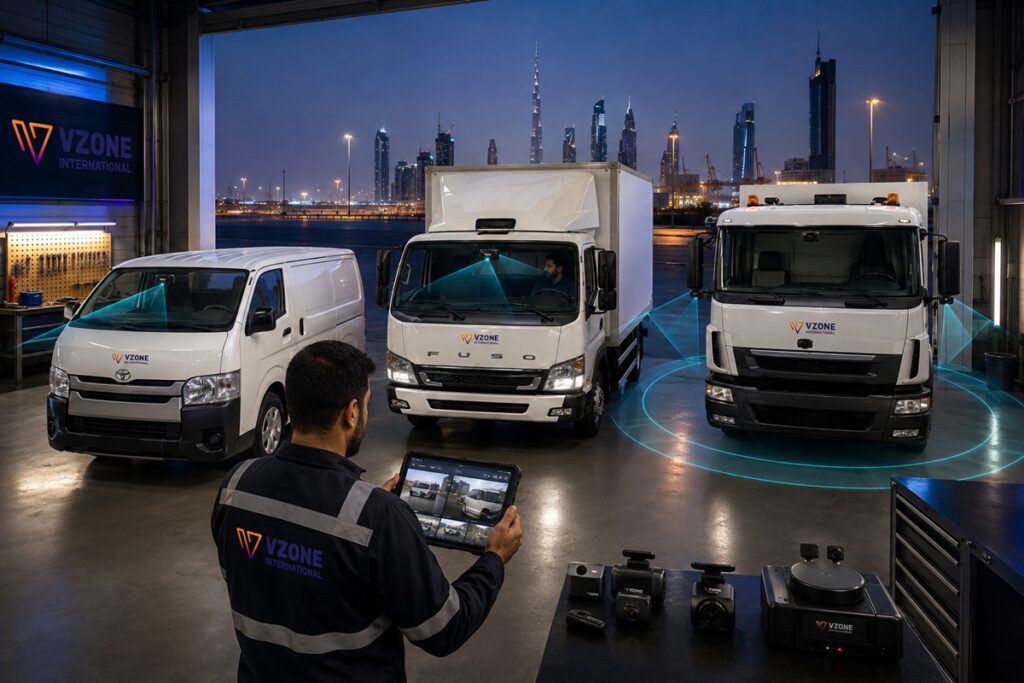
VZone International recommends and deploys all three camera configurations for UAE fleet clients, matching the specification to the fleet’s specific operational risk profile, compliance requirements, and budget framework. The standard recommendation for most UAE commercial fleet deployments is the dual-lens AI configuration forward 1080p camera plus driver-facing infrared AI detection camera integrated with the Wialon fleet management platform for real-time event alerts, weekly driver coaching reports, and cloud-stored GPS-corroborated footage.
For heavy transport, coach, and construction site fleets where blind spot risk is elevated, VZone integrates side and rear cameras alongside the dual-lens AI system providing the complete coverage that large vehicle operations require without applying 360-degree overhead to vehicles where the blind spot risk does not justify it. For car rental fleets where driver behaviour monitoring is not applicable and damage documentation is the primary need, VZone deploys front-facing only configurations with GPS-timestamped footage retention for damage claim defence.
The configuration recommendation is part of VZone’s fleet technology assessment service a free pre-engagement process where VZone’s UAE fleet specialists review the fleet’s specific risk profile, compliance obligations, insurance programme, and operational routes before specifying the dashcam configuration that delivers the most value for that specific deployment. Deploying the most cameras is not the objective; deploying the right cameras for the operational need is.
Conclusion: Camera Count Is Not the Goal Coverage That Matches Risk Is
The dashcam configuration decision for UAE fleet vehicles is not a question of how many cameras the budget can accommodate it is a question of which operational risks and compliance requirements need to be addressed, and which camera configuration most directly addresses those specific needs. A 360-degree system on a car rental compact car adds cost and data overhead without addressing any risk that a front-facing camera with GPS telematics does not already address. A dual-lens AI system on an ADNOC contractor long-haul vehicle satisfies fatigue monitoring, driver behaviour scoring, and incident evidence requirements that are central to that fleet’s operational and compliance profile.
The UAE fleet dashcam market offers every configuration from basic front-facing recorders to full-surround AI systems and the right choice is the one that matches the fleet’s specific operational context rather than the one with the most cameras. VZone International’s configuration assessment process helps fleet operators identify that match before committing to hardware ensuring the investment delivers the operational value the fleet actually needs rather than the maximum technical specification the budget can absorb.
Not sure which dashcam configuration your UAE fleet needs? Get a free assessment.
VZone International’s fleet specialists review your fleet type, operational routes, compliance obligations, and safety history to recommend the specific dashcam configuration front, dual-lens AI, 360-degree, or combination that matches your actual operational need. Free configuration assessment with no commitment. Contact our team today.
Frequently Asked Questions
A front-facing fleet dashcam records the road environment ahead of the vehicle providing road incident documentation and forward AI detections (lane departure, forward collision warning). A dual-lens dashcam adds a driver-facing infrared camera that records the driver simultaneously, enabling AI detection of fatigue, distraction, phone use, and seatbelt non-compliance. The dual-lens configuration is recommended for most UAE commercial fleet operations because it provides both the road documentation that front-facing cameras deliver and the driver behaviour data that coaching programmes, ADNOC IVMS compliance, and insurance telematics require the front-facing camera alone cannot satisfy these latter requirements.
360-degree cameras are recommended for large vehicles where blind spot risk is genuinely elevated by vehicle size: heavy trucks, articulated vehicles, coaches, large buses, and construction site equipment. For most light commercial vehicles delivery vans, SUVs, minibuses the dual-lens AI configuration (forward + driver-facing) provides the highest value per camera without the additional cost and installation complexity of full surround coverage. The decision should be based on whether blind spot, reversing, and rear collision incidents represent a significant proportion of the fleet's historical incident pattern if they do, 360-degree coverage addresses a real risk; if they do not, dual-lens is operationally sufficient.
For UAE trucks and heavy commercial vehicles, the recommended configuration is dual-lens AI (forward + driver-facing IR) combined with side cameras for blind spot coverage providing driver fatigue and behaviour monitoring alongside the road and blind spot documentation that truck-specific incident patterns require. For long-haul routes to ADNOC or PDO sites, the driver-facing AI camera is essential for fatigue detection. The infrared capability on the driver-facing lens handles the lighting variation that desert routes with dawn, dusk, and night driving create. VZone International deploys this configuration as standard for UAE heavy commercial fleet clients.
UAE school buses benefit most from a dual-lens AI configuration (forward + driver-facing) with an optional internal cabin camera for passenger monitoring. The forward camera documents road incidents and provides evidence for accident claims. The driver-facing AI camera monitors driver fatigue and behaviour relevant for early morning routes where driver alertness is at its lowest. The internal cabin camera provides passenger welfare visibility that school operators and parents expect for student transport. This three-camera configuration (forward, driver-facing, cabin) satisfies the MOE and RTA safety accountability expectations for school transport while keeping data and installation overhead proportionate to the operational requirement.