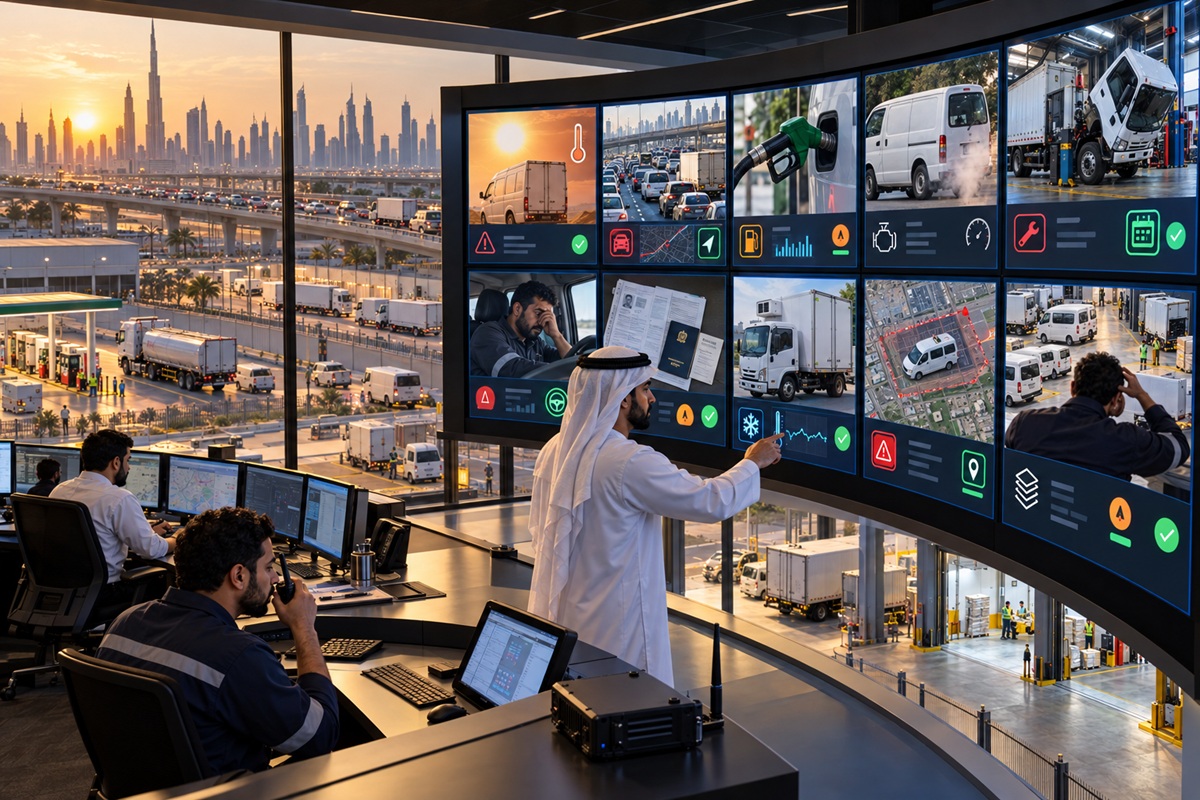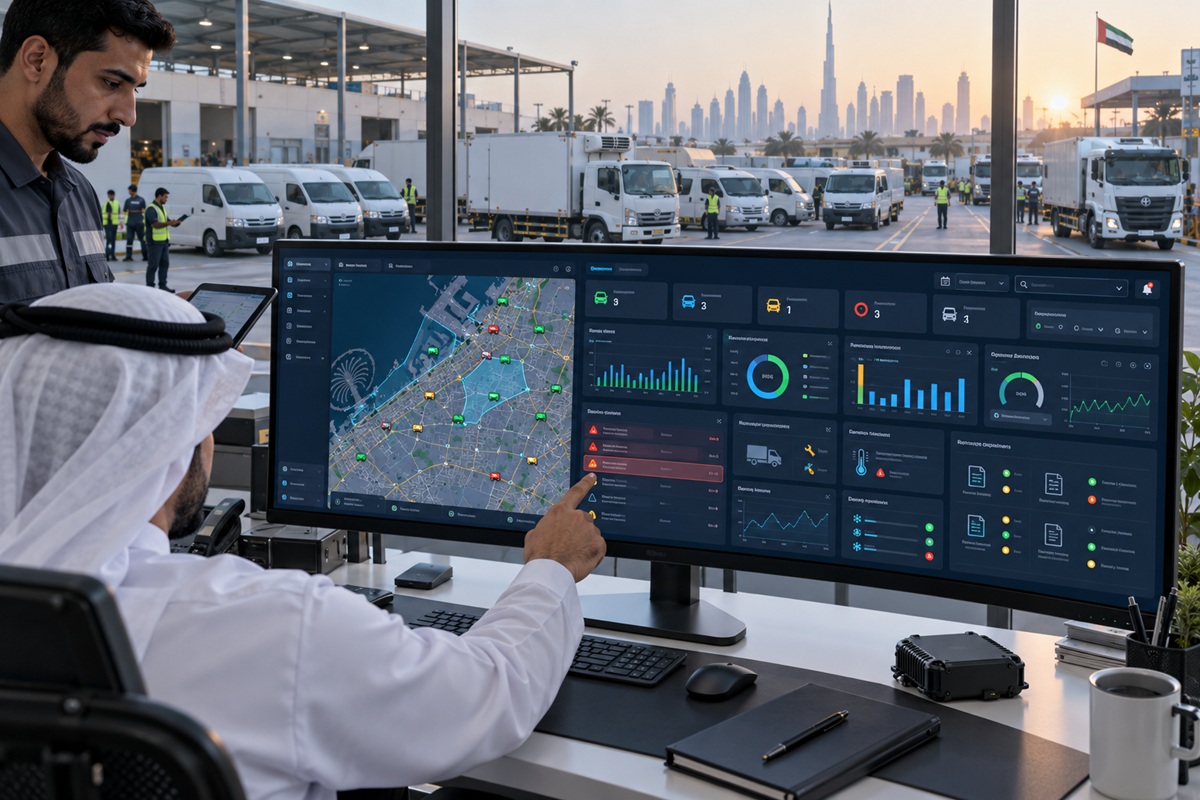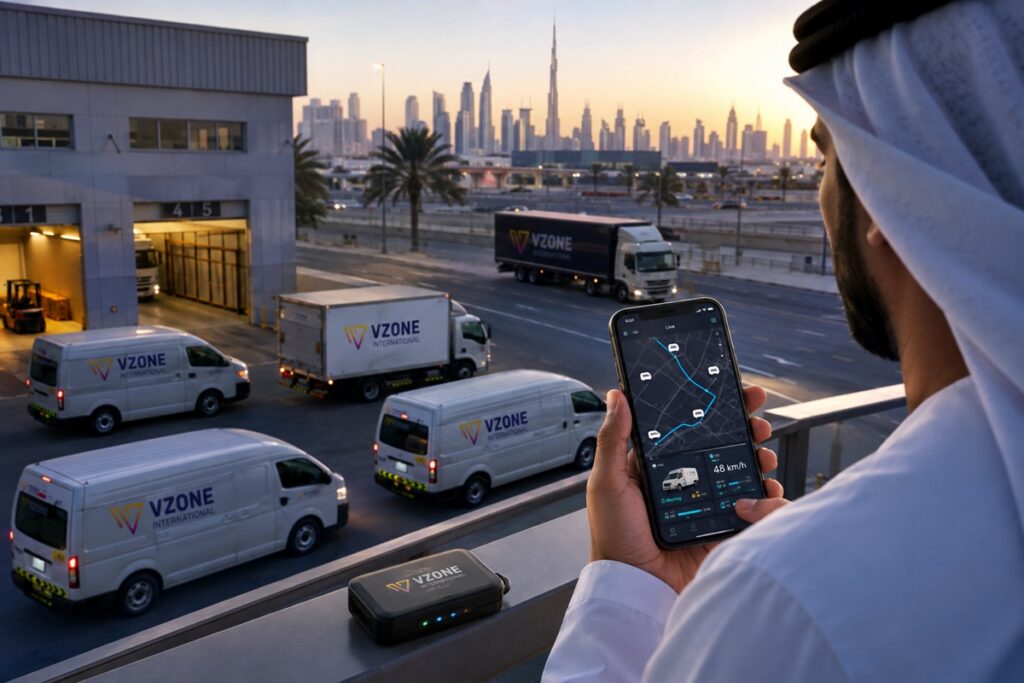
Fleet management has always had a mobility problem: the fleet moves, but the management tools are in the office. A fleet manager who needs to see where Vehicle 47 is right now should not need to be at their desk to find out. An after-hours geofence alert that fires at 11:30 PM needs to reach the fleet manager on their phone, not wait until 8:00 AM when they open the fleet management dashboard on a desktop. A driver who wants to see their own safety score before their Monday morning coaching conversation should be able to access it from the same device they use for navigation.
Fleet tracking mobile apps solve the mobility problem by extending the fleet management platform to the devices that fleet managers and drivers actually carry iOS and Android smartphones. The extension is not cosmetic: the manager app provides the same live map, alert delivery, and driver data as the web platform, optimised for a phone screen and with push notification delivery that arrives regardless of whether the app is currently open. The driver app provides tools that have no web-platform equivalent: route navigation, ePOD signature capture, and real-time safety score feedback that drivers access during and immediately after each trip. This guide explains what each app provides, what UAE-specific functions matter most, and what to look for when evaluating a fleet tracking mobile app for UAE fleet management.
Key Takeaways
- Fleet tracking mobile apps serve two separate user roles with different feature sets: the manager app (live map, push alerts, report access) for fleet managers and supervisors, and the driver app (dispatch, navigation, ePOD, safety score) for vehicle operators. Both are needed for a complete mobile fleet management capability.
- Push notification delivery is the most operationally critical mobile feature for UAE fleet managers after-hours geofence alerts, vehicle theft tamper alerts, and cold chain temperature breaches require immediate mobile response. A fleet tracking app that requires the user to open the app to see alerts is not adequate for these time-sensitive notification types.
- The driver app enables the driver coaching feedback loop that makes driving behaviour tracking most effective drivers who can view their own safety scores, per-trip event history, and fleet leaderboard ranking in real time between coaching conversations improve scores 30 to 40 percent faster than drivers who receive feedback only at weekly review meetings.
- Electronic proof of delivery (ePOD) through the driver app GPS-verified location at signature capture, timestamp, and customer sign-off provides the delivery documentation that protects against ‘not delivered’ disputes and satisfies customer service level agreement reporting requirements for UAE logistics and e-commerce clients.
- Offline functionality in both manager and driver apps is a UAE-specific requirement for fleets with Western Region or remote route operations the manager app must continue displaying last-known vehicle positions during connectivity gaps; the driver app must continue functioning for navigation and ePOD capture without cellular signal.
Section 1 The Manager App: Fleet Visibility From Anywhere
The fleet manager app is the mobile equivalent of the web dashboard displaying the live fleet map, vehicle status indicators, alert history, driver safety scores, and reports on a phone screen. For most fleet management functions, the manager app provides the same data as the web platform with a mobile-optimised interface. The fundamental advantage over the desktop platform is availability: the manager app is with the fleet manager at all times on the way to the office, during site visits, at 11:30 PM when an after-hours alert fires.
Live Fleet Map
The live map on the manager app displays all fleet vehicles as real-time position markers on a map layer, updating at the same interval as the web dashboard typically every 30 to 60 seconds. On a phone screen, the map interface must support: pinch-to-zoom without losing vehicle marker visibility, vehicle clustering at low zoom levels to prevent marker overlap for large fleets, and single-tap access to vehicle detail (driver identity, current speed, last alert, recent trip summary) without requiring navigation to a separate screen. For UAE fleet managers who need to identify the nearest available vehicle to dispatch for an urgent job, the manager app’s mobile map enables the same dispatch decision as the web dashboard from a site visit, a meeting, or a client location.
Push Notification Alerts
Push notification delivery is the manager app function that most differentiates mobile fleet management from desktop-only platform access. When a geofence exit alert fires at 2:00 AM, a vehicle tamper detection alert fires at a construction site at 3:30 AM, or a cold chain temperature excursion is detected during an overnight delivery, the alert must reach the fleet manager on their phone immediately before it can be dismissed as a notification the following morning when it is no longer actionable.
Alert push notifications should arrive within 60 to 90 seconds of the triggering event, should include sufficient context in the notification itself (vehicle identity, alert type, GPS location, current speed) that the manager can assess whether immediate response is required without opening the app, and should be configurable for alert type and recipient not every fleet manager needs every alert type; alert routing should match operational responsibility. VZone International’s Wialon mobile app delivers push notifications for all configured alert types to both iOS and Android devices, with configurable per-alert notification settings and recipient lists.
Driver Safety Scores and Reports
The manager app provides access to driver safety scorecards and fleet reports the weekly driver ranking, individual driver event history, fleet-level fuel reports, and compliance status summaries. Mobile report access enables fleet managers to review driver performance data during commutes, between client meetings, or before a coaching conversation without requiring a laptop. For UAE fleet supervisors who manage drivers from the field rather than from a fixed office construction site supervisors, logistics depot managers, service fleet coordinators the manager app is their primary management interface rather than a secondary access method.
Section 2 The Driver App: Tools for the Person in the Vehicle
The driver app serves a fundamentally different purpose from the manager app it provides the driver with the tools they need during their working shift, not visibility into the fleet as a whole. A driver does not need to see where other fleet vehicles are; they need to receive and navigate to their next job, complete delivery proof, view their own safety performance, and identify themselves to the vehicle’s GPS system. The driver app provides exactly these functions and no more simplicity is a feature, not a limitation.
Job Dispatch and Navigation
Fleet management platforms that include dispatch functionality job assignment from the dispatcher to a driver’s mobile device use the driver app as the delivery mechanism for job cards. The driver sees their current and next jobs on the app interface, with job details (customer name, address, instructions, time window), one-tap navigation launch (Google Maps or Waze for UAE road navigation), and job status update buttons (en route, arrived, completed, failed). For last-mile delivery operations in UAE’s dense urban delivery environments Dubai, Abu Dhabi city centre, industrial zone deliveries the dispatch-to-driver-app workflow replaces the WhatsApp job assignment that many UAE SMB logistics operators still use, creating a structured job record alongside the navigation.
Electronic Proof of Delivery (ePOD)
ePOD through the driver app captures the delivery completion record at the delivery location with GPS-verified location at the time of capture, timestamp, customer or recipient signature on the phone screen, and optionally a photo of the delivery condition. The GPS verification is the critical element: an ePOD record captured inside the delivery address geofence is geographically verified; an ePOD record captured outside the delivery address raises an exception that the dispatcher can investigate. For UAE logistics operators serving e-commerce clients, hospital supply chains, and government delivery contracts, GPS-verified ePOD provides the delivery audit trail that replaces paper waybill signatures and protects against ‘not delivered’ customer disputes.
ePOD capture works offline the driver can complete the ePOD signature capture and photo at a delivery location without cellular signal, with the record stored in the app and uploaded when connectivity is restored. This offline capability is relevant for deliveries in areas with variable cellular signal basement loading docks, industrial zone warehouses, and multi-storey car park delivery areas where signal is typically weak.
Driver Safety Score Self-View
The driver safety score view in the driver app shows the driver their own current safety score, weekly trend, per-event-type breakdown, and fleet leaderboard position the same data that the fleet manager sees in the manager app, restricted to the driver’s own records. This self-access is the coaching programme feature most consistently associated with faster score improvement: drivers who can see their own event history and score in real time immediately after a trip, before a coaching conversation, or in response to an in-cab alert connect feedback to behaviour more effectively than drivers who receive a weekly printout at a review meeting.
The leaderboard view showing the driver’s rank relative to fleet peers introduces the competitive motivation element that accelerates improvement in driver populations with a competitive culture. For UAE commercial fleet driver demographics, where many drivers are conscious of professional reputation and team standing, a leaderboard that rewards safety performance creates the social context that makes score improvement personally meaningful rather than just management-mandated.
Driver ID and Vehicle Check-In
The driver app can serve as the driver identification method for vehicles replacing physical iButton or RFID key fob identification with a mobile app check-in. At the start of each shift, the driver opens the app, selects the vehicle they are operating, and confirms their identity associating their driver profile with the vehicle’s GPS device for the shift duration. This software-based driver ID is appropriate for fleets where physical iButton readers are not installed on all vehicles, or for shared-vehicle operations where any driver may use any available vehicle and physical ID hardware would require installation on every vehicle.
The mobile app driver ID also enables digital daily vehicle check drivers complete a structured pre-trip inspection checklist (tyres, lights, fluid levels, damage) through the app before the shift begins, with the completed check submitted to the fleet management platform alongside the driver ID confirmation. Digital vehicle checks replace paper defect books, creating a searchable electronic maintenance record and flagging defects to the fleet manager immediately rather than through end-of-day paper submission.
Section 3 Manager App vs Driver App: Feature Comparison
| Feature | Manager App | Driver App | Notes |
| Live fleet map (all vehicles) | Yes full fleet visibility | No driver sees own vehicle status only | Driver privacy: seeing fleet position visible only to managers |
| Push notification alerts | Yes all alert types configurable | Yes own vehicle alerts only (safety events, job updates) | Manager receives fleet-wide alerts; driver receives own-vehicle alerts |
| Driver safety score view | Yes all drivers, all details | Yes own score only, full detail | Driver cannot see other drivers’ individual scores |
| Job dispatch receipt | Yes send jobs to drivers | Yes receive and action job cards | Two-way: manager sends, driver receives and updates status |
| ePOD capture | No manager reviews completed ePODs | Yes capture signature, GPS verify, photo | Driver captures at delivery point; manager reviews in dashboard |
| Fleet reports and analytics | Yes full report access | No scorecard and own trip history only | Finance/compliance reports accessible to manager; driver sees own data |
| Alert configuration | Yes configure geofences, thresholds, recipients | No driver cannot modify alert configuration | Platform configuration is manager function |
| Vehicle and driver management | Yes add vehicles, assign drivers, manage groups | No | Admin functions are manager/admin level |
| Compliance dashboard (Asateel, IVMS) | Yes compliance status per vehicle | No | Compliance monitoring is manager function |
| Offline map and navigation | Limited last-known positions cached | Yes navigation functions offline; ePOD capture offline | Driver app offline is essential for delivery completion |
| Arabic language support | Yes full Arabic UI | Yes full Arabic UI | UAE driver population; Arabic is primary language for many drivers |
| Vehicle check-in (driver ID) | Yes view which driver is in which vehicle | Yes driver selects vehicle and confirms identity at shift start | Both sides of driver ID: driver confirms, manager sees |
Section 4 UAE-Specific Mobile App Requirements
Arabic Language Interface
UAE fleet driver populations include a high proportion of drivers whose primary working language is Arabic South Asian drivers who have worked in UAE for years and communicate operationally in Arabic, Arab national drivers, and multilingual teams where Arabic is the common operational language. A driver app that provides only English language interface creates a significant usability barrier that reduces ePOD completion accuracy, driver check-in compliance, and safety score self-review engagement. VZone International’s driver app provides a full Arabic language interface including all job cards, ePOD capture instructions, safety score descriptions, and alert text enabling drivers to use the app effectively regardless of English literacy.
UAE Traffic Conditions and Navigation
UAE fleet navigation apps must handle UAE-specific traffic data Salik toll gate locations and peak/off-peak timing, UAE speed camera positions, construction zone routing changes that affect major arteries in Dubai and Abu Dhabi regularly, and UAE desert route navigation where standard mapping data may not reflect recent road construction. VZone International’s driver app integrates with UAE-optimised navigation (Google Maps or Waze, which maintain current UAE traffic data) rather than using an internal navigation engine that would require ongoing UAE map database maintenance. The integration launches navigation directly from the job card destination, with the driver’s current GPS position as the starting point.
Offline Operation for Remote Routes
For UAE fleet drivers operating on Western Region routes, construction site access roads, or UAE-Oman cross-border routes, cellular connectivity gaps are operationally normal. The driver app must continue functioning during these gaps: navigation should operate from cached map tiles without cellular data; ePOD capture and storage must work offline with upload queued for connectivity restoration; safety score and job status data should be cached locally and synchronised when connectivity returns. Apps that require continuous cellular connectivity for basic functions displaying the current job, completing a delivery record are not suitable for UAE fleet drivers who regularly operate in areas with variable coverage.
Section 5 What to Look for in a Fleet Tracking Mobile App for UAE
| Evaluation Criterion | What to Assess | UAE-Specific Requirement |
| Push notification reliability | Alert delivery speed (target: under 90 seconds from event); background delivery when app is closed; delivery in UAE cellular network conditions | After-hours geofence and theft tamper alerts require immediate delivery to sleeping managers app-open-required alerts are not adequate |
| Arabic language support | Full Arabic UI in driver app; Arabic alert text; Arabic ePOD instructions and capture flow | UAE driver population language diversity; Arabic-only drivers excluded without full Arabic support |
| Offline functionality | Navigation works without cellular; ePOD capture and queue works offline; last-known positions cached in manager app | Western Region, construction sites, UAE-Oman routes have regular connectivity gaps |
| ePOD GPS verification | ePOD captures GPS coordinates at signature time; coordinates verified against delivery address geofence; exception flag if ePOD captured outside geofence | UAE e-commerce and logistics clients increasingly require GPS-verified ePOD for delivery SLA documentation |
| iOS and Android parity | Both iOS and Android versions with equivalent features; no major function gaps between platforms | UAE fleet staff use mixed iOS/Android; feature parity prevents a two-tier management capability by device type |
| Driver self-access to own data | Driver can view own safety score, trip history, leaderboard position; cannot view other drivers’ individual data | Self-access associated with 30-40% faster score improvement vs weekly printout-only coaching |
| Role-based access control | Manager role sees all vehicles and all driver data; driver role sees own vehicle and own data only; supervisor role sees assigned vehicles and drivers only | UAE fleet organisational structures often have multi-level management with regional and depot-level supervision |
| Battery and data efficiency | Minimal background battery drain; configurable GPS reporting interval in driver app; low mobile data consumption | Drivers resist apps that drain phone battery before end of shift; UAE heat reduces phone battery life, amplifying this concern |
VZone International Fleet Tracking App iOS and Android for UAE Fleet Managers and Drivers
VZone International’s Wialon fleet management platform provides dedicated iOS and Android apps for fleet managers (live map, push alerts, driver scores, reports) and drivers (job dispatch, ePOD, safety score self-view, driver ID) in Arabic and English, with offline functionality for UAE remote route operations. Contact our team to see a demo of the manager and driver apps for your fleet profile.
Frequently Asked Questions
A fleet tracking mobile app provides two distinct interfaces. The manager app for fleet managers and supervisors shows the live GPS map with all fleet vehicles, delivers real-time alert push notifications (geofence exits, speed events, driver behaviour alerts, cold chain breaches), provides access to driver safety scores and fleet reports, and enables dispatch and vehicle management functions from a phone. The driver app for vehicle operators receives job dispatch cards with navigation, captures electronic proof of delivery with GPS verification, shows the driver their own safety score and trip history, and enables driver identification at vehicle start. Together, the manager and driver apps extend the complete fleet management platform to the mobile devices that fleet managers and drivers carry continuously enabling fleet management decisions and driver actions from anywhere, not just from a desktop in the office.
For day-to-day operational fleet management monitoring live vehicle positions, responding to alerts, reviewing driver safety scores, dispatching jobs, and receiving ePOD completion notifications yes, the manager mobile app provides sufficient functionality for continuous fleet management from a phone. For configuration tasks setting up new geofences, adding vehicles to the fleet, modifying alert rules, generating complex multi-period reports, and managing compliance portal registration the web dashboard provides a better interface for tasks that involve detailed configuration or large data review. Most UAE fleet managers use both: the mobile app as their primary interface for real-time operational decisions throughout the day, and the web dashboard for periodic configuration and analytical tasks. VZone International's Wialon platform is fully functional on both mobile and web no functions are restricted to one interface or the other except where screen size makes the task impractical on mobile.
Yes VZone International's driver app is designed for UAE fleet conditions where cellular connectivity is not continuous. Navigation functions using cached map tiles do not require a cellular connection once the map is loaded. ePOD delivery capture signature, photo, timestamp works offline with the completed record stored in the app and queued for upload when connectivity is restored. Job card display and status updates are cached for offline viewing. Driver safety score data updates when connectivity is available and displays the cached data when offline. The primary limitation of offline operation is that live GPS position data from other fleet vehicles is not available without connectivity the manager app shows last-known positions when offline. For driver app functions (navigation, ePOD, safety score self-view), offline operation covers all primary use cases for UAE remote route and construction site operations.
VZone International's fleet management mobile apps both the manager app and the driver app are available in full Arabic and English language versions, with complete UI translation including job cards, alert notifications, safety score descriptions, ePOD capture instructions, and navigation prompts. The Arabic interface enables UAE fleet drivers whose primary working language is Arabic to use the driver app effectively for job receipt, ePOD completion, and safety score self-review without English literacy requirements. Language selection is per-user rather than per-platform a manager using the Arabic interface and a driver using the Arabic driver app can both access the same Wialon platform with their preferred language, with all data shared between both language versions of the platform.