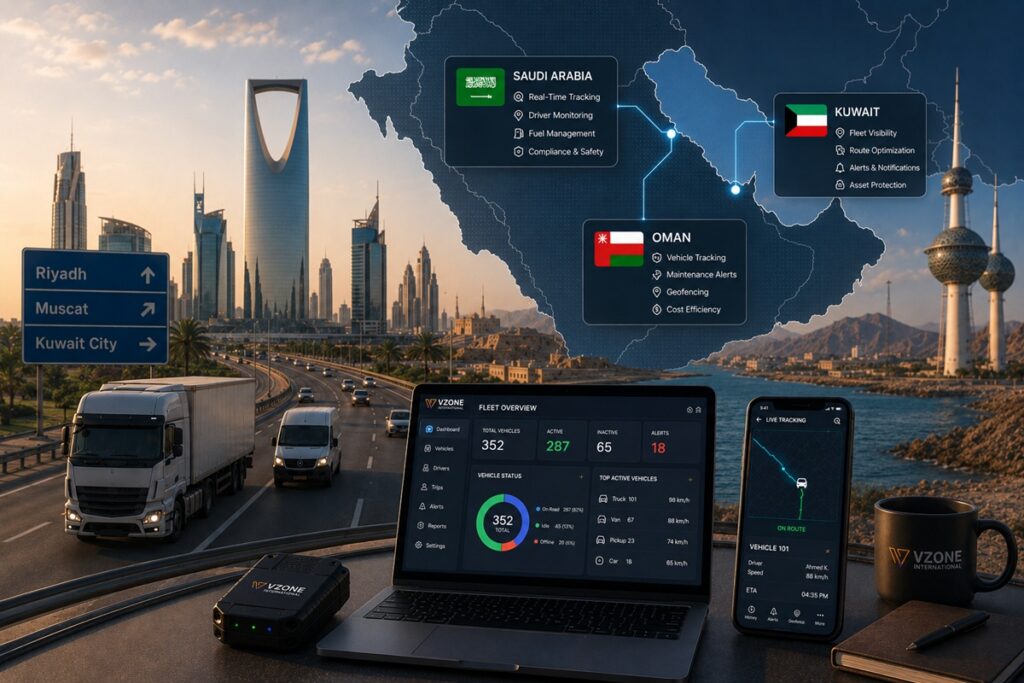
As UAE-based businesses expand their operations across the GCC, fleet managers face a complexity that catches many operators unprepared: the compliance frameworks, road environments, and GPS tracking requirements that apply in the UAE do not extend across the border. A fleet that is fully Asateel-registered in Abu Dhabi and SecurePath-compliant in Dubai is operating without any applicable compliance infrastructure the moment its vehicles cross into Saudi Arabia or Oman and the regulators in each country have no awareness of or interest in UAE compliance certifications.
Cross-border GCC fleet management requires a fundamentally different approach from single-country operations. The technology platform must maintain continuous tracking visibility across borders without cellular coverage gaps. The compliance infrastructure must satisfy separate regulatory requirements in each country simultaneously. The support team must be available in the time zones and languages of every country where vehicles operate. And the reporting layer must generate country-specific compliance documentation for each regulatory framework rather than producing generic GPS reports that are useful for internal management but useless for external compliance.
This guide covers the fleet compliance landscape in Saudi Arabia, Oman, and Kuwait what each country requires, which industries are driving fleet technology adoption, and what UAE-based businesses need to understand before expanding fleet operations into each market alongside the cross-border tracking challenges that apply regardless of destination country.
Key Takeaways
- Each GCC country operates its own independent fleet compliance framework UAE Asateel/SecurePath, Oman OPAL, Saudi MOT, Kuwait MOI and compliance in one country provides no coverage in another.
- Saudi Arabia is the largest fleet market in the GCC by vehicle population, with oil and gas, construction, government, and increasingly logistics fleets driving adoption of GPS telematics as Vision 2030 infrastructure investment accelerates.
- Oman’s OPAL (Oman Authority for Partnership for Energy and Water) mandate for IVMS-grade fleet tracking covers oil and gas contractor fleets and is the primary compliance driver for UAE-Oman cross-border logistics and contractor operations.
- Kuwait’s fleet compliance framework is less formalised than UAE’s or Oman’s but is developing, with the Ministry of Interior (MOI) increasingly requiring GPS tracking for commercial and government fleets.
- Cross-border GCC fleet management requires dual-SIM or satellite fallback hardware to maintain tracking continuity across the desert regions between UAE, Saudi Arabia, and Oman where cellular coverage is limited.
- A unified MENA fleet platform single login, single dashboard, multi-country compliance reporting eliminates the operational overhead of managing separate GPS systems in each country that fragmented provider relationships create.
GPS Fleet Tracking in Saudi Arabia (KSA)
Saudi Arabia is the largest commercial vehicle market in the Arab world, with a fleet population that spans government ministry vehicles, the Kingdom’s extensive oil and gas sector contractor fleets, a rapidly growing logistics and last-mile delivery sector driven by Vision 2030’s economic diversification programme, and one of the largest construction fleet bases in the world from the Neom megaproject, Red Sea Development, and the dozens of giga-project sites underway across the Kingdom.
Saudi Arabia Fleet Compliance Requirements MOT and ZATCA
Saudi Arabia’s Ministry of Transport (MOT) has progressively developed its commercial vehicle GPS tracking requirements, with mandatory GPS tracking increasingly specified for commercial freight vehicles, public transport, and contractor fleets operating on government-contracted projects. The regulatory framework is less comprehensively codified than UAE’s Asateel or Oman’s OPAL at the time of writing but it is actively developing, and GPS telematics is mandatory for most commercial fleet categories through contract requirements even where general legislation is still evolving.
The Zakat, Tax and Customs Authority (ZATCA) has integrated GPS and telematics data requirements into its commercial freight compliance programme with electronic freight consignment tracking increasingly required for border-crossing shipments between Saudi Arabia and neighbouring countries including the UAE and Oman. For UAE-based logistics companies operating cross-border supply chains into Saudi Arabia, ZATCA compliance is a distinct requirement from the MOT fleet tracking standards and both need to be addressed in the compliance framework for vehicles operating in the Kingdom.
Oil and gas contractor fleets operating for Saudi Aramco and its contractors are subject to Aramco HSE standards that parallel ADNOC’s IVMS requirements requiring driver behavior monitoring data and HSE-formatted reports for vehicles on Aramco sites. UAE contractors who work for both ADNOC and Aramco clients need fleet platforms that can generate both ADNOC IVMS-formatted and Aramco HSE-formatted reports from the same underlying data.
Road Environment Distances, Conditions, and Coverage Gaps
Saudi Arabia’s scale creates fleet management challenges that have no equivalent in UAE operations. The Kingdom spans 2.15 million square kilometres approximately 26 times the area of the UAE with major logistics corridors running 1,000 to 1,500 km between Jeddah, Riyadh, Dammam, and Abha. Drivers on the Riyadh to Jeddah run cover more distance in a single trip than a UAE long-haul truck covers in a week. Fatigue management, fuel planning, and remote breakdown response are all significantly more complex at Saudi operational scale than at UAE scale.
Cellular GPS network coverage in Saudi Arabia is well-established along major highways and in urban centres but thins progressively in desert interior regions the Empty Quarter (Rub’ al Khali) and the Nafud desert provinces particularly. GPS devices deployed on Saudi Arabia-wide routes need satellite fallback capability to maintain tracking continuity in coverage gaps that could last hours during desert interior transit. For ZATCA freight tracking compliance, which requires continuous documentation, cellular coverage gaps without satellite fallback create compliance record breaks that are unacceptable.
Industry Sectors Driving Fleet Demand in KSA
The primary fleet technology adoption drivers in Saudi Arabia in 2026 are: oil and gas contractor fleets for Saudi Aramco, SABIC, and their Tier 1 and Tier 2 contractors requiring IVMS-grade monitoring; logistics and last-mile delivery companies serving Saudi Arabia’s rapidly growing e-commerce market (one of the fastest growing in the Middle East); construction contractor fleets for Vision 2030 giga-projects including Neom, Red Sea Development, and ROSHN residential development; government fleet programmes at ministry and municipality level; and healthcare logistics operators running pharmaceutical cold chain distribution across the Kingdom’s expanding hospital network.
Fleet Management in Oman – OPAL Compliance
Oman is the most structurally regulated fleet market in the GCC outside of the UAE, primarily because of the Petroleum Development Oman (PDO) contractor ecosystem and the OPAL programme that governs commercial fleet tracking across the Sultanate. For UAE businesses with cross-border logistics operations into Oman, or with contractors working on Omani oil and gas infrastructure, OPAL compliance is not an optional enhancement it is an operational prerequisite.
What Is OPAL and What Does It Require?
OPAL the Oman Authority for Partnership for Energy and Water is the Omani government body that manages the country’s energy and water sector. In the fleet context, OPAL oversees the IVMS (In-Vehicle Monitoring System) mandate for commercial vehicles operating in Oman, particularly those serving the oil and gas sector and PDO’s contractor network. OPAL’s IVMS requirements closely parallel ADNOC’s UAE requirements in technical specification requiring certified hardware, multi-tier driver behavior event capture, and HSE-formatted compliance reports but they are administered through a separate certification and reporting infrastructure.
For UAE contractors who work across both ADNOC and PDO (Oman) projects, the dual compliance requirement means their fleet platform must generate both ADNOC IVMS-formatted reports and OPAL-format compliance documentation from the same data a capability that requires the fleet provider to hold both ADNOC IVMS certification and OPAL certification simultaneously. Not all GPS providers operating in the UAE hold OPAL certification; confirming this before committing a provider for cross-border operations is essential.
OPAL-Approved GPS Devices for Oman-Based Fleets
OPAL maintains an approved device list for GPS hardware certified for Oman commercial fleet compliance similar in structure to the ITC’s Asateel certified device list for Abu Dhabi. Hardware not on the OPAL approved list cannot satisfy OPAL compliance registration regardless of its technical capabilities. For UAE-Oman cross-border fleets, the ideal hardware is a device that appears on both the ITC Asateel certified list and the OPAL approved list enabling the same hardware to satisfy compliance in both countries without requiring separate device specifications for UAE-side and Oman-side vehicle assignments.
OPAL hardware must also meet the desert operating environment specifications relevant to Oman’s operating conditions particularly for Southern Oman routes through Dhofar, the Hajar Mountains approaches, and the interior desert zones where ambient temperatures and vehicle vibration levels create the same hardware durability challenges as UAE oil field deployments. Enterprise-grade hardware from Teltonika and similar manufacturers that appears on both Asateel and OPAL lists meets these environmental specifications as standard.
Cross-Border Fleet Operations UAE to Oman
The UAE-Oman border is crossed by a substantial volume of commercial traffic daily supply chain logistics serving Muscat’s retail and industrial base, oil and gas contractor equipment and personnel movements between Abu Dhabi’s Western Region and Oman’s interior, agricultural produce transport from the Batinah Coast, and construction materials for Oman’s ongoing infrastructure programme. For logistics companies managing this cross-border volume, the operational challenge is maintaining continuous fleet visibility and compliance documentation on both sides of the border simultaneously.
Practical cross-border implementation requires: hardware that holds both ITC Asateel and OPAL certifications; dual-SIM SIM configuration roaming between UAE and Oman cellular networks; a fleet platform that generates separate UAE-format and Oman-format compliance reports from the same data source; and a support team that is available across both countries’ operating hours and is familiar with both regulatory frameworks. VZone International’s Oman-certified operation provides all four requirements, enabling UAE-Oman cross-border clients to manage both compliance environments through a single provider relationship.
GPS Tracking in Kuwait Fleet Compliance and Infrastructure
Kuwait Fleet Market Key Industries and Fleet Types
Kuwait’s commercial fleet market is dominated by government and quasi-government entity fleets Kuwait Oil Company (KOC), Kuwait National Petroleum Company (KNPC), and their contractor ecosystems alongside a significant retail and logistics fleet base serving the country’s high per-capita consumption market. Government and energy sector fleets in Kuwait have been early adopters of GPS telematics, driven by HSE programme requirements aligned with international oil company standards. Commercial logistics fleets are increasingly adopting GPS as the Kuwait e-commerce market grows and last-mile delivery service quality expectations rise.
Kuwait’s geographic compactness approximately 17,800 square kilometres, smaller than any UAE emirate combined means that cross-border operations are more central to Kuwait’s logistics reality than for UAE. Kuwait shares land borders with Iraq and Saudi Arabia; virtually all imported goods transit through the Saudi Arabia land border corridor or through Kuwait’s Shuwaikh and Shuaiba ports. Cross-border logistics between Saudi Arabia and Kuwait is a significant operational context for fleet operators managing supply chains between the two countries.
GPS Compliance Requirements in Kuwait
Kuwait’s Ministry of Interior (MOI) oversees commercial vehicle regulations, and GPS tracking requirements for commercial fleets are in active development. Government and energy sector contract requirements are the primary current driver KOC and KNPC contractor vehicles are routinely required to carry GPS tracking as a contract condition, with HSE reporting requirements that parallel the ADNOC and OPAL standards familiar to UAE contractors. Formal national GPS mandate equivalent to UAE’s Asateel or Oman’s OPAL is less comprehensively implemented at the time of writing, but the trajectory of Kuwait’s fleet compliance framework follows the same direction as UAE’s toward mandatory GPS with data submission requirements for commercial vehicle categories.
For UAE-based companies expanding operations into Kuwait, the practical compliance approach is to deploy GPS hardware and platform capability that exceeds current minimum requirements ensuring that the fleet technology investment remains compliant as Kuwait’s regulatory framework develops rather than requiring hardware replacement when mandatory standards are formalised. Enterprise-grade devices with IVMS capability, already compliant with ADNOC and OPAL standards, provide a compliance overhead against current Kuwait requirements that future-proofs the technology investment.
GCC Fleet Compliance at a Glance
| Country / Emirate | Key Regulator | Compliance Programme | Primary Scope | VZone Certified / Operational |
| UAE Abu Dhabi | ITC (Integrated Transport Centre) | Asateel Platform | All commercial fleet categories including trailers | Yes ITC Asateel certified |
| UAE Dubai | RTA (Roads and Transport Authority) | SecurePath | Rental cars, taxis, buses, school transport | Yes RTA SecurePath compatible |
| UAE Dubai (Security) | SIRA (Security Industry Regulatory Agency) | SIRA Approved GPS | Licensed security company patrol fleets | Yes SIRA approved |
| Oman | OPAL (Oman Authority for Partnership for Energy and Water) | OPAL IVMS Standard | Oil and gas contractor fleets, commercial vehicles | Yes OPAL certified |
| Saudi Arabia | MOT (Ministry of Transport) + ZATCA | MOT Fleet Standards + ZATCA freight tracking | Commercial freight, O&G contractors, government fleets | Yes operational with MOT compliance |
| Kuwait | MOI (Ministry of Interior) | MOI Fleet Regulations | Government and energy sector fleets (developing) | Yes operational in Kuwait |
| Qatar | MOTC (Ministry of Transport and Communications) | Qatar Fleet Standard | Commercial and government fleets | Planned in progress |
| Bahrain | Ministry of Transportation | Fleet GPS Programme | Commercial fleets (developing) | Operational coverage |
Cross-Border Fleet Tracking Challenges in the GCC
The GCC’s geography vast desert expanses between major population centres, with borders that cut across the same continuous desert environment creates fleet tracking challenges that are distinct from the urban tracking problems UAE city operations face. Solving these challenges requires specific hardware configurations, platform capabilities, and support infrastructure that generic GPS solutions are not built to address.
Maintaining GPS Coverage Across GCC Border Zones
The UAE-Saudi Arabia border crossing at Ghuwaifat (on the Abu Dhabi Western Region boundary) and the UAE-Oman crossings at Hatta, Al Ain, and Khatmat Milaha all involve approach zones where cellular network coverage transitions between country operators. Devices with single-SIM configurations roaming only within the UAE network lose connectivity progressively as they approach the border and may have data transmission gaps during the actual crossing process. For freight tracking compliance applications where continuous documentation is required, these gaps create compliance record breaks.
The solution is hardware with multi-operator SIM roaming SIMS configured to connect automatically to the strongest available network from any operator in the current geographic zone, without regard for national boundaries. For the Saudi Arabia interior routes and Oman’s Hajar Mountain and Dhofar coastal approaches, where even multi-operator roaming may leave coverage gaps, satellite fallback capability maintains continuous tracking. The combination of multi-operator cellular roaming and satellite fallback provides the connectivity resilience that cross-border GCC operations require.
Multiple Compliance Frameworks How to Manage Them
A logistics company operating a 100-vehicle fleet across UAE, Saudi Arabia, and Oman simultaneously must satisfy ITC Asateel registration for Abu Dhabi vehicles, RTA SecurePath compliance for Dubai rental or transport vehicles, OPAL IVMS certification for Oman-operating vehicles, and MOT compliance requirements for Saudi-operating vehicles four separate regulatory frameworks with different approved hardware lists, different portal registration processes, different report formats, and different enforcement mechanisms. Managing this complexity through four separate GPS providers one for each country creates operational overhead that is disproportionate to the fleet management value delivered.
A unified MENA fleet platform addresses this by maintaining country-specific compliance modules within a single operational dashboard. The same GPS device if it holds multiple country certifications serves vehicles operating in any of the covered countries. Country-specific compliance reports are generated from the same underlying data. A single account management relationship handles registration and compliance maintenance across all countries. For multi-country fleet operators, the unified platform approach is not just operationally convenient it is a significant cost and risk reduction compared to the fragmented alternative.
Multi-Currency, Multi-Language, and 24/7 Support Requirements
Operational fleet management across the GCC involves currencies in AED, SAR, and OMR, reporting in Arabic and English, and operational hours that span multiple time zones with 24-hour logistics running across all jurisdictions simultaneously. A fleet platform that only presents data in English, invoices only in AED, and provides support only during UAE business hours creates practical barriers for fleet operations teams in Riyadh or Muscat that undermine the unified platform value proposition.
Language localisation Arabic dashboard interface, Arabic report generation, Arabic SMS alert content is operationally significant for GCC fleet operations where the majority of drivers and many supervisors work primarily in Arabic. A driver alert that appears in English only is an alert that a significant proportion of the UAE, Saudi, and Oman driver workforce may not read with the same comprehension as a native Arabic speaker. Platform localisation for Arabic speakers is not a cosmetic feature but an operational effectiveness requirement for multi-country MENA fleet management.
VZone International’s MENA Coverage 20+ Years in the Region
VZone International has operated fleet management services across the MENA region for over 20 years a tenure that predates many of the formal compliance programmes that now govern fleet tracking requirements in UAE, Oman, and Saudi Arabia. That operational history means VZone’s MENA capability was not built retrospectively to match regulatory requirements that emerged it was developed alongside those requirements, with the compliance knowledge, provider relationships, and implementation experience that can only come from having navigated each regulatory programme from its inception.
Unified Platform for Multi-Country Fleet Management
VZone’s MENA fleet platform presents a single operational dashboard for fleets operating across UAE, Saudi Arabia, Oman, and Kuwait with country-specific views filterable by any combination of countries, vehicle categories, or compliance status. Country-specific compliance reports ITC Asateel format, OPAL format, MOT compliance documentation are generated automatically from the same underlying platform data, available to compliance managers in each country without requiring manual reformatting or separate system access. Fleet cost reporting in local currency (AED, SAR, OMR) and Arabic-language dashboard and report options are standard platform capabilities rather than custom configurations.
Local Support Teams in UAE, KSA, and Oman
VZone International maintains UAE-based implementation and support teams with regional presence enabling responsive support for Saudi Arabia and Oman operations. For critical compliance issues Asateel data transmission failures, OPAL report generation errors, or hardware failures on vehicles in remote Saudi or Oman locations the support response draws on regional operational knowledge rather than routing through a distant global support centre unfamiliar with GCC regulatory environments. For clients managing large cross-border operations where a compliance data gap can trigger audit findings in multiple countries simultaneously, the regional support capability is as commercially important as the platform technology.
OPAL Certification Active Compliance in Oman
VZone’s OPAL certification is active and maintained covering OPAL-approved hardware deployment, portal registration for Oman-operating vehicles, OPAL-format HSE report generation, and compliance maintenance as OPAL’s technical specifications evolve. For UAE contractors expanding into PDO or Oman oil and gas operations, VZone provides the same managed compliance onboarding for Oman that it provides for ADNOC IVMS in UAE hardware installation, OPAL portal registration, and compliance certificate issuance without requiring the client to navigate Oman’s compliance infrastructure independently.
Conclusion: GCC Fleet Expansion Requires Regional Compliance Intelligence, Not Just Regional Coverage
The distinction between a GPS provider that has coverage in Saudi Arabia, Oman, and Kuwait and one that has compliance capability in those countries is the most important evaluation criterion for UAE businesses expanding their fleet operations across the GCC. Coverage means vehicles can be tracked. Compliance capability means those vehicles can operate without regulatory risk in each country and that the fleet manager can demonstrate compliance documentation for each jurisdiction on demand.
Each GCC country’s fleet regulatory framework is at a different stage of maturity, a different level of enforcement intensity, and a different degree of integration with international HSE standards. Managing these differences requires a provider with actual regulatory knowledge in each country not a UAE-centric provider who has added GCC SIM cards to its device inventory and calls it regional coverage. The practical test is specific: can the provider show you the OPAL certification documentation, the MOT compliance process, and the Aramco HSE report format from direct operational experience? Or are these claims that would need to be verified before vehicles are committed to cross-border routes?
VZone International’s two decades of MENA fleet operations provide the compliance depth and regional infrastructure that cross-border GCC fleet management requires not as a future aspiration but as a current operational capability serving logistics, oil and gas, and construction clients across the full GCC geography.
Expanding your fleet across the GCC?
VZone International provides unified fleet management across UAE, Saudi Arabia, Oman, and Kuwait one platform, full regional compliance, Arabic-language support, and 20+ years of MENA fleet technology experience. Get a MENA fleet consultation today and understand exactly what cross-border compliance your operation requires before you expand.
Frequently Asked Questions
VZone International operates GPS fleet tracking services across UAE, Saudi Arabia, Oman, and Kuwait providing multi-country fleet management with a unified platform, local compliance support for each country's regulatory framework, Arabic-language dashboard and reporting, and 24/7 regional support. With 20+ years of MENA fleet operations, VZone has the compliance knowledge and regional infrastructure to serve cross-border GCC fleet operations from a single provider relationship.
OPAL is the Oman Authority for Partnership for Energy and Water, the government body that oversees IVMS (In-Vehicle Monitoring System) requirements for commercial fleets operating in Oman particularly oil and gas contractor fleets and vehicles serving the PDO (Petroleum Development Oman) contractor network. OPAL requires certified IVMS hardware, multi-tier driver behavior event capture, and HSE-formatted compliance reports, similar in structure to ADNOC's IVMS requirements in UAE. VZone International holds OPAL certification and manages the full OPAL compliance registration process for UAE-Oman cross-border operators.
GPS tracking is increasingly mandatory for commercial fleets in Saudi Arabia, driven by both formal MOT regulatory requirements and contract-based requirements from Saudi Aramco, SABIC, and government entity contractors. The regulatory framework is actively developing toward formalised GPS mandates for commercial vehicle categories. ZATCA has integrated GPS tracking into its commercial freight documentation programme for cross-border shipments. UAE contractors working for Saudi clients typically find GPS telematics is a contract prerequisite even when general regulatory mandates are still being formalised.
VZone International covers UAE (ITC Asateel, RTA SecurePath, SIRA), Oman (OPAL certified), and Saudi Arabia (MOT compliant) with a single unified platform enabling GCC-wide fleet management from one dashboard with country-specific compliance reporting for each jurisdiction. VZone's cross-border capability includes dual-SIM cellular roaming and satellite fallback hardware for continuous tracking across GCC border zones and remote desert routes where cellular coverage is limited.
Managing a cross-border GCC fleet requires: hardware certified for compliance in each country where vehicles operate (ITC Asateel for Abu Dhabi, OPAL for Oman, MOT standards for Saudi Arabia); multi-operator SIM roaming with satellite fallback for tracking continuity across border zones and remote routes; a unified platform that presents all vehicles across all countries in a single dashboard with country-specific compliance report generation; and a support team with regional presence and knowledge of each country's regulatory framework. VZone International provides all four elements for UAE-Saudi-Oman cross-border fleet operations.