Choosing fleet tracking software for your delivery business comes down to three questions: does it give your dispatcher real-time visibility of every vehicle without calling drivers, does it integrate with the systems your business already uses for orders and dispatch, and will your drivers actually use the driver app without constant supervision? Get those three right and the rest reporting, alerts, compliance features follows from a solid operational foundation.
Key Takeaways
- Choosing fleet tracking software for a delivery business comes down to route optimisation, real-time visibility, and ease of driver use the three features that directly affect daily delivery performance rather than management reporting.
- Pricing models vary significantly (per-vehicle/month vs flat platform fee) match the pricing structure to your delivery volume and how quickly your fleet is growing.
- Integration with existing dispatch or order management systems is often the deciding factor for delivery businesses software that sits in a separate silo from your WMS or order platform creates data entry duplication that staff will route around.
Why Delivery Businesses Need Fleet Tracking Software
Delivery businesses operate on thin margins where each percentage point improvement in route efficiency, on-time delivery rate, or fuel cost directly affects profitability. Without fleet tracking software, the delivery operations manager has no real-time visibility of vehicle positions except through driver calls and WhatsApp updates, no objective delivery performance data except from customer complaints, no fuel cost visibility except from monthly card statements, and no driver accountability except from paper waybills that arrive back at the depot hours or days after the delivery.
Fleet tracking software addresses all four gaps simultaneously replacing the phone-call operational picture with a live GPS map, replacing customer complaints as the primary delivery feedback mechanism with ePOD timestamps, replacing monthly fuel statements with per-vehicle consumption data, and replacing paper waybills with GPS-verified delivery records. For a delivery business handling 200 to 500 stops per day across 10 to 30 vehicles, this operational transformation is the difference between managing reactively (discovering problems after they have affected customers) and managing proactively (identifying problems 30 to 60 minutes before they become customer issues).
How to Choose Fleet Tracking Software for Your Delivery Business
When evaluating fleet tracking software for a delivery business, assess five criteria in order of operational impact. The most common buying mistake is prioritising reporting dashboards and analytics features which look impressive in demonstrations but are rarely what determines day-to-day delivery performance over the operational features that drivers and dispatchers use every shift.
Real-Time Tracking and Route Optimisation
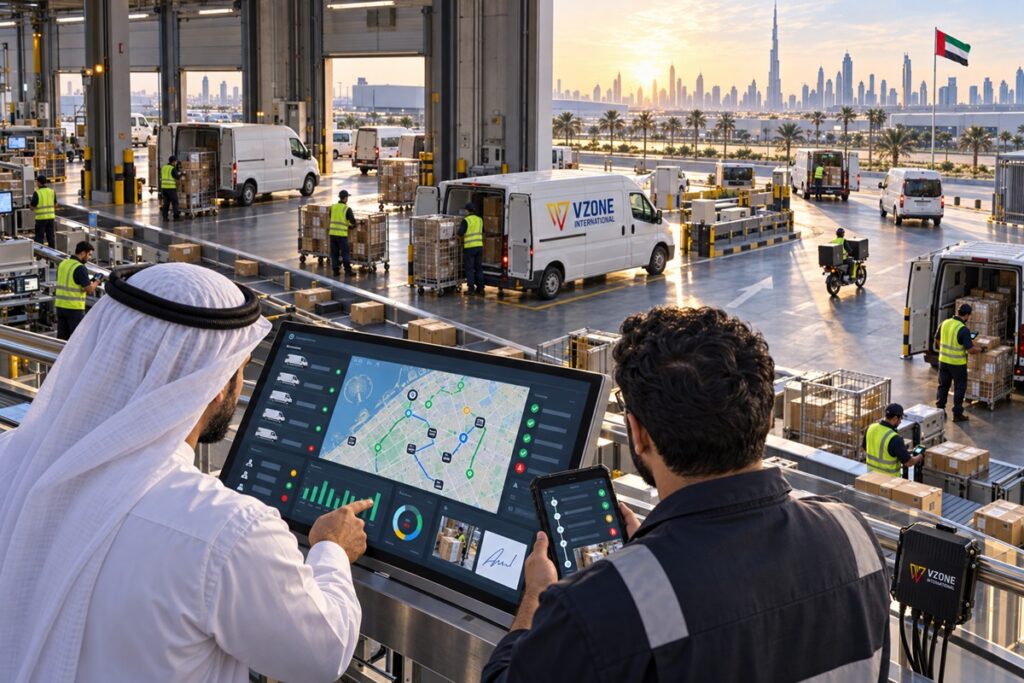
Real-time GPS tracking vehicle positions updating every 10 to 30 seconds on a live dispatcher map is the non-negotiable foundation for delivery fleet management. Without it, the dispatcher cannot identify the nearest available vehicle for a new collection request, cannot give customers reliable ETAs, and cannot detect a vehicle that has broken down or deviated from its route until the problem is already affecting deliveries.
Route optimisation is the feature that turns real-time tracking from a visibility tool into a planning and efficiency tool. Optimisation software calculates the most efficient multi-stop sequence for each vehicle’s daily deliveries accounting for load capacity, delivery time windows, and UAE-specific variables (Salik toll gate costs, Friday prayer time delivery gaps) producing routes that are 12 to 18 percent more efficient by distance than experienced manual dispatcher planning. For a delivery business spending AED 500,000 per year on fuel, a 15 percent distance reduction is AED 75,000 in annual savings typically more than the cost of the fleet tracking software itself.
Integration with Dispatch and Order Systems
Fleet tracking software that does not connect to your order management system, warehouse management system, or customer relationship platform creates a data silo delivery information that exists in two systems that staff must manually reconcile. In practice, staff will default to the familiar system (often the WMS or order platform) and use the fleet tracking software only when something goes wrong, rather than as the operational management tool it was purchased to be.
Before committing to any fleet tracking software, confirm the specific integration with your existing systems: does it have a native connector for your WMS or order platform, or does integration require custom development? What data flows in which direction do orders push to the fleet software for dispatch, or does the dispatcher manually re-enter them? Does ePOD delivery confirmation push back to the order platform to update delivery status, or does someone manually update the order record after the driver returns? A platform with native connectors for your specific systems (SAP, Oracle, Odoo, Zoho, or proprietary WMS) eliminates these questions; a platform requiring custom integration introduces a development project alongside the software deployment.
Ease of Use for Drivers
The most sophisticated fleet tracking software produces zero operational value if drivers do not use the driver app consistently and correctly. Driver app adoption failure is the most common reason fleet tracking software deployments underperform the app is installed, drivers use it for the first week, and within a month most drivers have reverted to WhatsApp for communication and paper waybills for delivery confirmation because the app is too complex, too slow, or not available in their working language.
Evaluate the driver app on four criteria before purchasing: is the interface genuinely simple (a driver should be able to complete an ePOD delivery confirmation in under 30 seconds without training), does it work in Arabic as well as English (essential for UAE’s multicultural driver population), does it function without reliable internet (offline capability for construction sites and remote routes), and does it include turn-by-turn navigation or integrate with Google Maps / Waze (drivers who must switch between the fleet app and a navigation app will stop using the fleet app first).
Fleet Tracking Software Pricing Models for Delivery Businesses
| Pricing Model | Structure | Best For | Watch Out For |
| Per-vehicle per-month subscription | Fixed monthly fee per GPS-tracked vehicle (AED 50–130/vehicle/month typical UAE range) | Fleets with stable vehicle counts; predictable monthly cost; easy to scale up or down | Per-vehicle cost adds up quickly for large fleets; confirm what is included (GPS hardware lease vs hardware purchase; SIM card vs separate) |
| Platform fee + per-vehicle | Base platform fee (AED 500–2,000/month) plus reduced per-vehicle fee (AED 30–70/vehicle/month) | Mid-size and growing fleets; base fee covers platform features; lower per-vehicle rate reduces marginal cost of adding vehicles | Base fee is committed cost even when fleet shrinks; confirm what is in the base fee vs add-on modules |
| Annual contract with volume discount | 12-month minimum commitment at discounted per-vehicle rate (10–20% below month-to-month) | Stable operations with predictable fleet size; maximises cost efficiency for established delivery businesses | Locked into platform for 12 months; ensure adequate trial period before committing (minimum 30 days in production use) |
| Free trial period | 30-day to 90-day full-feature trial before payment commitment | All delivery businesses evaluating software for the first time insist on production use, not sandbox demo | Confirm all features are active during trial; some vendors limit routes or vehicle counts in trial that create an unrealistic impression |
Common Mistakes When Choosing Fleet Tracking Software
- Buying on demo rather than trial: fleet tracking software always performs well in a vendor-controlled demonstration on clean data. The test that matters is running your actual routes, your actual driver population, and your actual dispatch workflow in production for 30 days. Any vendor that will not provide a meaningful trial period with your real data is not confident their software will perform in your specific operational context.
- Prioritising analytics over operations: reporting dashboards and management analytics are valuable, but they are downstream of operational performance. A platform that provides beautiful monthly reports but slow driver apps, unreliable GPS updates, or clunky dispatch tools will produce poor operational performance and good-looking reports of that poor performance. Evaluate the dispatcher experience and driver app first; evaluate reporting second.
- Ignoring integration early in the process: discovering that your preferred fleet tracking software does not have a native connector for your WMS or order platform at the contract signing stage means either accepting a data silo (expensive in staff time) or accepting a custom integration project (expensive in development time and cost). Integration requirements should be confirmed in the first evaluation meeting, not the last.
- Underestimating driver adoption: buying fleet tracking software and installing it on vehicles does not guarantee operational value. Driver adoption daily use of the driver app for job receipt, ePOD completion, and real-time reporting requires structured onboarding, clear communication of why the system is being deployed, and the two-way data access (drivers see their own performance scores) that makes the system feel fair rather than surveillance. Plan driver onboarding as a project, not an afterthought.
- Not accounting for UAE compliance requirements: for UAE commercial vehicles, fleet tracking software must support Asateel (Abu Dhabi commercial vehicle GPS data submission), ADNOC IVMS (for contractor vehicles), or SecurePath (Dubai school buses/rental) if any vehicles in the delivery fleet are subject to these programmes. A platform that does not manage UAE compliance from the same interface as fleet tracking creates a separate compliance administration workload that negates some of the operational efficiency gained from the tracking software.
Fleet Tracking Software Checklist Before You Buy
| ✓ | Criterion | What to Confirm |
| ☐ | Live GPS update frequency | GPS position updates every 10–30 seconds minimum intervals longer than 60 seconds miss short stops and make live dispatch unreliable |
| ☐ | Route optimisation included | Multi-drop optimisation with time window enforcement, vehicle capacity limits, and UAE Salik gate awareness not just A-to-B navigation |
| ☐ | Driver app Arabic/English | Full bilingual interface job cards, navigation, ePOD, safety score all available in Arabic for UAE multicultural driver population |
| ☐ | ePOD with GPS timestamp | Electronic proof of delivery with GPS coordinates of confirmation location, customer signature or photo, and delivery timestamp not just driver-clicked confirmation |
| ☐ | Dispatch/order system integration | Native connector for your specific WMS, order platform, or ERP confirm the data flows (orders in, ePOD status out) before contract |
| ☐ | UAE compliance support | Asateel, ADNOC IVMS, or SecurePath managed from the same platform confirm which programmes apply to your vehicle categories |
| ☐ | Production trial minimum 30 days | Full-feature trial with your actual routes, drivers, and dispatch workflow not a vendor-controlled sandbox demonstration |
| ☐ | Hardware and SIM included or separate | Confirm whether per-vehicle subscription includes GPS hardware lease and SIM card, or whether hardware is purchased separately total cost of ownership depends on this |
| ☐ | Driver behaviour monitoring | GPS safety scoring, harsh event detection, and idling alerts included these are fuel cost and insurance premium levers, not just safety tools |
| ☐ | UAE-based support and installation | Local Teltonika certified installer for GPS device installation; UAE-based customer support; Arabic language support availability |
Conclusion
Choosing fleet tracking software for a delivery business is a decision with a long operational tail the platform you select will shape your dispatcher’s daily workflow, your drivers’ app experience, and your customer’s delivery visibility for the next 2 to 5 years. The right fit depends on your delivery volume, route complexity, dispatch system integration requirements, and UAE compliance obligations not on which platform has the most impressive analytics dashboard.
The three non-negotiable criteria that delivery businesses should resolve first: real-time GPS tracking and route optimisation (the operational performance foundation), dispatch and order system integration (the data flow that prevents silos), and driver app quality and language support (the adoption factor that determines whether the investment produces operational value or collects dust). Get these three right and the platform decision is largely made. VZone International’s fleet management platform delivers all three for UAE delivery businesses with Asateel and IVMS compliance, Salik-aware route optimisation, and a bilingual Arabic/English driver app. Contact our team for a demo tailored to your delivery fleet size and dispatch setup.
VZone International Fleet Tracking Software for UAE Delivery Businesses
VZone International’s Wialon fleet tracking platform is built for UAE delivery operations: real-time GPS tracking, Salik-aware route optimisation, bilingual Arabic/English driver app with ePOD, dispatch integration (SAP, Oracle, Odoo, Zoho), and UAE compliance management (Asateel, IVMS, SecurePath) from a single deployment. Free trial available. Contact our team for a demo tailored to your delivery fleet size and dispatch workflow.
Frequently Asked Questions
Choose fleet tracking software for your delivery business by evaluating five criteria in order: real-time GPS tracking reliability (positions updating every 10 to 30 seconds the foundation for all other features), route optimisation capability (multi-drop sequence optimisation with time window enforcement and UAE Salik awareness), driver app quality and language support (Arabic/English bilingual interface, offline capability, ePOD collection in under 30 seconds), dispatch and order system integration (native connector for your WMS or order platform not custom development), and UAE compliance support (Asateel, ADNOC IVMS, or SecurePath if your vehicle categories require these programmes). Insist on a 30-day production trial with your actual routes and driver population before committing the operational performance you experience in production will differ from the vendor demonstration, and the trial is the only reliable evaluation method.
Fleet tracking software for small UAE delivery fleets (5 to 20 vehicles) typically costs AED 65 to AED 130 per vehicle per month for the platform subscription, plus AED 400 to AED 900 per vehicle one-time for the GPS hardware if vehicles are not already tracked. For a 10-vehicle delivery fleet, monthly platform cost is approximately AED 650 to AED 1,300, plus AED 4,000 to AED 9,000 one-time hardware investment. Annual total cost of ownership for the first year: AED 11,800 to AED 24,600. Against this, a 10-vehicle delivery fleet achieving 15 percent fuel cost reduction (AED 37,500 saving on AED 250,000 annual fuel spend) and eliminating AED 15,000 in fuel theft recovers the first-year investment within 5 to 7 months. From Year 2, the ongoing platform cost (AED 7,800 to AED 15,600 per year) is a fraction of the sustained annual savings.
Yes established fleet tracking platforms provide integration with common delivery and dispatch systems, though the depth and mechanism of integration vary significantly between platforms. Native connectors (pre-built integrations that require configuration rather than development) are available in major fleet tracking platforms for SAP, Oracle, Odoo, Zoho, and selected logistics-specific WMS platforms. For custom or proprietary dispatch systems, REST API access is the integration mechanism requiring development work from either the fleet software vendor or an integration partner. Before selecting a fleet tracking platform, confirm: does it have a native connector for your specific dispatch system, what data flows in which direction (job cards out to drivers, ePOD status back to dispatch), and what is the implementation timeline for the integration. Platforms that list 'API available' without native connectors for your specific system are offering potential integration, not existing integration an important distinction for deployment planning.
A route planning app calculates an optimised delivery sequence and provides turn-by-turn navigation it is a planning and navigation tool. Fleet tracking software does this and much more: it tracks all vehicles in real time on a live map (not just the planned route), monitors driver behaviour during execution (harsh events, speeding, idling), collects ePOD delivery confirmation at each stop with GPS timestamp, alerts the dispatcher when vehicles deviate from planned routes or when deliveries are at risk of SLA breach, generates fuel consumption and cost reports per vehicle, and manages compliance requirements (Asateel, IVMS, document expiry). The operational distinction matters because a route planning app stops being useful after the dispatcher sends drivers out; fleet tracking software is the management tool for the entire day from pre-departure to final delivery confirmation. Most delivery businesses that start with a route planning app and add fleet tracking software later find they should have started with fleet tracking software from the outset the route planning capability is included, and the operational visibility adds immediate value that a standalone route app cannot provide.