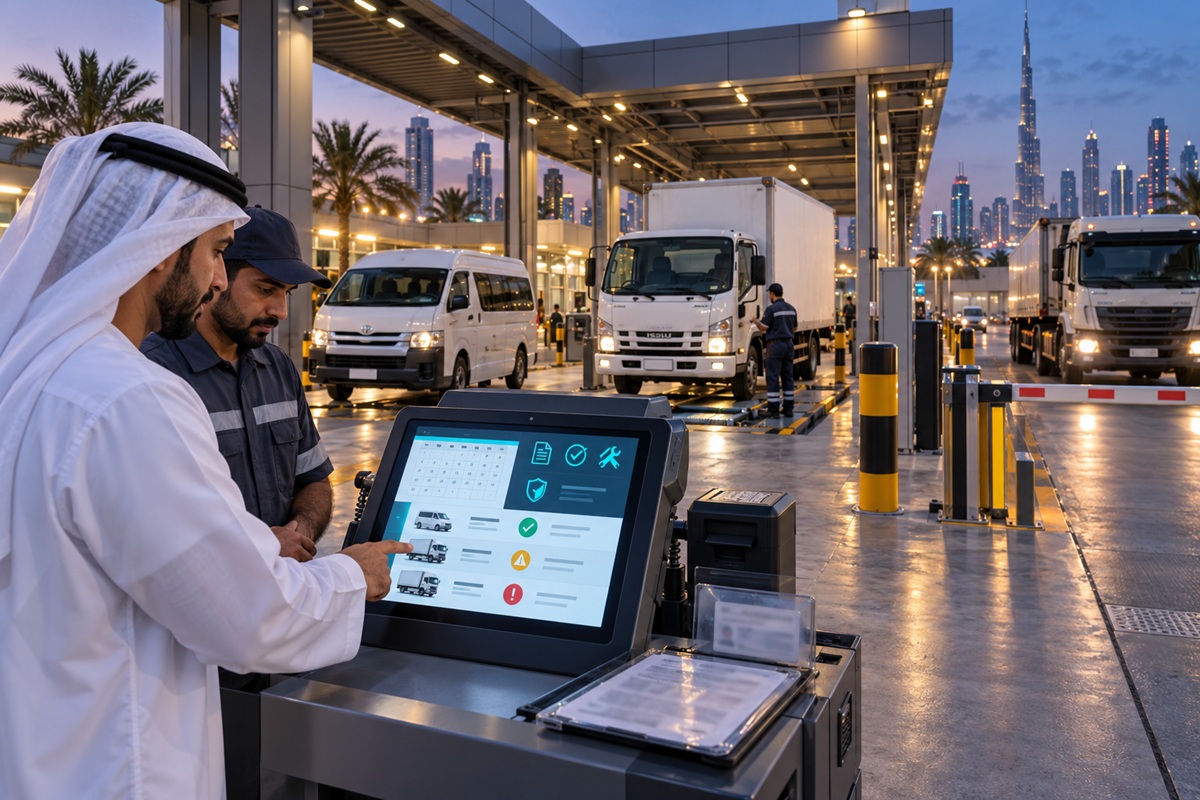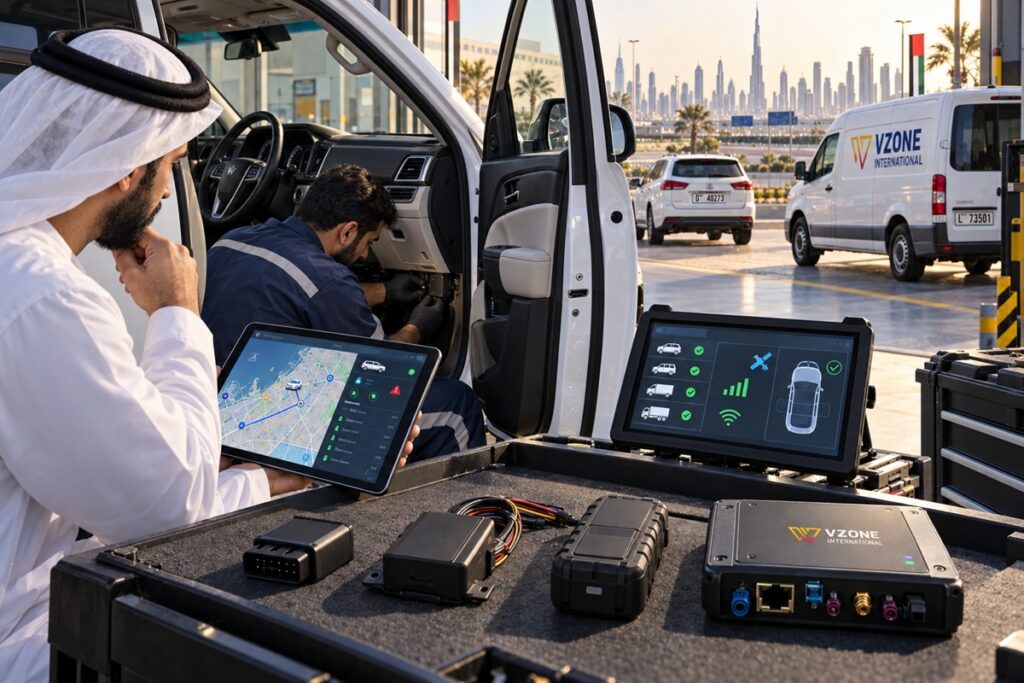
A GPS car tracker in the UAE does one thing at its core tells you where a vehicle is. What separates a useful GPS tracker from a pointless one is everything that surrounds that core: whether it uses a UAE 4G SIM or an unreliable 2G connection, whether the platform it connects to has features relevant to UAE operations, whether there is a local installer who can fit it correctly, and whether someone answers the phone when the device stops working in July.
This guide covers the device types, the features worth paying for, the UAE-specific connectivity requirements, the realistic price range, and the supplier questions that most buyers only ask after they have already made a mistake.
Key Takeaways
- A GPS car tracker in the UAE needs a local 4G SIM card and UAE-network connectivity 2G-only devices sold on online marketplaces are already unreliable across parts of the country and will require replacement as 2G coverage continues to diminish.
- The three device types are OBD plug-in (fastest to install, easiest to remove best for short-term needs or leased vehicles), hardwired (theft-resistant, tamper-evident, best for permanent fleet deployment), and battery or magnetic (for trailers, assets, and equipment without a vehicle power source).
- Price is split between hardware and monthly subscription a cheap device with no local support and a basic overseas platform typically costs more over three years than a mid-range UAE-supplied device with a proper local warranty.
Who Needs a GPS Car Tracker in the UAE
GPS car trackers in the UAE serve three distinct buyer categories with different requirements, different budgets, and different definitions of what a tracker needs to do.
Individual Car Owners
Individual car owners in the UAE typically want a GPS tracker for two reasons: anti-theft protection (real-time location for vehicle recovery if stolen, often combined with an immobiliser relay that can remotely cut ignition) and monitoring of a vehicle driven by a family member a teenager, a domestic employee, or a family member who borrows the car. For individual owners, an OBD plug-in tracker or a compact hardwired device on a basic platform subscription (AED 15 to AED 50 per month) is typically sufficient. The key requirements are ease of installation, a simple mobile app, and reliable geofence alerts for departures from a home or office location.
Small Businesses 2 to 15 Vehicles
Small business owners tracking company vehicles delivery vans, service technicians’ cars, pool vehicles need more than location. They need trip history for customer billing verification, driver behaviour monitoring for insurance and fuel management, and basic reporting that can be shared with a finance team. For this segment, a mid-range UAE-supplied device on a platform with driver behaviour scoring, trip reporting, and a simple management dashboard is the appropriate specification. Platform features matter more than hardware specification at this level the management reporting is the value, not the GPS accuracy.
Fleet Operators 15+ Vehicles
Commercial fleet operators need GPS car trackers that integrate with UAE compliance requirements (Asateel for Abu Dhabi-registered vehicles, ADNOC IVMS for contractor vehicles, SecurePath for Dubai rental vehicles), connect to fuel card APIs for consumption reconciliation, feed into ERP systems for cost allocation, and provide Arabic-language reporting for bilingual management teams.
This segment requires an enterprise-grade fleet management platform rather than a simple tracking subscription the tracker hardware is the data collection layer; the platform is the operational management tool. For fleet operators, the supplier’s UAE compliance module depth and implementation support matter more than the device unit cost.
Types of GPS Car Trackers Compared
OBD Plug-In Trackers
OBD plug-in trackers connect directly to the vehicle’s OBD-II diagnostic port a standardised 16-pin connector found under the dashboard on the driver’s side of all petrol and diesel vehicles manufactured after 2003. Installation takes under 5 minutes with no tools: plug the device into the OBD port and it powers from the vehicle’s electrical system immediately. The OBD connection also gives the tracker access to engine diagnostic data (fault codes, engine speed, fuel consumption as reported by the ECU), making OBD plug-in devices suitable for both location tracking and basic telematics.
Limitations in the UAE context: OBD port location varies by vehicle model on some UAE-market vehicles (particularly larger SUVs and pickup trucks common in the UAE), the OBD port is in a visible and accessible position that makes an OBD device easy for a driver or thief to remove. For fleet deployments where tamper-resistance matters, OBD devices are less suitable than hardwired installations. OBD plug-in trackers are also incompatible with some hybrid and fully electric vehicles that use non-standard OBD implementations.
Hardwired Trackers
Hardwired GPS trackers are wired directly to the vehicle’s electrical system connecting to constant power (the battery positive), ground (the chassis), and ignition (the ignition-on circuit) using spade terminals, fuse taps, or direct wire connection. Professional installation takes 30 to 60 minutes per vehicle and requires basic automotive electrical knowledge. The device is concealed behind dashboard panels, in the engine bay, or in the wheel arch lining positions that require tool access to remove and that are not visible without searching.
Hardwired installation is the standard for UAE commercial fleet deployments for three reasons: tamper resistance (the device cannot be unplugged by a driver who wants to avoid monitoring), theft prevention (a concealed hardwired tracker enables vehicle recovery after theft), and reliability (constant power connection eliminates the battery drain issues that affect magnetic or OBD devices on vehicles parked for extended periods). The installation cost (AED 200 to AED 450 per vehicle) is a one-time expense against a device that stays in the vehicle for 3 to 5 years.
Battery and Magnetic Trackers
Battery-powered magnetic trackers attach to a vehicle or asset magnetically without any wiring they operate from an internal rechargeable or replaceable battery and are repositionable between assets without installation. They are the appropriate solution for trailers (no constant power source), construction equipment (tracked by ownership, not by fixed GPS install), shipping containers, and high-value cargo. UAE-specific limitation: battery life is significantly reduced in UAE summer heat a device rated for 30 days battery life in temperate conditions may achieve 10 to 15 days in a vehicle parked in direct sun in July. Battery management and recharging schedules require more active management in UAE conditions than manufacturer specifications suggest.
| Feature | OBD Plug-In | Hardwired | Battery / Magnetic |
| Installation time | Under 5 minutes, DIY | 30–60 min, professional | Under 1 minute, no tools |
| Power source | Vehicle OBD port (ignition power) | Vehicle electrical system (constant) | Internal battery (rechargeable or replaceable) |
| Tamper resistance | Low easily unplugged | High requires tools to remove | None detachable by hand |
| OBD/engine data access | Yes fault codes, ECU fuel data | No (unless CAN bus wired separately) | No |
| Battery backup (when ignition off) | None powers off with ignition | Optional internal battery backup | Full operation from battery |
| UAE fleet deployment suitability | Leased vehicles, short-term, individual use | Commercial fleet standard | Trailers, assets, equipment, cargo |
| Typical UAE hardware cost | AED 250–600 | AED 500–1,000 | AED 400–900 (+ battery management) |
Features That Actually Matter in the UAE and Ones That Don’t
GPS car tracker feature lists grow longer every year. These are the features with genuine operational value in the UAE market, and the ones that are frequently marketed but rarely used:
| Feature | Worth Paying For in UAE? | Why |
| 4G LTE connectivity | Essential | UAE 2G coverage is shrinking; 2G-only devices will need replacement; 4G ensures UAE-wide reliable connection |
| Ignition detection | Essential | Distinguishes vehicle movement from GPS drift; enables accurate trip logging; required for idling monitoring |
| Geofencing with alerts | Essential for fleet | Depot departure, after-hours use, customer site arrival the operational alerts that make tracking useful day-to-day |
| Driver behaviour (harsh events) | Essential for fleet | Harsh braking/acceleration GPS events drive fuel saving and insurance premium reduction; personal owners can skip |
| UAE compliance module (Asateel/IVMS) | Essential if applicable | Abu Dhabi commercial vehicles require Asateel; ADNOC contractor vehicles require IVMS non-compliant without it |
| Arabic interface | Essential for UAE fleet | Multilingual driver and management teams; Arabic-only reports required by some UAE government clients |
| Fuel card integration | High value for fleet | Per-vehicle fuel cost visibility; theft detection via card-to-GPS reconciliation |
| Live video / dashcam | Optional | Valuable for incident evidence; adds cost and data; not required for basic fleet tracking |
| Engine immobiliser relay | Optional (anti-theft) | Remote ignition cut for theft recovery; valuable for individual owners; operationally complex for large fleets |
| Heartbeat interval < 10 seconds | Not necessary | 30-second updates are sufficient for all practical fleet management; shorter intervals increase data cost without operational benefit |
Connectivity, SIM Cards and UAE Regulations
Every GPS car tracker in the UAE requires a UAE mobile SIM card to transmit data to the fleet management platform. The SIM options for UAE GPS tracking:
- Provider-managed SIM (recommended): the GPS tracking provider supplies and manages the SIM card as part of the device or subscription the SIM is configured for the device, the data plan is appropriate for GPS reporting frequency, and SIM management (plan renewals, data top-ups, number changes) is handled by the provider without fleet administrator involvement. This is the standard arrangement for commercial fleet deployments.
- Self-managed SIM: the buyer provides their own UAE SIM from Etisalat or du on a data plan of at least 50 MB per month per device. This works but requires the buyer to manage SIM provisioning, data plan adequacy, and renewals across the fleet an administrative overhead that scales poorly beyond 5 to 10 devices.
- Roaming SIM: some overseas GPS tracker suppliers include a multi-country roaming SIM. These typically provide degraded UAE coverage (roaming rather than home network) and may not support all UAE frequency bands. For fleet deployments requiring consistent UAE-wide coverage including remote routes, roaming SIMs from overseas providers are not a reliable solution.
UAE regulatory note: GPS tracking of company vehicles is legal and does not require regulatory approval beyond PDPL employee disclosure. Vehicles requiring Asateel compliance (Abu Dhabi commercial vehicles above 3.5 tonnes) must use an Asateel-approved GPS device from the ITC-approved device list non-approved devices cannot be registered for Asateel compliance regardless of their technical capabilities. VZone International’s Teltonika devices are on the Asateel-approved list.
GPS Car Tracker Price in the UAE What to Expect
| Buyer Category | Hardware (per device) | Monthly Subscription | Installation | Year 1 Total per Vehicle |
| Individual car owner (basic) | AED 250–500 | AED 20–50 | DIY or AED 150 | AED 640–1,300 |
| Small business (5–15 vehicles) | AED 400–700 | AED 60–90 | AED 200–350 | AED 1,320–2,130 |
| Commercial fleet (15+ vehicles) | AED 600–1,000 | AED 80–120 | AED 250–450 | AED 1,810–2,890 |
| ADNOC/compliance fleet | AED 800–1,400 | AED 100–150 | Included in deployment | AED 2,000–3,200 |
Installation: DIY vs Professional
The installation decision depends on device type and the tamper-resistance requirement. OBD plug-in devices are genuine DIY plug in and the device activates, no tools required. Battery magnetic devices are also self-installed. Hardwired devices require basic automotive electrical work if the vehicle has a manufacturer warranty that could be affected by non-professional electrical modifications, a professional installer is the appropriate choice.
For UAE commercial fleet deployments, professional installation by a Teltonika-certified installer is the standard: the installer handles device placement for concealment and GPS signal quality simultaneously, wires the device correctly to constant power and ignition (common DIY wiring errors include connecting to accessory power rather than constant power, losing trip data when the vehicle is parked), and calibrates any fuel sensors if fuel monitoring is included. VZone International is a Teltonika certified installer with UAE-wide installation coverage installations are scheduled in batches for fleet deployments to minimise vehicle downtime.
How to Choose a Supplier in the UAE
- Confirm 4G device and UAE network compatibility before any purchase ask specifically which UAE mobile networks the device SIM operates on (Etisalat and du home network, not roaming) and whether the platform has UAE uptime history.
- Ask for the UAE compliance module detail relevant to your vehicles: Asateel approval status for Abu Dhabi vehicles, ADNOC IVMS certification for contractor vehicles, SecurePath approval for Dubai rental vehicles.
- Request a reference from a UAE fleet of similar size operating in similar conditions not a testimonial page, an actual contact at a company using the same platform and device combination.
- Confirm the warranty and device replacement policy in writing: what happens when a device fails (and in UAE summer heat, devices do fail), how quickly is it replaced, is there a loan device while the replacement is processed, and who pays for re-installation.
- Insist on a production trial of at least 2 weeks with your actual vehicles before committing to a multi-vehicle deployment run the trial on 2 to 3 vehicles from the actual fleet with the actual driver population and evaluate the platform in your real operational context, not a vendor-controlled demonstration.
Conclusion
A GPS car tracker in the UAE is a 3-year purchasing decision, not a one-off hardware purchase. The device type (OBD, hardwired, or battery), the platform features (4G connectivity, UAE compliance, Arabic interface, driver behaviour monitoring), the installation quality, and the local support structure together determine whether the tracker delivers operational value or sits as unused technology in the vehicle. For individual car owners with basic anti-theft or monitoring needs, an entry-level OBD device on a simple platform is adequate. For UAE commercial fleet operators where compliance, driver behaviour data, fuel monitoring, and local warranty support are operational requirements, a professionally installed hardwired device on a UAE-compliance fleet management platform is the only viable option the cheaper alternatives do not meet the requirements that UAE commercial operations impose.
VZone International supplies Teltonika GPS trackers for UAE commercial fleets 4G LTE, Asateel and IVMS certified, professionally installed, with the Wialon fleet management platform including Arabic interface, driver behaviour scoring, fuel monitoring, and Salik integration. Contact our team for a device consultation and demonstration for your UAE vehicle count and fleet type.
VZone International GPS Car Tracker UAE 4G Devices, UAE Compliance, Professional Installation
VZone International supplies Teltonika 4G GPS trackers for UAE cars and commercial vehicles Asateel and ADNOC IVMS certified, professionally installed by certified technicians across the UAE, with the Wialon fleet management platform including Arabic/English interface, driver behaviour scoring, Salik integration, and fuel monitoring. Contact our team for a device recommendation and installation quote for your vehicles.
Frequently Asked Questions
A GPS car tracker in the UAE costs AED 250 to AED 1,400 for the hardware depending on device type and specification, plus AED 20 to AED 150 per vehicle per month for the platform subscription. For an individual car owner using an OBD plug-in device on a basic platform, the Year 1 total is approximately AED 640 to AED 1,300. For a commercial fleet vehicle with hardwired installation on a full fleet management platform, the Year 1 total is AED 1,800 to AED 2,900 per vehicle. The hardware cost is a one-time purchase; the subscription is the recurring cost that determines the 3-year total cost of ownership always request the 3-year total, not the device price alone.
Yes installing a GPS tracker on a vehicle you own or a vehicle your company owns is legal in the UAE without any specific regulatory approval required for the installation itself. For company vehicles where employees are tracked, UAE PDPL (Federal Decree Law No. 45 of 2021) requires that employees are informed that GPS monitoring is active on company vehicles this disclosure should be included in the employment contract or a separate fleet GPS monitoring policy provided at onboarding. For specific vehicle categories, GPS compliance programmes apply: Asateel for Abu Dhabi commercial vehicles above 3.5 tonnes (requires an ITC-approved GPS device), ADNOC IVMS for contractor vehicles on ADNOC sites, and SecurePath for Dubai-licensed rental vehicles. These compliance programmes require specific approved devices; a generic GPS tracker does not satisfy the regulatory requirement even if it provides location tracking.
Subscription-free GPS car trackers exist in the UAE market as data loggers devices that store trip history on internal memory or an SD card without transmitting to a live platform. These devices provide trip records that can be downloaded when the device is retrieved, but do not provide live tracking, real-time alerts, or any remote management capability. For live GPS tracking seeing where a vehicle is right now, receiving geofence alerts, accessing trip history remotely a monthly subscription to a connected platform is required. The subscription pays for the cellular SIM data, the cloud platform hosting, the data processing, and the web and app interface. There is no practical alternative to a subscription for live real-time GPS tracking capability.
The best GPS tracker for a car in Dubai depends on the use case. For anti-theft protection on a personal vehicle, a hardwired device with an immobiliser relay and a concealed installation is the most effective it enables vehicle recovery after theft and cannot be easily removed by a thief. For a company vehicle in a Dubai commercial fleet, a hardwired 4G device on a UAE fleet management platform with Asateel approval, Arabic interface, and Salik toll integration is the appropriate specification basic trackers without these UAE-specific features do not meet commercial fleet operational requirements. For a trailer or asset without a vehicle power source, a battery-powered magnetic tracker is the only viable option. VZone International's Teltonika-based GPS tracking solutions cover all three use cases with UAE-certified devices and local installation support.
A GPS car tracker can be detected by a driver who knows what to look for OBD plug-in devices are visible in the OBD port without any searching; hardwired devices concealed behind dashboard panels require more effort to find but are not undetectable by a determined person with time and tools. GPS signal detectors are available commercially and can identify an active transmitting GPS device within a vehicle. For fleet operators concerned about driver tampering, hardwired installation in a concealed location (wheel arch, behind engine bay panels) combined with tamper alerts (the device sends an alert if it loses power or is disconnected) provides the most tamper-resistant deployment. For anti-theft installations where the goal is recovery rather than deterrence, the tracker should be as concealed as possible multiple devices in different locations is a strategy used by high-value vehicle owners in markets with elevated theft risk.