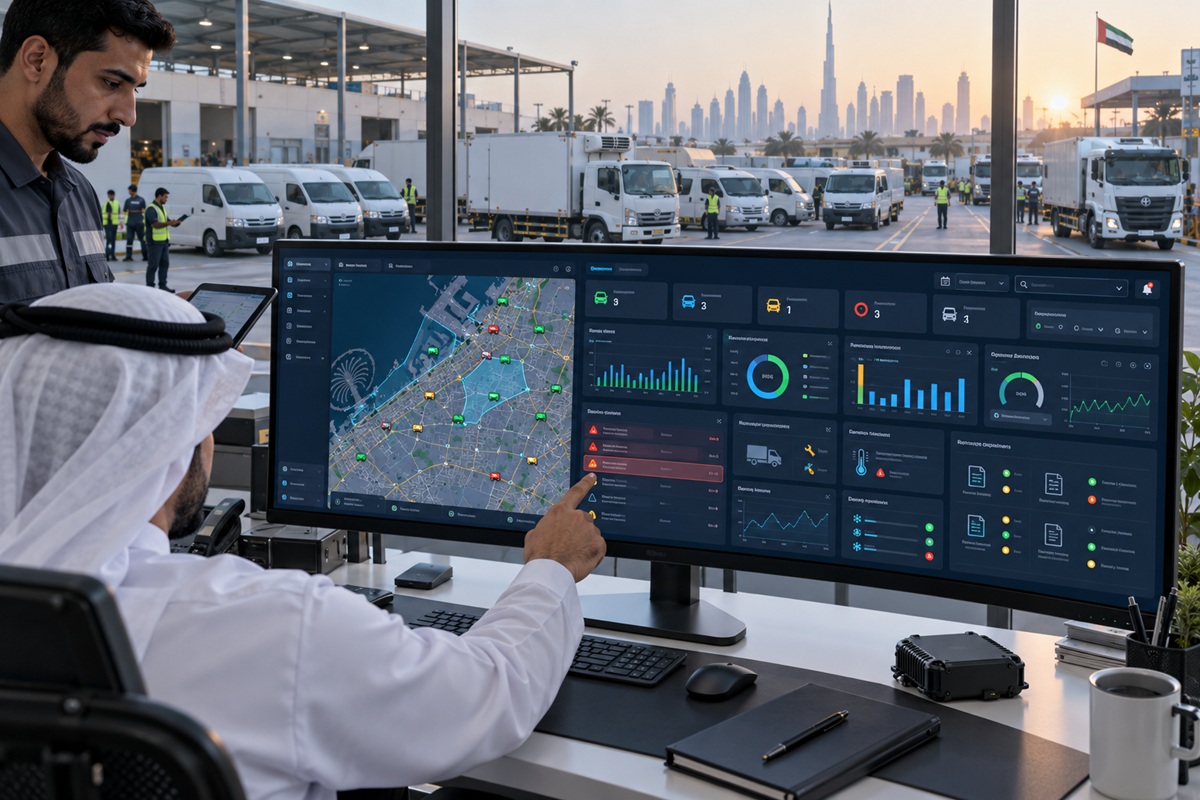
No industry in the UAE places greater demands on fleet management technology than oil and gas. The combination of remote desert and offshore operating locations, extreme environmental conditions, mixed asset fleets spanning light vehicles through heavy equipment and generators, high driver turnover across multilingual workforces, and the most rigorous contractor HSE compliance framework in the region makes fleet visibility and safety management a genuinely complex operational challenge one that generic GPS solutions consistently fail to address adequately.
ADNOC contractors who approach fleet tracking as a simple GPS hardware procurement exercise discover quickly that the requirement is substantially more specific. ADNOC mandates IVMS-certified hardware, HSE-formatted driver behaviour reports, fatigue monitoring on long-haul routes, and a management review process that auditors examine during performance assessments. Beyond the passenger and commercial vehicle fleet, oil and gas site operations also require tracking for heavy equipment excavators, cranes, mobile plant and increasingly for remote generators that represent both a significant fuel cost and a theft risk that is difficult to manage without IoT sensor integration.
This guide covers the full spectrum of GPS and telematics requirements for UAE oil and gas fleet operations: ADNOC IVMS compliance, heavy equipment tracking, genset monitoring, multi-country GCC coverage, and the specific operational challenges that make oil and gas fleet management distinctly different from other industry sectors.
Key Takeaways
- ADNOC IVMS compliance is mandatory for all vehicles operated by ADNOC contractors and sub-contractors on ADNOC sites including light vehicles such as pick-up trucks and SUVs used for site personnel transport, not just heavy trucks.
- Oil and gas fleet tracking in UAE requires hardware rated for extreme heat, sand, and vibration standard commercial GPS devices not specified for desert operating conditions experience significantly higher failure rates in UAE oil field environments.
- Heavy equipment tracking requires dedicated GPS asset trackers rather than standard vehicle telematics equipment without ignition circuits needs battery-powered devices with motion-activated transmission and long battery life.
- Remote generator (genset) monitoring using IoT fuel sensors and GPS communication devices enables real-time fuel level visibility, theft detection, and predictive maintenance scheduling without requiring on-site personnel for every status check.
- UAE-Oman cross-border oil and gas operations require both ADNOC IVMS certification for UAE-side operations and OPAL certification for Oman operations two separate compliance programmes that not all providers hold simultaneously.
- Desert and remote offshore GPS coverage requires devices with dual-SIM configurations or satellite fallback capability to maintain data transmission in areas beyond standard cellular network coverage.
Unique Fleet Challenges in UAE Oil and Gas Operations
Oil and gas fleet management in the UAE presents a specific combination of operational challenges that do not exist in the same form in any other industry sector. Understanding these challenges is the starting point for specifying fleet technology that will actually perform in this environment rather than generating the false sense of security that comes from deploying hardware that was designed for urban logistics operations.
Remote Operations Desert, Offshore, and Industrial Zone Coverage
ADNOC’s onshore operations span Abu Dhabi’s Western Region the Rub’ al Khali desert interior and the industrial zones of Ruwais, Habshan, and Bab. These areas extend 200 to 400 kilometres from Abu Dhabi city, with cellular network coverage that is progressively less reliable as operations move into the deep desert interior. Offshore operations on ADNOC platforms and support vessels introduce a different connectivity challenge: standard cellular GPS devices lose connectivity entirely beyond cellular coastal range, requiring satellite modem capability for continuous tracking.
The connectivity requirement for desert and offshore fleet tracking is not simply a data quality consideration it is a safety consideration. A vehicle that goes off-network in a remote desert location without a scheduled check-in protocol and without satellite-capable tracking creates a personnel search-and-rescue risk that ADNOC’s HSE framework takes seriously. Fleet tracking devices deployed on vehicles operating in the Western Region should carry dual-SIM configurations (roaming between UAE operators for maximum cellular coverage) with satellite fallback activated at the edge of cellular coverage.
Mixed Fleets Light Vehicles, Heavy Trucks, Heavy Equipment and Gensets
A typical ADNOC contractor operating on a major offshore or onshore project manages a fleet that spans five or six distinct asset categories simultaneously: light vehicles (crew transport SUVs and pick-ups), medium commercial vehicles (supply trucks and service vans), heavy trucks (tankers, flatbeds, crane trucks), mobile heavy plant (excavators, bulldozers, mobile cranes), stationary assets (generators, compressors, pumps), and occasionally marine vessels for offshore support. Each category has different tracking hardware requirements, different data capture specifications, and different monitoring priorities.
The fleet management platform challenge is unifying all of these asset categories into a single operational visibility dashboard rather than managing separate tracking systems for vehicles, equipment, and generators. A unified view is not just operationally convenient; it is a safety requirement. An incident that involves the interaction between a tracked vehicle and an untracked piece of mobile equipment on a congested project site creates liability exposure that unified tracking and zone management helps prevent.
Extreme Environmental Conditions Heat, Sand, and Vibration
UAE oil field operating conditions create hardware failure rates that significantly exceed those in standard commercial fleet environments. Ambient temperatures on ADNOC Western Region sites regularly exceed 50°C in summer, with vehicle interior temperatures reaching 75°C to 85°C during parked periods. Sand and dust penetration particularly during shamal wind events affects any hardware with exposed connectors or inadequately sealed enclosures. Vehicle-mounted equipment on construction and drilling sites is subjected to continuous high-amplitude vibration from engine operation, rough terrain driving, and mechanical equipment proximity.
GPS devices specified for oil and gas UAE deployments must carry IP67 or higher environmental protection ratings, be rated for operating temperatures of at least -20°C to +70°C, and have vibration resistance specifications appropriate for heavy vehicle and equipment mounting. Devices that perform reliably in European fleet deployments regularly fail within six to twelve months when deployed in UAE oil field conditions without these specifications. Hardware specification review for desert operating conditions is a non-negotiable step in any ADNOC contractor fleet technology procurement.
High Driver Turnover and Multilingual Workforce
ADNOC contractor workforces are characterised by high driver and operator turnover particularly for contract-duration projects where the workforce mobilises and demobilises on project cycles and by linguistic diversity that makes standard driver communication and training approaches ineffective. A safety monitoring programme that relies on drivers understanding written English-language alert notifications or coaching reports has limited impact across a workforce that may span 15 to 20 nationalities with primary languages including Arabic, Hindi, Urdu, Tagalog, Malayalam, and Nepali.
In-cab alert systems that use audio alerts rather than text notifications address the language barrier for real-time safety intervention a buzzer or voice alert in a driver’s primary language does not require literacy in any language. Driver ID systems that use physical iButton or RFID tokens rather than PIN entry eliminate the literacy requirement at the identification stage. These operational details matter significantly in oil and gas contractor fleets and are often overlooked in fleet technology specifications that assume a literate, single-language workforce.
IVMS Requirements for ADNOC Contractors
ADNOC’s IVMS requirements represent the most detailed and rigorously audited fleet compliance standard in the UAE. For contractors new to ADNOC site operations, the scope of the requirement is often surprising it goes substantially beyond installing a GPS device and extends to driver identification, multi-tier behavioral event capture, HSE report generation, management review evidence, and fatigue monitoring on qualifying routes.
What ADNOC Mandates Device, Data, and Reporting
ADNOC’s IVMS mandate covers three distinct requirements that must be satisfied simultaneously. First, hardware: vehicles must carry IVMS-certified devices capable of capturing multi-tier speed events, g-force driving behaviour (harsh braking, acceleration, cornering), seatbelt compliance, and driver identification. Standard GPS trackers do not satisfy this requirement regardless of brand or market reputation. Second, data: the device must transmit behavioral event data continuously to a platform that stores the full event record for audit access. Third, reporting: the platform must generate HSE-formatted driver behaviour reports weekly at driver and vehicle level, monthly at fleet summary level in the format that ADNOC auditors are trained to review.
The hardware, data, and reporting requirements are inseparable: a contractor who deploys certified hardware on an inadequate platform that cannot generate ADNOC-format HSE reports is non-compliant. A contractor who generates correctly formatted reports from a platform fed by non-certified hardware is equally non-compliant. All three components must be satisfied simultaneously by the same integrated solution.
HSE Compliance Reports What Your System Must Generate
ADNOC HSE audit reviews of IVMS data examine specific report components that not all fleet platforms can produce in the required format. The primary audit documents are the weekly driver behaviour summary event counts per driver per vehicle by event category, with trend comparison against the previous period and the monthly fleet HSE performance summary fleet-wide event rate trends, coaching action status, and incident correlation data. Auditors also examine management review records: evidence that the IVMS data has been reviewed at a level of management with authority to take corrective action, not simply filed by an administrative team.
Secondary audit examination points include: driver ID records confirming that each event is attributed to a named individual; seatbelt compliance rate statistics across the contractor fleet; speed event frequency at each threshold level; and for fleets operating on specific ADNOC facilities with lower on-site speed limits, evidence that site-specific speed thresholds were configured and actively monitored rather than road speed limits being applied uniformly.
Driver Fatigue Monitoring Mandatory for Long-Haul Site Routes
ADNOC’s HSE requirements include fatigue monitoring provisions for drivers operating on long-haul routes between Abu Dhabi and remote Western Region sites. Journey times of four to six hours each way often conducted by drivers on rotating shift patterns that do not always allow adequate rest between journeys create fatigue risk profiles that ADNOC’s HSE framework explicitly addresses. Contractors operating these routes are expected to demonstrate fatigue management measures, and AI dashcam-based fatigue monitoring is the technology standard that satisfies this requirement with continuous, evidence-based monitoring rather than manual fatigue assessment processes.
Heavy Equipment and Asset Tracking in Oil and Gas
The passenger and commercial vehicle fleet represents only part of the asset tracking challenge on a major UAE oil and gas project. Mobile heavy plant excavators, cranes, bulldozers, compactors and high-value portable equipment represent asset values that dwarf the vehicle fleet, and their movement, utilisation, and condition are equally important for both operational efficiency and loss prevention.
Tracking Cranes, Excavators, and Mobile Plant
Heavy plant tracking uses GPS asset trackers rather than standard vehicle telematics. The key difference is the power source: heavy equipment does not always have a consistent ignition circuit comparable to a road vehicle, and tracking devices must be capable of operating from a battery power source or from the equipment’s 12V/24V auxiliary supply, with motion-activated transmission that conserves battery during stationary periods and transmits actively when movement is detected.
The operational data priorities for heavy plant are different from road vehicles. Location matters but utilisation hours, engine-on duration, and movement patterns are equally important for project management and maintenance scheduling. A crane that has accumulated 850 engine hours since its last service inspection needs a maintenance intervention regardless of whether it has covered any meaningful distance. GPS asset trackers with engine-on hour recording via power circuit monitoring provide the utilisation data that project equipment managers need alongside location data.
Geofencing is particularly valuable for heavy plant on congested project sites where equipment movement into restricted zones live cable corridors, exclusion zones around ongoing civil works, or personnel areas where heavy equipment proximity creates collision risk is both a safety and a liability concern. Automated alerts when tracked equipment enters a restricted zone create real-time awareness for site safety managers without requiring continuous manual monitoring of equipment positions.
GPS Asset Tags for Tools and Portable Equipment
Below the heavy plant category, oil and gas projects manage large inventories of portable high-value equipment specialised tools, survey instruments, testing equipment, safety-critical spares, and specialist technical equipment that represents significant replacement cost and long lead times if lost or misplaced. Bluetooth Low Energy (BLE) asset tags provide a cost-effective tracking solution for this category: small, battery-powered tags attached to equipment items that are detected by GPS gateway devices installed in vehicles and fixed site locations, creating a proximity-based location record without requiring cellular connectivity in the tag itself.
The limitation of BLE asset tags is range they are detected within approximately 10 to 30 metres of a gateway device, making them suitable for zone presence tracking (confirming that a tagged item is within a warehouse, vehicle, or site compound) rather than precise individual location. For the portable equipment category where the primary concern is ensuring items have not left an authorised zone, BLE tag monitoring is a proportionate and cost-effective solution that does not require the per-item cellular subscription cost of full GPS tracking.
Unauthorised Movement Alerts for High-Value Equipment
High-value plant theft is a documented risk on UAE construction and oil and gas project sites, particularly during periods of reduced site activity such as public holidays and Eid breaks when security staffing is reduced. GPS tracking devices on high-value equipment configured with motion detection alerts triggered by any movement outside operational hours or outside the geofenced site boundary provide the earliest possible warning of unauthorised equipment movement, enabling a response before the equipment leaves the site perimeter.
The response window is critical: once heavy plant has been loaded onto a flatbed transporter and moved off-site, recovery becomes substantially more difficult even with GPS tracking active. Alerts triggered within two to three minutes of initial unauthorised movement before loading and transport are complete give security teams a realistic intervention window. This requires that alert notifications are routed to a 24-hour security operations contact rather than a fleet manager who may not be reachable outside business hours.
Generator (Genset) Monitoring The Hidden Fleet Cost
Remote generators are one of the most consistently under-managed asset categories in UAE oil and gas and construction operations. Sites in the Western Region and on offshore facilities that are not connected to the Abu Dhabi grid run on generator power, sometimes with 50 to 100 or more gensets operating simultaneously across a large project. The fuel cost of running this generator fleet combined with the theft risk and the maintenance cost of unscheduled breakdowns represents a significant and frequently opaque operational expense that remote IoT monitoring directly addresses.
Remote Fuel Level Monitoring for Gensets
IoT fuel level sensors installed in generator fuel tanks connected to a GPS communication device that transmits readings to the fleet management platform enable real-time visibility over fuel levels at every monitored genset from a single dashboard. Operators see fuel percentage, estimated runtime remaining at current consumption rate, and trend data showing consumption patterns over time. Pre-alert notifications when fuel reaches a defined minimum threshold typically 25 to 30 percent of tank capacity enable scheduled refuelling before operational disruption, eliminating the unplanned generator failures that previously required emergency fuel deliveries across remote desert sites.
The financial case for remote fuel monitoring on a large UAE project genset fleet is direct: a generator that runs dry and shuts down unexpectedly during active drilling or production operations can create downtime costs that exceed the entire annual fuel monitoring subscription cost for the site. The monitoring investment is justified not by the fuel saving alone but by the operational continuity protection it provides.
Runtime Tracking and Maintenance Scheduling
Generator maintenance is scheduled on runtime hours rather than calendar time or distance unlike road vehicles where mileage is the primary maintenance interval driver. IoT monitoring tracks cumulative runtime hours per generator and generates automated maintenance scheduling alerts when a unit approaches its service interval. This enables predictive, planned maintenance that prevents the unscheduled breakdowns that occur when generators are serviced only on calendar cycles that do not reflect actual utilisation intensity.
On a project site running 60 generators at different utilisation rates some providing base load power continuously, others in standby operation calendar-based maintenance schedules create either premature servicing of low-utilisation units or missed service intervals for high-utilisation units. Runtime-based scheduling triggered by IoT monitoring allocates maintenance resources accurately, reducing both over-servicing costs and breakdown risk simultaneously.
Theft and Unauthorised Drain Alerts
Generator fuel theft in remote UAE project locations is a documented operational problem. The typical theft pattern involves fuel drain from the generator tank during low-activity periods typically at night or during prayer times using portable pumps that can extract hundreds of litres in under 30 minutes. IoT fuel sensors configured with rapid-decline alerts triggered when fuel level drops at a rate inconsistent with normal generator consumption detect these events within minutes and enable a security response before the full tank volume is extracted.
Cross-referencing IoT fuel sensor data with GPS positioning and security access records creates a multi-layer theft detection framework. A fuel level drop at a monitored generator that correlates with no authorised refuelling or maintenance record, no generator runtime increase that would explain increased consumption, and no registered vehicle access to the generator location during the relevant period is a theft event signature that is difficult to explain away and straightforward to investigate with the available evidence.
| Asset Type | Tracking Method | Key Data Points | ADNOC Required? | Primary Value Driver |
| Light vehicles (SUVs, pick-ups) | Hardwired GPS + IVMS + driver ID | Speed events, braking, seatbelt, driver ID, location | Yes mandatory IVMS | ADNOC HSE compliance, fatigue monitoring |
| Heavy trucks (tankers, flatbeds) | GPS + IVMS + AI dashcam | IVMS data + fatigue/distraction detection, video evidence | Yes mandatory IVMS | HSE compliance, accident risk reduction |
| Excavators and cranes (mobile plant) | Battery GPS asset tracker | Location, engine-on hours, geofence alerts, movement detection | Yes site tracking required | Utilisation management, theft prevention |
| Gensets (remote generators) | IoT fuel sensor + GPS communicator | Fuel level %, runtime hours, consumption rate, drain alerts | Recommended | Fuel cost control, predictive maintenance, theft detection |
| Portable high-value equipment | BLE asset tag + GPS gateway | Zone presence, movement detection, last-seen location | Optional | Loss prevention, site inventory management |
| Marine vessels (offshore support) | Satellite GPS device | Location, AIS integration, offshore coverage beyond cellular | As applicable | Offshore fleet visibility, ADNOC offshore site access compliance |
Multi-Country Coverage UAE, Oman and Saudi Arabia for Oil and Gas
UAE-based oil and gas contractors frequently operate across GCC borders running supply convoys between UAE and Saudi Arabia’s Eastern Province, providing equipment and personnel support to Oman’s PDO (Petroleum Development Oman) operations, and supporting regional pipeline and infrastructure projects that cross multiple jurisdictions. Each country’s regulatory framework for commercial fleet tracking operates independently, and multi-country operations require compliance in each jurisdiction rather than simply in the country of fleet registration.
Cross-Border Compliance UAE to Oman (OPAL) Operations
The Oman Authority for Partnership for Energy and Water (OPAL) mandates IVMS for commercial fleet operations in Oman, with technical specifications that broadly align with ADNOC’s requirements but are administered through a separate certification and reporting process. UAE contractors who extend operations into Oman need OPAL certification for the vehicles and equipment operating in Oman ADNOC IVMS certification alone does not satisfy OPAL’s requirements, and OPAL certification does not substitute for ADNOC IVMS on UAE-side operations.
The practical implication for UAE-Oman cross-border contractor fleets is that IVMS hardware must satisfy both ADNOC and OPAL technical specifications simultaneously, and the fleet management platform must generate both ADNOC-format HSE reports and OPAL-format compliance documentation from the same data source. Not all IVMS providers hold both certifications confirming dual certification capability is essential before committing to a provider for a cross-border oil and gas operation.
GPS Signal Coverage in Remote Desert and Offshore Zones
GPS satellite signal quality in the UAE’s Western Region desert is generally good the open sky environment with minimal signal obstruction provides better GNSS positioning accuracy than urban environments with building canyons. The connectivity challenge is cellular data transmission rather than GPS positioning: 4G LTE coverage in the deep desert interior is patchy, and some remote ADNOC facility locations are outside reliable cellular range entirely.
The technical solutions for coverage in these environments are dual-SIM devices that roam between all available UAE cellular operators to maximise coverage, and satellite modem fallback for locations where cellular coverage is absent. Devices with integrated satellite capability transmitting via Iridium or similar low-orbit satellite networks when cellular is unavailable maintain continuous tracking and alert capability regardless of cellular network availability. The incremental cost of satellite fallback capability is justified for vehicles and equipment operating in genuinely remote locations where personnel safety depends on knowing their location and receiving safety alerts.
How VZone International Supports Oil and Gas Fleets
VZone International has served UAE oil and gas contractor fleets for over 20 years a tenure that spans ADNOC’s progressive expansion of IVMS requirements, the growth of Abu Dhabi’s offshore sector, and the increasing complexity of GCC cross-border contractor operations. That operational history translates into compliance knowledge, hardware specification experience, and implementation capability that generic telematics providers do not possess.
ADNOC-Compatible IVMS Hardware
VZone deploys ADNOC IVMS-certified hardware for all contractor fleet deployments vehicles and equipment with hardware specifications appropriate for UAE desert operating conditions: IP67 protection rating, operating temperature range rated to 70°C+, and vibration resistance appropriate for heavy vehicle and equipment mounting. Driver ID implementation via iButton tokens is standard in VZone’s oil and gas deployments, enabling individual event attribution across multilingual workforces without literacy requirements.
For heavy equipment and genset assets, VZone deploys battery-powered GPS asset trackers and IoT fuel sensor configurations rated for UAE environmental conditions ensuring that the tracking infrastructure deployed for non-vehicle assets survives the same environmental extremes that vehicle-mounted devices must withstand.
HSE Dashboard and Automated Compliance Reports
VZone’s platform generates ADNOC-compatible HSE reports automatically at the weekly and monthly intervals that ADNOC audit cycles require driver behaviour summaries, fleet-wide trend analysis, coaching action status records, and incident correlation reports. The HSE dashboard presents the fleet safety KPIs that operations directors and HSE managers monitor daily: active IVMS events in the field, current driver performance rankings, compliance data transmission status across the fleet, and any devices offline that require immediate attention.
For cross-border UAE-Oman operations, VZone generates both ADNOC-format and OPAL-format compliance reports from the same unified platform eliminating the dual-platform management overhead that contractors using separate UAE and Oman tracking providers typically face.
24/7 Support for Critical Operations
Oil and gas operations run continuously 24 hours a day, 365 days a year and fleet safety events do not schedule themselves for business hours. VZone provides 24/7 support capability for oil and gas contractor clients, with escalation paths for critical compliance issues IVMS data transmission failures, HSE report generation errors, or after-hours alert routing problems that require immediate resolution rather than next-business-day response. For ADNOC contractors where a compliance data gap can trigger an audit finding, the support model is as important as the technology platform.
Conclusion: Oil and Gas Fleet Tracking in UAE Demands More Than Standard GPS
Oil and gas fleet management in the UAE is a compliance-intensive, operationally complex challenge that requires technology solutions specified for its specific demands not generic GPS platforms adapted to the purpose. The combination of ADNOC IVMS requirements, remote desert and offshore operating conditions, mixed asset fleets spanning vehicles through equipment and generators, multilingual workforces, and cross-border GCC compliance obligations creates a requirements profile that only providers with deep UAE oil and gas sector experience can satisfy reliably.
The highest-performing oil and gas contractor fleets in the UAE share a common characteristic: their fleet technology investment is driven by compliance certainty and operational intelligence, not by hardware unit cost. Certified IVMS hardware on a platform that generates audit-ready HSE reports, heavy equipment tracking that provides utilisation and geofence data alongside location, and genset IoT monitoring that prevents the unscheduled failures and fuel theft that drain project margins this combination delivers both the compliance foundation and the operational efficiency that major oil and gas project contracts demand.
For UAE contractors preparing for ADNOC site access, OPAL certification for Oman operations, or the scaling demands of a large EPC project fleet mobilisation, the technology partner decision is as consequential as the hardware specification. Experience, certifications, support capability, and platform depth all matter in an operating environment where compliance gaps carry contract consequences and operational failures carry safety consequences.
Operating on ADNOC sites or oil and gas zones in UAE?
VZone International provides IVMS-certified GPS solutions with full ADNOC compliance reporting, heavy equipment tracking, remote genset IoT monitoring, and OPAL-certified coverage for UAE-Oman cross-border operations. With 20+ years of UAE oil and gas fleet experience and 24/7 support for critical operations, VZone is the fleet technology partner built for this environment. Contact our oil and gas specialist team today.
Frequently Asked Questions
The best fleet management solution for UAE oil and gas operations must include ADNOC-certified IVMS hardware generating HSE-formatted driver behaviour reports, fatigue detection for long-haul site routes, heavy equipment GPS asset tracking, remote genset IoT monitoring, and OPAL certification for UAE-Oman cross-border operations. VZone International provides all of these capabilities with 20+ years of UAE oil and gas fleet operations experience and UAE-based support for critical 24/7 operations.
ADNOC contractors must deploy IVMS-certified GPS devices on all vehicles operating on ADNOC sites capturing multi-tier speed events, harsh braking, acceleration, cornering, seatbelt compliance, and driver ID per trip. The platform must generate HSE-formatted driver behaviour reports at weekly and monthly intervals. Fatigue monitoring via AI dashcam is required for long-haul drivers on remote Western Region routes. Standard GPS trackers without IVMS behavioral data capture and HSE report generation do not satisfy these requirements.
Heavy plant and equipment on UAE oil and gas sites is tracked using battery-powered GPS asset trackers not standard vehicle telematics that operate without a vehicle ignition circuit. These devices record location, engine-on hours via power circuit monitoring, and movement events, transmitting data via cellular with satellite fallback in remote locations. Geofencing alerts notify site safety managers when equipment enters restricted zones. BLE asset tags provide zone-level presence tracking for portable high-value equipment at lower cost per item.
Remote genset monitoring uses IoT fuel level sensors installed in generator tanks, connected to GPS communication devices that transmit real-time fuel level data to a cloud platform. Fleet managers see current fuel level, estimated runtime remaining, and consumption rate trends for every monitored generator from a single dashboard. Pre-alerts fire when fuel reaches a defined minimum threshold; drain alerts fire when fuel level drops at a rate inconsistent with normal consumption detecting unauthorised fuel removal within minutes of the event.
Yes, with appropriate hardware configuration. GPS satellite signal quality in UAE desert environments is generally good open sky conditions provide excellent positioning accuracy. The challenge is cellular data transmission in remote Western Region locations beyond reliable 4G coverage. Solutions include dual-SIM devices roaming between all UAE cellular operators to maximise coverage, and satellite modem fallback capability (via Iridium or similar networks) for locations where cellular coverage is absent. VZone International configures dual-SIM and satellite fallback devices for ADNOC contractor fleets operating in remote Western Region sites.
ADNOC IVMS is the mandatory fleet monitoring standard for vehicles on ADNOC sites in UAE, administered by ADNOC's HSE management system. OPAL is the separate compliance programme for commercial fleet operations in Oman, administered by the Oman Authority for Partnership for Energy and Water. Both require IVMS-grade driver behaviour monitoring and HSE-formatted reporting, but they are separate certification and audit processes. UAE contractors operating in both countries need hardware and platform support for both programmes
VZone International holds both ADNOC IVMS and OPAL certifications.