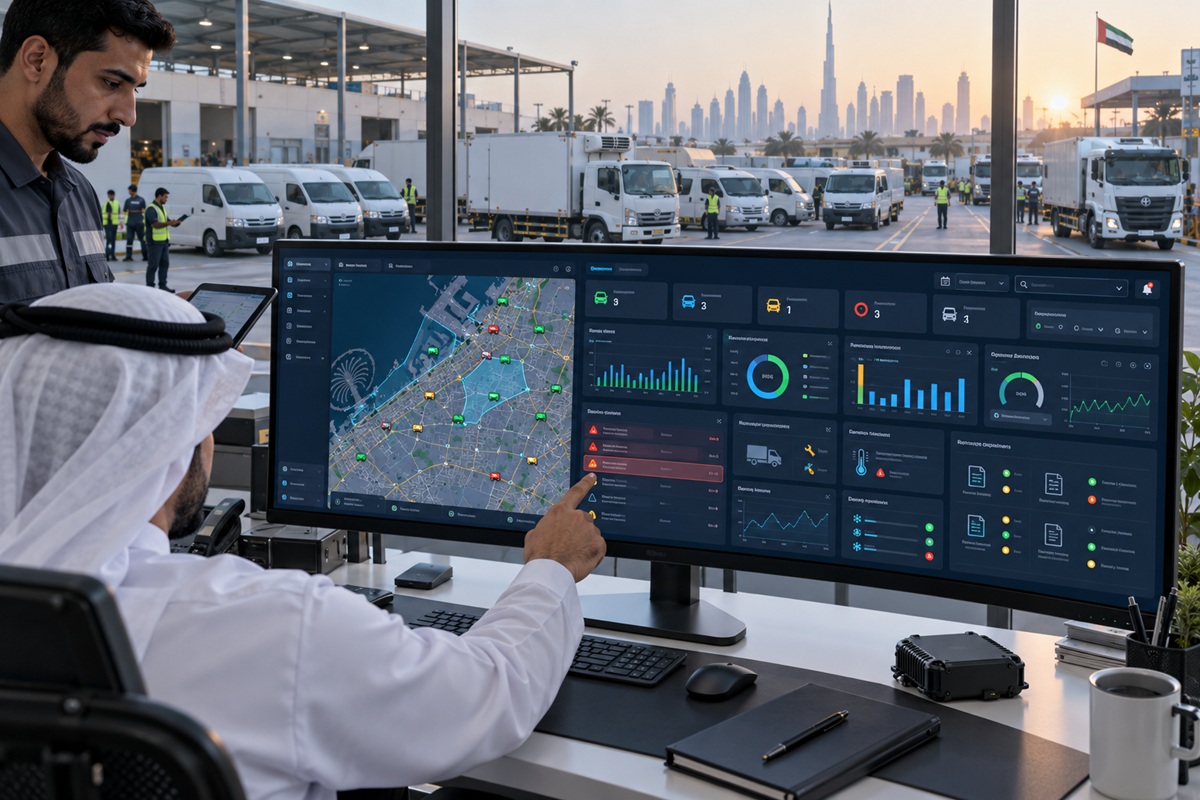
If your fleet operates on ADNOC oil and gas sites in the UAE or if you are pursuing OPAL certification for commercial fleet operations in Oman IVMS compliance is not a feature request or a safety preference. It is an operational prerequisite. Vehicles on ADNOC sites without certified IVMS hardware are in violation of contractor HSE requirements. Fleets without IVMS-generated driver behavior reports cannot pass the periodic HSE audits that determine whether a contractor’s site access is maintained or revoked.
What makes IVMS genuinely different from standard GPS tracking and why the distinction matters so much in the UAE oil and gas context is the depth of driver behavior data it captures and the specific report format it generates. A GPS tracker tells you where a vehicle was and how fast it was travelling. IVMS tells you how the driver performed throughout every trip: every speed threshold event, every harsh braking instance, every aggressive acceleration, every seatbelt non-compliance, and in more advanced configurations, every fatigue indicator and distracted driving event. That data, aggregated into HSE-formatted reports, is what ADNOC auditors are looking for.
This guide explains what IVMS is, how it works technically, who is required to use it in the UAE, what the difference between IVMS and standard GPS tracking really means in practice, how to achieve compliance, and what to look for when selecting an IVMS provider for an oil and gas or construction contractor fleet.
Key Takeaways
- IVMS (In-Vehicle Monitoring System) is mandatory for all vehicles operating on ADNOC oil and gas sites in the UAE not just trucks, but all contractor vehicles including light vehicles, SUVs, and service vehicles used on site.
- IVMS goes substantially beyond GPS tracking: it records driver behavior at the event level harsh braking, speeding, acceleration, cornering, seatbelt status and generates HSE-formatted reports that ADNOC auditors review during contractor performance assessments.
- Standard GPS trackers do not satisfy IVMS requirements regardless of brand or quality IVMS certification requires specific hardware capable of event-level driver behavior capture and HSE report generation.
- OPAL (Oman) also mandates IVMS for commercial fleet operations, making IVMS compliance a cross-border requirement for UAE contractors working in Oman.
- IVMS data has financial value beyond compliance: insurance premiums, accident rate reduction, fuel consumption improvement, and driver coaching effectiveness all benefit from the same behavioral data that ADNOC auditors review.
- VZone International holds ADNOC IVMS certification and OPAL certification deploying certified hardware and generating HSE-formatted compliance reports for oil and gas contractor fleets across UAE and Oman.
What Is IVMS?
IVMS stands for In-Vehicle Monitoring System. It is a telematics specification not a specific product or brand that defines the minimum data capture, recording, and reporting capability required from a monitoring device installed in a commercial vehicle operating in regulated environments such as oil and gas sites, mining operations, and construction facilities with formal HSE management systems.
At its core, IVMS is a driver behavior monitoring system. Where basic GPS tracking captures location and speed, IVMS captures the full spectrum of driver behavior events that correlate with accident risk and HSE non-compliance: speed threshold violations across multiple trigger levels, harsh braking events above defined g-force thresholds, aggressive acceleration patterns, harsh cornering events, seatbelt non-compliance, prolonged idle time, and in advanced configurations, driver fatigue indicators and distracted driving detection through AI dashcam integration.
The defining output of an IVMS system is not the raw data itself it is the HSE-formatted compliance report generated from that data. ADNOC and OPAL auditors do not review raw telematics data streams; they review structured HSE reports that present driver behavior event counts, violation rates per driver, trend analysis over defined reporting periods, and evidence that management has reviewed the data and taken corrective action where required. The report format, not just the data capture, is what makes a system IVMS-compliant.
What Does IVMS Stand For and Where Did It Come From?
IVMS In-Vehicle Monitoring System emerged as a formal specification in the global oil and gas industry as major operators sought to reduce the disproportionately high rate of road traffic incidents among contractor workforces. Road traffic incidents consistently rank as one of the leading causes of fatality in the oil and gas sector globally higher than many of the technical hazards that dominate safety programme attention. ADNOC’s IVMS mandate reflects this risk priority: requiring evidence-based monitoring of driver behavior as a condition of site access rather than relying on contractor self-reporting of driving standards.
The specification has been adopted across GCC oil and gas operators, with ADNOC in UAE and OPAL in Oman being the primary mandatory compliance programmes in the region. Construction and mining operators have adopted similar requirements in some UAE and GCC contexts, extending the reach of IVMS beyond pure oil and gas environments.
IVMS vs. GPS Tracking The Critical Difference
This is the distinction that most frequently creates compliance problems for contractors who install a GPS tracker thinking it satisfies their IVMS obligation and discover during an HSE audit that it does not. The difference is not about data quality or hardware brand. It is about what data is captured and what reports are generated.
| Data / Capability | Standard GPS Tracker | IVMS-Certified System |
| Real-time vehicle location | Yes | Yes |
| Vehicle speed | Yes continuous | Yes with event threshold triggers |
| Journey history and trip logs | Yes | Yes |
| Harsh braking event detection (g-force threshold) | No | Yes event-level capture with g-force values |
| Aggressive acceleration event detection | No | Yes event-level capture |
| Harsh cornering event detection | No | Yes event-level capture |
| Seatbelt compliance monitoring | No | Yes continuous status monitoring |
| Multiple speed threshold violation levels | No single speed only | Yes configurable multi-tier thresholds |
| Driver identification per trip | No | Yes driver ID via iButton, RFID, or PIN |
| Idle time reporting by driver | Limited | Yes per driver, per trip breakdown |
| HSE-formatted driver behavior report | No | Yes standardised ADNOC / OPAL format |
| Driver scorecard generation | No | Yes normalised per driver per period |
| CAN bus vehicle health data integration | Optional rarely configured | Yes standard in IVMS-certified hardware |
| Fatigue / distraction detection (AI dashcam) | No | Yes with AI dashcam integration |
| Asateel / OPAL compliance data transmission | Not applicable | Yes integrated in certified IVMS platforms |
Who Needs IVMS in the UAE?
IVMS requirements in the UAE are primarily driven by ADNOC’s contractor HSE standards, which apply to all vehicles operated by ADNOC contractors and sub-contractors on ADNOC sites and facilities. The scope is broader than many contractors initially assume.
ADNOC Contractor Fleets The Primary Mandatory Scope
Any company holding an ADNOC contractor or sub-contractor agreement that involves operating vehicles on ADNOC sites, facilities, or pipelines is subject to IVMS requirements for those vehicles. This covers light vehicles SUVs and pick-up trucks used by site personnel as well as heavy trucks, tankers, service vehicles, and specialised equipment vehicles. The vehicle type does not determine IVMS applicability; the fact of operating on an ADNOC site does.
ADNOC’s contractor HSE management system includes periodic audits of contractor safety performance, and IVMS compliance including evidence of active monitoring, regular report generation, and management review of driver behavior data is a standard audit checkpoint. Contractors who cannot demonstrate a functioning IVMS programme face performance improvement notices, and in cases of persistent non-compliance or following serious incidents, contract suspension.
ADNOC Subsidiary Operations Same Requirements Apply
ADNOC’s IVMS requirements apply across its subsidiary and affiliate structure, including ADNOC Drilling, ADNOC Logistics and Services, ADNOC Distribution, ADNOC Refining, and ADNOC Offshore. Contractors working for any ADNOC subsidiary are subject to the same HSE standards as ADNOC directly. This is important for contractors who work across multiple ADNOC entities the IVMS requirement follows them regardless of which subsidiary is the contracting party.
Construction and EPC Contractors in Abu Dhabi
Major construction and EPC (Engineering, Procurement, and Construction) contractors operating in Abu Dhabi increasingly adopt IVMS requirements in their own project HSE management plans, either because their clients mandate it contractually or because their own corporate HSE frameworks require IVMS-grade monitoring for all fleet operations above a defined risk threshold. For EPC contractors bidding on large Abu Dhabi infrastructure projects, demonstrating IVMS capability in the tender HSE documentation has become a differentiating factor.
OPAL Oman Cross-Border IVMS Requirement
The Oman Authority for Partnership for Energy and Water (OPAL) mandates IVMS for commercial fleet operations in Oman. For UAE-based contractors and logistics operators running cross-border operations between the UAE and Oman, OPAL certification is a separate but parallel requirement to UAE-side ADNOC compliance. OPAL’s technical IVMS specifications broadly align with ADNOC’s, but the certification and reporting processes are administered separately.
UAE contractors who operate in Oman without OPAL-certified IVMS risk the same consequences as ADNOC non-compliance: restricted site access, audit penalties, and contract exposure. VZone International holds OPAL certification alongside its ADNOC IVMS capability, enabling UAE contractors with Oman operations to satisfy both requirements through a single provider relationship.
| Who Needs IVMS | Regulatory Requirement | Consequence of Non-Compliance | Typical Fleet Categories |
| ADNOC direct contractors (all sites) | ADNOC contractor HSE standards | Audit failure, performance notice, contract suspension | All vehicle types on ADNOC sites |
| ADNOC subsidiary contractors | Same ADNOC HSE standards apply | Same as above no subsidiary exemption | Same as above |
| Abu Dhabi EPC / construction contractors | Often contractually mandated by client | Tender disqualification, HSE audit findings | Heavy equipment, light vehicles, service fleet |
| Commercial fleets operating in Oman | OPAL certification requirement | Restricted operations, OPAL audit failure | Trucks, tankers, LCVs on Oman routes |
| Mining and industrial site contractors UAE | Site-specific HSE plan requirement | Site access denial, HSE non-conformance | All site-operated vehicles |
What Data Does an IVMS System Capture?
The data captured by IVMS hardware is substantially more detailed than most fleet managers initially expect. Understanding what is captured and why each data type matters for HSE reporting helps explain why generic GPS trackers cannot be substituted for certified IVMS devices.
Speed Monitoring Multi-Tier Threshold Events
IVMS speed monitoring operates on a multi-tier threshold model rather than the binary speeding/not-speeding approach of basic GPS. A typical IVMS configuration records events at three or more speed thresholds for example: Zone 1 at 90 km/h (advisory), Zone 2 at 100 km/h (warning), and Zone 3 at 120 km/h (critical). Each zone generates separate event counts in the HSE report, enabling auditors to distinguish between occasional near-threshold events and patterns of sustained high-speed driving. The duration and frequency of events at each threshold level, by driver, is the data that drives HSE performance scoring.
Speed threshold configuration is site-specific in ADNOC contexts on-site speed limits are significantly lower than road limits (often 30 to 40 km/h on facility access roads), and IVMS configurations for site vehicles must reflect these lower operational limits rather than standard road speed thresholds. Contractors with vehicles operating both on-site and on public roads sometimes need dual-profile configurations that apply different threshold sets depending on whether the vehicle is within a geofenced site boundary.
Harsh Braking, Acceleration, and Cornering G-Force Event Capture
The three primary dynamic driving behavior events captured by IVMS harsh braking, harsh acceleration, and harsh cornering are detected through accelerometers in the IVMS device that measure g-force in three axes. An event is triggered when the measured g-force in any axis exceeds the configured threshold. Industry-standard thresholds for harsh braking in UAE oil and gas contexts are typically set at 0.35g to 0.45g, with harsh cornering at 0.35g to 0.40g and harsh acceleration at 0.35g to 0.45g though site-specific HSE plans may specify tighter thresholds for high-risk environments.
The operational significance of this data extends well beyond ADNOC compliance. Harsh braking frequency per driver is one of the strongest predictors of rear-end collision risk in UAE fleet operations. Aggressive acceleration patterns directly correlate with fuel overconsumption of 15 to 25 percent above baseline. Each harsh cornering event represents a tyre stress event that accelerates tyre wear. The same IVMS data that satisfies HSE audit requirements also drives the preventive interventions that reduce accident rates and operating costs simultaneously.
Seatbelt Compliance Monitoring
IVMS continuously monitors seatbelt status whether the driver’s seatbelt is buckled and records the duration and frequency of seatbelt non-compliance events during vehicle operation. This is distinct from the airbag-triggered seatbelt reminder found in standard vehicles: IVMS records seatbelt compliance as a HSE data point that appears in driver behavior reports. In ADNOC audit contexts, seatbelt compliance rates across the contractor fleet are a direct HSE performance indicator.
Seatbelt monitoring is also one of the behavioral data points most responsive to awareness programmes: when drivers know their seatbelt compliance is recorded and reviewed, compliance rates typically improve rapidly within the first monitoring period. The monitoring effect itself drives behavior change, reducing the coaching intervention required to achieve compliant performance.
Driver Identification Linking Events to Individuals
IVMS driver identification is the capability that makes behavioral data actionable. Without knowing which driver was operating a vehicle during a specific event, behavior data can identify problematic vehicles but cannot enable targeted driver coaching or individual accountability. IVMS driver ID is typically implemented through iButton tokens (a small electronic key that drivers touch to a reader on the device), RFID cards, or PIN entry on a driver-facing keypad.
Driver ID is particularly important in fleets where multiple drivers operate the same vehicle across different shifts common in oil and gas site operations with 24-hour rotation schedules. Without driver ID, a vehicle with high harsh braking rates cannot be attributed to a specific driver, and the coaching intervention has no individual target. With driver ID, the same data generates a ranked driver performance list that enables management to identify, coach, and track improvement for the specific individuals generating the highest risk events.
Idle Time Monitoring
Extended engine idle time is both a fuel waste event and, in ADNOC site contexts, sometimes a safety management indicator vehicles idling in restricted areas or during high-ambient-temperature conditions may indicate procedural non-compliance. IVMS idle time reporting captures total idle time per driver per trip and per day, with configurable thresholds that trigger alerts for extended idle events above a defined duration. For oil and gas contractor fleets, idle time data also supports fuel consumption accountability attributing fuel usage to specific drivers and operational contexts rather than aggregating it at fleet level.
IVMS HSE Reports What ADNOC Auditors Are Looking For
The HSE report is the output that transforms IVMS data collection into compliance evidence. Understanding what an ADNOC HSE audit examines in IVMS reports helps fleet managers configure their monitoring systems and reporting cycles to produce documentation that withstands audit scrutiny.
Driver Behavior Summary Report Fleet and Individual Level
The primary IVMS audit document is the driver behavior summary report typically produced weekly or monthly that presents event counts, violation rates, and driver performance scores at both fleet-wide and individual driver levels. ADNOC auditors examine this report for evidence that the contractor is actively monitoring driver performance, not just installing hardware. A report that shows consistent high event rates with no corresponding corrective action record is a performance concern regardless of whether the data was technically captured. The audit question is not just do you have IVMS? it is ‘what are you doing with the data?’
Trend Analysis Improvement or Deterioration Over Time
Periodic ADNOC HSE audits examine IVMS reports across multiple reporting periods to identify whether driver behavior performance is improving, stable, or deteriorating over time. A contractor whose IVMS data shows progressively worsening driver behavior scores rising harsh braking events, increasing speed violations, declining seatbelt compliance faces more intensive audit scrutiny than one showing a sustained improvement trend, even if the absolute performance levels are similar. The trend data demonstrates whether the contractor’s safety management programme is effective, not just whether a monitoring system is installed.
Management Review Evidence Closing the Loop
ADNOC HSE management systems require contractors to demonstrate that IVMS data is being reviewed at management level and that corrective actions are being taken for identified non-compliance. This means meeting minutes, coaching session records, driver improvement plans, or disciplinary documentation that shows the IVMS data is connected to a management response process not filed and ignored. Platforms that generate automated management review summaries and track action item closure make this documentation straightforward to produce; platforms that require manual data assembly for each reporting period create the overhead that causes this documentation to be neglected.
How to Achieve IVMS Compliance for ADNOC in UAE Step by Step
IVMS compliance for ADNOC contractor fleets follows a structured process. The steps below represent the full compliance journey from initial requirement identification through to active audit-ready reporting.
Step 1 Identify All Vehicles Subject to IVMS Requirements
Not every vehicle in a contractor’s broader fleet necessarily requires IVMS the requirement is triggered by operating on ADNOC sites. Begin with a full audit of which vehicles operate on ADNOC premises or under ADNOC contractor agreements, including light vehicles (SUVs, pick-ups) that site teams use for personnel transport. This scope definition determines hardware procurement volume and installation scheduling, and is the correct starting point before any provider engagement.
Step 2 Select an ADNOC IVMS-Certified Provider
IVMS compliance requires ADNOC-certified hardware and an ADNOC-compatible reporting platform. Ask providers specifically for their ADNOC IVMS certification documentation the hardware model and firmware version that is certified, not a general claim of ADNOC compatibility. Also confirm that their platform generates HSE reports in the format ADNOC auditors use, not a proprietary format that requires manual reformatting before submission.
If your operations include Oman, confirm OPAL certification separately. Both ADNOC IVMS and OPAL certifications should be documentable providers who cannot produce certification evidence for both programmes if your fleet requires both should be treated with caution.
Step 3 Configure IVMS Thresholds to Site Requirements
IVMS threshold configuration is not a default setting exercise. Speed thresholds must reflect both on-road limits and the lower speed limits applicable on ADNOC facility access roads and site areas typically requiring geofence-linked threshold profiles that apply different speed event triggers when a vehicle is inside a defined site boundary versus on a public road. Harsh braking and acceleration thresholds should align with your specific HSE plan parameters, which may differ from generic industry defaults. Work with your provider’s technical team to configure thresholds correctly before deployment misconfigured thresholds generate either under-reporting (missing real events) or over-reporting (generating excessive false events that saturate the report with noise and reduce audit credibility).
Step 4 Install Certified Hardware and Implement Driver ID
Professional installation of IVMS hardware is essential accelerometer-based event detection is sensitive to installation angle and mounting security. A device that shifts or vibrates in its mounting generates false events that corrupt the behavioral data. Certified IVMS installers know the correct mounting positions and cable management standards for different vehicle types. Driver ID implementation iButton, RFID, or PIN should be set up simultaneously with hardware installation and tested before the first reporting cycle begins.
Step 5 Establish Reporting Cycles and Management Review Process
Configure your platform to generate HSE reports at the frequency required by your ADNOC contract typically weekly at vehicle/driver level and monthly at fleet summary level. Establish a formal management review process: who receives the reports, who is responsible for identifying coaching actions, and how those actions are documented. This process is what closes the loop between monitoring and safety management and it is what ADNOC auditors examine to determine whether IVMS is functioning as a safety tool or simply as installed hardware.
Step 6 Maintain Continuous Compliance Device Health and Report Continuity
IVMS compliance is an ongoing operational discipline. Device failures, SIM issues, and firmware updates can all create data gaps that appear as non-transmission periods in HSE reports which auditors treat as monitoring failures. Enterprise IVMS platforms with automated device health monitoring and offline alert capabilities enable proactive resolution of transmission issues before they create compliance gaps. Designate a compliance owner within your operations team who monitors device health, verifies monthly report completeness, and manages the replacement process for failed hardware.
IVMS Beyond Compliance The Operational and Financial Value
ADNOC compliance is the requirement that drives IVMS investment for most UAE oil and gas contractors. But the behavioral data collected to satisfy that requirement is simultaneously one of the most financially valuable operational datasets available to a fleet manager. Treating IVMS as compliance-only infrastructure means capturing perhaps 20 percent of its actual value.
Accident Rate Reduction
The correlation between IVMS monitoring and accident rate reduction is one of the most consistently documented findings in fleet safety research. In UAE oil and gas and construction fleet contexts, contractors who implement active IVMS programmes with regular driver behavior reporting, targeted coaching for high-risk drivers, and management review processes typically see road traffic incident rates fall by 20 to 40 percent within 12 to 18 months of programme maturity. The mechanism is straightforward: drivers who know their behavior is monitored and reviewed perform differently than drivers who do not. The monitoring effect alone drives improvement before any coaching intervention is applied.
Fuel Cost Reduction
IVMS behavioral data is directly connected to fuel consumption. Harsh acceleration events one of the most common IVMS-captured behaviors in UAE contractor fleet operations generate fuel consumption premiums of 15 to 25 percent above smooth driving baseline on the same routes. Drivers identified through IVMS scoring as high-frequency harsh acceleration performers are the same drivers generating disproportionate fuel costs. Coaching these drivers to smoother acceleration profiles delivers measurable fuel savings that are quantifiable against the IVMS report data.
For a 50-vehicle ADNOC contractor fleet with a monthly fuel spend of AED 200,000, a 10 percent fuel consumption reduction through driver behavior coaching represents AED 20,000 per month AED 240,000 annually. Against an IVMS subscription cost of AED 5,000 to AED 10,000 per month for the same fleet, the fuel saving ROI alone justifies the investment within the first two months.
Insurance Premium Reduction
UAE commercial vehicle insurers are increasingly differentiating premiums based on demonstrated fleet safety management capability. Contractors who can present multi-year IVMS HSE report histories showing improving driver behavior trends and low incident rates have a credible basis for premium renegotiation that contractors without behavioral monitoring data cannot match. The documented reduction in harsh event rates and the corresponding reduction in insurance claims provides insurers with the actuarial basis to extend preferential pricing with reductions of 10 to 20 percent achievable for fleets with strong sustained IVMS performance records.
Tyre and Brake Component Life Extension
Harsh braking and cornering events are the primary mechanical drivers of tyre wear and brake pad degradation beyond normal service life. A driver in the top quartile of harsh braking frequency may generate tyre wear rates two to three times the fleet average an operating cost difference that is invisible without driver-level behavioral data. IVMS data that identifies and enables coaching of the highest-impact drivers on brake and tyre wear directly extends component replacement intervals across the fleet, reducing maintenance costs in a measurable and attributable way.
Common IVMS Compliance Mistakes UAE Contractors Make
Mistake 1 Installing a Standard GPS Tracker and Assuming IVMS Compliance
This is the most prevalent and costly IVMS compliance mistake in the UAE oil and gas contractor market. A GPS tracker regardless of brand, quality, or cost does not satisfy IVMS requirements if it cannot capture event-level driver behavior data (g-force events, seatbelt status, multi-tier speed thresholds) and generate HSE-formatted reports. Contractors who make this mistake discover it during their first ADNOC HSE audit, when the absence of compliant IVMS data generates a non-conformance finding. The remediation hardware replacement and retroactive report generation is substantially more expensive and operationally disruptive than correct specification from the outset.
Mistake 2 Using IVMS-Certified Hardware Without ADNOC-Compatible Reporting
A less common but equally problematic compliance failure: deploying IVMS-capable hardware but using a platform that generates reports in a non-standard format rather than the HSE report structure that ADNOC auditors are trained to review. IVMS hardware and IVMS-compliant reporting are two distinct requirements. Some providers deploy capable hardware on platforms that produce driver behavior data in proprietary report formats which requires manual reformatting before submission to ADNOC, creating both administrative overhead and formatting error risk.
Mistake 3 Configuring Incorrect Speed Thresholds
On-site speed limits on ADNOC facilities are significantly lower than road speed limits typically 30 to 40 km/h on access roads and 10 to 20 km/h in some facility areas. An IVMS configured with standard road speed thresholds (90/100/120 km/h) generates no speed events when a vehicle travelling at 60 km/h on a 30 km/h access road is not flagged. Threshold configuration must reflect the actual operating environment of each vehicle category, which for site vehicles requires geofenced profiles with site-specific limits active within the facility boundary.
Mistake 4 No Driver ID Implementation
Deploying IVMS hardware without driver identification capability means behavioral data is attributed to vehicles, not individuals. An ADNOC audit that identifies a vehicle with high harsh event rates but no individual driver accountability creates a compliance finding even if the data is technically present. Driver ID implementation iButton, RFID, or PIN is a required component of a functioning IVMS programme, not an optional enhancement.
Mistake 5 No Management Review Process Connected to IVMS Data
ADNOC HSE management systems require evidence that safety data drives management action. An IVMS installation with no formal review process, no coaching records, and no documented corrective actions is a monitoring system without a management system and it will fail the management review component of an HSE audit even if the technical data is correct. Establishing the review process and documentation discipline is as important as deploying the hardware.
VZone International’s IVMS Solution for UAE and Oman
VZone International provides ADNOC IVMS-certified fleet monitoring solutions for oil and gas contractor fleets across UAE, and OPAL-certified solutions for Oman operations deploying enterprise-grade IVMS hardware with HSE-formatted reporting on a unified Wialon and FMSiTrack platform. With over 20 years of UAE fleet technology operations and an established presence in the oil and gas and construction contractor sectors, VZone brings compliance certainty and operational depth that generic telematics providers cannot replicate.
ADNOC-Certified Hardware and HSE Report Generation
VZone deploys ADNOC IVMS-certified hardware capturing the full spectrum of driver behavior events required for ADNOC HSE compliance, including multi-tier speed events, harsh braking, acceleration, cornering, seatbelt compliance, and driver ID. HSE reports are generated in ADNOC-compatible formats directly from the platform, without manual reformatting weekly driver behavior summaries, monthly fleet performance reports, and trend analysis reports that demonstrate compliance programme maturity over time.
OPAL Certification for UAE-Oman Cross-Border Operations
VZone holds OPAL certification for Oman commercial fleet operations, enabling UAE contractors with cross-border operations to satisfy both ADNOC IVMS and OPAL requirements through a single provider relationship and a unified platform. Cross-border fleet tracking maintains continuous visibility through UAE-Oman border zones, with OPAL-formatted reports generated alongside ADNOC reports for fleets operating in both jurisdictions.
Site-Specific Threshold Configuration and Geofenced Speed Profiles
VZone’s implementation team configures IVMS threshold profiles specific to each client’s ADNOC site operating environment including geofenced speed profiles that apply facility-specific speed limits within defined site boundaries and road speed thresholds outside them. This configuration precision ensures HSE reports accurately reflect actual policy violations rather than generating false events from incorrectly calibrated thresholds.
| VZone IVMS Capability | Compliance Programme | Operational Value |
| Multi-tier speed event capture | ADNOC IVMS / OPAL | Speed violation trend tracking per driver |
| Harsh braking / acceleration / cornering (g-force) | ADNOC IVMS / OPAL | Accident risk scoring, fuel efficiency coaching |
| Seatbelt compliance monitoring | ADNOC IVMS / OPAL | HSE KPI compliance, safety culture indicator |
| Driver ID — iButton / RFID / PIN | ADNOC IVMS | Individual accountability, targeted coaching |
| Idle time reporting by driver | ADNOC IVMS | Fuel waste accountability, procedure compliance |
| HSE-formatted reports (ADNOC / OPAL) | ADNOC IVMS / OPAL | Direct audit submission, no reformatting required |
| Geofenced site speed profiles | ADNOC site requirements | Correct threshold application on-site vs. on-road |
| AI dashcam integration (fatigue/distraction) | Advanced HSE programmes | Fatigue event detection, video incident evidence |
| Asateel (ITC) integration for Abu Dhabi | ITC Abu Dhabi Asateel | Dual compliance IVMS + Asateel in single platform |
Conclusion: IVMS Is the Safety Foundation for UAE Oil and Gas Fleet Operations
IVMS compliance is the entry requirement for operating vehicles on ADNOC sites and the consequences of non-compliance extend from audit findings to contract suspension. But treating IVMS as purely a compliance exercise misses the operational and financial value that the same data delivers when it is actively used rather than passively collected.
Driver behavior data that satisfies ADNOC HSE audit requirements is the same data that identifies the drivers generating disproportionate fuel costs, the same data that predicts accident risk before incidents occur, and the same data that provides the evidential foundation for insurance premium renegotiation. The contractors who extract the most value from IVMS investment are those who close the loop: monitoring generates data, data generates insights, insights generate coaching actions, and coaching actions improve both HSE performance and fleet operating costs simultaneously.
Selecting the right IVMS provider means choosing one whose hardware carries documented ADNOC certification, whose platform generates HSE reports in the format auditors actually use, and whose implementation team understands the site-specific configuration requirements that distinguish compliant IVMS from merely installed hardware.
Need IVMS compliance for your ADNOC contractor fleet in UAE?
VZone International provides ADNOC IVMS-certified fleet monitoring and OPAL-certified solutions for Oman operations deploying certified hardware, configuring site-specific threshold profiles, generating HSE reports in ADNOC-compatible formats, and supporting management review processes that satisfy contractor HSE audit requirements. Contact our team for a free IVMS compliance assessment for your contractor fleet.
Frequently Asked Questions
IVMS stands for In-Vehicle Monitoring System. The term refers to both the category of telematics hardware that captures driver behavior event data and the broader compliance programme that requires this monitoring capability for vehicles operating in regulated environments such as oil and gas sites, mining facilities, and construction projects with formal HSE management systems.
Yes. ADNOC's contractor HSE standards require all vehicles operating on ADNOC sites and facilities to be equipped with certified IVMS hardware, with active monitoring and regular HSE driver behavior report generation as evidence of a functioning safety monitoring programme. This applies to all vehicle types light vehicles, service vehicles, and heavy trucks operated by ADNOC direct contractors and sub-contractors on any ADNOC site.
A standard GPS tracker records vehicle location, speed, and journey history. An IVMS-certified system records all of that plus event-level driver behavior data: harsh braking above defined g-force thresholds, aggressive acceleration, harsh cornering, seatbelt compliance status, multi-tier speed threshold violations, and driver identification per trip. Critically, IVMS generates HSE-formatted compliance reports from this data the structured audit documentation that ADNOC and OPAL require. A GPS tracker cannot produce these reports regardless of hardware quality.
Yes. UAE commercial vehicle insurers increasingly factor fleet safety management capability into premium assessments. IVMS reports showing sustained improvements in driver behavior scores, low harsh event rates, and documented management response processes provide the evidential basis for premium renegotiation. Contractors with multi-year IVMS performance records and declining incident rates have achieved insurance premium reductions of 10 to 20 percent with the documentation quality of the IVMS reporting being a key determinant of the insurer's assessment.
Yes. ADNOC IVMS requirements apply to all vehicle types operated on ADNOC sites including light vehicles such as SUVs, pick-up trucks, and crew transport vehicles used by site personnel. IVMS hardware for light vehicles is typically installed via OBD-II port or hardwired to the vehicle's power system, with accelerometer-based event detection and driver ID systems identical to those used in heavy vehicles. Light vehicle behavior monitoring often reveals higher harsh event rates than heavy vehicles site personnel driving light vehicles tend to drive more aggressively than heavy vehicle drivers.
Asateel is the ITC Abu Dhabi mandatory GPS fleet registration platform for commercial vehicles it requires location tracking data from registered vehicles. IVMS is a driver behavior monitoring specification required by ADNOC for vehicles on oil and gas sites it requires event-level behavioral data and HSE report generation. The two are different requirements from different authorities, serving different purposes. However, they are not mutually exclusive an oil and gas contractor fleet operating in Abu Dhabi needs both Asateel registration and IVMS compliance. VZone International's platform satisfies both simultaneously.