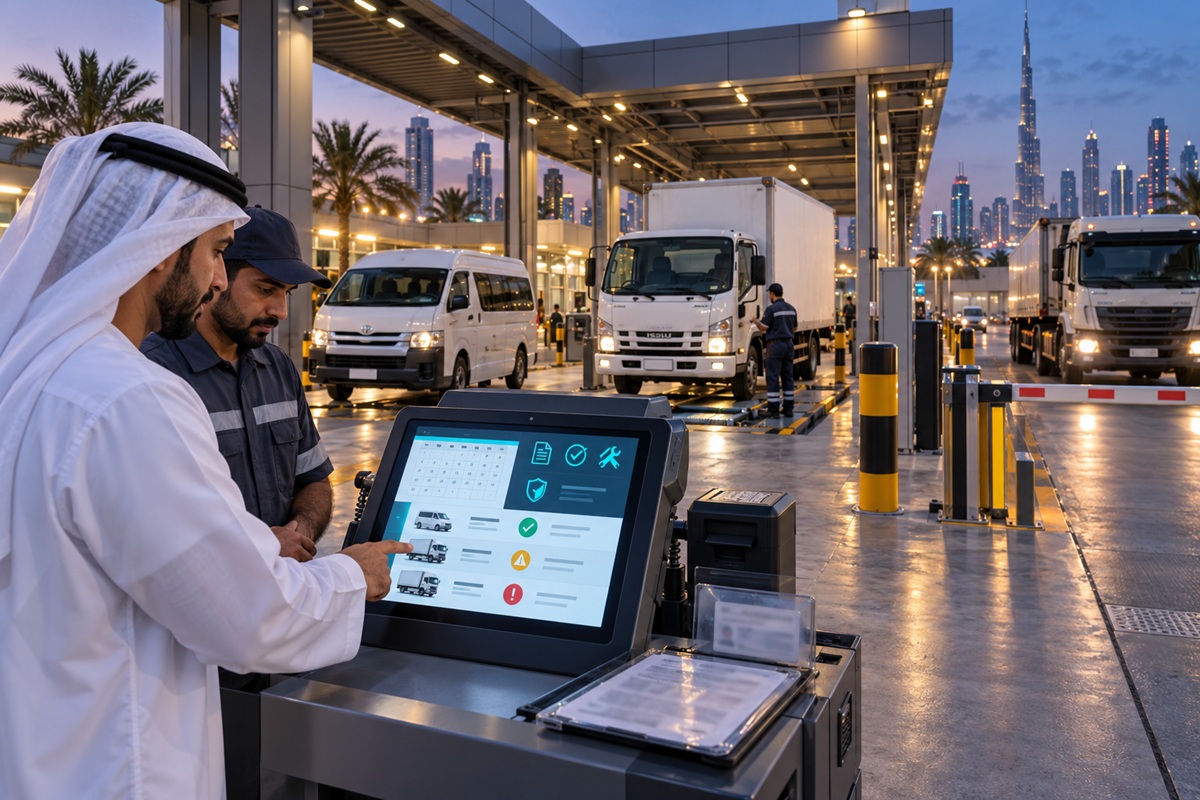
A surprise in fleet operations is a problem that has already developed to the point where it affects customers, SLAs, or assets before the operations manager becomes aware of it. A vehicle that broke down 45 minutes ago, a driver who has been stationary in the wrong location for 30 minutes, a delivery that has been at a customer site for an hour with no ePOD confirmation each of these is a problem that could have been identified and managed within minutes if the operations manager had real-time visibility, but instead becomes a customer complaint, a missed SLA, or an unplanned recovery operation because the information arrived too late.
Real-time fleet operations visibility is the management capability that converts these surprises into managed exceptions. The GPS platform knows that the vehicle stopped 45 minutes ago; the alert fired at minute 15 when the unexpected stop duration threshold was crossed; the operations manager had 30 minutes to arrange a recovery vehicle and notify the customer before the delivery SLA was breached. The breakdown still happened real-time visibility does not prevent mechanical failures but it prevented the breakdown from becoming a customer complaint by enabling a managed response rather than a reactive scramble.
Key Takeaways
- Real-time fleet operations visibility converts operational surprises into managed exceptions the problem still occurs, but the operations manager is aware of it within minutes rather than hours, enabling a proactive response before customer impact compounds.
- The five operational surprises that real-time GPS visibility eliminates for UAE operations managers are: unexpected vehicle stoppages (breakdown or unauthorized stop), route deviations (driver not on planned route), delivery delays (vehicle not progressing at expected rate toward next stop), after-hours vehicle movements (unauthorized use outside operating hours), and geofence violations (vehicle entering or exiting restricted areas without authorization).
- The operations centre view a single screen showing all vehicles’ live positions, delivery progress, open alerts, and ETA status is the enabling interface for proactive fleet operations management. Without this unified view, the operations manager’s awareness depends on driver calls and WhatsApp messages that arrive on the driver’s schedule rather than when the operations manager needs to act.
- UAE-specific real-time visibility requirements include remote Western Region route monitoring (where cellular coverage gaps require store-and-forward data buffering rather than continuous streaming), ADNOC facility perimeter monitoring (geofence alerts for vehicles entering and exiting ADNOC sites for journey management compliance), and cross-border position tracking for UAE-Oman routes (dual-SIM devices maintaining GPS data continuity through Oman cellular network handover).
- The response time gap the difference between a problem occurring and the operations manager taking action is the primary operational metric that real-time visibility improves. Reducing the response time gap from 30 to 60 minutes (phone call chain) to 2 to 5 minutes (GPS alert to operations manager) transforms the fleet from reactive to proactive management.
The Five Operational Surprises GPS Eliminates
Surprise 1 Unexpected Vehicle Stoppage
An unexpected vehicle stoppage a vehicle that stops in a location and for a duration inconsistent with the planned route and schedule is the most operationally impactful real-time visibility event. The stoppage may be a breakdown, an unauthorized personal stop, a driver welfare issue, a traffic incident, or a delivery taking significantly longer than scheduled. Without real-time GPS, the operations manager learns about the stoppage when the driver calls (which may be 20 to 40 minutes after the stop, after the driver has assessed the situation, attempted self-resolution, and decided to call), or when a downstream customer calls to ask where their delivery is. With GPS, an unexpected stop duration alert fires within the configured threshold typically 15 to 20 minutes of stationary time in a non-delivery location giving the operations manager 15 to 30 minutes of lead time before customer impact.
UAE-specific context: vehicle stoppages on the Western Region road network between Abu Dhabi and the Saudi Arabia or Oman borders create the highest-consequence breakdown scenarios remote locations, extreme heat, limited assistance availability, and potential driver welfare risk. GPS real-time position tracking enables the operations manager to dispatch recovery assistance to the exact GPS coordinates rather than relying on the driver’s description of their location on a road with no landmarks. For ADNOC contractor fleets with journey management requirements, the GPS stoppage data is also part of the incident documentation that ADNOC HSE requires.
Surprise 2 Route Deviation
A route deviation occurs when a vehicle diverges from its planned route by more than a configured distance threshold. Deviations can indicate: a driver taking a preferred but less efficient route from habit, an unauthorised personal stop en route to a delivery, a road closure requiring an unplanned detour, or a driver making an unscheduled delivery or collection that has not been dispatched through the system. Route deviation alerts fire when the GPS position diverges from the planned route giving the operations manager immediate awareness with the ability to call the driver, check the live map for the detour context, and assess whether the deviation is legitimate (road closure) or problematic (unauthorised stop).
Surprise 3 Delivery Delay in Progress
A delivery running significantly behind schedule detectable from GPS progress monitoring against the planned route timeline is a surprise that real-time visibility converts into an actionable advance warning. When the GPS shows that a vehicle is 45 minutes behind the planned schedule for its third stop, with two more time-window deliveries remaining on the route, the operations manager has actionable information: contact the next customer with a revised ETA, assess whether the remaining route can be recovered or whether the last stop needs to be rescheduled, and identify whether the delay is a single-stop anomaly (customer access issue) or a systemic pattern (traffic on the specific route today). This assessment and response, available from the live operations dashboard, is impossible without real-time GPS position data.
Surprise 4 After-Hours Vehicle Movement
After-hours vehicle movement a vehicle moving outside configured operating hours is detected by geofence exit alerts from the depot or by movement alerts during the configured non-operating period. For UAE commercial fleet operators, after-hours vehicle use represents both an operational liability (uninsured use outside covered operating hours in some policy configurations, vehicle wear without operational output) and a potential theft or misuse risk. The geofence exit alert fires within seconds of the vehicle departing the depot outside operating hours enabling the operations manager to investigate and respond before the vehicle has travelled any significant distance, rather than discovering the unauthorized use from GPS history the following morning.
Surprise 5 Geofence Violation
Geofence violations vehicles entering or exiting designated zones without authorization cover several UAE operational scenarios: a vehicle entering an ADNOC security perimeter without the journey management documentation that the site requires, a delivery vehicle entering a restricted residential zone during prohibited delivery hours, a school bus deviating from the RTA-approved route, or a construction site vehicle leaving the site boundary during working hours when it should be on site. Geofence alerts fire within seconds of the violation occurring the operations manager is aware before the vehicle has completed the unauthorized entry or exit, enabling immediate driver contact and correction.
The Operations Centre View
The operations centre view the unified dashboard that gives UAE operations managers real-time awareness of the entire fleet’s status requires five data layers displayed simultaneously on a single screen:
Dashboard Layer | What It Shows | Update Frequency | Operational Value | UAE-Specific Configuration |
Live fleet map | All vehicles: position, speed, heading, driver identity, vehicle status (moving/idle/stopped/alert) | Every 10-30 seconds from GPS | Immediate visual awareness of any vehicle in an unexpected position or status no need to check each vehicle individually | Default view covers UAE + Oman for cross-border fleets; Western Region visible at default zoom for ADNOC remote operations |
Alert queue | Active alerts ranked by severity and age: stoppage alerts, route deviations, geofence violations, OBD faults, driver safety events | Real-time as alerts fire | Operations manager sees only events that require attention not a data feed, an action queue | UAE-specific alert types: ADNOC journey management departure without inspection, Salik crossing outside planned route, after-hours depot exit |
Delivery progress tracker | Each route’s completion status: stops completed, stops remaining, current ETA for next stop, on-time status per stop | Updated on each ePOD confirmation and GPS position calculation | Operations manager sees at a glance which routes are on track and which are running behind without calling drivers | Construction site time window compliance visible per stop; customer ETA portal updated automatically from GPS position data |
Vehicle status summary | Fleet-level status: how many vehicles moving, idle, stopped, in alert, offline | Real-time aggregated from GPS | Executive view operations manager sees the fleet’s operational health in five numbers without opening the full map | Offline vehicle count is operationally critical for UAE Western Region routes where store-and-forward creates legitimate temporary offline status |
Open exceptions | Unresolved situations requiring operations manager action: unacknowledged alerts, delayed deliveries requiring customer contact, breakdowns requiring recovery coordination | Updated as situations evolve | Action list the operations manager works through the exception queue rather than scanning the full fleet for problems | ADNOC incident documentation queue: any stoppage or deviation on ADNOC contractor routes generates an exception that requires documentation before the vehicle’s next site entry |
From Reactive to Proactive: The Response Time Gap
The most measurable impact of real-time fleet operations visibility is the reduction in response time gap the interval between a problem occurring and the operations manager taking action. This gap determines whether the operations manager manages the problem or discovers it after the customer has already experienced the consequence.
Scenario | Without Real-Time Visibility | Response Time Gap (Reactive) | With Real-Time GPS Visibility | Response Time Gap (Proactive) | Customer Impact Difference |
Vehicle breakdown on E11 | Driver notices → assesses → calls supervisor → supervisor calls ops manager | 20-45 minutes | GPS stoppage alert fires at 15-minute threshold → operations manager alerted immediately → nearest vehicle dispatched | 2-5 minutes | Ops manager re-routes backup vehicle 15-40 minutes earlier; customer informed before SLA breach rather than after |
Driver unauthorized stop (30 min personal errand) | Only discovered from next-day GPS history review or customer complaint about late delivery | Hours to days | Route deviation + unexpected stop alert fires within 15 minutes; ops manager contacts driver | 15-20 minutes | Delivery delay contained to 30 minutes rather than compounding; driver accountability immediate |
Delivery running 45 min behind schedule | Customer calls ops team asking where delivery is ops manager has no data without calling driver | Customer calls after SLA missed | GPS progress tracking shows route behind schedule; ops manager contacts next customer proactively with revised ETA | 15-30 minutes before SLA breach | Customer receives advance notice; SLA conversation managed proactively rather than reactively |
Vehicle entering ADNOC site without pre-trip inspection | Discovered at ADNOC gate vehicle denied access; driver waits; ops manager contacted by driver after denial | Access denied + 30-60 minute disruption | GPS departure without completed inspection alert fires before vehicle reaches site gate; ops manager contacts driver to return | 5-10 minutes (before reaching gate) | Driver returns before reaching gate; inspection completed; site access not denied; no disruption |
After-hours depot exit (potential theft) | Discovered next morning from GPS history or missing vehicle report | 8-12 hours | Geofence exit alert fires within 60 seconds of depot departure; ops manager alerted immediately | 1-2 minutes | Immediate investigation and response before vehicle travels significant distance |
UAE-Specific Real-Time Visibility Requirements
Remote Route Coverage Western Region and Cross-Border
UAE fleet operations that include Western Region routes (Abu Dhabi to the Saudi Arabia or Oman border areas) and UAE-Oman cross-border logistics face cellular coverage gaps that interrupt continuous GPS data streaming. Standard GPS devices that rely on continuous cellular connection appear offline in coverage gaps creating false alerts and undermining the operations manager’s confidence in the real-time visibility the platform provides. Store-and-forward GPS devices buffer position data locally when cellular connection is unavailable and transmit the stored data when connection resumes the operations manager sees the vehicle’s position history reconstructed when coverage resumes, rather than a gap in the track. For ADNOC Western Region contractor operations, store-and-forward capability is essential for real-time visibility to function meaningfully across the full operational geography.
ADNOC Journey Management Real-Time Compliance
ADNOC contractor fleet operations require journey management compliance that integrates directly with real-time visibility: pre-trip inspection documentation before departure, GPS tracking throughout the journey with check-in at designated waypoints, and incident documentation for any unplanned stoppages. The operations centre view for an ADNOC contractor fleet should show the journey management status of each vehicle on a designated journey pre-trip inspection completed (green) or not completed (amber/red), waypoint check-ins on schedule (green) or missed (alert), any unplanned stoppages flagged for ADNOC HSE documentation. VZone International’s platform manages ADNOC journey management compliance from the same operations view as standard GPS fleet tracking the ADNOC compliance layer is integrated with the real-time visibility dashboard rather than requiring a separate compliance management interface.
Cross-Border Tracking UAE to Oman and Saudi Arabia
UAE fleet operations that include cross-border routes to Oman or Saudi Arabia require GPS tracking that maintains visibility through the border crossing process and into GCC territory. Dual-SIM GPS devices UAE primary SIM with Oman or Saudi secondary SIM handle the cellular network handover at the border crossing automatically, maintaining data transmission continuity without the vehicle appearing offline during the SIM transition. The operations centre live map should display UAE and Oman (or UAE and Saudi Arabia) simultaneously at the default zoom level, so the operations manager sees cross-border vehicles on the same map as UAE-based vehicles without needing to navigate to a separate country view.
Communicating Real-Time Status to Customers and Stakeholders
Real-time fleet operations visibility has value beyond the operations manager’s internal management it enables customer-facing and stakeholder-facing communication that transforms the customer experience of UAE delivery and service operations:
Communication Type | Manual Approach | Real-Time GPS Approach | Customer Experience Difference |
Delivery ETA communication | Operations manager calls customer with estimated time based on dispatcher’s plan often inaccurate by 30-60 minutes by mid-afternoon | Automated SMS or portal ETA update from GPS vehicle position and traffic-adjusted route calculation updated automatically as conditions change | Customer knows actual arrival time; reduces inbound calls; enables customer to plan for delivery without waiting all day |
Delay notification | Customer calls asking where delivery is; ops manager calls driver; calls customer back 15-30 minutes after SLA breach | GPS progress monitoring identifies delay developing; automated customer notification sent with revised ETA before SLA breach | Customer receives advance notice; manages expectation; reduces complaint escalation rate |
Proof of delivery confirmation | Driver returns paper waybill at end of day; customer confirmation next working day at earliest | ePOD timestamp and customer signature/photo available to customer portal within minutes of delivery completion | Customer can confirm delivery receipt same day; invoice can be issued same day; disputes resolved with GPS evidence |
Breakdown communication | Customer discovers late delivery by absence calls ops team when expected delivery doesn’t arrive | GPS alert enables ops manager to contact customer with breakdown notification and recovery timeline before customer notices absence | Customer informed proactively; relationship preserved; SLA conversation managed with transparency |
Conclusion
Real-time fleet operations visibility is not a monitoring tool for checking up on drivers it is the management infrastructure that converts fleet operations from reactive crisis management to proactive exception handling. The vehicle breakdown, the route deviation, the delivery running behind schedule these events still occur with GPS tracking deployed. What changes is when the operations manager becomes aware of them and how much management lead time is available before the customer experiences the consequence.
For UAE operations managers managing delivery fleets, contractor vehicle operations, or any commercial fleet where customer SLAs and operational reliability matter, the 2 to 5 minute response time gap that GPS real-time visibility enables versus the 20 to 45 minute reactive response gap of phone-call-based awareness is the operational difference between managing a professional, customer-responsive fleet and managing a fleet that consistently surprises both its managers and its customers. VZone International’s Wialon platform provides the live map, alert queue, delivery progress tracker, and ePOD integration that UAE operations managers need for complete real-time fleet visibility. Contact our team to discuss deployment for your UAE fleet.
VZone International Real-Time Fleet Operations Live Visibility for UAE Operations Managers
VZone International’s Wialon platform delivers real-time fleet operations visibility for UAE commercial fleets: live map updating every 10-30 seconds, alert queue with UAE-specific event types, delivery progress tracking with ePOD integration, ADNOC journey management compliance monitoring, store-and-forward for remote Western Region routes, and dual-SIM for UAE-Oman cross-border tracking. 4,000+ UAE fleets. 20+ years UAE operations. Contact our team for a real-time operations visibility demo for your UAE fleet.
Frequently Asked Questions
Real-time fleet operations visibility is the capability to know the status, location, and operational progress of every vehicle in a commercial fleet at any moment updated continuously from GPS devices rather than from driver calls or periodic check-ins. For a UAE operations manager, real-time visibility means the live map shows every vehicle's position updated every 10 to 30 seconds, alerts fire within minutes of any operational exception (unexpected stoppage, route deviation, geofence violation, OBD fault), and delivery progress against the planned route is visible without contacting the driver. The operational outcome is the elimination of the response time gap the delay between a problem occurring and the operations manager taking action from the 20 to 45 minutes of phone-call-based reactive awareness to the 2 to 5 minutes of alert-based proactive response that GPS visibility enables.
Real-time GPS tracking helps UAE operations managers in five specific ways. Breakdown response: GPS stoppage alerts fire within 15 minutes of an unexpected vehicle stop, giving the operations manager 15 to 30 minutes of lead time to arrange recovery and customer notification before SLA breach. Route deviation management: route deviation alerts fire immediately when a vehicle diverges from its planned route, enabling the operations manager to investigate and correct before the deviation affects subsequent stops. Delivery performance visibility: GPS progress tracking against planned routes shows which deliveries are running behind schedule before the customer calls, enabling proactive ETA communication. After-hours protection: geofence exit alerts detect unauthorized vehicle use within seconds of depot departure, enabling immediate investigation. Customer communication: GPS-driven automated ETA updates and ePOD delivery confirmations provide customers with real-time delivery status without requiring the operations manager to manually communicate with each customer.
GPS tracking is the data collection layer GPS devices in vehicles recording position, speed, and event data. Real-time fleet operations management is the management practice built on top of that data the alert configuration that determines which events require immediate attention, the operations centre dashboard that presents the fleet's status in an actionable format, the escalation protocols that route different alert types to the appropriate responder, and the customer communication integrations that translate GPS data into customer-facing ETA updates and ePOD confirmations. A fleet with GPS tracking deployed but no operations management layer built on top of it has data it is not using vehicle positions visible on a map but no alerts configured, no delivery progress tracking, no customer communication integration. Real-time fleet operations management is the discipline that converts GPS tracking data into the proactive management capability that eliminates operational surprises.
Real-time fleet visibility for remote UAE routes Western Region desert tracks, UAE-Oman border crossings, ADNOC facility access roads requires store-and-forward GPS devices rather than standard continuous-transmission devices. Store-and-forward devices buffer GPS position data locally when cellular coverage is unavailable (common on remote desert routes) and transmit the stored data when cellular connection resumes typically at the next town, fuel station, or return to an area with UAE network coverage. The operations manager sees the vehicle's buffered position history reconstructed on the map when data resumes, rather than a blank track during the coverage gap. For cross-border Oman routes, dual-SIM GPS devices maintain data transmission continuity through the cellular network handover at the UAE-Oman border the UAE primary SIM passes connectivity to the Oman secondary SIM as the vehicle crosses the border, without the vehicle appearing offline during the transition. VZone International configures store-and-forward and dual-SIM devices for UAE fleet operators with remote route operations as part of the standard platform deployment.