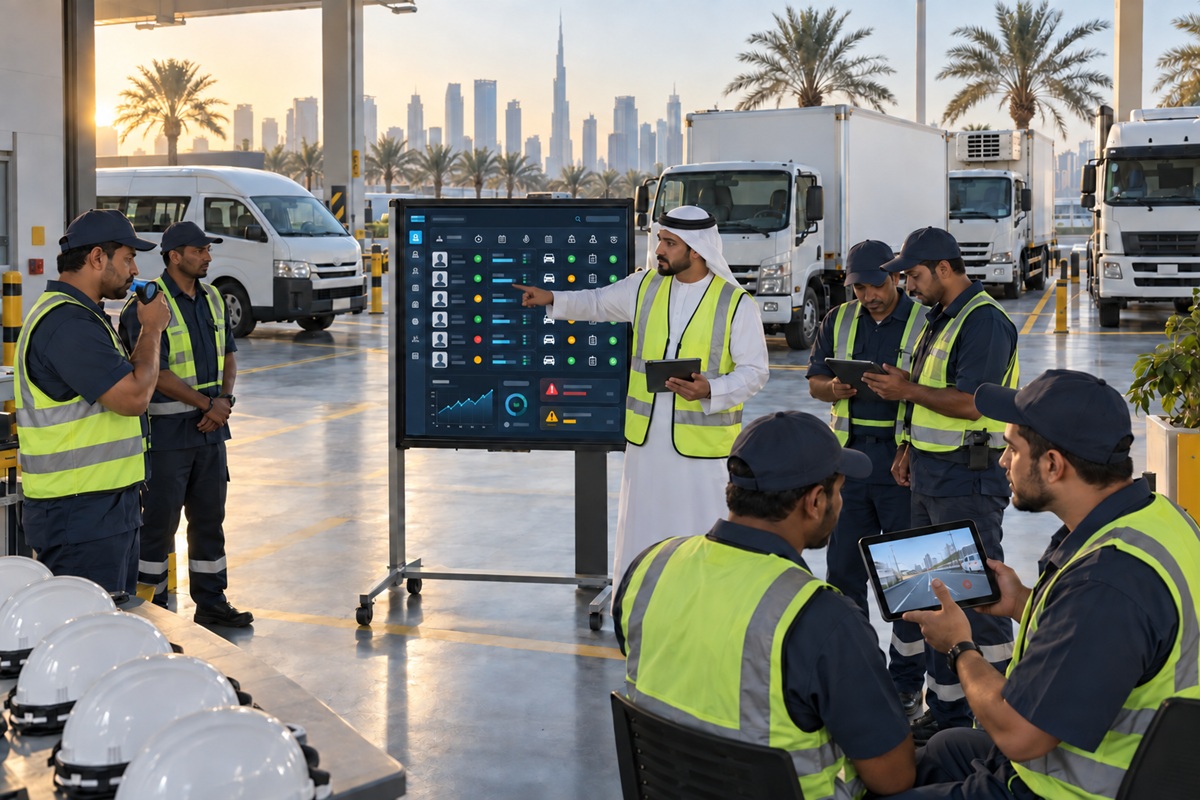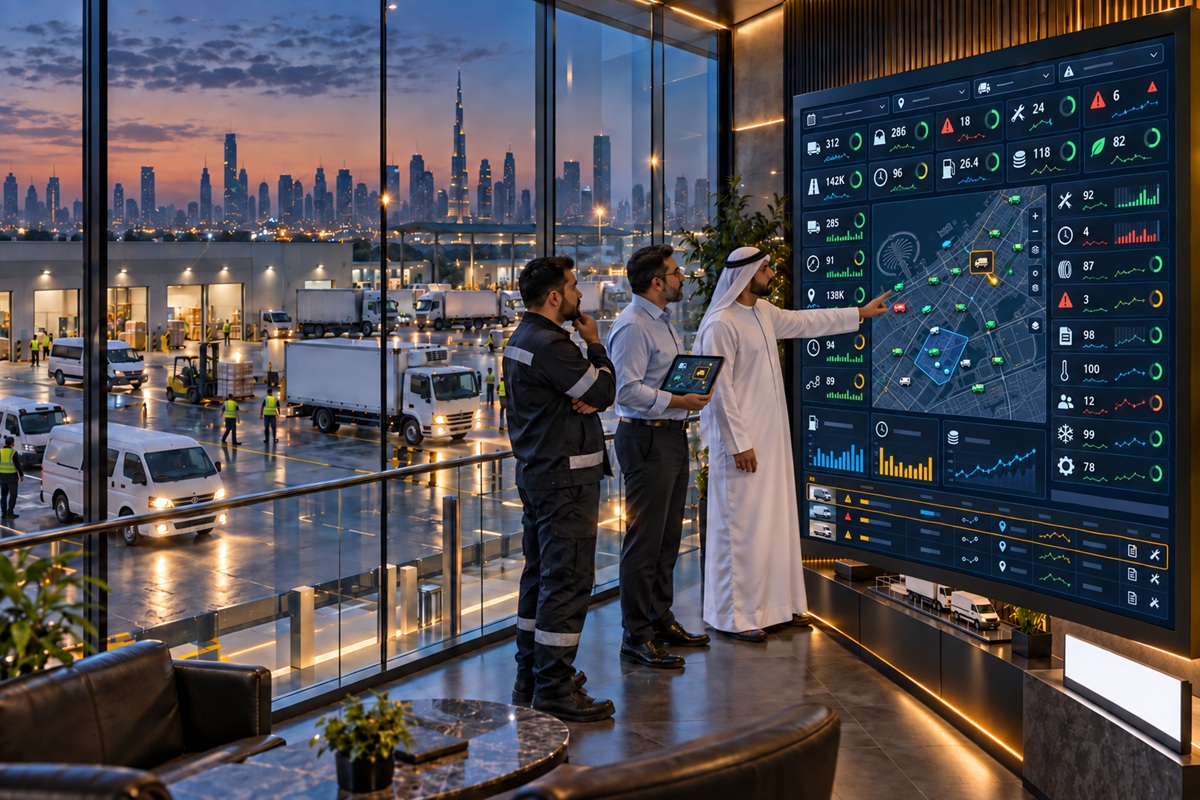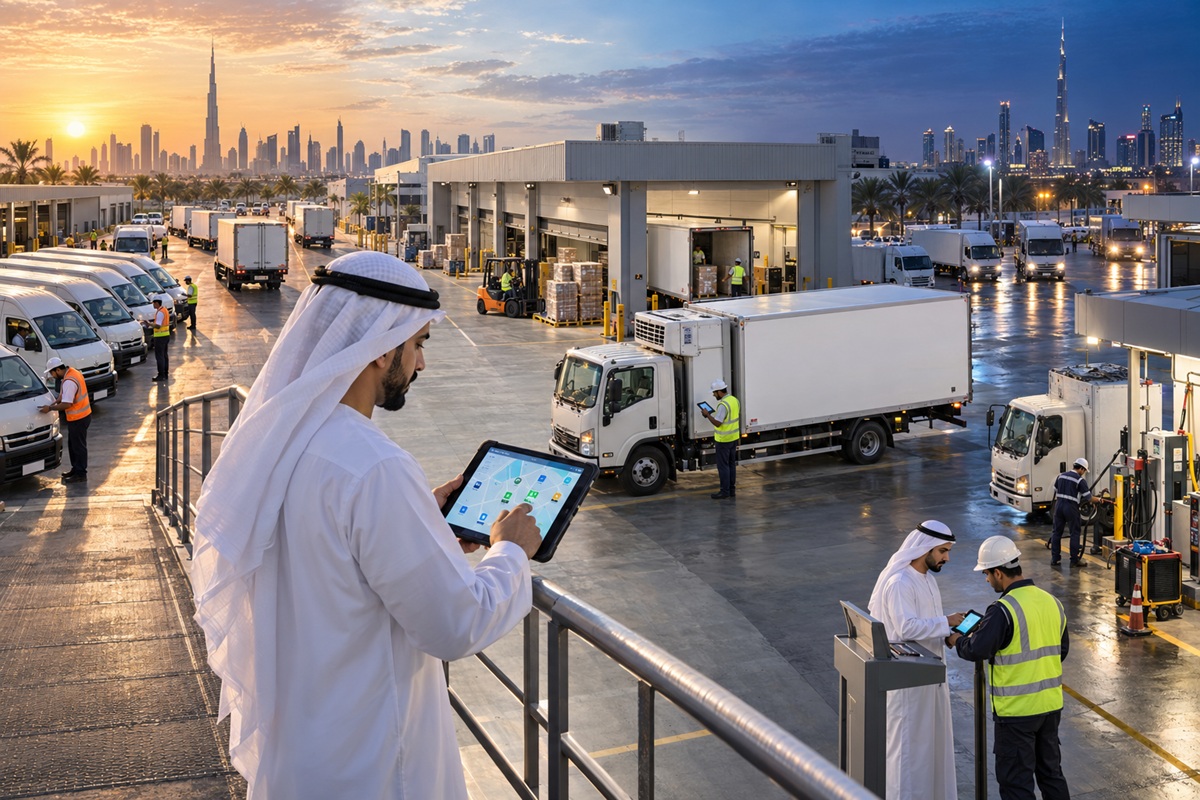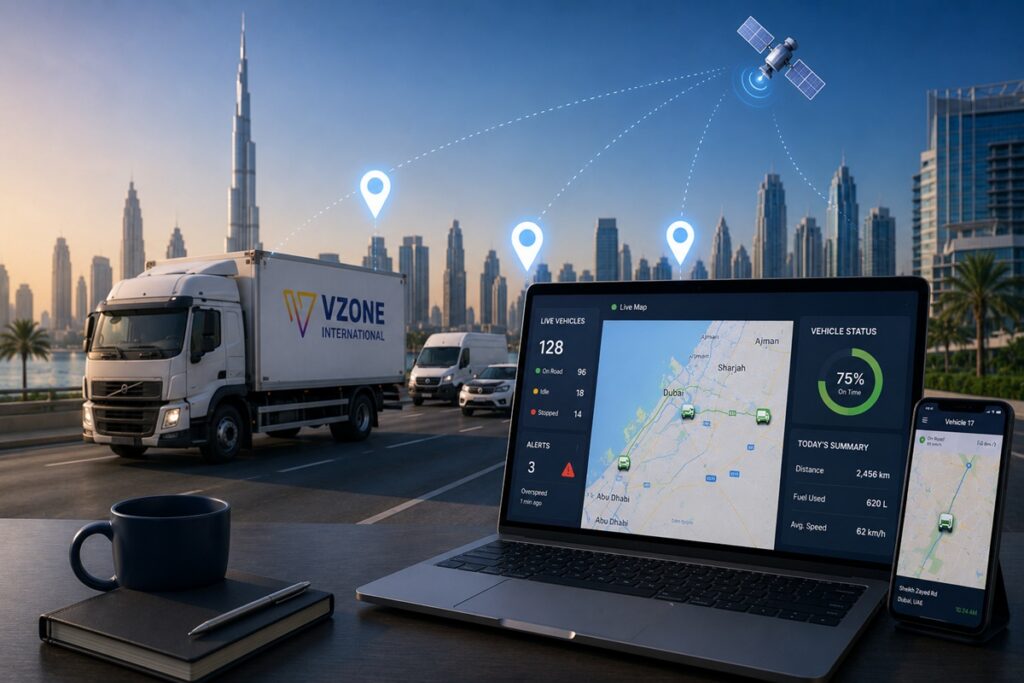
Consider two dispatchers managing the same 30-vehicle UAE logistics fleet on the same afternoon. The first dispatcher has a real-time fleet visibility platform: a live map showing all 30 vehicles, their current positions, their speeds, how many stops they have completed, whether their cargo is within temperature, and whether any driver has generated a harsh event alert in the last hour. When a customer calls to ask where their delivery is, the dispatcher looks at the screen and answers in 15 seconds. When Vehicle 17’s temperature pre-alert fires, the dispatcher can see that it is stationary at a delivery point and contacts the driver immediately.
The second dispatcher has GPS tracking: they know where each vehicle is. When the same customer calls, they check the map, see the vehicle is somewhere in Al Quoz, and estimate the delivery will arrive in 30 to 45 minutes. When Vehicle 17’s temperature excursion is discovered at delivery three hours after the reefer unit developed a fault the cargo is already compromised and the excursion record shows nothing that could have prevented it.
Same vehicles. Same routes. Same drivers. Completely different operational capability because real-time fleet visibility is not the same as GPS tracking, and the gap between them is the gap between managing a fleet reactively and managing it in real time.
Key Takeaways
- Real-time fleet visibility extends GPS location tracking with five additional data layers driver behaviour, vehicle condition, cargo status, compliance state, and operational context creating a unified live view that enables proactive fleet management rather than reactive incident response.
- The operational value of real-time visibility is measured in the decisions it enables and the decisions it prevents: dispatchers can redirect vehicles before delays cascade, drivers can be coached on developing behaviour patterns before accidents occur, temperature excursions can be intercepted before cargo is destroyed.
- UAE-specific factors amplify the value of real-time visibility: summer heat makes the 10-minute window between a temperature pre-alert and a cargo loss event critically short; Dubai’s peak-hour congestion makes live traffic-aware routing 25 to 40 minutes faster than static routes; and the density of compliance monitoring (Asateel, IVMS) means compliance status is an operational metric that must be visible in real time alongside location.
- Customer-facing real-time visibility sharing GPS-based ETAs and live tracking links with delivery recipients has shifted from competitive differentiator to commercial expectation among UAE retail and enterprise customers in the past three years.
- The difference between a fleet that has real-time visibility and one that does not is the difference between a fleet manager who knows what is happening right now across their entire operation and one who is managing from a picture that was accurate an hour ago.
What Is Real-Time Fleet Visibility?
Real-time fleet visibility is the continuous, live awareness of every vehicle’s current state across five dimensions simultaneously updated every 30 to 60 seconds from telematics data transmitted from each vehicle presented in a unified operational interface that fleet managers, dispatchers, and operations teams use to manage their fleet as it is now rather than as it was an hour ago.
The five dimensions of real-time fleet visibility are:
| Visibility Dimension | What It Shows in Real Time | Operational Decision It Enables |
| Location | Precise GPS coordinates, current speed, heading, and route progress for every vehicle | Dispatch to nearest vehicle; customer ETA; route deviation detection |
| Driver behaviour | Current and recent harsh events, safety score trend, active alerts (speeding, seatbelt) | Driver coaching trigger; incident prevention; insurance risk management |
| Vehicle condition | Engine status, fuel level, OBD-II fault code alerts, tyre pressure status | Proactive maintenance dispatch; breakdown prevention; fuel anomaly detection |
| Cargo status | Compartment temperature, reefer unit status, door open/close events, humidity | Cold chain excursion prevention; HACCP compliance; pharmaceutical GDP monitoring |
| Compliance state | Asateel data submission status (online/offline), IVMS event rate, document expiry proximity | Compliance gap prevention; regulatory audit readiness; document renewal action |
A platform that provides all five dimensions simultaneously not five separate screens or five separate data exports, but a single unified view is a real-time fleet visibility platform. A platform that provides GPS location without the other four dimensions is a GPS tracker with a live map. The distinction matters operationally because the decisions that prevent costs (cargo loss, accidents, compliance fines, downtime) are the ones enabled by seeing all five dimensions together, not by seeing location alone.
Real-Time Fleet Visibility vs GPS Tracking The Operational Difference
GPS tracking and real-time fleet visibility are often conflated in marketing and procurement discussions and the conflation is commercially convenient for providers whose systems are GPS trackers marketed as fleet management platforms. The operational distinction is fundamental, and understanding it is the single most important capability evaluation step for UAE fleet managers selecting a new system.
| Operational Scenario | GPS Tracking Response | Real-Time Fleet Visibility Response | Outcome Difference |
| Customer calls asking where delivery is | Check map for vehicle location; estimate time based on distance | Check map for vehicle location, current speed, stops remaining, and precise ETA calculated from GPS + route data | ETA accuracy: ±45 min (GPS) vs ±8 min (visibility platform) |
| Driver developing harsh braking pattern over past 2 hours | No visibility until end-of-day report | Alert fires when harsh event rate crosses threshold; dispatcher contacts driver mid-route | Accident prevented vs accident investigated |
| Vehicle reefer unit fault developing during route | No visibility until cargo temperature crosses alert threshold (if configured) | Reefer unit status alert fires when compressor performance degrades before cargo temperature is affected | Cargo saved vs cargo lost |
| Asateel portal offline for Vehicle 12 | No visibility until ITC compliance notice received | Offline alert fires within 30 minutes; technical team reconnects device before compliance gap is recorded | Compliance maintained vs compliance finding |
| Unexpected traffic congestion affecting three vehicles | No visibility until driver calls; delay discovered reactively | All three vehicles visible on live map with live traffic overlay; dispatcher reroutes two vehicles, notifies customer of third | Two deliveries saved; customer proactively informed |
| Driver idle for 45 minutes in a rest area | Visible as stationary vehicle, no alert | Idle duration alert fires at configured threshold; supervisor contacts driver | Unauthorised stop investigated vs ignored |
Why Real-Time Fleet Visibility Matters More in UAE Than in Most Markets
The operational value of real-time fleet visibility is universally significant but several UAE-specific factors make the difference between real-time visibility and retrospective data management more consequential here than in most other markets.
UAE Summer Heat Compressing the Response Window
In a cold chain operation, the time between a temperature pre-alert and a confirmed cargo loss event determines whether the cargo is saved or destroyed. In a European cold chain operation at 20°C ambient, this window is typically 25 to 40 minutes enough time for a dispatcher to receive an alert, assess the situation, contact the driver, and initiate a response. In a UAE summer operation at 45°C ambient, the same window is 8 to 15 minutes. Real-time visibility that delivers a pre-alert with GPS location context enables an intervention in this window. A batch-update system that shows the temperature only when the driver checks in or the route ends arrives after the window has closed.
The same compression applies to vehicle breakdown response: a vehicle that breaks down on the Dubai–Abu Dhabi highway in July creates a time-sensitive cargo rescue scenario where a rapid response from real-time GPS coordinates enables a replacement vehicle dispatch to reach the breakdown point before the cargo is compromised. A system that shows the vehicle as ‘stationary’ without an alert, and does not generate a proactive breakdowndetection alert from engine status monitoring, creates a response delay that may cost the entire cargo load.
Dubai Peak Congestion The Dynamic Routing Advantage
Dubai’s peak-hour congestion on Sheikh Zayed Road, Al Khail Road, and the Emirates Road creates route timing variability that static dispatch planning cannot account for. A delivery route planned at 7am based on historical travel times may encounter a traffic incident at 9am that adds 35 minutes to three vehicles’ routes simultaneously affecting customer SLA commitments that were made based on the 7am plan. Real-time fleet visibility with live traffic integration enables the dispatcher to see the traffic impact on all three routes simultaneously, redirect two of the three vehicles through alternative routes while they are still upstream of the bottleneck, and proactively notify the customer for the third vehicle that cannot be rerouted.
The difference between a dispatcher who sees this situation developing on a live map and one who discovers it when the first customer complaint call arrives is the difference between proactive service recovery and reactive damage control. For UAE logistics operators where major retail and hospitality customers have SLA penalty clauses, this is a directly quantifiable financial difference.
Compliance Density Multiple Programmes Require Constant Monitoring
UAE fleet operators managing vehicles across multiple compliance programmes Asateel (Abu Dhabi), SecurePath (Dubai), ADNOC IVMS (contractor sites), SIRA (security patrol) face a compliance monitoring challenge that is denser than in virtually any other market. Each programme requires continuous data transmission, and a device that goes offline creates a compliance gap that may generate a regulatory notice within hours. Real-time visibility of compliance state Asateel online/offline status visible alongside GPS position on the fleet dashboard enables immediate response to connectivity issues before they generate compliance findings.
The alternative discovering compliance gaps when ITC or RTA sends a notice is a retrospective response to a problem that real-time visibility would have resolved within the 30-minute window between device going offline and compliance monitoring systems flagging the gap. The difference in consequence between ‘reconnected within 30 minutes’ and ‘discovered on the compliance notice three days later’ is the difference between no finding and a formal compliance record.
The Five Components of a Real-Time Fleet Visibility Platform
A genuine real-time fleet visibility platform as opposed to a GPS tracker with a live map has five specific components working together to create the unified operational awareness that enables proactive fleet management.
1. Live Fleet Map with Multi-Layer Status Overlay
The live fleet map is the primary operational interface showing all vehicles as real-time icons on a geographic map, updated every 30 to 60 seconds. What distinguishes a visibility platform map from a basic GPS tracker map is the information density available at each vehicle icon: status colour-coding (moving green, idle amber, stopped red, offline grey), speed indicator, current driver identity, stops completed vs planned for the day, active alerts, and vehicle group / site assignment all visible without opening a vehicle detail panel. The map should also display live traffic overlay, geofence boundaries, and scheduled delivery zones simultaneously, so the operational context of each vehicle’s position is immediately visible without switching views.
2. Proactive Alert Engine With Pre-Alert Configuration
A visibility platform does not wait for thresholds to be crossed it alerts before they are crossed. Pre-alert configuration across all five visibility dimensions: temperature approaching limit (not at limit), driver safety score declining trend (not at a threshold), reefer unit performance degrading (not failed), Asateel offline approaching 30 minutes (not at the point of non-compliance), vehicle idle time approaching configurable limit (not unlimited). This pre-alert layer is what converts the platform from a monitoring tool (telling you what happened) to a visibility tool (telling you what is about to happen so you can prevent it).
3. Contextual Incident Response Location + Status + Action
When an alert fires on a visibility platform, the response interface provides three things simultaneously: the vehicle’s current GPS location with route context (where is it, what is it doing, where was it going); the alert detail with trend data (what is the temperature, what is the trend rate, how long has this been developing); and the action options available (contact driver, redirect vehicle, dispatch replacement, escalate to supervisor). This contextual response interface is what makes alerts actionable rather than informational the dispatcher has everything needed to decide and act without switching screens or making phone calls to establish context.
4. Customer-Facing Visibility Layer
Real-time fleet visibility is not only an internal operational tool it is increasingly a customer service and commercial differentiation tool in UAE’s logistics and delivery market. A visibility platform that exposes vehicle position and ETA data through a customer portal API enables UAE fleet operators to give their customers the same delivery tracking experience that consumer parcel delivery services provide: a live tracking link, ETA notification when the vehicle is 20 minutes away, delivery confirmation when the driver completes the stop. For B2B fleet operators supplying major UAE retailers, this customer visibility capability has shifted from premium offering to procurement requirement in the past three years.
5. Offline and Connectivity Resilience
Real-time visibility is only as reliable as the data connection between the vehicle and the platform. A visibility platform must maintain the appearance of continuous visibility through the connectivity interruptions that UAE fleet operations encounter: cellular dead zones in the Western Region, brief signal gaps in urban tunnels and underground car parks, and the multi-country roaming transitions that cross-border GCC fleets experience. Offline data buffering storing data locally during connectivity gaps and uploading at reconnection ensures that the historical record is complete even when real-time transmission is briefly interrupted. Connectivity status indicators on the live map distinguishing between ‘offline 2 minutes’ (brief gap, not concerning) and ‘offline 47 minutes’ (potential device fault, requires attention) enable dispatchers to distinguish normal connectivity variation from genuine technical issues without false-alarm escalation.
Real-Time Fleet Visibility Across UAE Industry Sectors
| Industry Sector | Primary Visibility Need | Key Real-Time Data Layer | UAE-Specific Value Driver |
| Urban last-mile delivery (logistics) | Customer ETA accuracy; multi-stop route progress | GPS + traffic + stop completion | Dubai peak congestion creates 25–40 min timing variability real-time rerouting captures this |
| Pharmaceutical cold chain | Temperature pre-alert; GDP documentation; excursion prevention | Temperature + GPS + reefer status | UAE summer compresses intervention window to 8–15 min real-time pre-alert is not optional |
| ADNOC contractor fleet | IVMS compliance state; driver safety score; HSE event rate | Driver behaviour + GPS + IVMS compliance | ADNOC site access depends on IVMS compliance real-time status prevents contractor site exclusion |
| Security patrol (SIRA) | Patrol route completion; response time to incidents; GPS audit trail | GPS + geofence + SIRA compliance status | SIRA patrol route audit requires verifiable real-time GPS records retrospective logs are insufficient |
| School transport | Student safety; route compliance; parent communication | GPS + student boarding + driver monitoring | Parent notification requires real-time departure and arrival GPS triggers batch data cannot serve this |
| Construction multi-site | Equipment location; utilisation; plant access logging | GPS + asset status + geofence entry/exit | Multi-site construction fleets move equipment between project sites daily real-time prevents loss |
VZone International’s Real-Time Fleet Visibility Platform
VZone International’s fleet visibility platform built on Wialon’s enterprise IoT infrastructure provides all five dimensions of real-time fleet visibility simultaneously on a unified dashboard: GPS location with live traffic overlay, driver behaviour real-time scoring, vehicle condition monitoring from OBD-II and IoT sensors, cold chain cargo status, and UAE compliance state monitoring across Asateel, SecurePath, and IVMS programmes. The platform updates every 30 seconds from telematics data transmitted from Teltonika devices installed across the fleet providing the current picture that fleet managers, dispatchers, safety officers, and compliance teams each need in their role-specific dashboard views.
AI Fleet Assistant Predictive Visibility Beyond Real-Time
VZone’s AI Fleet Assistant extends real-time visibility into predictive visibility: not just showing what is happening now but identifying what is likely to happen next based on pattern analysis from 300M+ km of UAE and GCC driving data. A driver whose safety score has declined from 84 to 71 over the past three weeks is statistically more likely to generate an incident in the coming week than one whose score is stable at 84 the AI assistant flags this developing trend before it becomes a safety event. A vehicle whose fuel consumption per kilometre has increased 12 percent over the past month may be developing an engine issue the AI assistant flags the trend before the OBD fault code appears. This predictive layer converts the platform from situational awareness (knowing what is happening) to operational intelligence (knowing what to do about what will happen next).
Multi-Site and Role-Based Visibility
VZone’s visibility platform supports hierarchical, role-based fleet views for enterprise UAE fleet operations: operations managers see their depot’s vehicles in real time; regional managers see all vehicles across their region; safety officers see driver behaviour alerts fleet-wide; quality managers see cold chain compliance status across all refrigerated vehicles; and senior leadership sees the KPI summary view populated from the same real-time data. Each role sees the visibility layer relevant to their decisions without information overload from data appropriate to other roles from the same unified platform.
Conclusion: Visibility Is Not a Feature It Is the Foundation
Every fleet management capability that matters proactive maintenance, driver coaching, cold chain compliance, customer SLA management, regulatory compliance monitoring depends on knowing what is happening across the fleet right now. Not an hour ago. Not yesterday. Now. Real-time fleet visibility is not a premium feature to be added once the basic GPS tracking requirement is satisfied. It is the operational foundation that every other fleet management capability is built on.
In the UAE context, where summer heat compresses intervention windows to minutes, where compliance monitoring is continuous and multi-programme, where customer expectations for delivery visibility are rising, and where the consequences of reactive rather than proactive management range from cargo loss to compliance findings to lost contracts, the difference between a GPS tracker and a real-time visibility platform is the difference between a fleet that manages incidents and a fleet that prevents them.
VZone International’s fleet management platform provides all five dimensions of real-time fleet awareness location, driver behaviour, vehicle condition, cargo status, and compliance state on a single unified dashboard, updated every 30 seconds, with proactive alerts before thresholds are crossed, customer-facing ETA visibility, and the AI Fleet Assistant layer that converts current awareness into predictive intelligence. This is what fleet managers in UAE’s demanding operational environment need not to know what happened yesterday, but to act on what is happening right now.
See your entire UAE fleet in real time on one screen.
VZone International’s fleet visibility platform shows you every vehicle’s location, driver behaviour, cargo temperature, vehicle condition, and compliance state simultaneously updated every 30 seconds. Book a live platform demonstration and see what real fleet visibility looks like for your specific operation.
Frequently Asked Questions
Real-time fleet visibility is the continuous, live awareness of every vehicle's location, driver behaviour, vehicle condition, cargo status, and compliance state updated every 30 to 60 seconds from telematics data presented in a unified operational dashboard that enables fleet managers and dispatchers to make decisions based on what is happening right now rather than on historical reports. It differs from GPS tracking by adding four additional data dimensions beyond location: driver behaviour events, vehicle diagnostics, cargo environment monitoring (temperature, fuel level), and compliance state monitoring (Asateel online status, IVMS event rate). Together these five dimensions create the operational picture that enables proactive fleet management.
GPS tracking shows where vehicles are in real time. Real-time fleet visibility shows where vehicles are and what is happening to them, their drivers, their cargo, and their compliance status simultaneously, in a single view, with proactive alerts before problems develop rather than after they occur. The operational difference in UAE is particularly significant: a GPS tracker tells you a vehicle is stationary; a visibility platform tells you it has been stationary for 47 minutes with engine on in Al Quoz during a peak summer afternoon, the cargo temperature is approaching the alert threshold, and the reefer unit fuel level is below 15 percent. These are different operational situations requiring completely different responses and only real-time visibility provides the information to distinguish between them.
With a full real-time fleet monitoring platform in UAE, operations teams can see: every vehicle's current GPS position, speed, and route progress updated every 30 to 60 seconds; driver behaviour events as they occur (harsh braking, speeding, seatbelt alerts) with the driver's current safety score trend; vehicle condition data including engine fault codes, fuel levels, and tyre pressure; cargo compartment temperature in real time for cold chain vehicles, with pre-alerts before limits are crossed; Asateel and SecurePath data submission status (online/offline) for compliance monitoring; and active alerts across all categories requiring dispatcher or supervisor attention. This unified view is what enables proactive operational decisions rather than reactive incident response.
Real-time fleet visibility improves UAE fleet operations across six specific outcomes: customer ETA accuracy improves from ±45 minutes (GPS estimate) to ±8 minutes (live GPS + route calculation); cold chain cargo loss events reduce through pre-alert intervention before temperature limits are crossed; driver accident rates reduce through real-time coaching triggers when safety scores decline; compliance gaps are caught within 30 minutes of device going offline rather than discovered on regulatory notices; Dubai peak-hour congestion impact is minimised through live traffic-aware rerouting; and unauthorised vehicle use is detected immediately through idle duration and after-hours movement alerts rather than discovered in weekly reports.