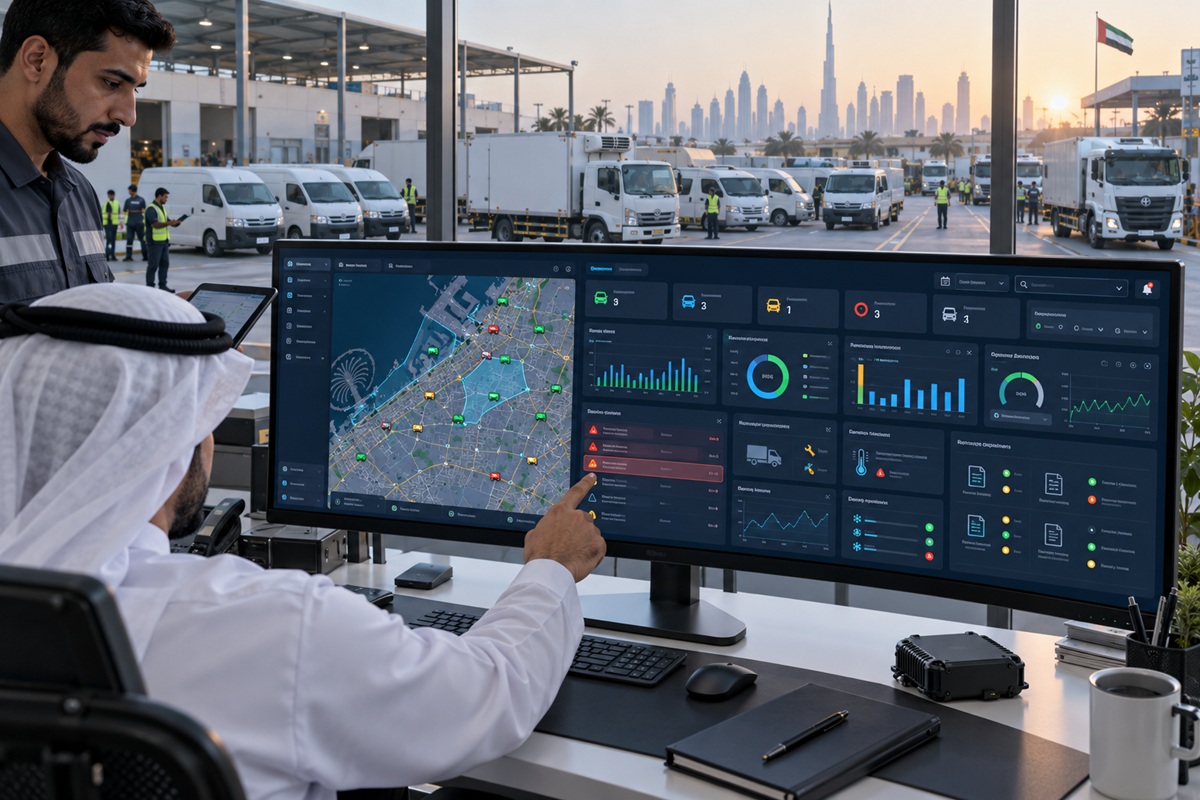
Advanced Driver Assistance Systems universally referred to as ADAS have moved from passenger car premium features to commercial fleet safety tools over the past decade. What began as lane-keeping assist and adaptive cruise control on luxury saloons is now a category of AI-powered camera and sensor systems that UAE fleet operators deploy specifically on commercial vehicles to reduce the road-environment accident patterns that GPS tracking and driver behaviour scoring alone cannot prevent.
The distinction between ADAS and the driver behaviour monitoring that the AI Dashcam series has covered so far is important: driver behaviour monitoring (fatigue detection, distraction detection, harsh event scoring) focuses on what the driver is doing. ADAS focuses on what is happening on the road ahead of, alongside, and behind the vehicle and alerts the driver to road-environment hazards that the driver may not have perceived, regardless of whether the driver is fatigued, distracted, or performing normally. A fully alert, undistracted driver can still fail to perceive the vehicle that enters their lane at the last second on a busy UAE highway; ADAS forward collision warning provides the additional seconds of alert that the driver’s own perception may not.
This guide explains what ADAS is, how each major ADAS capability works, which UAE fleet types benefit most from which ADAS features, how ADAS integrates with AI dashcam systems to provide both road-environment safety and driver behaviour monitoring from the same hardware, and the important distinction between passive warning ADAS (which alerts the driver) and active intervention ADAS (which acts on the vehicle without driver input).
Key Takeaways
- ADAS (Advanced Driver Assistance Systems) are camera and sensor-based systems that monitor the vehicle’s road environment and alert drivers or automatically intervene to prevent specific accident scenarios caused by road-environment hazards rather than driver behaviour failures.
- The six most relevant ADAS capabilities for UAE commercial fleet vehicles are: Forward Collision Warning (FCW), Lane Departure Warning (LDW), Blind Spot Monitoring (BSM), Pedestrian Collision Warning (PCW), Traffic Sign Recognition (TSR), and Automatic Emergency Braking (AEB) each addressing a different road-environment accident pattern.
- Modern AI dashcams with forward-facing cameras can deliver FCW, LDW, PCW, and TSR ADAS capabilities from the same hardware used for incident recording providing ADAS alerts without requiring separate dedicated sensors or radar units, at a fraction of the cost of OEM-fitted ADAS systems.
- The distinction between passive ADAS (warning alerts only driver must act) and active ADAS (vehicle intervention without driver input, such as AEB) is significant for commercial fleet deployment: active ADAS systems require OEM integration at the vehicle manufacturing stage and cannot be retrofit-added by a telematics provider; passive warning ADAS can be delivered through aftermarket AI dashcam systems.
- UAE-specific ADAS value drivers: forward collision warning has elevated value on UAE highways where tailgating is a common driving pattern; lane departure warning has elevated value on desert highway segments with lane-marking visibility degraded by sand; and pedestrian collision warning has elevated value in UAE’s dense urban pedestrian zones and residential areas where delivery and service vehicles operate at high stop frequency.
What Is ADAS? Defining the Category
Advanced Driver Assistance Systems is the collective term for a range of electronic safety technologies that use cameras, radar, LiDAR, ultrasonic sensors, or combinations of these to monitor the vehicle’s immediate road environment and provide the driver with warnings, guidance, or in active systems autonomous vehicle responses to detected hazard conditions. ADAS does not replace driver judgment; it supplements driver perception by monitoring aspects of the road environment that exceed the driver’s natural visual field or reaction time capability.
ADAS capabilities exist on a spectrum from passive-warning systems (which generate a sound or visual alert when a hazard condition is detected, leaving the driver to respond) to active-intervention systems (which take control of specific vehicle functions braking, steering when the hazard condition exceeds the threshold where driver response time alone is insufficient to prevent the incident). For aftermarket fleet deployments, the practical reality is that virtually all available ADAS capabilities are passive-warning systems active intervention requires OEM vehicle integration at the manufacturing stage that aftermarket telematics providers cannot replicate without modifying the vehicle’s safety-critical systems.
The Six Core ADAS Capabilities for UAE Fleet Vehicles
1. Forward Collision Warning (FCW)
Forward Collision Warning uses the forward-facing camera’s video feed and AI processing to continuously calculate the time-to-collision with the vehicle ahead monitoring closing speed and following distance simultaneously. When the calculated time-to-collision drops below a configured threshold (typically 2.5 to 3.5 seconds), the system fires an audible and visual alert to the driver. On UAE highways where driving at 120 km/h with following distances of 15 to 20 metres is common distances that provide less than 0.5 seconds of reaction time before a brake application can begin to have effect FCW provides the additional 2 to 3 seconds of alert that converts a reaction-time collision into a preventable incident.
UAE-specific FCW value: tailgating is documented as one of the most common driving patterns on UAE highways in Road Safety emirate studies. Drivers who habitually maintain insufficient following distance create the precise road-environment condition that FCW addresses. For UAE fleet operators whose drivers cover high-mileage highway routes, FCW is the single most commercially relevant ADAS capability because it directly addresses the incident pattern most likely to generate claims on those routes.
2. Lane Departure Warning (LDW)
Lane Departure Warning monitors the vehicle’s position relative to lane markings using the forward camera’s video processing detecting when the vehicle crosses a lane boundary without an active turn indicator signal. When the system detects an unindicated lane crossing, it fires an alert: a steering wheel vibration, audible tone, or visual warning depending on the vehicle’s display capability. LDW is designed to catch two specific incident patterns: unintentional drift (the gradual lane deviation that occurs when a driver’s attention lapses) and deliberate but unsafe lane change (the sudden lane change without adequate signal or observation that creates collision risk for vehicles in the adjacent lane).
UAE-specific LDW value: UAE highway segments in the Western Region and on desert transit routes between the Emirates have lane markings that are periodically degraded by sand drift reducing the marking visibility that human drivers rely on for lane positioning and that camera-based LDW systems must detect to function. Fleet operators deploying LDW on desert route vehicles should confirm with their telematics provider that the LDW algorithm is calibrated to handle reduced-contrast lane marking conditions rather than only performing reliably on freshly painted high-contrast road surfaces.
3. Blind Spot Monitoring (BSM)
Blind Spot Monitoring uses side-mounted cameras or ultrasonic sensors to detect vehicles in the driver’s blind spot zones the areas alongside and slightly behind the vehicle that are not visible in mirrors and that the driver must physically turn to check. When a vehicle is detected in the blind spot zone while the driver activates the turn indicator toward that side, the system fires a warning alert typically a visual indicator in the mirror or A-pillar area and an audible tone. BSM is most valuable for large commercial vehicles where the blind spot zones are largest and where the driver’s ability to physically check those zones is most limited.
For heavy trucks, articulated vehicles, and coaches operating in UAE’s urban traffic, BSM addresses the specific incident pattern vehicle-merging-into-occupied-adjacent-lane that is most associated with large commercial vehicle accidents in dense traffic. For light commercial vehicles and delivery vans operating on UAE urban routes, BSM provides additional safety margin during the frequent lane changes that urban delivery routing requires. BSM requires side-facing camera or sensor hardware beyond the standard forward-facing dashcam it is not deliverable through a forward-camera-only AI dashcam systems.
4. Pedestrian Collision Warning (PCW)
Pedestrian Collision Warning uses the forward camera’s AI processing to detect human figures in or approaching the vehicle’s path firing an alert when the system calculates that a pedestrian poses a collision risk given the vehicle’s speed and trajectory. PCW is the ADAS capability with the highest humanitarian value: pedestrian fatalities in commercial vehicle accidents are disproportionately severe, and the low-speed urban environments where PCW is most relevant are precisely the environments where driver distraction (from phone navigation, delivery stop stress, or traffic complexity) creates the specific lapse that PCW is designed to catch.
UAE-specific PCW value: UAE urban environments in Dubai’s residential zones, Abu Dhabi’s city core, and the high-pedestrian-density commercial districts create the specific conditions where PCW adds most value for last-mile delivery, service, and retail supply fleet vehicles. A delivery driver executing a roadside park approach in a busy Abu Dhabi residential area who has not fully checked the pedestrian environment receives a PCW alert if a pedestrian steps off the pavement into the vehicle’s path providing the fraction-of-a-second warning that changes a collision into a near-miss.
5. Traffic Sign Recognition (TSR)
Traffic Sign Recognition uses the forward camera to detect and interpret road signs primarily speed limit signs and stop/yield signs and display the recognised limit or instruction to the driver via an in-cab display or HUD. When the driver’s GPS-tracked speed exceeds the recognised speed limit by a configured margin, TSR can fire an alert. TSR integrates naturally with GPS speed monitoring: the GPS system knows the vehicle’s speed; TSR identifies the applicable limit from the physical sign rather than relying on map-based speed limit data that may not reflect temporary limits (road works, school zones, emergency speed restrictions).
UAE-specific TSR value: UAE highway speed limits vary along route segments and are subject to temporary reductions in specific zones (school zones during operating hours, road works sections, weather condition responses). TSR that reads physical signs rather than relying exclusively on map data is more responsive to temporary limit changes that map databases may not update in real time. For fleet operators running ADNOC IVMS compliance programmes where speed tier violations carry specific penalty thresholds, TSR integration with the IVMS system can provide pre-alert before a speed event is generated.
6. Automatic Emergency Braking (AEB)
Automatic Emergency Braking is the only active intervention ADAS capability relevant to commercial fleet vehicles it autonomously applies the vehicle’s brakes when the system detects an imminent collision that the driver has not responded to within the available reaction window. Unlike all other ADAS capabilities listed above, AEB does not alert the driver and wait for a response it acts directly on the vehicle’s brake system without driver input. This autonomous intervention capability is why AEB is the ADAS feature most associated with measurable accident prevention in research studies: it does not depend on the driver acting on an alert in the available time window.
For UAE fleet operators, AEB is a vehicle procurement decision rather than a telematics deployment decision: AEB requires OEM integration at the vehicle manufacturing level and is available as standard or optional equipment on most modern commercial van and truck platforms. Aftermarket telematics providers cannot add AEB to vehicles that were not manufactured with it a point that creates important clarity between the capabilities of aftermarket AI dashcam ADAS and OEM-integrated ADAS. Fleet procurement teams specifying new vehicles should include AEB as a standard specification requirement; fleet telematics teams deploying AI dashcams on existing vehicles should understand that their ADAS capabilities are all passive-warning rather than active-intervention.
ADAS vs AI Dashcam The Same Hardware, Different Outputs
The most common source of confusion in fleet ADAS discussions is the relationship between ADAS and AI dashcams. The answer for most forward-camera-based ADAS capabilities is: they are the same hardware delivering two different output streams simultaneously.
| Capability | AI Dashcam Output | ADAS Output from Same Camera | Delivered by AI Dashcam? |
| Forward video recording | Event-tagged footage for incident evidence and driver coaching | N/A recording is the dashcam function itself | Yes core dashcam function |
| Driver fatigue detection | Fatigue event alerts from driver-facing IR camera analysis | N/A DMS function, not road-environment ADAS | Yes via driver-facing camera |
| Distraction detection | Phone use and gaze anomaly alerts from driver-facing camera | N/A DMS function | Yes via driver-facing camera |
| Forward Collision Warning (FCW) | N/A for standard dashcam; AI-enabled forward camera provides FCW | Alert when time-to-collision drops below threshold | Yes AI-enabled forward camera |
| Lane Departure Warning (LDW) | N/A for standard dashcam; AI forward camera provides LDW | Alert when vehicle crosses lane marking without indicator | Yes AI-enabled forward camera |
| Pedestrian Collision Warning (PCW) | N/A for standard dashcam; AI forward camera provides PCW | Alert when pedestrian enters vehicle path | Yes AI-enabled forward camera |
| Traffic Sign Recognition (TSR) | N/A for standard dashcam; AI forward camera provides TSR | Speed limit display and excess speed alert | Yes AI-enabled forward camera |
| Blind Spot Monitoring (BSM) | N/A requires side cameras or radar | Alert when vehicle in blind spot on indicator activation | Only with additional side cameras/sensors |
| Automatic Emergency Braking (AEB) | N/A requires OEM brake system integration | Autonomous brake application driver not required | No OEM vehicle integration required |
The practical implication for UAE fleet operators is that deploying an AI dashcam with forward-facing intelligent camera processing provides four ADAS capabilities (FCW, LDW, PCW, TSR) alongside the driver monitoring (fatigue, distraction) and incident recording functions all from a single hardware installation without additional sensors. BSM requires side hardware additions; AEB is a vehicle specification decision. This integration makes AI dashcam investment the most cost-effective ADAS deployment pathway for commercial fleet vehicles.
UAE-Specific ADAS Deployment Considerations
False Positive Management in UAE Conditions
ADAS false positives alerts that fire when no genuine hazard exists are the primary adoption barrier for fleet ADAS systems. A driver who receives 15 FCW alerts during a shift because the system is calibrated too sensitively for UAE highway driving conditions will begin ignoring alerts converting the safety system into background noise. UAE-specific false positive sources include: FCW triggering on bridge supports and overhead gantries that the AI interprets as approaching obstacles; LDW triggering on temporary construction lane markings that conflict with permanent markings; and TSR reading information signs with speed-like numbers as speed limit instructions.
VZone International’s AI dashcam ADAS deployment for UAE fleets uses calibration developed from UAE road environment data reducing false positive rates on UAE highway and urban environments to levels that maintain alert credibility. The calibration addresses the specific UAE road features (overhead gantry density on Dubai and Abu Dhabi arterial roads, temporary construction marking patterns, UAE traffic sign design standards) that generic ADAS algorithms trained on European or North American road data handle poorly.
Heat and Camera Performance
UAE summer conditions create a specific camera performance challenge for ADAS systems: dashboard-mounted forward cameras in direct sunlight can reach temperatures exceeding 70°C inside an unventilated vehicle interior. Camera performance at these temperatures both sensor function and AI processing must be verified for the specific hardware deployed in UAE conditions. Enterprise-grade AI dashcam hardware for UAE deployment uses components rated for extended high-temperature operation; consumer-grade dashcam hardware may exhibit degraded performance or failure at sustained high temperatures.
The thermal performance of the camera is particularly relevant for ADAS functions because ADAS alerts require reliable camera operation throughout the operating day not just during the cooler morning period when performance is at its best. A forward collision warning that works reliably at 8 AM but produces unreliable alerts at 2 PM because the camera’s processor is thermally throttling is a system that fleet operators cannot rely on for the afternoon shift when the highest-risk driving conditions often occur.
ADAS and UAE Compliance Frameworks
ADAS capabilities are not currently mandated by UAE compliance frameworks (Asateel, IVMS, SecurePath) as required features they are safety enhancements above the compliance baseline. However, the ADNOC HSE management system’s broader expectation for active safety management on contractor vehicles creates an environment where ADAS capabilities particularly FCW for highway routes are increasingly included in contractor fleet HSE programme documentation as evidence of active road safety management. Fleet operators who can demonstrate ADAS alert frequency data alongside their IVMS driver behaviour records present a more comprehensive active safety programme than those who present behaviour monitoring alone.
Which UAE Fleet Types Benefit Most from ADAS
| Fleet Type | Highest Value ADAS Capability | Specific UAE Incident Pattern Addressed | Deployment Priority |
| Highway logistics (Dubai-Dammam, E311) | FCW forward collision warning | Tailgating at 120 km/h on UAE federal highways; closing speed incidents in heavy traffic | High FCW most impactful ADAS for highway routes |
| Urban last-mile delivery | PCW pedestrian collision warning | Low-speed pedestrian incidents during roadside park approach in residential and commercial areas | High PCW most impactful for urban stop routes |
| Heavy trucks and articulated vehicles | BSM blind spot monitoring | Lane-change incidents on UAE highways and urban roads where large vehicle blind spots are greatest | High BSM addresses the specific size-related risk |
| School and staff transport buses | LDW + PCW + FCW combination | Lane discipline on intercity routes; child pedestrian risk at school zones | High combination ADAS for passenger transport duty of care |
| ADNOC contractor long-haul | FCW + LDW + TSR combination | Highway fatigue-related lane drift; speed limit compliance at oilfield approach zones | High ADAS complements IVMS for comprehensive active safety |
| Construction site vehicles | PCW + BSM | Pedestrian exposure during site manoeuvres; reversing and blind spot incidents on site | Medium PCW valuable; BSM for large site vehicles |
| Car rental fleet | FCW basic ADAS alerting | Customer at-fault highway incidents; closes the gap where driver coaching is not applicable | Medium FCW provides safety floor for unknown driver quality |
| Government fleet (urban routes) | PCW + LDW | Urban pedestrian exposure; lane discipline on arterial roads | Medium ADAS complements basic GPS monitoring |
VZone International’s ADAS-Enabled AI Dashcam Deployment
VZone International’s enterprise AI dashcam systems for UAE fleet clients deliver FCW, LDW, PCW, and TSR ADAS capabilities from the forward-facing intelligent camera alongside driver fatigue detection, distraction monitoring, and incident recording all on the same device, from the same hardware installation, integrated into the same Wialon fleet management platform. ADAS events (FCW alert, LDW alert, PCW alert) appear in the same event record as driver behaviour events (fatigue alert, distraction event, harsh braking) providing the fleet manager with a complete road-safety picture from a single data source.
ADAS alert frequency data from VZone’s platform enables a specific fleet management insight that behaviour monitoring alone cannot provide: identifying which routes, time periods, and road segments generate the highest ADAS event rates. A route segment that consistently generates high FCW event rates is a route segment where following distances are systematically too close either because of road design, traffic pattern, or driver assignment. This route-level ADAS data is the input for route safety analysis that driver behaviour data, which describes individual driver performance, cannot provide.
Conclusion: ADAS Addresses What Driver Behaviour Monitoring Cannot
Driver behaviour monitoring fatigue detection, distraction scoring, harsh event coaching addresses accidents caused by driver state and driver decisions. ADAS addresses accidents caused by road-environment conditions that affect even alert, undistracted drivers: the vehicle that closes the gap too quickly on a UAE highway, the pedestrian who steps off the pavement at the exact moment the driver’s attention is on the navigation screen, the lane boundary that disappears under sand drift on a desert highway at dawn. Both categories of accident cause are present in UAE commercial fleet operations; both require technology that addresses their specific mechanism.
The practical news for UAE fleet operators is that modern AI dashcam systems deliver both capabilities from the same hardware. The forward-facing AI camera that records incident footage and fires FCW, LDW, PCW, and TSR alerts is the same camera. The driver-facing infrared camera that detects fatigue and distraction is the same camera. A single dual-lens AI dashcam installation on a UAE fleet vehicle delivers a comprehensive active safety package driver monitoring and road-environment ADAS alerts that would have required multiple separate systems five years ago. That integration is what makes the investment case straightforward and what makes ADAS a standard fleet deployment decision rather than a specialist technology procurement.
Deploy ADAS and driver monitoring from a single AI dashcam calibrated for UAE road conditions.
VZone International’s enterprise AI dashcam systems deliver FCW, LDW, PCW, TSR, fatigue detection, and distraction monitoring from a single dual-lens installation, integrated on the Wialon fleet platform with UAE road-calibrated false positive management. Contact our team for a free ADAS capability assessment for your fleet.
Frequently Asked Questions
ADAS (Advanced Driver Assistance Systems) in fleet vehicles are AI-powered camera and sensor systems that monitor the vehicle's road environment to warn drivers or in some active systems, automatically intervene when detected hazard conditions create accident risk. The six core ADAS capabilities for commercial fleet vehicles are: Forward Collision Warning (FCW), Lane Departure Warning (LDW), Blind Spot Monitoring (BSM), Pedestrian Collision Warning (PCW), Traffic Sign Recognition (TSR), and Automatic Emergency Braking (AEB). The first four passive-warning capabilities are deliverable through aftermarket AI dashcam systems; BSM requires additional side cameras or sensors; AEB requires OEM vehicle integration and cannot be retrofit-added. ADAS complements driver behaviour monitoring by addressing road-environment hazards regardless of the driver's behavioural state.
Forward collision warning in fleet vehicles uses the forward-facing AI camera to continuously calculate the time-to-collision with the vehicle ahead measuring the closing distance and speed between the fleet vehicle and the preceding vehicle in the same lane. When the time-to-collision drops below a configured threshold (typically 2.5 to 3.5 seconds), the system fires an in-cab audio and visual alert, giving the driver the additional warning time needed to initiate a braking response before the reaction time window closes. At 120 km/h, a 2.5-second FCW alert provides 83 metres of additional warning distance compared to a driver reacting from their own perception alone the physical margin that converts many potential rear-end collisions into avoided incidents.
Not exactly but modern AI dashcams with forward-facing intelligent camera processing deliver several ADAS capabilities alongside their primary dashcam functions. A standard dashcam records video passively without ADAS capability. An AI dashcam processes the forward camera feed in real time and can simultaneously deliver incident recording, driver fatigue detection (from driver-facing camera), and forward ADAS capabilities (FCW, LDW, PCW, TSR from the forward camera) from the same hardware. The AI dashcam is therefore an ADAS delivery platform as well as a recording device and driver monitoring system but it delivers passive-warning ADAS capabilities only. Active ADAS like automatic emergency braking (AEB) requires OEM vehicle integration that aftermarket dashcams cannot provide.
The ADAS capabilities most relevant to UAE fleet vehicles depend on the fleet's specific route profile: highway logistics and ADNOC contractor fleets benefit most from FCW for the tailgating and closing-speed incidents that UAE federal highway driving generates; urban last-mile delivery fleets benefit most from PCW for the pedestrian exposure incidents in UAE's dense urban stop environments; heavy trucks and coaches benefit most from BSM for the blind spot lane-change incidents that large vehicle size creates; and all commercial fleet types operating on UAE roads benefit from LDW for the lane discipline monitoring that desert highway sand drift and overnight fatigue create. TSR complements GPS speed monitoring by reading physical signs rather than relying exclusively on map data, which is most valuable for ADNOC contractor routes where temporary speed limits apply at site approach zones.