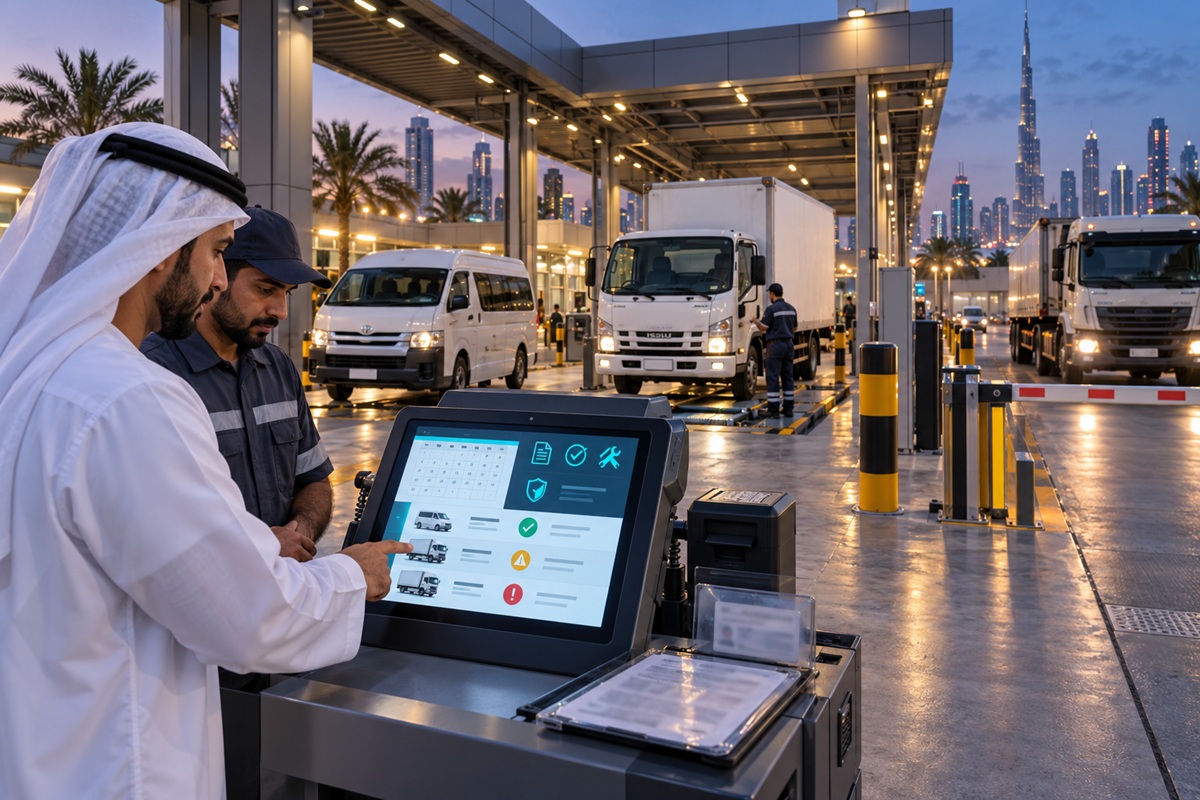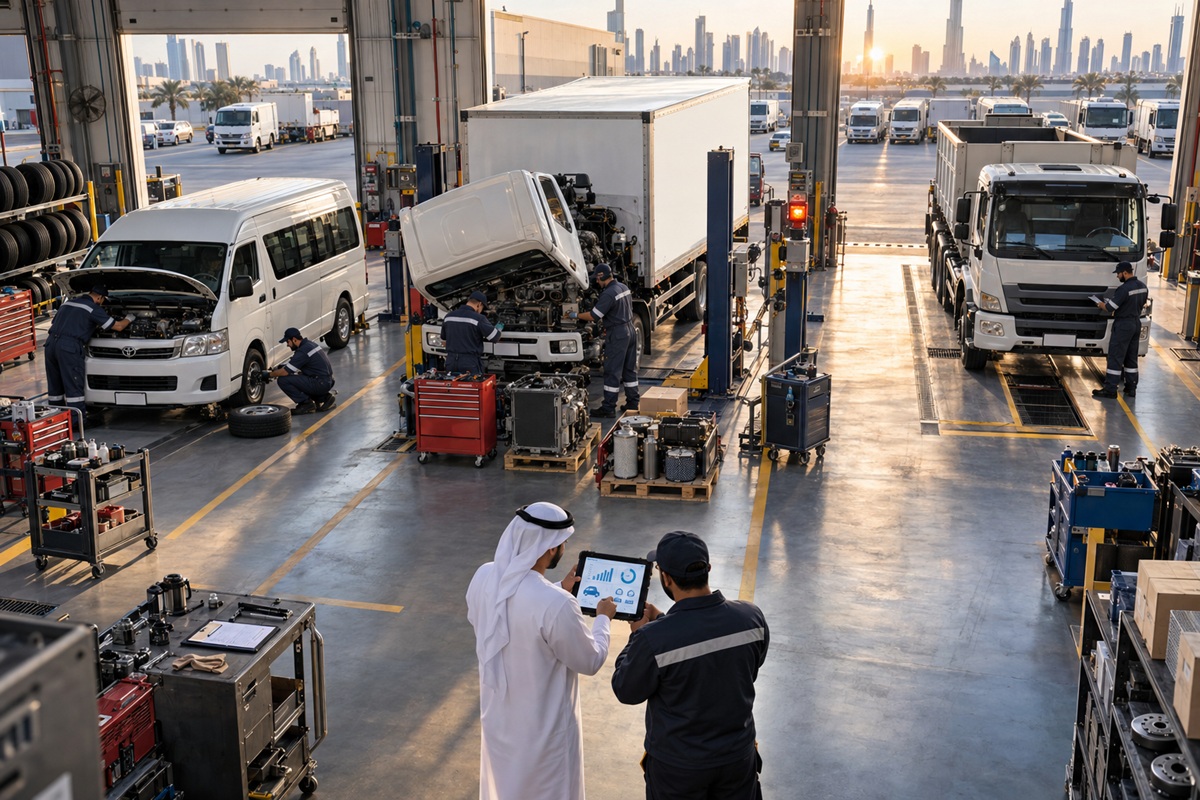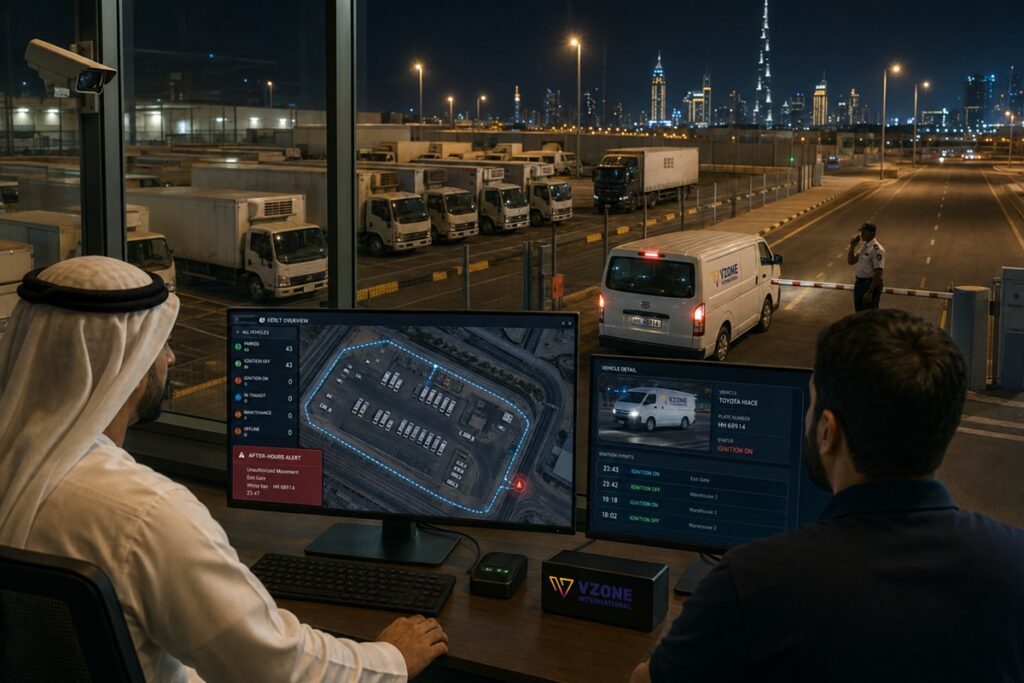
Fleet management does not end when the last driver clocks off. The hours between 8:00 PM and 6:00 AM when most UAE fleet management attention is elsewhere are when three of the most costly fleet management problems consistently occur: drivers taking company vehicles for personal use, equipment being stolen from construction sites and storage yards, and vehicles being involved in incidents with no management awareness until the morning review. After-hours vehicle tracking addresses all three through the same GPS infrastructure that manages the fleet during operating hours, with alert rules configured specifically for the after-hours window.
For UAE fleet operators, the after-hours monitoring case has an additional dimension beyond operational management: a company vehicle involved in an incident at 11:00 PM an accident, a traffic violation, or a criminal incident creates employer liability and insurance exposure regardless of whether the vehicle was authorised for after-hours use or not. GPS tracking that records the vehicle’s position, speed, and route during the after-hours incident provides the factual record that determines liability, not the driver’s account. After-hours tracking is not surveillance for its own sake it is the management visibility that allows fleet operators to distinguish between legitimate after-hours use and unauthorised use, and to manage both appropriately.
Key Takeaways
- After-hours vehicle tracking uses GPS geofencing (alerts when vehicles exit defined zones outside operating hours), ignition-on monitoring (alert when a vehicle’s engine starts during a period when it should be parked), and parking mode movement detection (alert when equipment moves without its engine running) to provide 24/7 fleet visibility without requiring 24/7 human monitoring.
- Unauthorised personal vehicle use drivers taking company vehicles for personal errands, weekend trips, or evening activities without authorisation is among the most consistent initial findings when UAE fleet operators deploy GPS tracking with after-hours alerts for the first time. The average cost per unauthorised trip in fuel, wear, and toll charges is AED 80 to AED 200; across a medium fleet, the aggregate monthly cost of unauthorised use can reach AED 5,000 to AED 20,000.
- Construction equipment and high-value assets stored on unmanned sites overnight face the highest theft risk during after-hours periods after-hours geofence exit and parking mode movement alerts are the primary GPS anti-theft mechanism for equipment that can be moved without starting its own engine (loaded onto a transport vehicle).
- After-hours vehicle tracking has a direct privacy and disclosure requirement under UAE PDPL fleet operators must disclose in employment contracts or fleet policy documents that vehicles are monitored outside working hours and for what purpose (security and theft prevention, not personal surveillance).
- VZone International’s Wialon platform supports unlimited after-hours geofence configurations with per-zone operating hour schedules, immediate mobile push notification delivery, and a tamper detection integration that fires if someone attempts to interfere with the GPS device on a parked vehicle.
What After-Hours Vehicle Tracking Detects?
Unauthorised Vehicle Use
Unauthorised personal use of company vehicles after hours is the most common after-hours tracking finding in UAE fleet deployments and the one that fleet managers are most surprised by when they see the data for the first time. Patterns are consistent: a small number of drivers (typically 5 to 15 percent of a fleet) use company vehicles regularly for personal errands in the evenings or on weekends. The usage pattern is usually gradual starting with occasional short trips and expanding as the absence of detection creates confidence that monitoring is not in place.
The financial cost of unauthorised personal vehicle use includes fuel (AED 40 to AED 100 per unauthorised trip), wear and tyre mileage accumulating beyond the vehicle’s operating schedule, Salik toll costs on personal routes (charged to the company account), and in some cases, the liability consequences of incidents during the unauthorised use period. For a 50-vehicle fleet where 6 vehicles average 3 unauthorised trips per week at AED 120 per trip in combined costs, the monthly unauthorised use cost is AED 8,640 AED 103,680 per year from a problem that an after-hours geofence alert programme eliminates in the first week after deployment.
The deterrence effect is immediate and powerful: when drivers are informed that after-hours vehicle use generates automatic alerts to the fleet manager, unauthorised personal use typically stops within the first week of alert activation not because every trip is investigated, but because the certainty of detection removes the risk calculation that enabled the behaviour.
Equipment and Vehicle Theft
Construction equipment theft on UAE sites occurs primarily during night hours and weekends when sites are unmanned and security personnel are absent or reduced. After-hours geofence exit alerts configured around site perimeters fire within minutes of any vehicle or equipment departing the site boundary during the designated after-hours period. For equipment that is stolen by loading it onto a transport vehicle without starting its own engine, parking mode movement detection fires when the equipment’s GPS device detects movement while the equipment is nominally parked with ignition off.
The intervention window that after-hours tracking provides is the critical advantage: without tracking, construction equipment theft on a Friday night may not be discovered until Sunday morning when work resumes a 36-hour head start during which the equipment can be moved hundreds of kilometres. With an after-hours geofence alert, the fleet manager and site security receive notification within 2 to 5 minutes of the equipment leaving the site boundary, with the live GPS position enabling an immediate response while the equipment is still on or near the site.
After-Hours Incidents and Liability
A company vehicle involved in a traffic accident, traffic violation, or other incident at 11:00 PM creates employer liability that the fleet operator may be unaware of until the morning. Without after-hours tracking, the first notification of an after-hours incident may be a phone call from the driver, a Police report, or a third-party claim each of which provides only the driver’s account or a partial official record. GPS tracking records the vehicle’s exact position, speed, and route at the time of any after-hours incident creating the objective factual record that is the most reliable input to any liability determination, insurance claim, or disciplinary process arising from the incident.
For incidents involving unauthorised vehicle use the driver was using the vehicle for personal purposes without authorisation when the incident occurred the GPS record also establishes whether the vehicle was being used outside its authorised scope at the time, which is relevant to both the employer’s liability and the insurance claim validity. This distinction matters commercially: an incident during authorised vehicle use is a covered insurance claim; an incident during explicitly unauthorised personal use that the fleet policy expressly prohibits may be a different insurance and liability situation. The GPS record is the evidence that makes this distinction factually determinable.
How After-Hours Vehicle Tracking Works?
After-Hours Geofence Configuration
After-hours geofencing works by combining a geographic boundary (the geofence zone) with a time schedule (the operating hours during which the zone alert is active or inactive). The fleet manager defines the geofence around the depot, construction site, equipment yard, or storage location, and configures the alert rule to fire when any vehicle or asset exits the zone outside the defined operating hours. A depot geofence configured with operating hours of 6:00 AM to 8:00 PM fires an exit alert at 8:01 PM if any vehicle exits the depot boundary and the alert continues to fire for any subsequent exits until 6:00 AM the following day.
Multiple after-hours geofences can be active simultaneously a fleet with vehicles deployed to multiple sites can have each site’s geofence configured independently with its own operating hour schedule. Vehicles that legitimately operate at night (security patrols, emergency maintenance teams, overnight logistics) can have their after-hours alert rules adjusted individually disabling the alert for specific vehicles during specific authorised after-hours windows without affecting the alert configuration for the rest of the fleet.
Ignition-On Monitoring
Ignition-on monitoring fires an alert when a vehicle’s engine starts during the after-hours period regardless of whether the vehicle has left a defined geofence zone. This alert type is complementary to geofencing: a vehicle whose engine is started inside the depot at 11:00 PM may not have left the geofence boundary yet, but the ignition-on event is itself anomalous and warrants investigation before the vehicle has opportunity to depart. The ignition-on alert combined with driver ID (iButton or RFID reader) identifies which driver started the vehicle enabling immediate contact before any after-hours trip begins.
Driver ID integration is the capability that transforms an after-hours ignition-on alert from a vehicle event into an accountable driver event. When the alert fires, the fleet manager can see immediately: which vehicle, which driver (from the driver ID logged into the vehicle), what time, what location enabling a direct call to the specific driver before the vehicle has moved far from its start location. For fleets with strict after-hours vehicle use policies, the driver ID-linked ignition alert is the primary accountability tool.
Parking Mode Movement Detection
Parking mode is a GPS device operating state for vehicles and equipment that are parked with their ignition off the device reduces its cellular transmission frequency to conserve power while maintaining accelerometer monitoring to detect movement. When the accelerometer detects motion above the configured threshold, the device wakes from parking mode, acquires a GPS fix, transmits an alert with the current position, and continues real-time tracking until the movement stops. This capability is specifically designed for detecting theft of construction equipment, trailers, and assets that can be moved without starting their own engine.
Parking mode sensitivity is configurable lower sensitivity (higher threshold g-force) for equipment stored in vibration-prone environments where passing vehicles or wind-induced vibration might trigger false alerts; higher sensitivity for equipment in stable, quiet storage locations where any movement is genuinely anomalous. VZone International configures parking mode sensitivity during deployment based on the storage environment for each asset category, with test-period calibration in the first week to eliminate false alerts from environmental noise before the real alert programme begins.
After-Hours Tracking by Fleet Type
| Fleet / Asset Type | Primary After-Hours Risk | Alert Type | Alert Configuration | Expected Outcome |
| Construction equipment (excavators, cranes, graders) | Equipment theft loaded onto flatbed without ignition | Parking mode movement detection + site geofence exit | Site perimeter geofence; parking mode max sensitivity; alert to fleet manager + site security + duty manager | Alert within 2-5 min of equipment moving; Police notification with live GPS while equipment still near site |
| Commercial delivery vans (depot overnight) | Driver personal use; theft if keys accessible | After-hours ignition-on + depot geofence exit | Depot geofence 8PM-6AM; ignition-on alert with driver ID; immediate mobile push notification | Deterrence eliminates most unauthorised use; remaining alerts enable same-night driver contact |
| Refrigerated trucks (depot overnight, loaded) | Cargo theft (doors opened) + vehicle theft | After-hours ignition-on + geofence exit + door-open sensor | Depot geofence; door-open alert after hours; cargo temperature integration | Cargo and vehicle security monitored; theft and cargo breach both detected |
| Corporate and executive vehicles (taken home) | Weekend personal errands; undisclosed trips | After-hours ignition-on (location-based rule) + weekend movement | Ignition-on alert on weekends; route review available Monday AM | Policy enforcement for vehicles taken home; liability protection for weekend incidents |
| Construction site fuel tanker | Fuel siphoning (after-hours drain without moving vehicle) | After-hours fuel level drop alert + geofence | Fuel sensor with after-hours drop alert; site geofence; tamper detection on device | Siphoning detected within 10-15 minutes of significant fuel level drop without authorised fill |
| Specialist plant (generators, pumps, portable equipment) | Theft high value, portable, no ignition detection | Parking mode movement + asset geofence (if fixed site) | Parking mode maximum sensitivity; solar-powered GPS for remote sites; asset location update on movement | Movement detected immediately; asset location tracked if taken off site |
Configuring After-Hours Tracking in VZone International’s Platform
VZone International’s Wialon fleet management platform provides unlimited after-hours geofence configurations with individual operating hour schedules per zone, per-vehicle alert rule exceptions, and immediate mobile push notification delivery to designated recipients. The configuration steps for a standard after-hours fleet monitoring programme are:
Step 1 Define Geofences Around All Overnight Storage Locations
Create polygon geofences around each location where fleet vehicles are stored overnight depot perimeters, construction site boundaries, equipment yards, and secure parking areas. Draw geofences precisely to match the actual storage boundary rather than a generic approximation: a geofence that is too large may miss vehicles moved within the property; a geofence drawn accurately to the storage boundary is crossed as soon as any vehicle departs. For construction sites with irregular perimeters, polygon geofences traced from satellite imagery provide the precise boundary matching that circular zones cannot achieve.
Step 2 Set Operating Hours and Alert Rules Per Zone
For each geofence, configure the operating hours during which the zone is ‘active’ for normal fleet operations typically the fleet’s standard working hours (e.g. 6:00 AM to 8:00 PM, Monday to Friday; 6:00 AM to 2:00 PM Saturday). Configure the alert rule to fire on exit events outside these operating hours. The Wialon platform allows different operating hour schedules per zone a 24-hour logistics depot has different alert hours than a Monday-to-Friday construction site. Configure the alert recipients: fleet manager (always); duty manager or security contact (for high-value asset sites); SMS and mobile push notification for immediate delivery regardless of platform login status.
Step 3 Configure Per-Vehicle Exceptions for Legitimate After-Hours Operations
Identify vehicles that legitimately operate outside standard hours security vehicles, emergency maintenance teams, 24-hour logistics drivers and configure per-vehicle alert exceptions that suppress the after-hours alert for these specific vehicles during their authorised after-hours shifts. Exceptions should be time-limited (e.g. specific shift window) rather than permanent, and should require documented authorisation rather than ad hoc platform configuration changes. All other vehicles in the fleet retain the full after-hours alert configuration.
Step 4 Enable Parking Mode on High-Value Assets
For construction equipment, fuel tankers, and other assets where theft without ignition is the primary risk, enable parking mode in the device configuration. Set the parking mode entry conditions (ignition off for more than X minutes) and the movement detection threshold appropriate to the storage environment. Configure parking mode alerts to fire immediately to the fleet manager, site security contact, and duty manager with the asset’s GPS position at the time of movement detection. Test parking mode alert timing in the first week with a deliberate low-impact movement (nudge the equipment slightly) to confirm alert delivery time before the configuration is considered live.
After-Hours Tracking and Driver Communication
After-hours vehicle tracking is one of the GPS monitoring capabilities that generates the most driver questions and concerns because it extends monitoring beyond working hours and because the most common after-hours alert scenario (unauthorised personal use) creates a disciplinary conversation that the driver did not expect when they started the vehicle for an evening errand.
Handling after-hours tracking communication well requires: explicit disclosure in the fleet policy that vehicles are monitored 24 hours a day, with a clear statement of the purpose (vehicle security, theft prevention, incident liability protection) and the consequence for unauthorised after-hours use (disciplinary process per the company’s HR policy); a clear definition of what constitutes authorised after-hours use (emergency maintenance call, authorised overnight logistics, driving home when permitted) and the process for requesting authorised after-hours use; and a consistent, non-punitive initial response to the first after-hours alert for a driver who has never used the vehicle after hours before a conversation and a reminder of the policy, not an immediate formal warning, unless the use is egregious.
Fleets that communicate after-hours gps monitoring policies clearly and consistently before deployment see dramatically lower rates of first-alert incidents than fleets that deploy after-hours tracking without prior communication the deterrence effect of known monitoring eliminates most unauthorised use before the first alert fires.
ROI of After-Hours Vehicle Tracking
| Saving Category | Mechanism | Conservative Estimate 50-Vehicle Fleet | Annual Saving (AED) |
| Unauthorised personal vehicle use fuel and tolls | After-hours geofence alerts eliminate after-hours personal use within first week of deployment | 6 vehicles × 3 trips/week × AED 120/trip × 48 weeks | AED 103,680 |
| Equipment theft prevention | After-hours alerts and rapid Police response prevent theft or enable early recovery | 1 avoided theft/year at AED 150,000 average construction equipment value | AED 150,000 |
| Vehicle theft prevention | After-hours monitoring reduces unrecovered vehicle theft rate | 1 avoided vehicle theft/year at AED 80,000 average commercial van replacement | AED 80,000 |
| After-hours incident liability reduction | GPS record protects employer from fraudulent or exaggerated third-party claims for after-hours unauthorised use incidents | 2 incidents/year GPS evidence reduces settlement by 40% on average AED 25,000 claim | AED 20,000 |
| Insurance premium reduction | Active 24/7 monitoring reduces theft and liability risk cited in insurance renewal telematics submission | 3% of AED 12,000 annual premium per vehicle across 50 vehicles | AED 18,000 |
| TOTAL ANNUAL SAVING | AED 371,680 |
Protect Your UAE Fleet After Hours 24/7 with VZone International
VZone International’s fleet management platform provides unlimited after-hours geofence configurations, parking mode monitoring, ignition-on alerts, and tamper detection for UAE fleet vehicles and construction equipment. After-hours monitoring is enabled through platform configuration no additional hardware cost for fleets already running VZone GPS tracking. Contact our team to configure after-hours protection for your fleet.
Frequently Asked Questions
After-hours vehicle tracking is the use of GPS geofencing, ignition monitoring, and parking mode movement detection to monitor fleet vehicles and equipment outside the fleet's scheduled operating hours typically evenings, nights, weekends, and public holidays. When a vehicle exits a defined zone, starts its engine, or moves without ignition during the after-hours period, the GPS tracking system fires an alert to the fleet manager or designated security contact within 2 to 5 minutes of the event. The purpose of after-hours tracking is to detect and deter three categories of after-hours fleet problem: unauthorised personal vehicle use by drivers, vehicle and equipment theft on unmanned sites, and after-hours incidents that create employer liability without management awareness.
The most effective approach combines disclosure, alert configuration, and consistent follow-up. First, disclose explicitly in the fleet policy and employment contract that company vehicles are GPS-monitored 24 hours a day, that after-hours use without authorisation is a policy breach, and that after-hours vehicle use generates automatic alerts to the fleet manager. Second, configure after-hours geofence exit and ignition-on alerts in the fleet management platform, with immediate mobile push notification delivery to the fleet manager. Third, follow up every after-hours alert with a conversation not necessarily a formal disciplinary process on first occurrence, but a clear reminder of the policy and acknowledgment that the driver knows monitoring is active. The deterrence effect of known monitoring eliminates most unauthorised use within the first week after disclosure the majority of after-hours personal vehicle use stops when drivers understand that departure will be detected within minutes
Yes after-hours GPS tracking is the primary anti-theft technology for construction equipment stored on unmanned UAE sites. Two detection mechanisms work in combination: site perimeter geofencing fires an alert when any equipment exits the site boundary outside operating hours; and parking mode movement detection fires when equipment moves without its engine running the method used by thieves who load equipment onto a transport vehicle rather than driving it away. The combined alert fires within 2 to 5 minutes of theft initiation, providing the fleet manager and security contact with the live GPS position of the equipment while it is still on or near the site. VZone International configures both detection mechanisms for construction equipment clients, with site boundary polygon geofences drawn from satellite imagery and parking mode sensitivity calibrated for each site's environmental noise level.
Yes UAE PDPL transparency requirements mean that employees must be informed that their company vehicles are GPS-monitored, including outside working hours. The disclosure should be made in writing in the employment contract or fleet policy document and should specifically mention that after-hours monitoring is active for security and liability protection purposes. The disclosure does not require employee consent to conduct the monitoring the legal basis is legitimate interests (vehicle security, theft prevention, employer liability protection) but the monitoring must be disclosed before it begins. Fleets that deploy after-hours tracking without prior disclosure risk PDPL transparency violations and employee relations disputes if drivers discover monitoring only when confronted with an after-hours alert. Proactive disclosure also enhances the deterrence effect drivers who know monitoring is active are less likely to attempt unauthorised after-hours use than those who assume monitoring stops at 6:00 PM.