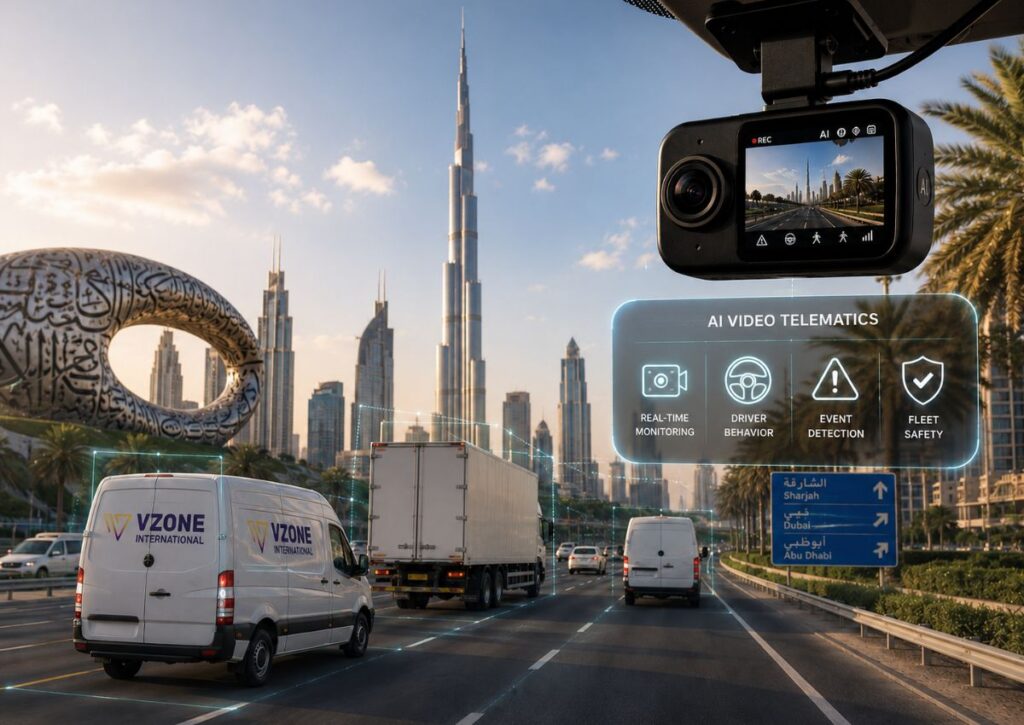
UAE roads carry some of the highest commercial vehicle traffic density in the Middle East. Despite significant infrastructure investment and improving road safety statistics, driver behaviour remains the primary cause of fleet accidents and the financial consequences extend far beyond vehicle repair costs. An incident involving a commercial vehicle in Dubai or Abu Dhabi can generate insurance claims, third-party liability exposure, driver downtime, reputational risk with clients, and in serious cases, regulatory scrutiny of the fleet operator’s safety management practices.
AI dashcams have changed the dynamic from reactive to proactive. Where a standard dashcam records what happened after an incident, an AI-powered camera analyses driver behaviour continuously and intervenes with an in-cab audio alert at the moment a risk is detected, before it escalates to an incident. The same system that prevents accidents also generates the video and behavioral evidence that resolves insurance disputes, exonerates drivers from fraudulent claims, and provides the coaching data that produces sustained safety improvements across a fleet.
This guide explains how AI video telematics works, what specific capabilities differentiate AI dashcams from standard camera systems, how the technology translates into measurable business outcomes for UAE fleet operators, and what to look for when evaluating an AI dashcam solution for your fleet.
Key Takeaways
- AI dashcams analyse video in real time detecting fatigue, phone use, distraction, and unsafe following distances while the vehicle is in motion, not after the fact.
- In-cab audio alerts triggered at the moment of risk detection are the primary safety mechanism they interrupt dangerous behaviour before it causes an incident rather than documenting it afterwards.
- GPS-integrated AI dashcam systems pair video events with precise location, speed, and behavioral data, creating a multi-layer incident record that is substantially more defensible in insurance disputes than video alone.
- UAE fleet operators consistently report insurance premium reductions of 15 to 25 percent after deploying AI dashcam programmes with documented driver coaching and improving behavioral metrics.
- AI dashcams are compatible with IVMS requirements for ADNOC contractor fleets AI video event data adds a fatigue and distraction layer to the speed and g-force behavioral data that IVMS hardware captures.
- Driver scorecards generated by AI dashcam platforms enable targeted coaching of the highest-risk drivers a more cost-effective and faster safety improvement approach than fleet-wide training programmes.
What Is AI Video Telematics?
AI video telematics is the combination of GPS fleet tracking, event-based dashcam recording, and artificial intelligence video analysis in a single integrated system. The ‘AI’ element is what separates modern fleet cameras from legacy recording systems: instead of passively recording footage that someone must review after the fact, an AI video telematics system processes the video stream in real time, identifies specific risk events from the visual data, and triggers immediate in-cab alerts and platform notifications when those events occur.
The result is a fundamentally different operational capability. A standard dashcam produces evidence after an incident. An AI dashcam produces interventions before one occurs and then produces evidence if the intervention fails and an incident happens anyway. For fleet safety managers, this shift from post-incident documentation to pre-incident prevention is the operational case for AI dashcam investment.
How AI Dashcams Differ from Standard Dashcams
Standard dashcams are passive recording devices. They capture continuous or event-triggered video footage of the road ahead, store it on a local SD card or cloud platform, and provide footage for review when an incident occurs. They have no awareness of what is in the video, generate no real-time alerts, and provide no driver coaching capability. Their value is entirely retrospective.
AI dashcams are active monitoring systems. The camera hardware contains an onboard AI processor a dedicated neural network chip that analyses the video feed in real time against trained detection models. These models recognise specific visual patterns associated with driver risk: the visual signature of a driver’s eyes closing during microsleep, the posture and visual attention pattern of a driver looking at a phone, the following distance geometry that indicates tailgating risk. When the model detects a matching pattern above a confidence threshold, it triggers an immediate in-cab audio alert and simultaneously logs the event with a video clip, timestamp, GPS coordinates, and vehicle speed to the fleet management platform.
Forward-Facing vs. Driver-Facing Camera Why Both Matter
Effective AI fleet dashcam systems deploy two camera perspectives simultaneously forward-facing and driver-facing because the most important safety risks occur in both directions. The forward-facing camera monitors road conditions: forward collision risk from inadequate following distance, lane departure events, pedestrian proximity alerts, and the visual record of what the driver encountered. The driver-facing camera monitors driver state: fatigue indicators from eye tracking and blink rate analysis, distraction events from gaze direction analysis, and specific violations such as phone use, eating, or seatbelt non-compliance.
Neither camera alone provides complete safety coverage. A forward-facing-only system can detect that a vehicle drifted into an adjacent lane but cannot determine whether the cause was driver fatigue, distraction, or a genuine road hazard requiring avoidance. A driver-facing-only system can detect that a driver is fatigued but cannot capture the road context that determines whether that fatigue created immediate danger. The combined dual-lens system creates a paired record of driver state and road environment simultaneously the combination that produces both the most accurate risk detection and the most defensible incident evidence.
Core AI Features in Modern Fleet Dashcams
The specific AI detection capabilities available in enterprise fleet dashcam systems have expanded significantly in recent years. The following represent the core features that define an enterprise-grade AI dashcam appropriate for UAE commercial fleet deployment.
Driver Fatigue Detection Eye Tracking and Blink Rate Analysis
Fatigue detection uses the driver-facing camera to monitor eye state continuously tracking blink rate, blink duration, and eyelid position relative to calibrated baseline measurements for the individual driver. Microsleep events very brief involuntary eye closures lasting 500 milliseconds or more are detected and trigger immediate in-cab alerts. Extended periods of reduced blink rate combined with head nodding patterns the visual signature of drowsiness trigger earlier advisory alerts before a microsleep event occurs.
In the UAE fleet context, fatigue detection has particular relevance for long-haul drivers operating on Abu Dhabi to Saudi Arabia routes, night-shift logistics drivers, and construction site workforce transport vehicles covering early morning shifts. The combination of extreme heat, long driving hours, and shift patterns that conflict with natural sleep cycles creates fatigue risk profiles that are above average compared to temperate climate fleet operations. Early fatigue detection that prompts a rest stop prevents the kind of high-speed motorway incident where fatigue-related accidents cause the most serious casualties.
Distracted Driving Detection Phone Use, Eating, Smoking
Distracted driving detection analyses driver gaze direction and hand position to identify specific distraction behaviours. Phone use detection identifies the visual pattern of a driver holding a device at eye level and directing gaze toward it rather than the road one of the most consistently high-risk behaviours in commercial fleet operations and one that is particularly difficult to address through awareness programmes alone without monitoring evidence. Eating and smoking detection identifies hand-to-mouth movements combined with forward gaze distraction patterns.
The in-cab alert at the moment of detection is the primary intervention it interrupts the behaviour in real time. The platform log of the event, with video clip, enables post-trip review and provides the evidence basis for individual coaching conversations and, where the behaviour is persistent and policy-violating, HR documentation. For UAE fleet operators with corporate driver conduct policies, AI distraction detection provides the evidence layer that makes policy enforcement objective rather than supervisor-dependent.
Forward Collision Warning and Tailgating Detection
The forward-facing camera continuously analyses the distance to the vehicle ahead and calculates time-to-collision based on relative speed. When following distance falls below the configured safe threshold typically expressed as a time-to-collision value rather than a fixed distance, since safe following distance is speed-dependent the system generates an in-cab alert and logs the event. Persistent tailgating repeated following distance events by the same driver is one of the strongest predictors of rear-end collision involvement, and identifying it through AI monitoring enables targeted intervention before a collision occurs.
In urban UAE driving conditions particularly on Sheikh Zayed Road and the E11 corridor in Abu Dhabi stop-start traffic and aggressive lane changes create following distance risk patterns that differ from highway driving. Enterprise AI dashcam systems with configurable time-to-collision thresholds allow different alert sensitivities to be applied for urban versus highway driving contexts.
Lane Departure Alerts
Lane departure detection analyses the forward camera’s view of road lane markings and triggers an alert when the vehicle crosses a lane boundary without a turn signal being activated indicating an unintentional lane departure rather than a deliberate lane change. Unintentional lane departures are strongly associated with driver fatigue and distraction, making lane departure events a secondary fatigue indicator that complements the direct eye-state monitoring of the driver-facing camera.
For UAE long-haul routes the E11 Abu Dhabi to Dubai highway, the Abu Dhabi to Al Ain road, and cross-border routes to Saudi Arabia where monotonous highway driving over extended periods creates elevated fatigue risk, lane departure monitoring provides a road-environment-based safety net that catches fatigue-related risk even when the driver-facing camera’s eye-state detection may have a brief detection gap.
Harsh Event Recording Braking, Cornering, Acceleration
AI dashcams with integrated GPS and accelerometers capture harsh driving events harsh braking, aggressive acceleration, and harsh cornering above configured g-force thresholds and automatically save the video clip from the seconds before, during, and after the event alongside the GPS location and speed data. This creates a richer incident record than the behavioral data alone: the video shows the road context that preceded the harsh event, which is often more informative for coaching purposes than the event data in isolation.
A harsh braking event recorded by a GPS tracker tells you that a driver braked hard at a particular location and speed. The same event captured by an AI dashcam shows whether the hard brake was caused by the driver following too closely and reacting late, by a sudden cut-in from another vehicle, or by a road hazard. The coaching conversation enabled by video evidence is substantially more productive than one based on event data alone and the distinction between driver fault and external cause is critical for fair performance assessment.
Live Video Streaming to Fleet Dashboard
Enterprise AI dashcam systems support live video streaming the ability for fleet managers or safety officers to view a live camera feed from any vehicle in the fleet at any time through the platform dashboard. This capability has specific operational applications: verifying driver behaviour during an active alert situation, supporting remote driving assessment for new drivers on their first routes, and providing real-time visibility during high-risk cargo or passenger transport operations.
Live streaming is cellular-bandwidth-intensive, which means it is most appropriate as an on-demand tool for specific operational needs rather than a continuous monitoring mode for an entire fleet. The bandwidth and data cost implications should be factored into platform subscription planning for fleets deploying AI dashcams at scale.
| Feature | Standard Dashcam | AI Dashcam |
| Continuous video recording | Yes | Yes |
| Event-triggered clip saving | Yes g-force trigger only | Yes g-force + AI event triggers |
| Real-time in-cab driver alert | No | Yes audio at moment of risk |
| Fatigue detection (eye tracking) | No | Yes microsleep and drowsiness |
| Phone use / distraction detection | No | Yes gaze and hand position analysis |
| Forward collision / tailgating warning | No | Yes time-to-collision calculation |
| Lane departure detection | No | Yes lane marking analysis |
| GPS event pairing (location + speed) | Optional — rarely integrated | Yes standard, real-time pairing |
| Fleet dashboard event reporting | No | Yes all AI events logged with clip |
| Live video streaming | No | Yes on demand from platform |
| Driver scorecard generation | No | Yes per driver, per period |
| AI coaching report for managers | No | Yes event breakdown with video |
| IVMS-compatible behavioral data | No | Yes with IVMS integration |
| Insurance dispute video evidence | Partial road view only | Yes dual lens, GPS + behavior context |
AI Driver Coaching Turning Data into Safer Drivers
The safety value of AI dashcam data is realised through driver coaching, not through monitoring alone. Raw event data a log of fatigue alerts, distraction events, and harsh manoeuvres tells you that a problem exists. Driver coaching converts that awareness into behaviour change. The quality of the coaching programme is what determines whether AI dashcam investment produces a sustained reduction in fleet incidents or simply generates data that sits unreviewed in a platform dashboard.
How AI Coaching Reports Work
AI dashcam platforms automatically generate per-driver coaching reports structured summaries of each driver’s event counts by category (fatigue, distraction, harsh events, forward collision), ranked against fleet peers, and trending over time. These reports are the primary tool for safety managers and supervisors conducting one-to-one coaching sessions: they provide objective data on specific behaviours, timestamped video evidence that drivers can view alongside the discussion, and a trend line that shows whether performance is improving, stable, or deteriorating after previous coaching conversations.
The video evidence component is what makes AI dashcam coaching materially more effective than coaching based on GPS behavioral data alone. A driver who is shown a 15-second video clip of themselves using a phone while driving on Sheikh Zayed Road at 110 km/h cannot dispute the behaviour or attribute it to sensor error. The conversation moves directly to corrective action rather than being delayed by contestation of the underlying data. This accelerates the behaviour change cycle and reduces the number of coaching iterations required to achieve sustained improvement.
Driver Scorecard Ranking and Incentive Programmes
Driver scorecards normalise individual performance across all monitored event categories into a composite safety score, enabling fleet-wide ranking that identifies both the highest-risk drivers requiring immediate intervention and the highest-performing drivers whose habits merit recognition. Scorecards are most effective when combined with an incentive structure safety bonuses, fuel vouchers, or public recognition for sustained high-scoring performance create positive motivation alongside the corrective accountability of coaching for low performers.
In UAE fleet operations where driver retention is a persistent challenge, a transparent, data-driven performance management system has a secondary benefit: it provides objective promotion criteria and demonstrates to drivers that performance is evaluated on measurable evidence rather than supervisory relationships. Drivers who perform well on objective safety metrics tend to respond positively to a system that makes that performance visible and rewarded.
Reducing Repeat Offenders Through Targeted Coaching
Fleet safety data consistently shows that a small percentage of drivers typically 10 to 15 percent of a fleet generates a disproportionate share of high-severity events. In a 100-driver fleet, the bottom 10 by AI dashcam safety score may account for 40 to 50 percent of the fleet’s total fatigue, distraction, and harsh event count. Targeting coaching resources at these drivers rather than distributing training budget evenly across the fleet is the most efficient safety improvement strategy available to a fleet safety manager.
AI dashcam platforms that generate weekly bottom-quartile driver lists, flag drivers with deteriorating trend lines, and track coaching action status enable this targeted approach systematically. Safety managers know which drivers need attention this week, can schedule coaching sessions with video evidence prepared, and can track whether performance improves in the following period creating a closed-loop safety management cycle that fleet-wide training programmes cannot replicate.
Business Benefits of AI Dashcams for UAE Fleets
Accident Rate Reduction Typical Improvement Rates
The connection between AI dashcam deployment and accident rate reduction is one of the most consistently evidenced outcomes in fleet safety technology research. Fleets deploying AI dashcam programmes with active driver coaching not just hardware installation typically achieve accident rate reductions of 20 to 40 percent within 12 to 18 months of programme maturity. The mechanism is dual: the monitoring effect produces immediate behavioural improvement when drivers know their actions are recorded and reviewed; the coaching programme produces sustained improvement by addressing the specific risk behaviours identified by the AI analysis.
In the UAE context, where a commercial vehicle accident on a major arterial road generates direct costs vehicle repair, third-party claims, driver downtime alongside indirect costs insurance premium impact, client notification requirements, potential regulatory scrutiny the financial value of a 30 percent accident rate reduction across a 100-vehicle fleet is substantial. For a fleet averaging one recordable incident per six vehicles per year, a 30 percent reduction represents approximately 5 fewer incidents annually with each incident’s total cost including direct and indirect components typically exceeding AED 50,000 to AED 150,000 depending on severity.
Insurance Premium Reduction Evidence from UAE Fleet Operations
Insurance companies operating in the UAE commercial vehicle segment are increasingly receptive to telematics-based premium adjustments for fleets that can demonstrate documented safety improvement programmes. The AI dashcam data provides insurers with exactly the evidence they need to actuarially justify preferential pricing: declining event rates over time, coaching programme records, and a claims history that reflects the behavioural improvement trend shown in the monitoring data.
UAE fleet operators who have deployed AI dashcam programmes with documented driver coaching and improving safety metrics have achieved insurance premium reductions of 15 to 25 percent on renewal negotiations. The critical differentiator is not just having the hardware it is presenting the insurer with a multi-period trend report showing improving driver behavior scores alongside a declining claims frequency. Insurers respond to evidence-based arguments, and AI dashcam data provides exactly that evidence in a format that underwriting teams can directly apply to their risk models.
Exonerating Drivers in Fraudulent Accident Claims
Fraudulent accident claims where a third party deliberately causes or fabricates an incident involving a commercial vehicle to generate an insurance claim are a documented problem in the UAE insurance market, particularly for high-visibility commercial vehicles such as logistics trucks, bus fleets, and construction vehicles. A dual-lens AI dashcam that captures the road event from both forward and cabin perspectives, paired with GPS speed and location data timestamped to the second, creates a forensic record that makes fraudulent claims extremely difficult to sustain.
Fleet operators without dashcam footage frequently settle fraudulent claims because the cost of contesting without evidence exceeds the claim value. With AI dashcam footage showing that the vehicle was travelling within speed limits, that the driver was attentive, and that the alleged impact point is inconsistent with the vehicle’s trajectory, claims teams can contest fraudulent incidents effectively. Several UAE fleet operators have reported recovering the full cost of their AI dashcam hardware investment within the first year purely through fraudulent claim rejections that would previously have been settled.
HR and Compliance Documenting Driver Policy Violations
For fleet operators with formal driver conduct policies prohibiting phone use while driving, requiring seatbelt compliance, specifying maximum speed thresholds AI dashcam data provides the objective, timestamped evidence basis for policy enforcement that witness-based or supervisor-reported violations cannot match. A driver who contests a disciplinary action related to phone use cannot credibly dispute AI dashcam footage showing the event with GPS location, vehicle speed, and a precise timestamp.
This evidentiary quality also protects fleet operators in employment disputes: if a driver’s dismissal for repeated safety policy violations is challenged, the AI dashcam event log with associated video clips constitutes a substantially stronger evidence base than supervisor reports or verbal warnings. HR and legal teams in organisations managing large driver workforces increasingly recognise AI dashcam data as a category of operational evidence that materially improves their position in driver conduct disputes.
VZone International’s AI Dashcam Solution for UAE Fleets
VZone International deploys enterprise AI dashcam solutions for UAE fleet operators integrating dual-lens AI camera hardware with the Wialon and FMSiTrack fleet management platform to deliver real-time safety monitoring, automated driver coaching reports, and video evidence management in a unified operational interface. With over 20 years of UAE fleet technology operations, VZone’s AI dashcam implementations cover logistics, oil and gas, construction, school transport, and security fleet sectors.
Hardware Options Dual Camera, 4-Channel, Cabin View
VZone offers AI dashcam hardware configurations matched to different fleet vehicle types and safety requirements. The standard dual-lens configuration forward-facing road camera and driver-facing cabin camera covers the primary AI detection use cases for most commercial fleet applications. For passenger transport vehicles such as school buses, crew transport coaches, and minibuses, 4-channel configurations add side and rear cameras, providing complete vehicle perimeter coverage. For high-security or high-value cargo operations, AI cameras with night vision capability and tamper detection extend monitoring to after-hours and low-light operating environments.
Hardware selection for UAE deployments considers thermal resilience cameras must operate reliably through interior temperatures that can exceed 70°C when a parked vehicle is exposed to UAE summer sun and vibration resistance appropriate for heavy vehicle and off-road construction site applications. Consumer-grade dashcams marketed for personal vehicle use are not appropriate for commercial fleet deployment in these conditions.
Integration with VZone Fleet Management Platform
VZone’s AI dashcam hardware integrates directly with the Wialon and FMSiTrack fleet management platform feeding AI event data, video clips, and GPS-paired behavioral records into the same dashboard that displays vehicle location, driver behavior scores, maintenance alerts, and compliance reports. Fleet managers do not need to toggle between separate GPS and dashcam platforms to build an operational picture: location, behavioral data, and video evidence are co-located in a single interface.
Driver scorecard reports generated by the AI dashcam module sit alongside the GPS-based behavioral scores in the platform’s driver performance module creating a composite safety profile per driver that combines road-environment awareness (forward collision, lane departure) with driver-state data (fatigue, distraction) and vehicle dynamics (harsh braking, acceleration). This composite view is more accurate and more actionable for coaching than either data source alone.
IVMS Compatibility for Oil and Gas Sites
For ADNOC contractor fleets requiring IVMS compliance, VZone’s AI dashcam integration adds a fatigue and distraction detection layer to the standard IVMS behavioral data package. ADNOC’s HSE programme has progressively expanded its interest in distraction and fatigue monitoring beyond the speed and g-force events captured by standard IVMS hardware AI dashcam integration positions contractor fleets ahead of this evolving requirement rather than having to retrofit capability when auditors begin examining fatigue and distraction data as standard HSE report components.
The combined IVMS + AI dashcam record multi-tier speed events, g-force behavioral data, seatbelt compliance, fatigue alerts, distraction events, and video incident clips creates the most comprehensive driver safety evidence package available in the UAE market for ADNOC HSE audit purposes.
Conclusion: AI Dashcams Shift Fleet Safety from Reactive to Preventive
The fundamental value proposition of AI dashcam technology for UAE fleet operators is the shift from documentation to prevention. Standard dashcams record accidents. AI dashcams prevent them and when they cannot prevent them, they produce the forensic evidence that resolves the financial and legal consequences more effectively than any other available tool.
The business case is measurable: accident rates fall, insurance premiums decrease, fraudulent claims are contested successfully, and driver conduct policy enforcement becomes objective rather than supervisory. The fleet safety managers who achieve the strongest results are those who treat AI dashcam data not as a passive monitoring record but as the input to an active coaching programme targeting the specific drivers and behaviours that the data identifies as the fleet’s highest risk concentration.
For UAE fleet operators in logistics, oil and gas, construction, school transport, and security sectors, AI dashcam integration with IVMS and fleet management platforms represents the current leading edge of operationally proven fleet safety technology. The hardware costs have come down, the detection accuracy has improved, and the platform integration has matured to the point where the barriers to deployment are organisational rather than technological.
See AI dashcam video telematics in action for your UAE fleet.
VZone International deploys enterprise AI dashcam solutions integrated with GPS fleet management for UAE commercial fleets dual-lens AI cameras, driver fatigue and distraction detection, automated coaching reports, IVMS compatibility for ADNOC sites, and live video streaming. Book a live demo with our UAE team and see exactly how our AI cameras monitor your drivers in real time.
Frequently Asked Questions
AI video telematics combines GPS fleet tracking with AI-powered cameras that analyse video in real time detecting fatigue, phone use, distraction, tailgating, and lane departure while the vehicle is moving. Standard dashcams passively record footage for post-incident review. AI dashcams actively intervene with in-cab audio alerts at the moment a risk is detected, preventing incidents before they occur. They also generate automated driver coaching reports and event-paired video clips for fleet management platforms.
AI video telematics improves UAE fleet safety through three mechanisms: real-time in-cab alerts that interrupt dangerous behaviour before incidents occur; data-driven coaching that targets the specific drivers and behaviours generating the highest risk; and trend monitoring that enables safety managers to identify deteriorating performance patterns before they produce incidents. Fleets deploying active AI dashcam coaching programmes consistently achieve accident rate reductions of 20 to 40 percent within 12 to 18 months.
Yes. UAE commercial vehicle insurers accept AI dashcam data as evidence for premium adjustment when fleet operators present documented driver behavior improvement trends alongside declining claims frequency. Operators who deploy AI dashcam programmes with active driver coaching and can demonstrate improving safety metrics on renewal have achieved premium reductions of 15 to 25 percent. The key is presenting multi-period trend data not just the hardware installation as evidence of a functioning safety management programme.
Fatigue detection uses the driver-facing camera to monitor eye state continuously tracking blink rate, blink duration, and eyelid position. Microsleep events (eye closures of 500 milliseconds or more) are detected and trigger immediate in-cab audio alerts. Earlier advisory alerts trigger when extended drowsiness patterns reduced blink rate combined with head position changes are detected before a microsleep event occurs. This graduated alert system gives drivers a warning window to take corrective action before impairment reaches a critical level.
AI dashcam systems integrate with IVMS-certified hardware to add fatigue and distraction monitoring to the standard IVMS behavioral data package. ADNOC IVMS captures speed events, g-force driving behaviors, seatbelt compliance, and engine data. AI dashcam integration adds driver face analysis fatigue and distraction events with video evidence creating a more comprehensive HSE-formatted driver safety record. VZone International provides this combined IVMS and AI dashcam solution for ADNOC contractor fleets in UAE.
The highest-impact AI dashcam deployments in the UAE are in long-haul logistics and freight (fatigue risk on extended highway routes), oil and gas contractor transport (ADNOC HSE requirements and fatigue risk on early morning site access shifts), school and employee bus transport (passenger duty of care and MOE compliance context), construction fleet operations (urban and site driving with high distraction risk), and security company patrol fleets (SIRA accountability requirements and high-mileage night driving). Each sector has specific risk profiles that AI dashcam detection capabilities directly address.