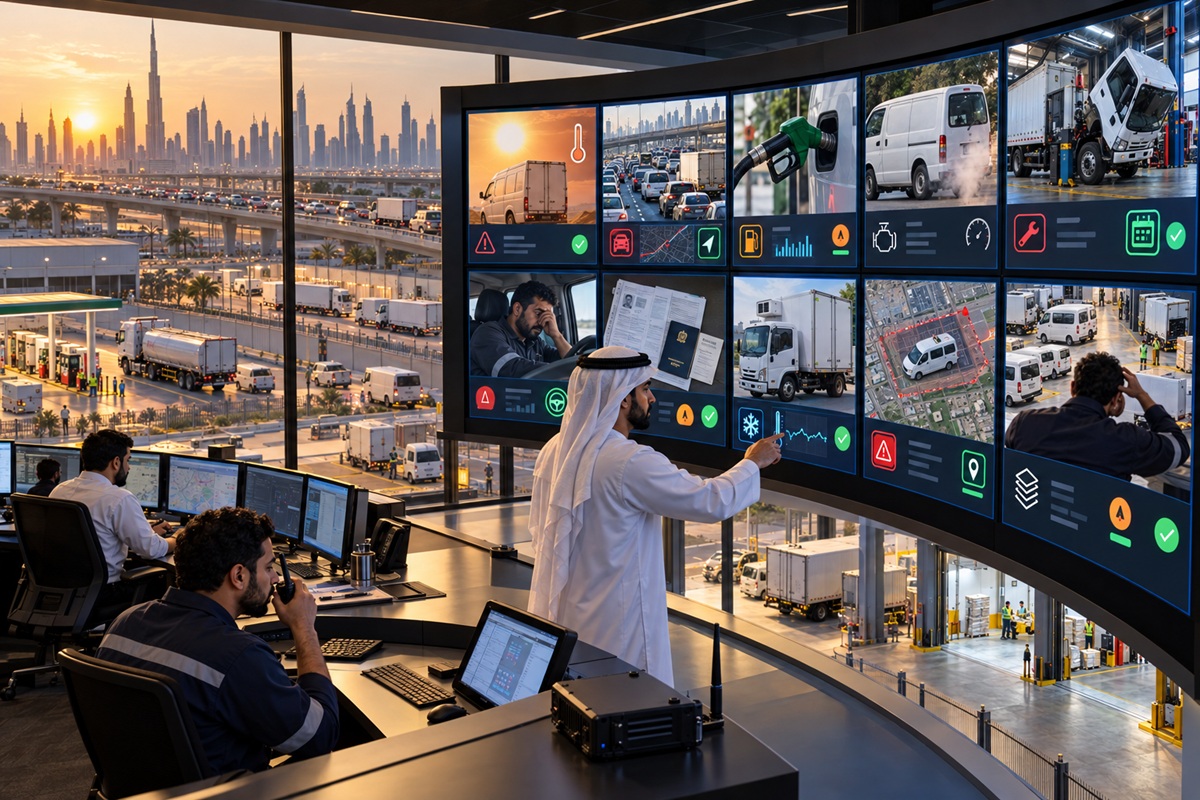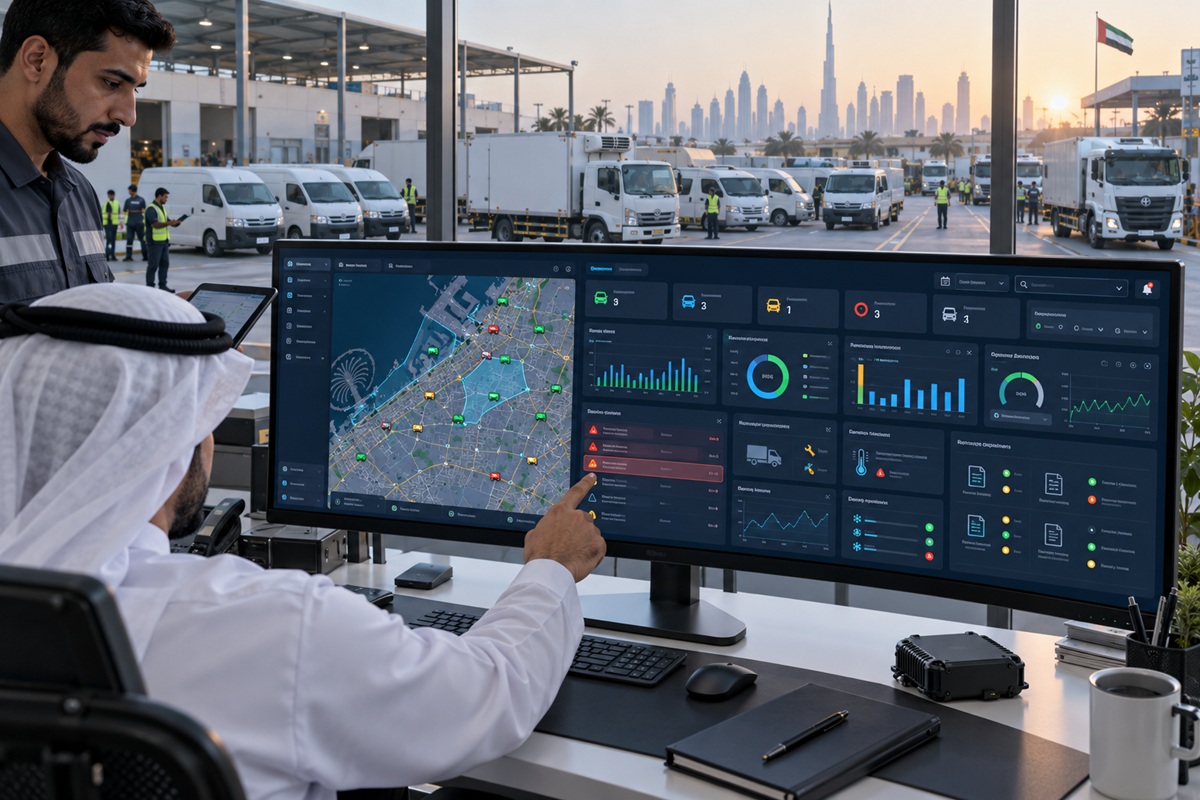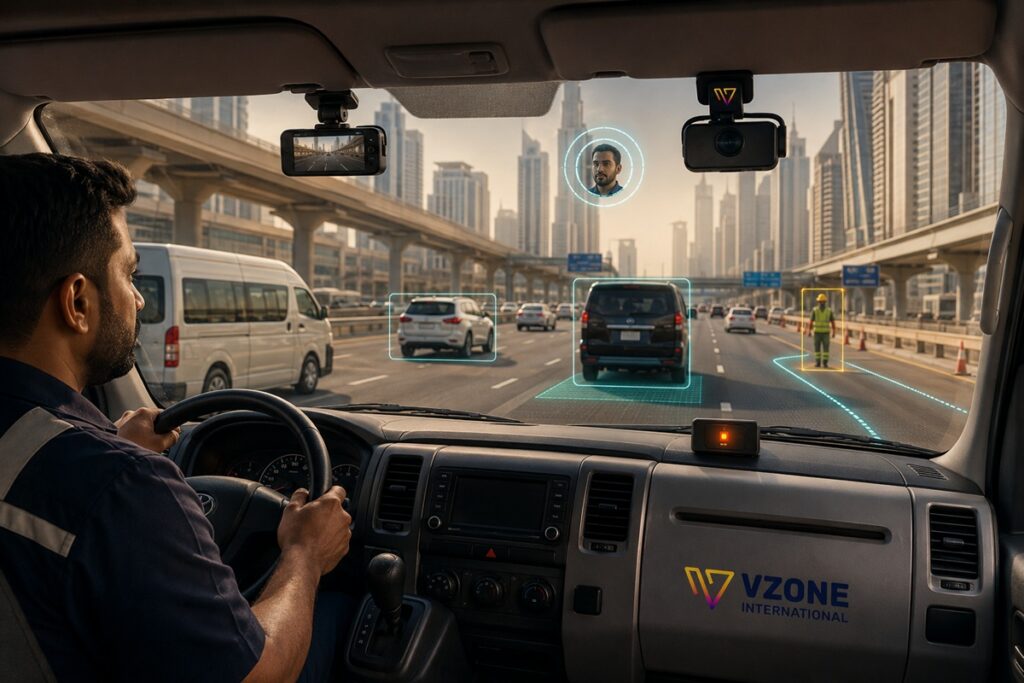
UAE roads recorded over 140,000 traffic accidents in 2023 a figure that includes commercial fleet vehicles disproportionately, given the volume of heavy transport, long-haul logistics, and urban delivery traffic that UAE’s fleet-intensive economy generates. The question of how to reduce fleet accident rates is not abstract for UAE fleet managers it is a weekly operational reality that affects insurance premiums, HSE audit results, driver welfare, and corporate liability exposure.
Dashcams are part of the answer for most UAE fleet operators but the category has diverged so significantly in the past three years that ‘dashcam’ no longer describes a single technology. A standard dashcam records video. An AI dashcam analyses it in real time, on the device, before the footage reaches any cloud platform detecting the specific driver behaviours that precede accidents and alerting both the driver and the operations centre while there is still time to intervene. The difference between these two technologies is not a feature upgrade. It is the difference between evidence collection and accident prevention.
This guide explains exactly what AI dashcams do that standard dashcams cannot, why the distinction matters for UAE fleet operations specifically, which fleet types and regulatory frameworks require AI dashcam capability, and how to evaluate AI dashcam systems before deployment.
Key Takeaways
- AI dashcams process video on the device itself using neural network models detecting fatigue, distraction, phone use, seatbelt non-compliance, smoking, and unsafe following distance in real time without cloud upload latency. Standard dashcams record passively and require human review or cloud AI processing (with significant latency) to identify incidents.
- The operational consequence of this distinction is fundamental: AI dashcams prevent accidents by alerting drivers and operations centres before an incident occurs. Standard dashcams document accidents after they have already happened.
- ADNOC’s long-haul route HSE requirements for contractor vehicles specifically reference fatigue monitoring capability a requirement that standard dashcams and GPS-only telematics cannot satisfy, but that AI dashcams with onboard fatigue detection algorithms address directly.
- UAE fleet insurance underwriters are moving toward AI dashcam telematics data as a premium reduction mechanism fleets that can provide verified AI safety event data demonstrating low-risk driving patterns receive preferential premium rates that standard dashcam footage (which requires manual review) cannot support.
- AI dashcam integration with GPS telematics creates a dual-stream operational record: every tagged AI safety event carries GPS coordinates, speed, and driver identity enabling operations teams to replay not just the footage but the full vehicle state at the moment of the event.
- The cost differential between AI dashcams and standard dashcams for UAE fleet deployment is AED 300 to AED 800 per vehicle a gap that closes within the first insurance premium renewal cycle for most fleet profiles.
What Is an AI Dashcam?
An AI dashcam is a vehicle-mounted camera system with an embedded artificial intelligence processor a neural network inference engine that analyses the camera’s video feed in real time on the device itself, without requiring the footage to be uploaded to a cloud server for analysis. The AI model is trained on millions of labelled video frames showing driver behaviours of interest eye closure, head drooping, looking away from the road, phone held to ear, seatbelt absent, smoking and runs continuously against the live camera feed, classifying each frame against its training in milliseconds.
When the AI model detects a behaviour that crosses a configured confidence threshold a driver whose eyes have been closed for more than 2.5 seconds, or whose head has drooped below the steering wheel line it triggers three simultaneous actions: an in-cab audio or vibration alert to the driver, a video clip tag that marks the event in the footage record for later review, and a real-time alert transmission to the fleet management platform, where the operations centre sees the event notification with GPS location and driver identity within seconds of it occurring.
This onboard processing architecture is what distinguishes AI dashcams from cloud-dependent safety cameras that upload video continuously and process it in the cloud. Cloud processing introduces latency typically 30 to 90 seconds from footage capture to event notification that eliminates the real-time intervention capability that makes AI dashcams operationally different from passive recording devices. An alert that arrives 60 seconds after a driver’s eyes closed for a dangerous period is not a safety tool; it is a compliance log. An alert that fires within 2 seconds of the event creates the intervention window that matters.
What AI Dashcams Detect and What Standard Dashcams Miss
| Detection Capability | Standard Dashcam | AI Dashcam (Onboard Processing) | UAE Operational Relevance |
| Forward video recording | Yes continuous | Yes continuous + event-tagged | Accident evidence; route documentation |
| Driver-facing video recording | Optional passive only | Yes AI-analysed in real time | Required for fatigue/distraction detection |
| Fatigue detection (eye closure, head droop) | No video only, no detection | Yes alert within 2–3 seconds of event | Critical for UAE long-haul desert routes; ADNOC requirement |
| Distraction detection (phone use, looking away) | No | Yes phone to ear, eyes off road >2 sec | UAE urban delivery; high stop frequency routes |
| Seatbelt compliance monitoring | No | Yes driver-facing camera detects absence | ADNOC IVMS mandatory; insurance requirement |
| Smoking detection | No | Yes detected by driver-facing camera | Corporate fleet policy enforcement |
| Tailgating / unsafe following distance | No | Yes forward camera + AI distance calculation | UAE highway accident prevention |
| Lane departure warning | No | Yes forward camera lane marking detection | UAE highway and highway ramp safety |
| Harsh event video clip tagging | No manual review required | Yes automatic clip extraction at event | Accident investigation; driver coaching |
| Real-time operations centre alert | No | Yes within 2–5 seconds of event | Enables dispatcher intervention before incident |
| Driver coaching report | No requires manual video review | Yes automated weekly coaching summary by event type | Systematic safety improvement programme |
| Insurance telematics data | No footage only | Yes structured event data by category and frequency | UAE insurer premium reduction programmes |
Why UAE Fleet Operations Make AI Dashcams More Valuable Than Global Benchmarks Suggest
Long-Haul Desert Routes The Fatigue Risk Amplifier
UAE’s logistics geography creates fatigue risk conditions that are more severe than in most other fleet markets. Dubai–Riyadh highway routes cover 1,200 km of predominantly desert highway where monotonous road conditions, high ambient temperature, and the physiological effects of long-distance driving combine to create acute fatigue risk significantly earlier than urban routes of comparable duration. UK and European fatigue monitoring benchmarks where regulatory break requirements were calibrated against cooler, more varied road environments do not adequately represent the fatigue risk on UAE desert highway routes.
AI dashcams with fatigue detection capability provide the monitoring layer that catches microsleep events the 2 to 5 second eye-closure episodes that precede full sleep events and that drivers frequently cannot recognise in themselves at the point where a cab alert can still wake the driver and avert an incident. On a UAE desert highway at 120 km/h, a 3-second microsleep covers 100 metres with no driver control a distance that crosses multiple lanes and creates collision risk with any vehicle within that radius. An AI dashcam alert that wakes the driver before this sequence progresses prevents the incident that no GPS alert or post-incident dashcam review could have prevented.
UAE Urban Delivery The Distraction Risk Environment
Urban delivery driving in Dubai and Abu Dhabi creates a different but equally significant distraction risk profile: stop-and-go traffic, high pedestrian density, complex intersection layouts, and the phone-based communication culture that UAE urban delivery operations involve drivers receiving job updates, confirming delivery addresses, and navigating unfamiliar delivery zones while managing traffic create a persistent distraction environment where phone-in-hand events are frequent and the consequences of a momentary attention lapse in dense traffic are severe.
AI dashcams with distraction detection phone-to-ear detection, eyes-off-road duration monitoring, and dangerous gaze direction analysis provide the continuous monitoring that physical supervision cannot scale to. A fleet with 30 urban delivery drivers cannot have a supervisor in each vehicle. An AI dashcam monitors every driver continuously and flags distraction events to the operations centre in real time, enabling driver coaching that targets the specific event types and drivers with the highest risk profiles not a generic safety programme applied uniformly.
ADNOC Contractor Requirements The Compliance Dimension
ADNOC’s HSE management system has progressively tightened fatigue monitoring requirements for long-haul contractor vehicle routes particularly for vehicles operating to and from the Western Region, where journey times to Liwa, Ruwais, and offshore support facilities frequently exceed 3 to 4 hours of continuous driving. ADNOC contractor HSE auditors increasingly expect evidence of active fatigue monitoring capability, not merely driver hour logs and rest period compliance documentation. AI dashcam fatigue detection provides the active monitoring evidence that distinguishes compliant contractor fleet management from paper-based fatigue management systems that document driver hours without monitoring driver condition.
AI Dashcam System Architecture How It Works
Onboard AI Processing The Edge Computing Layer
The defining technical characteristic of AI dashcams is edge computing: the AI inference engine runs on a processor embedded in the camera unit itself, not in the cloud. The camera continuously captures video at 1080p or higher resolution, feeds each frame through the neural network inference pipeline, and classifies it against the trained model in 50 to 150 milliseconds faster than human perception. This onboard processing produces event classifications (fatigue event, distraction event, phone use event) rather than raw video the event classification is transmitted immediately to the fleet platform over the vehicle’s telematics connection, while the full video clip of the event is buffered locally and uploaded to cloud storage asynchronously.
The separation of event classification (low data volume, real-time transmission) from video clip upload (high data volume, asynchronous) is what makes AI dashcam real-time alerting viable on standard 4G cellular connections without overwhelming the data plan. A standard dashcam that streams continuous high-resolution video to a cloud AI platform consumes 5 to 15 GB of data per vehicle per day impractical and expensive for most UAE fleet deployments. An AI dashcam that transmits event classifications and uploads only event-tagged clips consumes 200 to 500 MB per vehicle per day a manageable data footprint that standard telematics data plans accommodate.
Dual-Lens Configuration Forward and Driver Facing
Enterprise AI dashcam systems for UAE fleet deployment typically use a dual-lens configuration: a forward-facing lens that captures the road environment ahead of the vehicle, and a driver-facing infrared (IR) lens that monitors the driver’s face and upper body regardless of lighting conditions. The infrared capability is essential for UAE operations: vehicles driving into direct low-angle sunlight (particularly dawn and dusk on east-west routes), driving through tunnels, or operating during night hours create lighting conditions that standard visible-spectrum cameras cannot handle adequately for facial feature analysis. IR illumination provides consistent image quality across all lighting conditions, ensuring fatigue and distraction detection reliability is maintained throughout the full operating day.
The forward lens provides the environmental context that gives GPS-tagged events their operational meaning: a fatigue event on a clear highway has a different risk profile from a fatigue event while approaching a complex intersection, and the forward footage provides the context that the operations team needs to assess both the event severity and the driver coaching priority. The dual-lens record driver behaviour and road environment at the same moment is also the evidence package that makes AI dashcam footage significantly more valuable than driver-only or road-only footage for accident claim defence.
GPS Integration and Telematics Pairing
VZone International deploys AI dashcams integrated with the vehicle’s GPS telematics device, so every AI safety event fatigue alert, distraction detection, seatbelt non-compliance is automatically timestamped and GPS-location-tagged on the fleet management platform. The operations team sees not just that a fatigue event occurred but where the vehicle was at the moment it occurred, what speed it was travelling, and which driver was operating the vehicle (from driver ID). This multi-dimensional event record is what enables the specific, contextual coaching conversations that reduce repeat event rates not generic ‘be careful about fatigue’ briefings, but ‘you had three microsleep events between Dubai and the Western Region last Tuesday, the first at km 185 and the second 40 minutes later’ conversations with footage evidence.
AI Dashcam vs Standard Dashcam Which Fleet Types Need Which?
| Fleet Type | Standard Dashcam Adequate? | AI Dashcam Required / Recommended | Specific Reason |
| ADNOC long-haul contractor (Western Region) | No | Required | ADNOC HSE fatigue monitoring expectation; desert route microsleep risk |
| Urban last-mile delivery (Dubai/Abu Dhabi) | No | Strongly recommended | High distraction environment; phone use in traffic; frequent stop-start risk |
| School bus / student transport | No | Required | Driver fatigue on early morning routes; MOE and RTA safety expectations; parent accountability |
| Heavy transport (trucks, tankers) | No | Required | Long-haul fatigue; tailgating risk at highway speed; ADNOC/OPAL HSE requirements |
| Car rental fleet | Yes for incident evidence | Optional insurance benefit | Accident evidence value; AI coaching less relevant for short-term rental drivers |
| Construction site vehicles | Yes for site access log | Recommended | Fatigue on early-start construction site schedules; on-site speed compliance |
| Government fleet (low mileage) | Yes sufficient | Optional | Low mileage, controlled routes; standard recording adequate for audit trail |
| Pharmaceutical cold chain last-mile | No | Recommended | High-value cargo; urban distraction risk; driver behaviour linked to cargo safety |
VZone International’s AI Dashcam Solution
VZone International deploys Enterprise AI dashcam systems for UAE fleet operators dual-lens IR dashcams with onboard fatigue detection, distraction monitoring, seatbelt compliance, phone use detection, tailgating alerts, and lane departure warning, integrated with GPS telematics on the Wialon platform for real-time event visibility across the entire fleet.
AI Dashcam Integration with Wialon Fleet Platform
Every AI dashcam event on VZone’s platform is visible on the fleet manager’s live dashboard alongside GPS position, speed, and driver identity creating the dual-stream operational record that enables immediate response and systematic coaching. Event video clips are uploaded to cloud storage within minutes of the event and available for review through the platform dashboard without requiring the manager to request footage from the driver or download from a physical SD card. Driver coaching reports weekly summaries of each driver’s AI event frequency by category are generated automatically and available to safety managers without manual compilation.
AI Dashcam for ADNOC Contractor Compliance
For VZone’s ADNOC contractor fleet clients, AI dashcam fatigue detection data integrates with the IVMS driver behaviour record fatigue events appear alongside harsh braking, speed events, and seatbelt compliance in the weekly HSE driver behaviour summary. The AI fatigue monitoring capability provides the active monitoring evidence that ADNOC HSE auditors increasingly expect for long-haul route contractor vehicles, differentiating contractors who actively monitor driver fatigue from those who document driver hours without monitoring driver condition.
AI Dashcam and Insurance Premium Reduction
VZone’s AI dashcam telematics data supports insurance premium negotiation for UAE fleet clients providing structured AI safety event frequency data by driver and vehicle category that insurance underwriters can use for actuarial risk assessment. Fleets that demonstrate measurably lower AI event rates through driver coaching programmes receive preferential premium rates at renewal. VZone provides standardised AI safety performance reports in the format that UAE commercial fleet insurers accept for telematics-based premium assessment not raw video footage that requires insurer-side manual review.
Conclusion: The Dashcam That Records Accidents vs the One That Prevents Them
The choice between a standard dashcam and an AI dashcam for a UAE fleet is a choice between two fundamentally different operational philosophies: documentation versus prevention. A standard dashcam tells you exactly what happened in the 30 seconds before a collision. An AI dashcam makes that footage less likely to ever be needed.
For UAE fleet operators whose vehicles operate on desert highways where fatigue events happen at 120 km/h, in urban environments where distraction events happen in dense traffic, and under ADNOC HSE frameworks that expect active fatigue monitoring evidence the standard dashcam’s documentation value is no longer sufficient justification for its deployment cost. The same installation investment in an AI dashcam provides everything the standard dashcam provides, plus the real-time detection, driver alerts, operations centre notifications, and driver coaching data that convert a camera into a safety management tool.
The AED 300 to AED 800 incremental cost per vehicle of AI over standard dashcam hardware is recovered within the first insurance premium renewal cycle for most UAE fleet profiles and every accident prevented before it happens returns a multiple of that investment in avoided repair costs, liability exposure, driver welfare, and the reputational damage that at-fault fleet accidents create for UAE commercial operators.
See AI dashcam in action live, with your fleet’s specific route and driver profiles.
VZone International provides a live AI dashcam demonstration showing fatigue detection, distraction alerts, real-time operations centre notification, and automated driver coaching reports. Contact our team to book a demonstration tailored to your fleet type and UAE compliance requirements.
Frequently Asked Questions
A regular dashcam records video passively and stores or streams footage for human review after an incident. An AI dashcam uses an onboard neural network processor to analyse the camera feed in real time, detecting specific driver behaviours fatigue (eye closure, head droop), distraction (phone use, eyes off road), seatbelt absence, smoking, tailgating and triggering alerts to the driver and operations centre within 2 to 5 seconds of detection. The fundamental operational difference is that an AI dashcam prevents accidents by enabling real-time intervention, while a standard dashcam documents them after they have occurred.
AI dashcams are not universally mandatory for all UAE fleet vehicles, but are required or strongly expected in specific contexts: ADNOC contractor vehicles on long-haul routes where HSE fatigue monitoring expectations apply; school transport vehicles where MOE and RTA safety standards for student transport are being interpreted progressively; and enterprise fleet operations where insurance underwriters require telematics-verified safety data for premium reduction programmes. For most commercial fleet operators, AI dashcams are commercially mandatory in the sense that the insurance cost differential between telematics-verified and non-verified fleets makes them financially essential not legally mandated.
An AI dashcam contains an embedded processor running a trained neural network model that analyses the camera feed frame-by-frame in real time on the device, without cloud upload. The driver-facing infrared camera captures facial features regardless of lighting conditions. The AI model classifies each frame against its training (eye closure duration, head position, phone presence, seatbelt status) and triggers an alert when confidence exceeds the configured threshold. The alert fires an in-cab audio warning to the driver, tags the video clip for event review, and transmits an event notification to the fleet management platform with GPS location, speed, driver identity, and event type all within 2 to 5 seconds of the detected behaviour.
Yes verifiably. UAE fleet operators who have deployed AI dashcam programmes with driver coaching workflows typically report 25 to 45 percent reductions in harsh event rates within 6 to 12 months of implementation, with corresponding reductions in at-fault accident frequency. The mechanism is coaching rather than surveillance: AI dashcam event data enables specific, footage-supported coaching conversations that change driving behaviour patterns, rather than generic safety training that addresses hypothetical risk scenarios. The combination of real-time in-cab alerts (immediate feedback to the driver) and weekly coaching reviews (systematic behaviour improvement programme) produces the sustained reduction in risk events that accident rate improvement requires.
AI dashcam hardware for UAE fleet deployment costs AED 600 to AED 1,200 per vehicle for dual-lens enterprise devices with onboard fatigue and distraction detection. Installation costs AED 150 to AED 300 per vehicle. Platform subscription for AI dashcam monitoring adds AED 50 to AED 100 per vehicle per month to standard fleet telematics subscription. Total 24-month investment per vehicle: AED 2,000 to AED 4,000. Against insurance premium reduction of AED 500 to AED 2,000 per vehicle annually from telematics-verified safe-driving data, and accident cost reduction from improved driver safety scores, the investment typically pays back within 6 to 12 months for most UAE commercial fleet profiles.