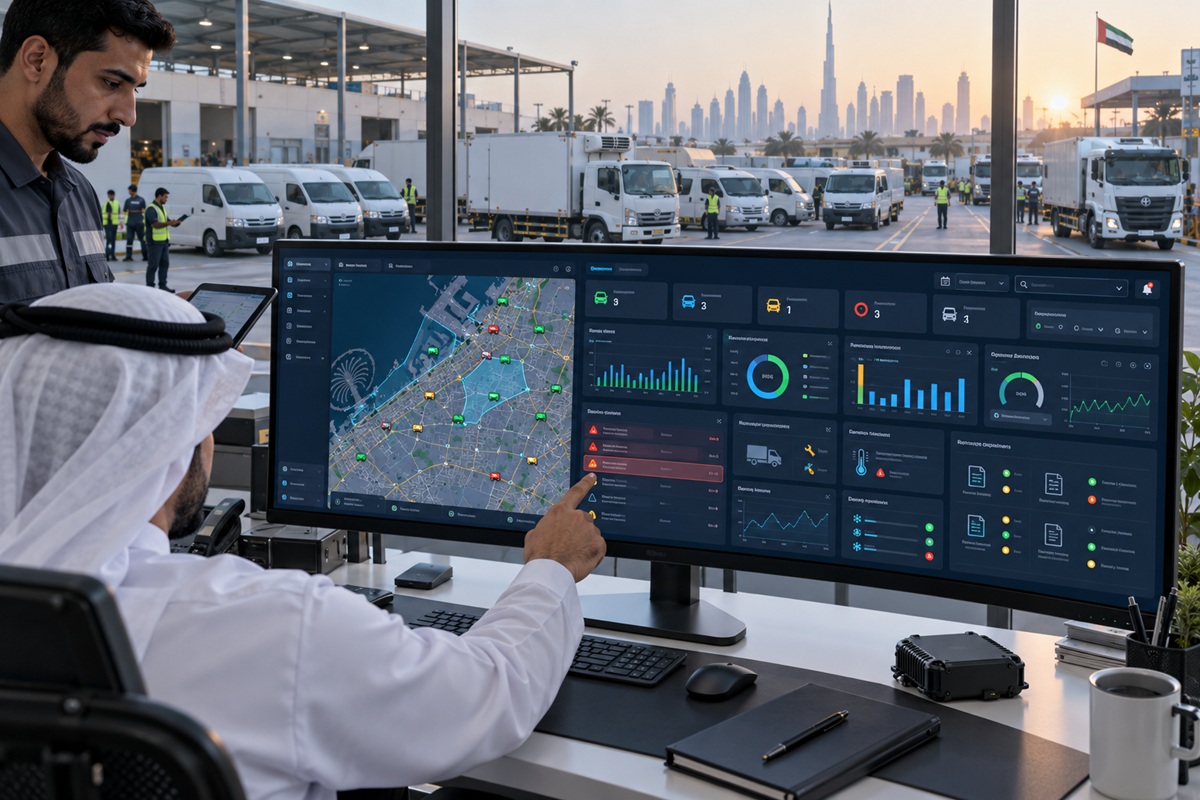
Managing a commercial fleet in the UAE has never been straightforward and in 2026, the operational and regulatory demands on fleet managers have intensified further. Fuel costs remain the dominant variable operating expense. Driver behavior directly determines accident rates, insurance premiums, and tyre and brake wear. Compliance requirements across Abu Dhabi, Dubai, and oil and gas sites now involve multiple platforms, certified hardware standards, and audit-ready reporting cycles. And the expectation from senior management is real-time operational intelligence, not end-of-week spreadsheets.
Fleet management software is the technology layer that makes it possible to run a large, complex fleet in this environment without drowning in manual data collection, reactive decision-making, and compliance exposure. But the market for fleet software in the UAE is crowded with options ranging from basic GPS location platforms to deep enterprise telematics systems and the differences between them are not always obvious from product marketing materials.
This guide is designed for fleet managers, operations directors, and procurement decision-makers who need to understand what fleet management software actually does, how to evaluate it in the UAE context, what features genuinely matter at different fleet sizes and industry contexts, and how to structure a selection process that results in a platform that delivers long-term operational value rather than short-term compliance tick-boxing.
Key Takeaways
- Fleet management software is a unified operational platform combining GPS tracking, driver behavior analytics, fuel monitoring, maintenance scheduling, dispatch, and compliance reporting in a single interface.
- In the UAE context, compliance capability is a non-negotiable platform requirement your software must support Asateel (Abu Dhabi ITC), SecurePath (Dubai RTA), and IVMS (ADNOC oil and gas) reporting depending on your fleet’s operating profile.
- The gap between entry-level GPS platforms and enterprise telematics systems is substantial basic trackers provide location data; enterprise platforms provide the operational intelligence needed to reduce fleet operating costs by 15 to 25 percent.
- Platform selection should be driven by fleet size, industry sector, compliance obligations, and integration requirements not by hardware price alone.
- AI-powered features predictive maintenance alerts, driver coaching automation, dashcam-integrated incident detection are now operationally proven in UAE enterprise fleets, not experimental add-ons.
- Enterprise platforms built on established global stacks (Wialon, FMSiTrack) offer significantly better stability, integration ecosystem depth, and long-term scalability than proprietary single-vendor platforms.
- Monthly software subscription costs in UAE range from AED 30 to AED 150 per vehicle depending on feature depth the ROI case on full telematics typically pays back within 6 to 12 months through fuel savings and accident reduction alone.
What Is Fleet Management Software?
Fleet management software is a cloud-based operational platform that centralises monitoring, data collection, analysis, and reporting for a commercial vehicle fleet. It receives data from GPS telematics devices installed in each vehicle, processes it in real time, and presents actionable insights to fleet managers through web and mobile dashboards.
At its most capable, a fleet management platform is an operational intelligence system not just a location map. It tells you not only where every vehicle is right now, but how efficiently each route is being run, which drivers are generating disproportionate fuel costs, which vehicles are approaching maintenance thresholds, which temperature-sensitive loads are at risk of a cold chain breach, and which compliance reports are due before the next RTA or ITC audit cycle.
In the UAE’s commercial fleet environment, where fuel costs, regulatory compliance, and safety accountability all carry direct financial consequences, fleet management software is the operational infrastructure that separates reactive fleet management from data-driven fleet optimisation.
Fleet Management Software vs. GPS Tracking What Is the Difference?
This distinction is one of the most important in the UAE fleet technology market, and the one most commonly blurred by vendors who position basic GPS trackers as fleet management solutions. GPS tracking provides location data: where a vehicle is, how fast it is travelling, and a record of where it has been. Fleet management software provides operational intelligence: why costs are increasing, which drivers need coaching, when a vehicle will need maintenance, and whether your fleet is compliant with its regulatory obligations.
| Capability | GPS Tracking Only | Fleet Management Software |
| Real-time vehicle location | Yes | Yes |
| Journey history and replay | Yes | Yes |
| Driver behavior scoring and analytics | No | Yes |
| Fuel consumption monitoring and anomaly detection | No | Yes |
| Preventive maintenance scheduling and alerts | No | Yes |
| AI dashcam video integration and incident detection | No | Yes |
| Route optimisation and dispatch management | No | Yes |
| Asateel / SecurePath / IVMS compliance reporting | Limited | Yes full audit-ready reports |
| Cold chain temperature monitoring integration | No | Yes with IoT sensor integration |
| Multi-country GCC coverage on unified dashboard | Limited | Yes Saudi Arabia, Oman, UAE |
| Driver mobile app with task and POD management | No | Yes |
| API integration with ERP and TMS systems | No | Yes full API suite |
| Predictive analytics and AI-based operational insights | No | Yes |
How Fleet Management Software Works Architecture Overview
The technical architecture of enterprise fleet management software has three layers. The hardware layer consists of GPS telematics devices, AI dashcams, fuel sensors, temperature probes, and driver ID modules installed in each vehicle. These devices transmit data continuously over cellular (4G LTE) or satellite networks to the cloud platform. The platform layer receives, processes, and stores this data applying rules-based alerts, behavioral analytics algorithms, and machine learning models to convert raw data streams into structured operational intelligence. The interface layer presents this processed intelligence to fleet managers through role-based dashboards on desktop and mobile, with configurable alerts, automated reports, and real-time notifications.
Enterprise platforms such as Wialon which VZone International operates on are built on distributed cloud architectures that handle data ingestion from hundreds of thousands of vehicles simultaneously, with processing latency measured in seconds rather than minutes. This matters operationally: a fleet manager investigating a speeding event or a temperature breach needs to see real-time data, not a 15-minute-old snapshot.
Core Features Every UAE Fleet Management Platform Must Have
Not all fleet management features carry equal operational weight. The following capabilities represent the baseline for any enterprise-grade platform deployed in the UAE context features whose absence creates specific operational gaps or compliance exposures.
Real-Time GPS Tracking with GCC-Wide Coverage
The foundation of fleet management is knowing where every asset is at all times. For UAE fleets with cross-border operations into Saudi Arabia and Oman, ‘real-time’ means continuous tracking without gaps at border zones not a platform that loses visibility when a vehicle crosses out of the UAE. Enterprise platforms with GCC-wide SIM roaming or dual-SIM hardware configurations maintain tracking continuity that single-country platforms cannot. Update frequency should be configurable per vehicle category 10-second intervals for urban delivery fleets, 30 seconds for highway long-haul rather than a system-wide fixed rate.
Driver Behavior Monitoring and Scoring
Driver behavior data is arguably the single highest-ROI data stream in fleet management. The operational connections are direct and quantifiable: harsh braking correlates with elevated brake pad wear and rear-end collision risk; aggressive acceleration correlates with fuel overconsumption of 15 to 20 percent above baseline; speeding correlates with accident probability and insurance premium levels; excessive idle time correlates directly with fuel waste and engine wear.
Enterprise platforms aggregate these individual events into driver scorecards normalised performance scores per driver per shift or per week that enable fleet managers to identify the bottom 10 percent of drivers by safety and efficiency performance and focus coaching resources where they will have the greatest impact. Platforms that only log events without scoring and ranking drivers leave managers manually analysing raw data under operational pressure, which rarely happens consistently.
Fuel Management and Consumption Analytics
Fuel represents 30 to 40 percent of total fleet operating costs in the UAE. A fleet management platform that cannot account for fuel consumption at the vehicle, driver, and route level is leaving your largest variable cost opaque. Effective fuel management requires integration with either CAN bus data or dedicated fuel sensors to track consumption per trip and per driver enabling the identification of consumption anomalies that indicate either driving inefficiency or fuel theft.
The theft detection application is particularly valuable in UAE logistics and construction environments: siphoning events create a characteristic fuel level drop signature rapid decline without corresponding mileage increase that analytics rules can detect automatically and alert managers to within minutes. Cross-referencing fuel card transaction records with GPS-verified vehicle positions at each transaction adds a second fraud detection layer at no marginal hardware cost.
Preventive Maintenance Scheduling and Alerts
Reactive maintenance fixing vehicles after they break down is consistently the most expensive maintenance strategy available to fleet operators. A breakdown on a delivery route creates not just repair costs but a missed SLA, a recovery operation, driver downtime, and potentially a temperature breach if the vehicle carries refrigerated cargo. Enterprise fleet platforms eliminate reactive maintenance by monitoring mileage, engine hours, and vehicle health data from the CAN bus to generate automated maintenance scheduling alerts before critical thresholds are reached.
At scale a 200-vehicle fleet preventive maintenance scheduling through a fleet management platform typically reduces unplanned breakdowns by 30 to 50 percent compared to mileage-only manual tracking, with corresponding reductions in repair costs and vehicle downtime. The maintenance module should integrate with the operator’s workshop booking system or generate job cards that maintenance teams can action without replicating data manually.
UAE Compliance Reporting Asateel, SecurePath, and IVMS
In the UAE fleet management context, compliance reporting is not a supplementary feature it is a core platform requirement. A fleet management system that cannot generate audit-ready reports for Asateel (Abu Dhabi ITC), SecurePath (Dubai RTA), and IVMS (ADNOC oil and gas) depending on the fleet’s operating profile creates a compliance gap that cannot be bridged with operational data alone.
Asateel compliance reports need to demonstrate continuous data transmission for each registered vehicle. IVMS reports for ADNOC sites need to present driver behavior events in the HSE-specified format. SecurePath data needs to flow automatically to the RTA portal without manual intervention. Each of these is a different report format, a different portal integration, and a different audit standard enterprise platforms with pre-built compliance modules for each programme handle this automatically; platforms without them require manual extraction and reformatting that creates both administrative overhead and error risk.
AI Dashcam and Video Telematics Integration
AI dashcams represent the most significant evolution in fleet safety technology in the UAE market over the past three years. Unlike standard dashcams that passively record footage, AI-enabled cameras analyse video streams in real time detecting distraction events (phone use, eating, drowsiness), lane departure, following distance violations, and driver identification through facial recognition. Events are automatically tagged, timestamped, and paired with GPS and behavioral data, creating a multi-layer incident record.
The operational value is twofold: proactive coaching drivers receive in-cabin audio alerts at the moment of a risk event, enabling immediate correction rather than post-trip review and reactive evidence management. An AI dashcam incident record paired with GPS speed data and behavioral context is a substantially more defensible position in an insurance dispute than a standard dashcam video clip alone. For ADNOC contractor fleets under HSE scrutiny, AI dashcam data integrated with IVMS behavior reporting creates the most comprehensive safety compliance record available in the UAE market.
Route Optimisation and Dispatch Management
For delivery and logistics fleets, route optimisation is one of the most directly ROI-measurable features in fleet management software. Optimising multi-stop delivery routes for distance, time window compliance, and vehicle capacity reduces fuel consumption per delivery, improves on-time delivery performance, and allows operations managers to handle higher delivery volumes without proportional fleet expansion. Dispatch management integration connecting the fleet platform to delivery management or TMS systems eliminates the data re-entry overhead that slows driver briefing and creates order accuracy errors.
Fleet Management Software for Different UAE Industries
Fleet management requirements vary significantly by industry. The features that matter most for a cold chain logistics operator are different from those critical to an ADNOC contractor fleet or a car rental company. Understanding industry-specific requirements prevents over-engineering for simple applications and under-specifying for complex ones.
| Industry | Primary Platform Requirements | UAE-Specific Compliance Need | Key ROI Driver |
| Logistics & last-mile delivery | Route optimisation, proof of delivery, real-time ETAs, driver dispatch app | Asateel (Abu Dhabi), SecurePath (Dubai) | On-time delivery rate, fuel per km, SLA compliance |
| Oil & gas contractor fleets | IVMS behavior reporting, HSE dashboards, zone restriction enforcement, ADNOC audit reports | ADNOC IVMS certification, Asateel | HSE audit pass rate, incident reduction, contract retention |
| Cold chain & refrigerated logistics | Temperature monitoring integration, breach alerting, cold chain compliance reports, reefer monitoring | Asateel, HACCP-compatible reporting | Cargo loss reduction, compliance documentation, customer SLA |
| Car rental operations | Real-time vehicle location, geofencing, after-hours alerts, stolen vehicle recovery, utilisation reports | SecurePath (Dubai RTA) | Fleet utilisation rate, insurance cost, theft recovery |
| Construction & heavy equipment | Asset tracking, equipment utilisation, geofence zone enforcement, maintenance scheduling | Asateel (Abu Dhabi), ADNOC IVMS for site vehicles | Equipment utilisation, theft prevention, maintenance cost |
| School transport | Real-time tracking, parent notification app, route adherence, driver behavior monitoring | MOE / RTA school bus GPS requirements | Route compliance, parent satisfaction, safety record |
| Security company fleets | Patrol route tracking, guard management app, task scheduling, SIRA compliance reporting | SIRA Dubai approval required | Patrol coverage compliance, operational accountability |
How to Evaluate and Choose Fleet Management Software in UAE
The selection process for enterprise fleet management software should be structured as a business decision, not a technology procurement. The right platform for a 50-vehicle logistics fleet in Abu Dhabi is not the same as the right platform for a 500-vehicle construction equipment operation with ADNOC site access requirements. Evaluation criteria need to be weighted by operational context, not by feature count alone.
Step 1 Define Your Compliance Obligations First
Before evaluating any platform feature, map your compliance requirements precisely. Which emirate or emirates does your fleet operate in? Does your fleet category trigger Asateel, SecurePath, or both? Do any vehicles operate on ADNOC sites requiring IVMS certification? Are any vehicles in SIRA-licensed security operations? Do any routes cross into Oman, requiring OPAL compliance? This compliance map defines the non-negotiable platform requirements any platform that cannot satisfy these requirements is disqualified regardless of feature quality in other areas.
Step 2 Assess Fleet Size and Operational Complexity
Platform complexity should match operational complexity. A 15-vehicle service van fleet needs a clean mobile app interface, basic geofencing, and straightforward journey reporting the full enterprise platform is overhead without operational benefit at this scale. A 300-vehicle logistics fleet with multi-city operations, driver management complexity, and ERP integration requirements needs the full enterprise stack. Matching platform depth to operational needs prevents both under-investment in capability and over-investment in complexity that the operation cannot utilise.
Step 3 Evaluate Platform Architecture and Scalability
Platform architecture matters more than the sales presentation suggests. A fleet management system built on a proprietary platform developed and maintained by the local provider without a global technology foundation carries vendor risk: if the provider changes direction, is acquired, or loses technical capacity, your operational platform is at risk. Enterprise platforms built on globally deployed stacks such as Wialon (used by 2,700+ companies across 130+ countries) or FMSiTrack carry a significantly lower vendor risk profile and offer a larger ecosystem of third-party integrations.
Scalability questions to ask: How does the platform perform with 10 times your current fleet size? What is the API documentation quality for ERP and TMS integration? How are platform updates and new features delivered? What is the data retention policy and historical data access timeline?
Step 4 Evaluate Mobile App Quality for Field Operations
The desktop dashboard matters for operations managers and directors. The mobile app matters for everyone else drivers, supervisors, depot managers, and field engineers who need platform access without a desk. A fleet management platform with a high-quality web interface and a poorly designed mobile app is a platform that will have low adoption among the people closest to the operational data. Evaluate the driver app specifically: notification clarity, task management usability, and the quality of driver scorecard feedback that drivers actually see. Driver engagement with performance data is one of the primary determinants of behavior change outcomes.
Step 5 Assess UAE-Based Support and Implementation Capability
Fleet management software implementation in the UAE involves hardware installation across a potentially large vehicle fleet, compliance programme integration that requires local regulatory knowledge, and ongoing support in a time zone and business culture where responsiveness expectations are high. A platform supported only through overseas ticket systems or email-based support is unsuitable for operations where a compliance data gap or platform outage has immediate regulatory consequences. Evaluate the provider’s local team size, support hours, escalation path, and SLA commitments explicitly, not just their product feature list.
Key Evaluation Questions to Ask Any UAE Fleet Software Provider
- Which compliance programmes does your platform support natively Asateel (ITC), SecurePath (RTA), IVMS (ADNOC), SIRA, OPAL? Can you demonstrate the compliance report outputs?
- What is the underlying platform architecture proprietary or built on an established global platform such as Wialon or FMSiTrack?
- What API integrations do you support for ERP, TMS, and maintenance management systems?
- What is your UAE-based support model team size, hours, escalation path, and SLA for critical platform issues?
- How does the platform handle multi-emirate operations with different compliance requirements per vehicle category?
- What does the data migration and onboarding process look like for a fleet of our size?
- What are the total costs hardware, installation, monthly subscription, and any per-feature add-on fees?
- Can you provide references from UAE fleet operators of similar size and industry sector?
Fleet Management Software Pricing in UAE What to Budget
Understanding the true total cost of a fleet management platform requires looking beyond the headline monthly subscription rate. The full cost picture includes hardware procurement, professional installation, platform subscription, any module-specific add-on fees, and the implementation cost of integrating with existing ERP or TMS systems.
| Cost Component | Typical Range (AED) | Notes |
| GPS telematics hardware basic | 150 – 300 per vehicle | Location, geofencing, basic alerts only |
| GPS telematics hardware enterprise (IVMS/Asateel-certified) | 350 – 600 per vehicle | Full telematics, CAN bus, compliance-certified |
| AI dashcam hardware | 400 – 900 per unit | Dual-lens, AI event detection, live streaming capable |
| Professional installation | 100 – 200 per vehicle | Varies with vehicle type and wiring complexity |
| Monthly platform subscription basic GPS tracking | 30 – 70 per vehicle | Location, journey history, basic geofencing |
| Monthly platform subscription full fleet management | 80 – 150 per vehicle | All features: behavior, fuel, maintenance, compliance |
| Enterprise fleet (100+ vehicles) | Custom contract pricing | Includes onboarding, compliance certs, API integration |
| ERP/TMS API integration setup | AED 5,000 – 20,000 one-time | Depends on integration complexity and system type |
ROI Framework How to Justify Fleet Management Software Investment
The ROI case for enterprise fleet management software in the UAE context is typically built across four measurable value streams. Fuel savings: driver behavior coaching and route optimisation consistently deliver 8 to 15 percent fuel consumption reduction in UAE fleet deployments a directly quantifiable saving against fuel budget. Maintenance cost reduction: preventive maintenance scheduling reduces unplanned breakdown costs by 30 to 50 percent, with additional savings from extended component life through earlier intervention. Insurance premium reduction: GPS compliance records and driver behavior data support premium renegotiation, with documented reductions of 10 to 20 percent achievable in the UAE commercial vehicle insurance market for fleets with sustained behavioral improvement records. Compliance cost avoidance: fines, vehicle impoundment, and licence suspension costs all of which accumulate in non-compliant fleets are entirely avoidable with a correctly configured compliance reporting platform.
For a 100-vehicle fleet with an average monthly fuel spend of AED 150,000, a 10 percent fuel saving alone represents AED 15,000 per month AED 180,000 annually against a full telematics subscription cost of approximately AED 10,000 to AED 15,000 per month. The payback period on full platform investment is typically six to twelve months for mid-size to large UAE fleets.
Common Mistakes When Buying Fleet Management Software in UAE
Mistake 1 Prioritising Hardware Price Over Platform Capability
The cheapest hardware option almost never delivers the best fleet management outcome. Entry-level devices that cannot capture CAN bus data, cannot support AI dashcam integration, and are not certified for Asateel or IVMS will need to be replaced when operational requirements outgrow their capability at full hardware cost plus reinstallation. Specifying hardware against current and anticipated future requirements from the start is consistently cheaper than incremental hardware replacement driven by platform limitations.
Mistake 2 Selecting a Platform Without UAE Compliance Modules
International fleet management platforms with strong global reputations often have limited or no native support for UAE-specific compliance requirements Asateel portal integration, IVMS report formatting, or SecurePath data transmission. A platform that requires custom development to generate these reports, or that cannot integrate with the ITC and RTA portals directly, creates a compliance management overhead that negates much of the operational efficiency the platform was supposed to deliver.
Mistake 3 Underestimating Change Management
Fleet management software implementation is not a technology project it is an operational change programme. Drivers whose behavior is now visible and scored will have concerns. Depot managers who previously worked from experience and intuition will now be accountable to data. Operations directors will receive more information than they have had before and will need to change how they use it. Implementations that invest only in technology deployment without corresponding investment in manager training, driver communication, and behavioural change processes consistently underdeliver against their ROI potential.
Mistake 4 Treating Fleet Software as a Set-and-Forget Installation
Fleet management platforms deliver ongoing value only if they are actively used and maintained. Alert configurations that are set incorrectly flood managers with irrelevant notifications until they are ignored entirely. Driver scorecards that are generated but never shared with drivers produce no behavior change. Compliance reports that are generated but never reviewed create a false sense of compliance security. The most successful fleet management implementations have a clearly designated platform administrator, a quarterly review process for alert configurations and reporting, and a structured driver performance feedback cycle.
VZone International’s Fleet Management Platform What Sets It Apart
VZone International’s fleet management capability is built on two of the most widely deployed enterprise fleet platforms globally Wialon and FMSiTrack combined with UAE-specific compliance integration developed over 20 years of operating in the Abu Dhabi, Dubai, and wider GCC market.
Wialon Enterprise-Grade Platform Foundation
Wialon is one of the world’s most extensively deployed fleet management platforms used by over 2,700 companies across more than 130 countries, with over 3 million connected objects. Its architecture is built for scale: designed to handle real-time data ingestion from hundreds of thousands of vehicles simultaneously, with redundant cloud infrastructure and a processing latency profile that supports genuine real-time operational decision-making. For VZone clients, Wialon provides the platform depth of a global enterprise system delivered through a UAE team with the local regulatory knowledge and support infrastructure that a global vendor alone cannot provide.
UAE Compliance Modules Asateel, SecurePath, IVMS, SIRA, OPAL
VZone’s platform includes pre-built compliance modules for each of the UAE’s primary fleet regulatory programmes Asateel portal integration for Abu Dhabi ITC requirements, SecurePath data transmission for Dubai RTA, IVMS-formatted behavior reporting for ADNOC contractor audits, SIRA-compatible patrol management for Dubai security fleets, and OPAL reporting for Oman cross-border operations. These are not custom development projects they are maintained compliance modules updated as each programme’s technical specifications evolve.
AI Fleet Intelligence Beyond Basic Telematics
VZone’s platform integrates AI-powered fleet intelligence that go beyond conventional telematics data analysis: AI dashcam integration with real-time driver coaching, predictive maintenance analytics that use CAN bus health data to predict component failures before they cause breakdowns, and fleet-wide behavioral trend analysis that identifies systemic operational patterns rather than individual event logging. For enterprise fleet operators facing continuous pressure to reduce operating costs and improve safety performance, this AI layer represents the difference between a compliance platform and a genuine operational intelligence capability.
| VZone Platform Capability | Technology Stack | UAE Compliance Coverage |
| Real-time fleet tracking — GCC-wide | Wialon / FMSiTrack | UAE, Saudi Arabia, Oman continuous coverage |
| Driver behavior monitoring and scoring | Wialon analytics + IVMS hardware | ADNOC IVMS HSE reporting format |
| AI dashcam video telematics | AI dual-lens dashcam integration | Insurance evidence, HSE incident records |
| Fuel monitoring and theft detection | CAN bus + fuel sensor integration | Fuel card cross-reference analytics |
| Preventive maintenance scheduling | OBD / CAN bus health data | Maintenance job card and scheduling alerts |
| Cold chain temperature monitoring | IoT temperature sensor integration | HACCP-compatible cold chain compliance reporting |
| Compliance reporting — all programmes | Pre-built portal integrations | Asateel (ITC), SecurePath (RTA), IVMS (ADNOC), SIRA, OPAL |
| Route optimisation and dispatch | Wialon route module + driver app | Multi-stop delivery optimisation, POD management |
Conclusion: Fleet Management Software Is Operational Infrastructure, Not Optional Technology
The commercial case for enterprise fleet management software in the UAE is no longer a matter of debate. The combination of regulatory compliance obligations across multiple programmes, persistent fuel cost pressure, driver safety accountability requirements, and customer SLA expectations has made fleet management software a business necessity for any serious commercial fleet operation in the emirate.
The question is not whether to invest in fleet management technology it is whether to invest in a platform with the depth, the compliance certifications, and the UAE-based support that protects your operation long-term, or to start with an entry-level solution that requires re-platforming as your requirements grow.
The most effective fleet management implementations share three characteristics: the platform’s compliance modules match the fleet’s regulatory obligations precisely; the platform architecture scales with operational growth without requiring a disruptive migration; and the implementation is supported by a provider with local regulatory knowledge and a support model built for the operational urgency of commercial fleet management in the UAE.
Ready to evaluate fleet management software for your UAE fleet?
VZone International’s enterprise fleet platform is built on Wialon and FMSiTrack, with native compliance modules for Asateel (ITC Abu Dhabi), SecurePath (RTA Dubai), IVMS (ADNOC), SIRA, and OPAL. Our UAE-based team manages the full implementation from hardware specification through compliance registration to manager training. Request a free demo and ROI assessment tailored to your fleet size and industry.
Frequently Asked Questions
The best fleet management software for a UAE fleet depends on fleet size, industry sector, and compliance obligations. For enterprise fleets requiring Asateel (Abu Dhabi), SecurePath (Dubai), and IVMS (ADNOC) compliance alongside full telematics capability, VZone International's Wialon and FMSiTrack-based platform is among the most capable options in the UAE market combining a globally proven platform architecture with 20+ years of UAE compliance knowledge and UAE-based support.
Essential features for UAE fleet management include: real-time GPS tracking with GCC-wide coverage, driver behavior monitoring and scoring, fuel consumption analytics, preventive maintenance scheduling, Asateel or SecurePath compliance reporting (depending on emirate), IVMS reporting for ADNOC site operations, AI dashcam video integration, and API connectivity for ERP or TMS system integration. The compliance reporting module is the most UAE-specific requirement that international platforms frequently lack.
IVMS In-Vehicle Monitoring System is a telematics specification that captures driver behavior data (speed, braking, acceleration, seatbelt compliance, engine data) in a standardised format required for HSE audit reporting. In the UAE, IVMS is mandatory for vehicles operating on ADNOC oil and gas sites and for fleets seeking OPAL certification in Oman. A standard fleet management GPS device does not satisfy IVMS requirements certified IVMS hardware and HSE-formatted report generation are both required.
Yes enterprise fleet management platforms provide API integrations that connect fleet data with ERP systems (SAP, Oracle, Microsoft Dynamics), TMS platforms, maintenance management systems, and fuel card providers. The integration connects vehicle utilisation data, driver hours, maintenance job cards, and fuel consumption records directly to financial and operational management systems, eliminating manual data re-entry and enabling management reporting that combines fleet operational data with financial performance metrics.
Yes, though the right platform configuration differs from enterprise scale. For fleets under 25 vehicles in the UAE, the priority is compliance certification (Asateel or SecurePath as applicable), a clean mobile interface, basic geofencing and journey reporting, and a subscription cost appropriate to a smaller operational budget. Full enterprise telematics features predictive maintenance analytics, AI dashcam integration, route optimisation deliver ROI more clearly at 50+ vehicles where the data volume justifies the analytical overhead.
Telematics refers to the technology that collects data from vehicles GPS positioning, CAN bus vehicle health data, driver behavior event detection. Fleet management software is the platform that receives, processes, and presents this data as operational intelligence. In common usage, 'fleet telematics' often refers to the combined hardware-and-software system. The key distinction is that telematics is data collection; fleet management software is operational decision support built on top of that data.