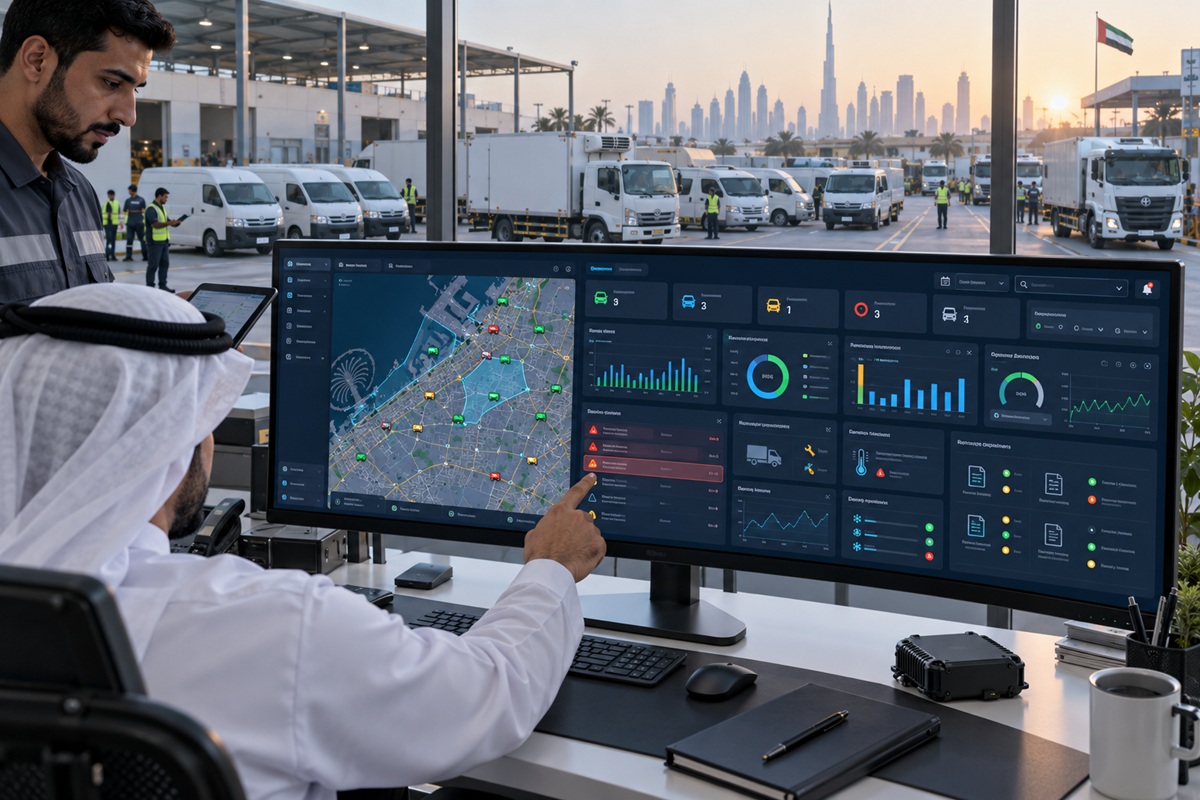
The United Arab Emirates has one of the highest commercial vehicle densities in the Middle East and one of the most structured regulatory frameworks for fleet oversight anywhere in the GCC. For fleet owners and operations managers, a GPS tracker is not a discretionary investment. It is a legal requirement, a compliance instrument, and in competitive logistics markets, a meaningful operational advantage.
Yet many fleet operators in the UAE still approach GPS tracking as a commodity purchase comparing hardware prices and monthly fees without understanding the compliance layer that determines whether their chosen solution actually keeps them on the right side of the RTA, ITC, ADNOC, or SIRA.
This guide cuts through that confusion. It covers how GPS tracking works in the UAE context, what the regulatory landscape actually requires, which features separate entry-level trackers from enterprise-grade telematics platforms, and what to look for when selecting a provider with the certifications your specific fleet type demands.
Key Takeaways
-
- GPS tracking is legally mandatory for commercial fleets in UAE non-compliance carries fines, vehicle impoundment, and licence suspension depending on the emirate.
- Dubai commercial and rental fleets fall under the RTA SecurePath program; Abu Dhabi commercial fleets must register on the ITC Asateel platform these are separate compliance frameworks with different approved hardware lists.
- Oil and gas fleets operating on ADNOC sites require IVMS-compliant devices that generate HSE-formatted driver behavior reports beyond basic location tracking.
- Enterprise GPS telematics platforms go far beyond location data integrating driver behavior scoring, fuel monitoring, AI dashcam video, predictive maintenance alerts, and multi-country GCC coverage.
- Hardware costs in UAE typically range from AED 150 to AED 600 per device; monthly platform subscriptions run AED 30 to AED 150 per vehicle depending on feature depth.
- Provider certification matters as much as platform features an Asateel or SIRA-unapproved device will fail compliance audits regardless of technical capability.
What Is a GPS Tracking System? (Quick Definition for Fleet Operators)
A GPS tracking system is a combination of hardware installed in a vehicle and a cloud-based software platform that receives, processes, and presents location and operational data from that vehicle in real time. In fleet management, the term covers a spectrum from basic location loggers to advanced telematics systems that capture dozens of data points per second.
At its core, a GPS tracking system uses signals from the Global Navigation Satellite System (GNSS) to calculate a vehicle’s precise geographic coordinates, then transmits that data via a cellular (GSM/4G LTE) or satellite modem to a central platform accessible by fleet managers on desktop or mobile interfaces.
How GPS Trackers Work Satellites, Modems, and the Cloud
The tracking hardware typically a hardwired OBD device or a concealed wired unit receives signals from multiple satellites simultaneously to triangulate position with accuracy generally within two to five metres. That positional fix, combined with vehicle speed, heading, and engine status data drawn from the OBD-II port or CAN bus, is packaged and transmitted over a cellular network to the cloud platform.
Modern enterprise trackers transmit data updates every 5 to 30 seconds when a vehicle is in motion, and can be configured to ping at longer intervals during idle periods to manage data costs. The platform stores all this data historically, enabling not just live visibility but retrospective journey analysis, compliance reporting, and trend-based operational intelligence.
GPS Tracking vs. Telematics What Is the Difference?
This distinction matters operationally and commercially. Basic GPS tracking tells you where a vehicle is and where it has been. Telematics goes substantially further integrating vehicle health data, driver behavior analysis, fuel consumption monitoring, AI-powered dashcam footage, and compliance-grade reporting into a unified operational intelligence platform.
For UAE fleet operators subject to IVMS requirements or ADNOC HSE audits, basic GPS tracking is insufficient. Those environments require telematics-grade solutions capable of generating the standardised behavior reports regulators expect.
| Feature | Basic GPS | Fleet Telematics |
|---|---|---|
| Real-time vehicle location | ✅ | ✅ |
| Journey history & replay | ✅ | ✅ |
| Speed monitoring | ✅ | ✅ |
| Driver behavior (braking, acceleration, cornering) | ❌ | ✅ |
| Fuel monitoring & consumption analysis | ❌ | ✅ |
| AI dashcam & video telematics integration | ❌ | ✅ |
| IVMS-compliant HSE reporting | ❌ | ✅ |
| Predictive maintenance alerts | ❌ | ✅ |
| Driver scorecard & coaching module | ❌ | ✅ |
| Asateel / SecurePath compliance reporting | ❌ | ✅ |
Is GPS Tracking Mandatory in the UAE?
Yes for most commercial fleet categories operating in the UAE, GPS tracking is a legal requirement, not a recommendation. The regulatory framework is structured by emirate and industry sector, with distinct programmes, approved hardware lists, and enforcement mechanisms. Understanding which programme applies to your fleet is the first step before evaluating any technology.
Dubai RTA SecurePath Requirements
The Roads and Transport Authority (RTA) in Dubai mandates GPS tracking for rental cars, taxis, e-hail vehicles, public buses, and school buses through the SecurePath programme. Fleet operators in these categories must use RTA-approved GPS hardware that transmits real-time location data to the SecurePath portal. Operating without approved tracking or with a device that fails to maintain continuous data transmission can result in fines and licence suspension. The key operational point for multi-emirate fleets: SecurePath compliance does not satisfy Abu Dhabi’s Asateel requirement. These are entirely separate systems with separate approved device lists.
Abu Dhabi ITC Asateel Platform
The Integrated Transport Centre (ITC) of Abu Dhabi operates the Asateel platform, which governs GPS tracking requirements for all commercial fleets operating in Abu Dhabi. This includes heavy trucks, light commercial vans, school buses, taxis, trailers, and semi-trailers. Asateel requires ITC-certified GPS devices specifically approved for the platform not every GPS device on the market qualifies.
Notably, trailers in Abu Dhabi must carry their own dedicated GPS unit registered separately on Asateel, distinct from the tractor unit. This is a common compliance gap for logistics companies that register the truck but overlook the trailer.
Oil & Gas ADNOC IVMS Requirements
Vehicles and equipment operating on ADNOC sites or those contracted to ADNOC and its subsidiaries are subject to IVMS (In-Vehicle Monitoring System) requirements. IVMS goes beyond location tracking it records speed events, harsh braking, acceleration profiles, seatbelt compliance, and engine data in a format that generates HSE-ready reports for contractor audits. Standard GPS devices do not satisfy this requirement. ADNOC contractors must use certified IVMS hardware and demonstrate regular reporting compliance.
School Buses Ministry of Education Compliance
All school buses operating under Ministry of Education contracts in UAE must carry certified GPS tracking devices, and many school transport operators are also required to provide real-time tracking access to parents through dedicated mobile applications. This creates a dual requirement: regulatory compliance for the operator and end-user visibility for parents something basic fleet GPS platforms rarely address without a parent notification module.
Security Vehicles SIRA Dubai Requirements
The Security Industry Regulatory Agency (SIRA) in Dubai requires licensed security companies to use approved GPS tracking solutions for their patrol vehicles. Security firms operating without SIRA-approved vehicle tracking risk licence revocation. VZone International holds SIRA approval, making it one of the few GPS providers that can serve this specific compliance requirement in Dubai.
| Emirate / Sector | Regulator | Programme | Mandatory For | Penalty for Non-Compliance |
|---|---|---|---|---|
| Dubai | RTA | SecurePath | Rental cars, taxis, buses | Fine + licence suspension |
| Abu Dhabi | ITC | Asateel | All commercial fleets | Fine + vehicle impoundment |
| Oil & Gas (UAE) | ADNOC | IVMS | All contractors on ADNOC sites | Contract suspension + audit failure |
| Oman | OPAL | OPAL Approved | Commercial vehicles | Operating restriction |
| Security (Dubai) | SIRA | SIRA Approved | All licensed security fleets | Licence revocation |
| School Transport (UAE) | MOE / RTA | Certified GPS | All school buses | Operating suspension |
Key Features to Look for in a UAE GPS Tracking System
Not all GPS platforms are equal and in the UAE context, some capabilities that are optional features in other markets become operational necessities. Here is what matters most when evaluating a GPS tracking system for a UAE fleet.
Real-Time Location Tracking (Every 5 to 60 Seconds)
The core function but update frequency matters operationally. For urban delivery fleets, 10-second updates are the practical minimum to provide accurate ETAs and monitor route adherence. For long-haul trucks on highways, 30-second intervals are generally adequate. Look for platforms that allow per-vehicle or per-group interval configuration rather than a single system-wide setting different vehicle types within the same fleet often have different real-time visibility requirements.
Geofencing and Zone Alerts
Geofencing is one of the highest-value features for operations managers it enables automated alerts when vehicles enter or exit defined geographic zones. For UAE fleets, practical applications include alerting when a vehicle leaves the approved operating zone (a common fuel theft vector), monitoring arrival and departure at customer sites for proof-of-service, flagging vehicles that enter restricted areas on ADNOC or construction sites, and triggering after-hours use alerts for rental vehicle operators.
Enterprise platforms allow unlimited zone creation with role-based alert routing so depot managers receive site-specific alerts without being flooded with system-wide notifications.
Driver Behavior Monitoring (Speed, Braking, Idle Time)
In IVMS-required environments, driver behavior monitoring is non-negotiable. But even outside ADNOC contexts, driver behavior data is one of the most financially consequential data streams a fleet manager can access. Harsh braking and aggressive acceleration are the primary drivers of elevated fuel consumption and accelerated brake pad wear. Speeding events are the primary predictor of accident risk and insurance premium increases.
The most operationally useful platforms present this data as driver scorecards normalised scores per driver per shift that make it easy to identify outliers and focus coaching where it will have the most impact. Platforms that only log events without aggregating them into actionable rankings force managers to manually analyse raw data, which rarely happens under operational pressure.
AI Video Telematics and Dashcam Integration
AI dashcams represent the most significant recent evolution in fleet safety technology in the UAE market. Unlike standard dashcams that simply record footage, AI-enabled cameras analyse driver-facing and road-facing video in real time detecting distraction, phone use, fatigue, and lane departure. They pair video evidence with GPS and behavioral data, creating timestamped incident records that serve both safety coaching and insurance dispute purposes.
For ADNOC contractors and logistics operators under HSE scrutiny, AI dashcam footage integrated with IVMS behavior data creates a substantially more defensible compliance record than behavior data alone.
Fuel Monitoring and Consumption Reports
Fuel typically represents 30 to 40 percent of total fleet operating costs in the UAE. A GPS platform that does not connect to fuel data is leaving your single largest variable cost invisible. Effective fuel monitoring integrates with fuel sensors or CAN bus data to track consumption per trip, per driver, and per route enabling the identification of consumption anomalies that indicate either mechanical issues or fuel theft.
Fuel theft is a persistent operational problem across UAE logistics and construction fleets. Siphoning from parked vehicles and false fill reconciliation both become significantly harder to execute undetected when real-time fuel level data is integrated with GPS positioning and timestamp records.
Multi-Country Coverage Across the GCC
UAE logistics operations routinely cross into Saudi Arabia and Oman. A GPS platform that loses visibility at the border or that requires a separate subscription and platform login for each country creates exactly the kind of operational blind spot that exposes cross-border shipments to theft risk and makes customer ETA commitments unreliable. Enterprise platforms that maintain continuous tracking across GCC border zones, with a single unified dashboard, are the appropriate standard for any fleet running cross-border routes.
GPS Tracker Pricing in UAE What to Expect
GPS tracking costs in UAE have two components: hardware (the device installed in the vehicle) and the ongoing platform subscription. Hardware is typically a one-time capital cost; subscriptions are monthly or annual operational costs that scale with fleet size. Enterprise contracts for 100+ vehicles almost always involve custom pricing, bundled onboarding, and dedicated account management
| Cost Component | Typical Range (AED) | What It Covers |
|---|---|---|
| Hardware basic GPS device | 150 – 300 / vehicle | Location, tracking, speed, basic alerts |
| Hardware enterprise telematics | 350 – 600 / vehicle | IVMS, CAN bus, fuel sensor, Asateel-certified |
| Monthly ubscription basic tracking | 30 – 70 / vehicle/month | Location, geofencing, journey reports |
| Monthly subscription full telematics | 80 – 150 / vehicle/month | Behavior monitoring, AI dashcam, fuel, compliance |
| Enterprise setup (100+ vehicles) | Custom quote | Onboarding, compliance certs, API integration |
| AI dashcam hardware | 400 – 900 / camera | Dual-lens, AI event detection, live streaming |
A note on total cost of ownership: the cheapest hardware option is rarely the cheapest operational outcome. Devices that are not Asateel or SIRA certified may need to be replaced entirely if a compliance audit requires approved equipment at full hardware cost plus reinstallation. Evaluating GPS providers on compliance certification upfront is significantly cheaper than remediation after the fact.
Common GPS Tracking Mistakes UAE Fleet Operators Make
These are the operational and procurement errors that consistently create problems for UAE fleet managers and the ones a well-structured GPS evaluation process should prevent.
Mistake 1 Assuming All GPS Devices Are Asateel-Compliant
Asateel maintains a specific approved device list maintained by ITC Abu Dhabi. Not every GPS tracker on the UAE market appears on that list. Fleet operators who purchase hardware based on price comparisons without verifying ITC certification discover this during their first Asateel registration attempt and face the cost of hardware replacement.
Mistake 2 Treating SecurePath and Asateel as the Same Programme
They are entirely separate compliance frameworks with different regulators, different approved hardware lists, and different portal registration processes. A device certified for SecurePath may not be approved for Asateel, and vice versa. Multi-emirate operators need clarity from their provider on exactly which certifications their chosen hardware carries.
Mistake 3 Forgetting Trailer Registration on Asateel
ITC Abu Dhabi requires semi-trailers to be registered on Asateel with their own dedicated GPS units separate from the tractor. This is one of the most consistently overlooked compliance requirements for logistics and construction fleets in Abu Dhabi. An unregistered trailer is a compliance liability regardless of whether the pulling vehicle is fully registered.
Mistake 4 Using Basic GPS for ADNOC IVMS Requirements
ADNOC’s IVMS specification requires driver behavior data capture that a standard GPS tracker does not provide. Contractors who deploy location-only trackers on ADNOC site vehicles fail HSE audits that check for IVMS certification. The fix requires hardware replacement a cost and timeline disruption that can be avoided entirely with correct specification from the outset.
Mistake 5 Selecting a Provider Without UAE-Based Support
Fleet operations in the UAE run around the clock, and GPS system downtime particularly during Asateel platform connectivity failures can create compliance exposure very quickly. Providers without UAE-based technical support teams, or those relying purely on email ticket systems, routinely create operational problems for clients managing large fleets under live regulatory scrutiny.
How to Choose the Right GPS Tracking System for Your UAE Fleet
The selection decision comes down to three variables: fleet size and complexity, industry-specific compliance requirements, and platform scalability as your operations grow. Here is a practical decision framework.
Small Fleets (Under 25 Vehicles)
For small fleets delivery vans, service vehicles, small car rental operations the priority is compliance certification and operational simplicity. You need Asateel or SecurePath-certified hardware, a clean mobile app that field managers can actually use, basic geofencing and journey history, and reliable cellular coverage. A platform that requires a dedicated IT team to operate creates more overhead than it resolves at this fleet size.
Mid-Size Fleets (25 to 150 Vehicles)
At this scale, driver behavior data becomes financially significant. The difference between your highest-risk and lowest-risk drivers, when measured in fuel consumption and brake wear alone, will typically justify the full telematics subscription cost within the first six months. Route optimisation, maintenance scheduling, and driver scorecards all start delivering measurable ROI at this fleet size. Look for platforms with clear reporting hierarchies operations managers need fleet-wide summaries; depot supervisors need vehicle-level data; drivers respond better to weekly scorecard summaries than to real-time monitoring notifications.
Enterprise Fleets (150+ Vehicles or Multi-Country Operations)
Enterprise fleet management at this scale requires API integration with ERP and dispatch systems, multi-country GCC coverage on a single platform, role-based access control across multiple operational tiers, dedicated account management with UAE-based support, and a provider that can accommodate custom compliance reporting for ADNOC, OPAL, or SIRA audits. Platform scalability both technical and contractual needs to be evaluated explicitly rather than assumed.
Questions to Ask Your GPS Provider Before Committing
-
-
- Which specific compliance certifications does your hardware hold — Asateel (ITC), SecurePath (RTA), IVMS (ADNOC), SIRA, OPAL? Can you provide the certification documentation?
- Is your platform built on a proprietary stack or an established enterprise telematics platform such as Wialon or FMSiTrack?
- What is the process and timeline for Asateel registration do you manage the full registration, or does my team handle it?
- How is data transmitted across GCC borders do I maintain continuous tracking visibility in Saudi Arabia and Oman?
- What is your UAE-based support model hours, escalation path, and SLA for critical issues?
- What API documentation is available for integration with our ERP or dispatch system?
- What does hardware replacement look like if a device fails lead time, cost, and who manages the Asateel re-registration?
-
Industry-Specific GPS Tracking Use Cases in UAE
Logistics and Last-Mile Delivery
The UAE logistics sector operates under intense SLA pressure same-day delivery expectations from e-commerce customers and just-in-time requirements from manufacturing and retail clients. GPS tracking in this context delivers value through route optimisation that accounts for Dubai and Abu Dhabi traffic patterns, real-time ETA updates to customers, proof-of-delivery timestamping, and driver idle time monitoring that directly impacts fuel cost per shipment.
Oil and Gas Contractor Fleets
The most compliance-intensive fleet environment in the UAE. ADNOC contractors face IVMS requirements, restricted zone enforcement, driver fatigue monitoring, and HSE reporting cycles. GPS platforms in this context need to be certified at both the hardware and software level, with reporting templates that align with ADNOC’s audit formats. Failure to maintain continuous IVMS data transmission during site operations can trigger contractor performance reviews.
Car Rental and Lease Operations
SecurePath compliance is non-negotiable for Dubai car rental operators. Beyond compliance, GPS tracking enables rental companies to monitor vehicle misuse unauthorised border crossings, after-hours operation, speeding events that create insurance liability, and real-time stolen vehicle recovery. The ROI on GPS tracking for a mid-size UAE car rental fleet is typically achieved within 8 to 12 months through insurance claim reduction and asset recovery alone.
Construction and Heavy Equipment
Construction fleets present a specific asset tracking challenge: equipment moves between sites on a schedule that changes daily, and much of the high-value asset base consists of non-self-propelled equipment such as generators, compressors, and lifting gear. GPS asset trackers with long-life batteries and anti-tamper features protect this category. Driver behavior monitoring on construction site vehicles where speed events in confined spaces have disproportionate injury risk also creates direct HSE value.
Why UAE Businesses Choose VZone International
VZone International has operated in the UAE fleet technology market for over 20 years a tenure that spans the introduction of mandatory GPS requirements, the rollout of Asateel, the SecurePath programme, and the evolution from basic location tracking to AI-driven fleet intelligence platforms. That operational history translates into compliance knowledge and implementation experience that newer market entrants cannot replicate.
Asateel-Certified for Abu Dhabi Commercial Fleets
VZone International holds ITC Asateel certification, covering the full commercial fleet spectrum in Abu Dhabi heavy trucks, trailers, light commercial vehicles, school buses, and taxis. More importantly, VZone manages the complete Asateel registration process for clients: hardware installation, portal setup, data transmission verification, and compliance certificate issuance. Fleet operators do not need to navigate the ITC registration process independently.
SIRA-Approved for Dubai Security Fleets
SIRA approval is held by a limited number of GPS providers in the UAE market. For security companies operating patrol vehicles in Dubai, this certification is a hard requirement not a preference. VZone’s SIRA-approved solution covers patrol vehicle tracking, guard monitoring via mobile app, and task management functionality aligned with SIRA’s operational accountability requirements.
OPAL-Certified for Oman Operations
For fleets running cross-border routes between UAE and Oman, OPAL certification ensures continuous compliance on both sides of the border. VZone maintains OPAL certification and provides the multi-country platform coverage that logistics operators with UAE-Oman routes require.
Enterprise Platform: Wialon and FMSiTrack
VZone’s platform is built on Wialon and FMSiTrack two of the most widely deployed enterprise fleet management platforms globally. This matters for enterprise clients because it means platform stability, a large ecosystem of third-party integrations, and a proven architecture that scales from 10 vehicles to 10,000. It also means clients are not dependent on a proprietary platform that could be discontinued if the local provider changes direction.
| VZone Certification | Scope | Why It Matters |
|---|---|---|
| ITC Asateel | Abu Dhabi all commercial fleet categories | Legal requirement for Abu Dhabi fleet registration |
| RTA SecurePath | Dubai rental cars, taxis, public transport | Mandatory for Dubai rental and public transport fleets |
| ADNOC IVMS | Oil & gas contractor fleets across UAE | Required for ADNOC site access and HSE compliance |
| SIRA Approved | Dubai security company fleets | Required for SIRA-licensed security operators |
| OPAL Certified | Oman commercial fleets, cross-border ops | Required for UAE-Oman cross-border logistics |
Conclusion: GPS Tracking in UAE Is a Compliance Imperative and an Operational Asset
The UAE fleet tracking landscape is more structured and more consequential than many fleet operators realise until they face a compliance audit or an Asateel registration rejection. Understanding that SecurePath, Asateel, IVMS, and SIRA represent distinct regulatory programmes each with specific hardware certification requirements is the foundation of any sensible GPS procurement decision.
Beyond compliance, the gap between basic GPS location tracking and enterprise telematics is where the real operational and financial returns emerge. Driver behavior data that reduces fuel consumption and brake wear, AI dashcam footage that resolves insurance disputes, fuel monitoring that detects theft these are not marginal improvements. For a fleet of 100 vehicles running 250 operating days per year, the difference between a GPS-enabled operation and a GPS-blind one is measured in millions of dirhams, not thousands.
The most effective GPS implementations share a common characteristic: the provider’s certifications align precisely with the fleet’s regulatory environment, the platform scales with operational complexity, and the support model is built for the 24-hour nature of UAE commercial fleet operations.
Ready to explore GPS tracking for your UAE fleet?
VZone International is Asateel-certified (ITC Abu Dhabi), SIRA-approved (Dubai), and OPAL-certified (Oman) with 20+ years of fleet tracking experience across UAE and MENA. Contact our team for a free demo and compliance assessment.