UAE summer temperatures exceed 50°C a single cold chain break lasting as little as 20 minutes can destroy an entire pharma or food shipment worth AED 50,000 or more. A pharmaceutical distributor whose insulin shipment exceeds 8°C during a Dubai delivery run faces not just the immediate cargo loss but a chain of consequences: regulatory reporting to the UAE Ministry of Health, patient safety implications, insurance claim processing, and the reputational risk with the hospital or clinic that received an unusable shipment. A cold chain monitoring system with real-time temperature and humidity monitoring keeps cargo within safe thresholds throughout transit and creates the timestamped, GPS-verified compliance documentation that UAE regulators, pharmaceutical manufacturers, and food safety authorities demand.
VZone International’s integrated vehicle tracking system with cold chain sensors gives UAE fleet operators full visibility from warehouse loading to delivery point continuous temperature and humidity data, GPS-verified location at every data point, instant alerts when thresholds are breached, and automated compliance reports in the format that ESMA, Dubai Municipality, and ADAFSA audits require. This guide explains how cold chain monitoring systems work, which UAE industries require them, and what features separate a genuinely protective system from a basic data logger.
Key Takeaways
- A cold chain monitoring system integrates temperature sensors, humidity sensors, door-open detection, and GPS vehicle tracking into a unified platform providing continuous cargo condition visibility from warehouse to delivery point, with real-time alerts when any parameter breaches its defined threshold.
- UAE’s extreme climate makes cold chain monitoring significantly more critical than in most other markets: ambient temperatures above 50°C mean that a refrigeration unit failure or open door event causes cargo temperature to rise at 2 to 5°C per minute in summer conditions making detection speed and alert immediacy the most important system characteristics.
- Cold chain compliance documentation is a regulatory requirement in UAE for pharmaceutical transport (GDP guidelines enforced by UAE Ministry of Health and MOHAP), food distribution (Dubai Municipality food safety standards and ADAFSA), and specific chemical transport categories a cold chain monitoring system that generates automated audit-ready logs is the most efficient method of satisfying these requirements.
- Integrating cold chain monitoring with GPS vehicle tracking creates a correlated record that links every temperature and humidity data point to the vehicle’s exact GPS location and speed enabling post-event investigation to identify precisely where and when a cold chain break occurred, and whether the break was caused by driver behaviour (door left open), route delay (vehicle stationary in traffic with refrigeration load exceeded), or equipment failure.
- ROI from cold chain monitoring systems in UAE comes from three sources: prevented cargo loss (AED 10,000 to AED 100,000+ per avoided spoilage event), insurance premium reduction from documented cargo protection evidence, and faster compliance audit resolution from automated temperature log generation.
What Is a Cold Chain Monitoring System?
A cold chain monitoring system is an integrated technology solution that continuously measures and records the temperature, humidity, and physical condition of temperature-sensitive cargo during storage and transport combining sensor hardware inside the refrigerated compartment, a data transmission gateway that sends measurements to a cloud platform, and a monitoring dashboard with alert logic that notifies operators immediately when any measured parameter moves outside its defined safe range.
The key distinction from a standalone GPS vehicle tracking system is the cargo condition layer: a GPS vehicle tracking system tells operators where the vehicle is; a cold chain monitoring system tells operators whether the cargo inside that vehicle is within its required temperature and humidity range at that location. Without cold chain monitoring, a fleet manager knows that the pharmaceutical delivery truck arrived at the hospital but has no record of whether the insulin maintained 2°C to 8°C throughout the route, or experienced a temperature excursion when the truck sat in Abu Dhabi traffic for 45 minutes with the doors improperly sealed after the previous stop.
The Three Pillars of Cold Chain Monitoring
- Temperature monitoring: continuous measurement from calibrated probes at defined locations in the refrigerated compartment front, middle, and rear zones for multi-zone systems recording temperature at 30-second to 5-minute intervals throughout the journey
- Humidity monitoring: continuous relative humidity measurement relevant for cargo categories where moisture content affects product integrity fresh produce, certain pharmaceutical formulations, electronics, and flowers with alerts when RH% moves outside the cargo’s specified range
- Location tracking: GPS vehicle tracking correlated with every temperature and humidity data point creating a location-stamped cargo condition record that links each temperature reading to where the vehicle was at that moment, enabling precise identification of where any cold chain failure occurred.
How Temperature and Humidity Monitoring Systems Work in Fleet Vehicles
Sensor Types Wired Probes, Wireless Bluetooth, and Multi-Zone
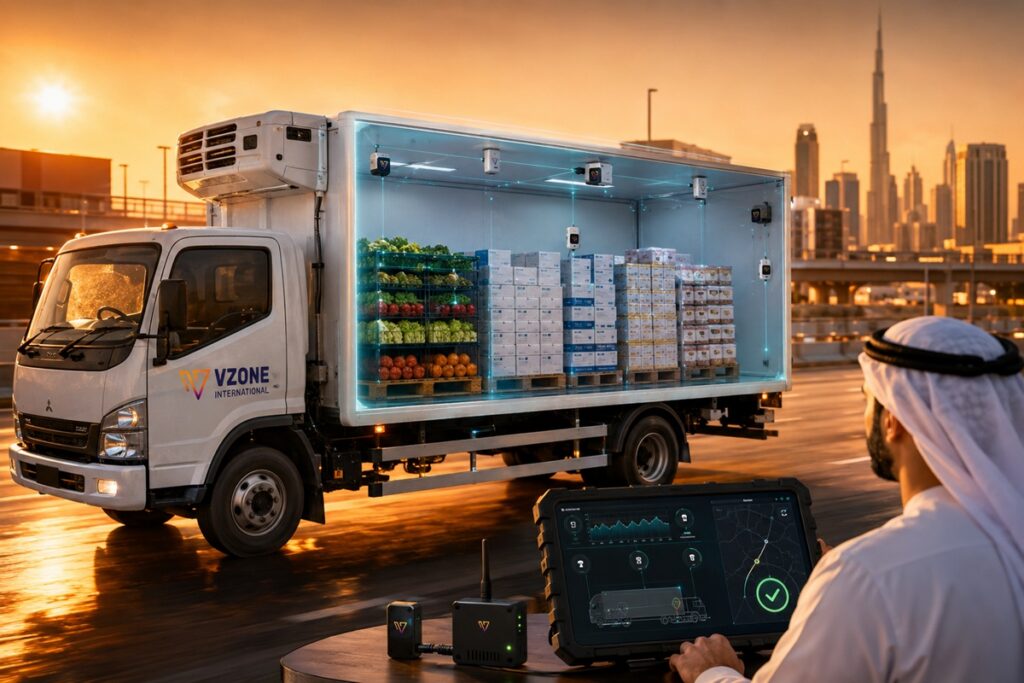
Cold chain monitoring sensors in UAE fleet vehicles are deployed in three configurations depending on the vehicle type and cargo category. Wired temperature probes calibrated NTC or PT100 sensors attached to a central logger unit inside the refrigerated compartment provide the highest measurement accuracy and are standard for pharmaceutical GxP-compliant transport where sensor calibration certificates are required for regulatory audit. The probes are positioned at cargo zone locations specified in the transport validation protocol: typically front, centre, and rear of the compartment, with additional probes for multi-temperature zone vehicles (fresh, chilled, and frozen compartments on the same vehicle).
Wireless Bluetooth Low Energy (BLE) sensors provide the flexibility of sensor placement without cable routing appropriate for vehicles where wired installation is complex (insulated panels, multi-door access points) and where regulatory requirements do not mandate wired calibrated probes. BLE sensors transmit readings to a gateway device installed in the cab or near the compartment access point, which aggregates the readings and transmits them to the cloud platform over the vehicle’s cellular data connection. Multi-zone systems combine wired probes in critical measurement positions with wireless sensors for supplementary monitoring points providing both regulatory-grade primary measurements and broader spatial temperature mapping of the compartment interior.
Data Transmission Sensor to Gateway to Cloud to Alert
The data flow in a vehicle-mounted cold chain monitoring system follows four stages: sensors measure temperature and humidity at configured intervals (30 seconds is standard for high-sensitivity pharmaceutical transport; 5 minutes is adequate for less sensitive food distribution); readings transmit to the in-vehicle gateway logger (wired or Bluetooth); the gateway aggregates readings and transmits the combined dataset to the cloud platform over the vehicle’s 4G cellular connection; and the platform’s alert engine compares incoming readings against configured thresholds, firing alerts to designated recipients (driver app, fleet manager dashboard, operations centre) within 60 to 120 seconds of a threshold breach being detected.
For UAE operations where cellular connectivity varies remote construction sites, Western Region desert routes, border crossing wait queues the gateway logger stores readings in its buffer memory and uploads in bulk when connectivity is restored. This store-and-forward architecture ensures no data is lost during connectivity gaps, maintaining the unbroken temperature record that GDP pharmaceutical transport documentation requires even on routes with intermittent coverage.
Integration with the Vehicle Tracking System
The most operationally valuable aspect of integrating cold chain monitoring with GPS vehicle tracking is the location-stamped condition record every temperature and humidity reading is tagged with the vehicle’s GPS coordinates at the time of measurement. This correlation enables post-delivery investigations that standalone temperature data loggers cannot support: when a temperature excursion is identified in the delivery record, the GPS-correlated data shows exactly where the vehicle was when the excursion began, how long it lasted, and what vehicle speed and status (moving, stopped, engine-on, engine-off) were recorded simultaneously. This investigation precision is the difference between discovering ‘a cold chain break occurred during transit’ and establishing ‘the temperature excursion began at 14:23 when the vehicle stopped at [GPS location] for 18 minutes with the engine off consistent with an extended delivery stop with the refrigeration unit de-powered.
Industries That Need a Cold Chain Monitoring System in the UAE
Pharmaceutical and Healthcare Logistics
Pharmaceutical cold chain transport in UAE is regulated under GDP (Good Distribution Practice) guidelines enforced by the UAE Ministry of Health and Prevention (MOHAP) and SEHA for government health authority supply chains. GDP-compliant pharmaceutical transport requires: validated temperature-controlled vehicles with documented temperature mapping studies, continuous temperature monitoring with calibrated sensors throughout transport, unbroken temperature data records with timestamps and GPS verification, documented alert and escalation procedures for temperature excursions, and formal investigation and deviation reporting for any excursion that occurs.
UAE’s pharmaceutical cold chain volume is significant and growing the country serves as a regional distribution hub for GCC markets, with pharmaceutical imports transiting through Jebel Ali and Abu Dhabi ports and redistributing to healthcare facilities across the UAE and neighbouring countries. Temperature range requirements vary by product: vaccines and biologics (2°C to 8°C, with zero tolerance for excursions above 8°C or below 0°C), ambient-stable medicines (15°C to 25°C, protected from UAE summer heat), and frozen biologics (-20°C or below). A cold chain monitoring system serving pharmaceutical distribution must cover all three temperature ranges simultaneously on multi-product vehicles.
Food and Beverage Distribution
Food safety regulation for temperature-controlled transport in UAE is administered by Dubai Municipality’s Food Safety Department for Dubai operations and Abu Dhabi Agriculture and Food Safety Authority (ADAFSA) for Abu Dhabi. Both authorities apply temperature requirements based on food category: fresh meat and fish (0°C to 4°C), chilled dairy and ready-to-eat foods (0°C to 5°C), frozen products (-18°C or below), and fresh produce with humidity-sensitive shelf life (temperature and humidity combined monitoring). Dubai Municipality’s food establishment licensing and vehicle inspection regime includes spot checks of temperature records for food distribution vehicles operators without documentary evidence of continuous temperature monitoring face compliance findings and potential operating licence implications.
UAE’s food service and retail sector creates specific cold chain pressure points that the monitoring system must address: multi-temperature zone vehicles delivering to hypermarkets, hotel kitchens, and restaurant chains across Dubai’s dense urban delivery network make multiple door-open events per route, each representing a potential temperature excursion risk in summer conditions. A cold chain monitoring system with door-open detection and immediate driver alert capability is the operational tool that prevents the accumulated effect of multiple short door-open events from creating a sustained excursion that affects the entire load.
Chemical Transport
Certain chemical categories transported by UAE industrial and petrochemical fleets have temperature sensitivity requirements beyond standard chemical transport regulations: temperature-sensitive adhesives and sealants used in construction and manufacturing, heat-sensitive lubricants and specialty chemicals for ADNOC facility maintenance, and pharmaceutical raw materials in the API supply chain. For these categories, temperature monitoring satisfies both the cargo protection requirement (preventing degradation that affects product performance) and the transport documentation requirement (chain of custody records demonstrating that product was maintained within specification throughout the supply chain).
Flower and Agriculture Supply Chain
UAE’s flower import and distribution industry supplying hotels, events venues, and retail outlets from the import hub at Dubai Flower Centre at DXB airport requires temperature and humidity monitoring to maintain the specific storage conditions (typically 2°C to 8°C with 80 to 95 percent relative humidity) that cut flower shelf life depends on. A temperature-correct but humidity-deficient environment desiccates flowers within hours; a humidity-correct but temperature-elevated environment accelerates bacterial growth and shortens shelf life. The dual temperature-and-humidity monitoring that flowers require is the most demanding monitoring specification in UAE ambient transport, making BLE wireless sensors with multi-point humidity capability the appropriate technology for this sector.
UAE Regulations for Temperature-Controlled Transport
| Regulatory Authority | Scope | Temperature Documentation Requirement | Cold Chain Monitoring System Implication |
| ESMA (Emirates Authority for Standardisation and Metrology) | Standards for temperature-controlled transport equipment and procedures across UAE | UAE.S GSO 1728: requires calibrated monitoring, unbroken records, and documented deviation procedures | Calibrated sensor with traceable calibration certificate; unbroken timestamped data record; documented alert escalation procedure |
| MOHAP (Ministry of Health and Prevention) | Pharmaceutical GDP compliance for medicine distribution | Continuous temperature monitoring throughout transport; immediate deviation reporting; full audit trail | GDP-validated monitoring system; calibrated probes; GPS-correlated records; deviation reporting capability |
| Dubai Municipality Food Safety | Food transport vehicle licensing and inspection in Dubai | Vehicle temperature records available for inspection; documented HACCP plan including transport monitoring | Continuous record with timestamps; available on request during vehicle inspection; driver-accessible alert history |
| ADAFSA (Abu Dhabi Agriculture and Food Safety Authority) | Food safety regulation for Abu Dhabi including temperature-controlled transport | Temperature monitoring records for perishable food transport; traceability documentation | Timestamped temperature records per trip; GPS location correlated with temperature data |
| DAFSA (Dubai Agriculture and Food Safety Authority) | Food safety authority for Dubai agricultural and food products | Monitoring of transport conditions for regulated food categories | Trip-level temperature records with location data for supply chain traceability |
VZone International’s cold chain monitoring system generates automated compliance reports in formats aligned with each regulatory authority’s documentation requirements eliminating the manual data extraction and report compilation that fleet quality managers would otherwise perform for each audit. The platform’s report archive retains full temperature and humidity records with GPS correlation for a configurable period (minimum 12 months for pharmaceutical GDP compliance; 6 months for most food safety requirements), accessible on demand without requiring the physical data logger to be retrieved from the vehicle.
Key Features of an Effective Temperature and Humidity Monitoring System
Multi-Zone Temperature Sensors
Multi-zone temperature monitoring deploys separate calibrated sensors at different locations within the refrigerated compartment front zone, centre zone, and rear zone at minimum, with additional sensors for multi-temperature vehicles that carry fresh, chilled, and frozen product simultaneously. Multi-zone monitoring is the requirement for pharmaceutical GDP transport (where temperature mapping studies define the number and position of sensors needed to characterise the entire compartment’s thermal performance) and for large refrigerated trucks where the temperature differential between the evaporator outlet zone and the far end of the compartment can reach 2 to 4°C during loading conditions. A single temperature sensor at one location cannot detect the warm zone that may be developing at the rear of the compartment nearest the door while the front zone remains within specification.
Real-Time Humidity Tracking
Humidity monitoring is relevant for cargo categories where moisture content affects product integrity fresh produce (too low humidity causes desiccation; too high causes condensation and microbial growth), cut flowers, certain pharmaceutical formulations, and humidity-sensitive packaged goods. The monitoring system should record relative humidity percentage continuously alongside temperature, with configurable alert thresholds for both upper and lower humidity limits appropriate to the cargo type. For UAE fleet operations where summer conditions create significant humidity differentials between the vehicle’s operating environment and the cargo’s required humidity range, humidity monitoring provides a second dimension of cargo protection that temperature monitoring alone cannot deliver.
Door Open/Close Detection
Door-open detection is one of the most operationally valuable features in a UAE cold chain monitoring system because door-open events are the primary source of temperature excursions in multi-stop delivery operations. A delivery driver who opens the refrigerated compartment for a 3-minute delivery stop in Abu Dhabi at 47°C ambient admits significantly more thermal energy than the same operation in a temperate market, and the cumulative effect of 8 to 12 door-open events per delivery route on a summer day can produce a sustained temperature elevation that compromises the entire remaining load. Door-open sensors fire an alert to the driver when the door has been open beyond a configurable duration threshold (typically 3 to 5 minutes), prompting the driver to close the door promptly and the refrigeration unit to recover to set temperature before the next opening.
Automated Alerts When Thresholds Are Breached
Alert logic in a cold chain monitoring system must satisfy two competing requirements: sensitive enough to detect genuine excursions before they cause cargo damage, and specific enough to avoid alert fatigue from false positives that cause operators to begin ignoring alerts. The alert architecture should include: primary threshold alerts (temperature or humidity moves outside the safe range immediate notification to driver and operations centre); sustained excursion alerts (temperature outside safe range for more than a configurable duration escalated notification to quality manager and documentation of excursion start time, severity, and GPS location); recovery confirmation alerts (temperature has returned within safe range after an excursion timestamped for deviation record completion); and equipment failure alerts (temperature sensor reading outside physically possible range, or no reading received for longer than expected interval indicating sensor failure or disconnection).
Historical Data Logs for Audit Trails
Every temperature, humidity, and door-open event recorded by the monitoring system must be stored in a cloud-accessible, tamper-evident archive that generates audit-ready reports on demand. The historical data log should include: full timestamped temperature and humidity records for every trip at the configured measurement interval; GPS location at every data point; alert event history with timestamps and response records; door-open events with duration; refrigeration unit operating status (on/off); and driver identity at trip start. These records must be retrievable by trip, by vehicle, by date range, and by product batch (for pharmaceutical GDP traceability) without requiring specialist technical access quality managers and regulatory auditors should be able to generate the required reports from the platform dashboard without assistance.
Integration with Vehicle Tracking System for Route and Temperature Correlation
The GPS-temperature correlation capability mapping every temperature reading to the vehicle’s GPS location at the time of measurement is the feature that transforms cold chain monitoring from a data collection exercise into an operational investigation tool. When a temperature excursion appears in the delivery record, the correlated GPS data immediately answers: where was the vehicle when the excursion began? Was the vehicle moving or stationary? How long was it stationary? What road segment was it on? This location context enables the fleet manager to distinguish between a refrigeration equipment failure (excursion beginning while the vehicle is moving, unrelated to door events), a driver behaviour issue (excursion correlating precisely with a door-open event at a delivery stop where the driver left the door open for 12 minutes), and an external factor (excursion beginning while the vehicle was stopped in traffic on a sun-exposed road segment with no shade for an extended period).
How VZone International’s Cold Chain Monitoring System Works
VZone International’s cold chain monitoring solution integrates Teltonika FMB640 or FMCOO1 IoT gateway hardware with calibrated temperature probes, BLE wireless sensors (for multi-zone flexible deployment), door-open magnetic sensors, and the Wialon fleet management platform providing the complete cold chain monitoring system within the same platform that manages GPS vehicle tracking, driver behaviour, and compliance reporting for the entire fleet.
Platform Dashboard and Live Monitoring
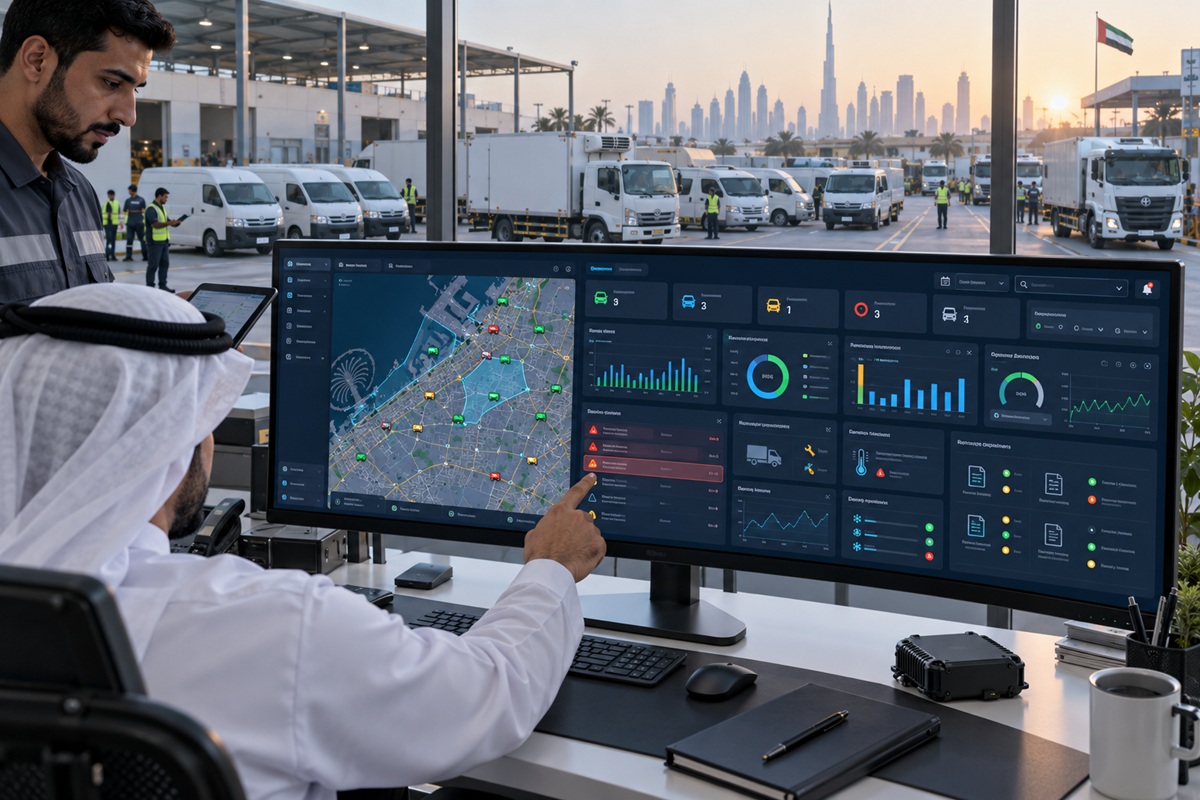
The fleet manager’s Wialon dashboard displays a dedicated cold chain monitoring view alongside the live GPS map showing each refrigerated vehicle’s current temperature zones (colour-coded: green within range, amber approaching threshold, red excursion active), current humidity readings, door status (open/closed), refrigeration unit status, and the last GPS location update. Temperature trending charts for each vehicle show the temperature history for the current trip overlaid on the required range enabling the fleet manager to see not just current temperature but whether temperature is trending toward the threshold boundary or stable well within range. Alert notifications appear on the dashboard and push to the manager’s mobile app simultaneously no separate system login required to see cold chain status alongside GPS fleet visibility.
Driver Alert System
Driver alerts from VZone’s cold chain monitoring system reach the driver through three simultaneous channels when a threshold breach is detected: an audible and visual alert on the in-cab display or driver-facing alert unit (immediately actionable without requiring the driver to use a phone); a push notification to the driver app on their company mobile device; and a simultaneous alert to the fleet manager and operations dispatcher so that the manager is aware of the excursion at the same time as the driver. The driver alert includes the specific parameter breached (temperature zone and current reading vs threshold), the recommended action (check refrigeration unit, close door, return to depot if equipment failure suspected), and the GPS location of the vehicle at the time of the alert.
ROI Prevented Spoilage, Faster Audits, Insurance Documentation
The financial return from cold chain monitoring deployment in UAE fleet operations comes from three sources. Prevented cargo loss a single avoided pharmaceutical excursion event that would have required disposal and replacement of the load represents AED 20,000 to AED 150,000 in avoided loss at UAE pharmaceutical distribution values; a single avoided food spoilage event on a restaurant supply delivery represents AED 5,000 to AED 30,000. Faster compliance audit resolution automated temperature log generation reduces quality manager time for regulatory audit documentation from 4 to 8 hours of manual data extraction per audit to 15 to 30 minutes of report generation from the platform. Insurance documentation cargo insurance carriers in UAE increasingly require continuous temperature monitoring evidence for reduced premiums on temperature-sensitive cargo in transit; fleets with documented monitoring evidence typically achieve 10 to 15 percent reduction in cargo insurance costs.
Common Cold Chain Failures and How a Monitoring System Prevents Them
| Failure Type | How It Occurs in UAE Conditions | Impact Without Monitoring | How Cold Chain Monitoring System Prevents It |
| Pre-cooling failure | Vehicle departs before compartment reaches set temperature UAE ambient heat means a 47°C compartment needs 20-40 minutes to reach 4°C | Cargo loads into warm compartment; first 30-60 minutes of transit are at risk temperature | Pre-departure temperature verification alert departure blocked (or flagged) until compartment confirms set temperature |
| Door seal degradation | Rubber door seals deteriorate faster in UAE heat; gaps allow warm air infiltration continuously during transit | Gradual temperature rise that reaches excursion threshold mid-route, discovered only at destination | Continuous temperature monitoring detects the gradual rise pattern characteristic of seal failure vs acute door-open event |
| Driver door-open excess | Delivery driver leaves refrigerated door open during stop 47°C ambient vs 4°C compartment = 2-5°C/min temperature rise in UAE summer | Temperature excursion during multi-stop route; discovered at destination during temperature check | Door-open sensor fires driver alert after configurable duration; GPS-stamped door event in excursion record |
| Refrigeration unit malfunction | Compressor failure, refrigerant leak, or electrical fault causes gradual temperature rise during transit | Load delivered outside temperature range; spoilage discovered at destination or quality check failure | Temperature trend monitoring detects anomalous rise before excursion threshold; alert fires for maintenance dispatch |
| Loading dock exposure | Long loading dock wait with doors open in UAE summer heat before refrigeration can recover | Initial load temperature compromised before vehicle departs depot | Dock door-open duration monitoring; alert when dock loading time exceeds threshold without compartment recovery |
| Cellular connectivity gap (data loss) | Vehicle in remote area (Western Region, Oman crossing) loses cellular signal; temperature data not transmitted | Gap in temperature record unacceptable for GDP pharmaceutical documentation | Store-and-forward buffer: data stored locally and uploaded when connectivity restored unbroken record maintained |
Book a Cold Chain Demo See Live Temperature Data from UAE Fleets
VZone International’s cold chain monitoring demo shows live temperature and humidity data from active UAE fleet vehicles pharmaceutical delivery vehicles, food distribution trucks, and refrigerated logistics operations alongside GPS location on the same dashboard. See how threshold alerts appear, how GPS-correlated excursion reports are generated, and how automated compliance documentation is produced for MOHAP, Dubai Municipality, and ADAFSA audit requirements. Contact our team to book your demo.
Frequently Asked Questions
A cold chain monitoring system is an integrated solution that combines calibrated temperature sensors, humidity sensors, door-open detection, and GPS vehicle tracking to continuously monitor the condition and location of temperature-sensitive cargo during transport. It measures cargo compartment temperature and humidity at defined intervals, transmits the readings to a cloud platform over cellular data, compares each reading against configured safe-range thresholds, and fires real-time alerts to the driver and fleet manager when any parameter breaches its limit. In UAE, cold chain monitoring systems are essential for pharmaceutical, food, and certain chemical transport categories where extreme summer ambient temperatures create significant excursion risk and where UAE regulatory authorities (MOHAP, Dubai Municipality, ADAFSA) require continuous temperature documentation.
In a delivery truck, a temperature and humidity monitoring system consists of: calibrated temperature probes (wired NTC sensors) and humidity sensors placed at defined positions inside the refrigerated compartment; a gateway unit in the cab that receives sensor readings and aggregates them with GPS location data from the vehicle's telematics device; a 4G cellular data connection that transmits the combined dataset to the cloud platform every 30 seconds to 5 minutes; and the fleet management dashboard and driver app that display live readings, alert when thresholds are breached, and archive all data for compliance reporting. Door-open sensors on the compartment doors add physical condition data that correlates temperature changes with delivery stop events. The entire system is passive from the driver's perspective it runs automatically without driver interaction and alerts only when action is required.
Continuous temperature monitoring is effectively mandatory for pharmaceutical transport in UAE under GDP guidelines enforced by MOHAP, which require documented temperature records throughout the distribution chain. For food transport, Dubai Municipality and ADAFSA food safety regulations require that perishable food vehicles maintain and document appropriate temperature conditions in practice, automated cold chain monitoring is the most efficient way to satisfy this documentation requirement consistently. For other cargo categories, cold chain monitoring is not mandated by a single UAE law but may be required by the cargo manufacturer's transport specifications (pharmaceutical supply contracts), the retailer's supplier requirements (major UAE hypermarket chains), or the cargo insurer's coverage conditions. VZone International can confirm which regulatory and contractual cold chain monitoring requirements apply to your specific cargo categories and UAE operating routes.
Yes when a cold chain monitoring system is integrated with the vehicle's GPS telematics device, the vehicle tracking system and temperature monitoring operate on the same hardware and platform simultaneously. VZone International's fleet management platform displays GPS vehicle location and cargo temperature data on the same dashboard view the fleet manager sees where each refrigerated vehicle is and what its cargo compartment temperature is reading at the same time, without switching between systems. The GPS location is correlated with every temperature data point, creating the location-stamped cargo condition record that enables post-event investigation to identify precisely where and when any temperature excursion occurred during the route.
Cold chain sensors for UAE fleet vehicles are available in temperature ranges appropriate for all pharmaceutical and food transport categories: standard chilled range (-25°C to +70°C ambient) covering fresh, chilled, and ambient-controlled products; deep freeze range (-40°C to +85°C) for frozen pharmaceutical biologics and deep-frozen food products; and ultra-cold range (-80°C to +20°C) for specialised pharmaceutical categories including certain vaccines and cell therapies requiring ultra-low temperature maintenance. VZone International specifies sensors appropriate for each vehicle's cargo category during the deployment assessment a pharmaceutical GDP vehicle requires calibrated probes with traceable calibration certificates valid within the cargo's required temperature range; a food distribution van requires sensors covering the fresh and chilled categories with appropriate resolution (±0.5°C accuracy or better).
VZone International's system alerts drivers through three simultaneous channels when a threshold breach is detected: an audible and visual alert on the in-cab display unit fires within 60 to 120 seconds of the breach being confirmed (the brief confirmation window prevents false alarms from brief door-open events during normal delivery operations); a push notification appears on the driver's company mobile device through the VZone driver app, specifying which zone has breached, the current reading versus the threshold, and the recommended action; and an identical alert fires simultaneously to the fleet manager's dashboard and operations supervisor's mobile app ensuring the operations team is aware of the excursion at the same time as the driver rather than discovering it hours later in the trip report. The driver alert includes a one-tap acknowledgment that records the driver's response time in the excursion log, providing the documented escalation response that GDP pharmaceutical deviation procedures require.