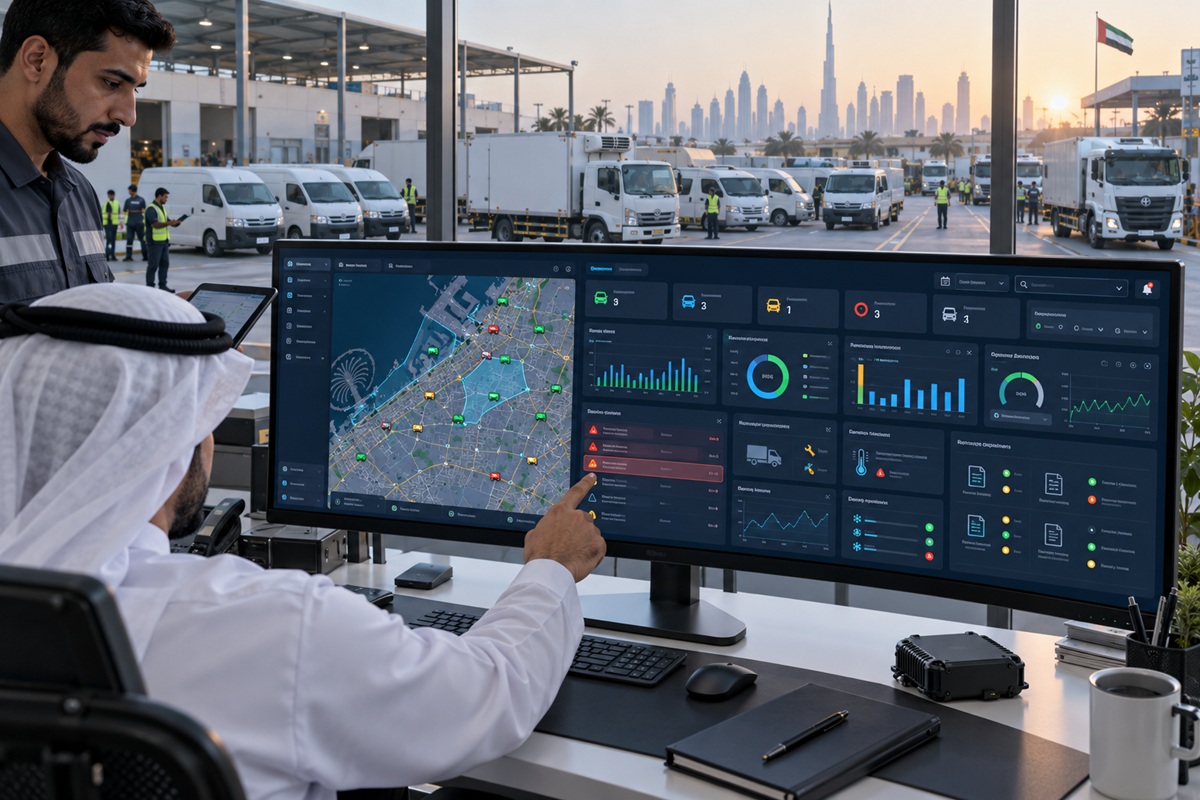
A cold chain monitoring system is the combination of sensors, connectivity, and software that continuously measures the temperature and where required, humidity of temperature-sensitive cargo during transport, firing real-time alerts when readings move outside safe thresholds and generating the timestamped audit records that prove cargo was maintained within specification from warehouse to delivery point.
Three categories of UAE operator need this technology most urgently. Pharmaceutical distributors: UAE’s MOHAP and the Ministry of Health require documented proof that medicines were maintained within their specified temperature ranges throughout the distribution chain GDP-compliant cold chain monitoring is a licence condition, not a best practice. Food and beverage logistics: Dubai Municipality and ADAFSA inspect food transport vehicles and can suspend operating licences for operators without documented temperature monitoring procedures. Dairy and fresh produce importers: product shelf life and quality depend on humidity as well as temperature, and the UAE’s extreme summer ambient creates cold chain failure risks that temperate-market monitoring systems routinely underestimate.
Key Takeaways
- A cold chain monitoring system differs from a standard GPS vehicle tracking system by adding temperature sensors, optional humidity sensors, and door-open detection inside the refrigerated compartment creating a cargo condition record alongside the vehicle’s location record.
- UAE summer ambient temperatures above 50°C mean that a refrigeration unit failure or improperly closed door can raise compartment temperature from 4°C to 20°C+ within 20 minutes detection speed and immediate driver alert are the most important system characteristics in UAE conditions.
- UAE cold chain compliance involves three regulatory frameworks: MOHAP GDP guidelines for pharmaceutical transport, Dubai Municipality food safety standards for F&B transport, and ADAFSA guidelines for Abu Dhabi food distribution. Each requires documented, unbroken temperature records a cold chain monitoring system is the most reliable method of satisfying all three simultaneously.
- The financial return from cold chain monitoring comes from three sources: prevented cargo spoilage (AED 10,000 to AED 150,000+ per avoided loss event depending on cargo), insurance premium reduction for documented cargo protection, and faster regulatory audit resolution from automated compliance record generation.
- Choosing a cold chain monitoring system requires evaluating six criteria: sensor type and calibration standard, measurement interval, alert response time, GPS correlation capability, compliance report format, and connectivity architecture for UAE remote routes all covered in the buyer checklist at the end of this guide.
What Is a Temperature and Humidity Monitoring System?
A temperature and humidity monitoring system is the sensor and data-transmission layer of a cold chain monitoring system the hardware inside the refrigerated compartment that measures cargo environment conditions and transmits those measurements to the cloud platform for processing, alerting, and archiving. Temperature monitoring measures the air temperature inside the cargo compartment at configured locations and intervals. Humidity monitoring measures the relative humidity percentage relevant for cargo categories where moisture content affects product integrity and shelf life alongside temperature.
The monitoring system sits inside the refrigerated compartment; the GPS vehicle tracking system sits in the cab or connected to the vehicle’s electrical system. A cold chain monitoring system integrates both, corroborating every temperature reading with the vehicle’s GPS location at the time of measurement so that when an excursion appears in the record, the investigation can immediately establish where the vehicle was, whether it was moving or stationary, and whether a door-open event coincided with the temperature rise.
Sensor Types Bluetooth BLE, IoT-Based, and Wired Probes
| Sensor Type | How It Works | Accuracy | UAE Compliance Suitability | Best Application |
| Wired calibrated probe (NTC/PT100) | Physical temperature probe connected by cable to a gateway logger; calibrated to traceable standard with certificate | ±0.1°C to ±0.3°C | Highest meets GDP pharmaceutical calibration requirements; calibration certificate available | Pharmaceutical GDP transport; any cargo requiring regulatory audit with calibration evidence |
| Bluetooth Low Energy (BLE) wireless sensor | Battery-powered sensor transmits readings to a BLE gateway in the cab; no cable routing required | ±0.3°C to ±0.5°C | Good for food and F&B compliance; not GDP-grade without calibration certificate | Food and beverage distribution; multi-temperature zone vehicles; flexible sensor placement |
| IoT cellular-connected sensor | Sensor transmits directly over cellular data without a gateway; independent of vehicle telematics device | ±0.3°C to ±0.5°C | Good built-in connectivity independent of vehicle network | Assets without permanent vehicle telematics; portable cold chain monitoring for intermodal shipments |
| Multi-zone wired system | Multiple calibrated probes at defined compartment positions mapped in a temperature validation study | ±0.1°C per probe | Highest required for GDP validation of multi-zone vehicles | Large refrigerated trucks; multi-temperature zone vehicles (fresh/chilled/frozen) |
| Humidity + temperature combined sensor | Measures relative humidity percentage alongside temperature in a single sensor unit | ±2-3% RH typical | Appropriate for food, flowers, certain pharma formulations | Fresh produce, cut flowers, humidity-sensitive packaged goods |
For UAE pharmaceutical GDP compliance, wired calibrated probes with a traceable calibration certificate are the required standard BLE sensors, while accurate and appropriate for food distribution, do not typically satisfy the calibration documentation that MOHAP GDP audit inspections request. For food and F&B distribution, BLE sensors are practical, cost-effective, and compliant with Dubai Municipality and ADAFSA temperature documentation requirements.
How Cold Chain Monitoring Systems Work in Transit
The operational data flow in a vehicle-deployed cold chain monitoring system follows five stages from measurement to management action. Temperature sensors measure compartment temperature at configured intervals 30 seconds for pharmaceutical GDP transport; 2 to 5 minutes for standard food distribution. Readings transmit to the gateway logger (wired connection from probe, or BLE wireless from sensor). The gateway aggregates temperature readings with the vehicle’s GPS position at each measurement moment and transmits the combined dataset to the cloud platform over 4G cellular. The cloud platform’s alert engine compares incoming readings against configured thresholds for each cargo type carried. When a reading breaches a threshold or when the trend toward a threshold crosses a secondary alert boundary the system fires alerts simultaneously to the driver (in-cab unit and driver app), fleet manager (platform dashboard and mobile push notification), and where configured, the logistics quality manager.
The GPS correlation step matching every temperature reading to the vehicle’s exact position is the capability that transforms cold chain monitoring from a data recorder into an investigation tool. Without GPS correlation, an excursion in the trip record shows that the compartment temperature exceeded 8°C at some point. With GPS correlation, the same record shows that the temperature began rising at 14:23 when the vehicle stopped at a GPS location correlating to a delivery address on Al Khail Road, that the temperature peaked at 11.4°C 8 minutes later, that the door-open sensor confirmed the compartment door was open for 7 minutes, and that the vehicle then moved and temperature began recovering a complete causal record that the driver’s memory cannot replicate and the paper temperature log cannot produce.
Real-Time Alerts for Temperature Excursions
Effective cold chain alert logic must balance two competing requirements: sensitive enough to detect genuine excursions before cargo damage occurs, and specific enough to avoid the alert fatigue that causes drivers and fleet managers to ignore alerts after the first week of deployment. The alert architecture for UAE cold chain operations should include four distinct alert levels, each with a different response requirement:
| Alert Level | Trigger Condition | Recipients | Required Response | UAE-Specific Context |
| Pre-departure temperature check | Compartment temperature above set-point at scheduled departure time | Driver, depot manager | Delay departure until temperature confirmed at set-point | UAE ambient heat means pre-cooling requires 20-40 minutes departure check prevents loading into warm compartment |
| Threshold approach warning | Temperature within 1-2°C of breach threshold for more than 3 minutes | Driver, fleet manager | Driver checks refrigeration unit status; reduces door openings | Early warning gives driver time to respond before breach critical in UAE heat where temperature rises 2-5°C per minute on compartment opening |
| Threshold breach alert | Temperature outside safe range confirmed excursion | Driver, fleet manager, quality manager | Investigate cause; document excursion; assess cargo condition; initiate deviation report if pharmaceutical | Excursion start time, GPS location, and door-open status all captured automatically for GDP deviation form |
| Equipment failure alert | No temperature reading received for longer than configured interval, or reading outside physically possible range | Fleet manager, maintenance team | Dispatch maintenance; reroute vehicle to depot if cargo at risk | Refrigeration unit compressor failure is the primary cause in UAE summer early detection prevents total cargo loss |
Cold Chain Monitoring for UAE Fleet Operators Heat, Humidity, and Compliance
The UAE Summer Heat Challenge
UAE summer ambient temperatures create cold chain failure conditions that monitoring systems calibrated for European or North American markets systematically underestimate. At 47°C ambient, a refrigerated compartment door opened for a 3-minute delivery stop admits heat at a rate that raises compartment temperature by 2 to 5°C per minute compared to less than 1°C per minute in a 20°C ambient environment. A delivery driver making 12 stops on a Dubai summer route who leaves the door open for an average of 4 minutes per stop creates a cumulative thermal load equivalent to keeping the door open continuously for 48 minutes. Without door-open detection and immediate driver alerts, this cumulative loading is invisible until the post-route temperature log shows an excursion that cannot be investigated without GPS and door event correlation.
Pre-cooling is a UAE-specific cold chain management step that most temperate-market cold chain guides do not address: a refrigerated compartment that has been parked in UAE summer sun for 2 hours before loading reaches 60 to 80°C internally. Loading pharmaceutical or food cargo into a compartment at this temperature even with the refrigeration unit running creates an initial temperature spike that can cause excursion alerts before the vehicle has left the depot. Cold chain monitoring systems for UAE deployment should include a pre-departure temperature confirmation step: departure is only cleared when the platform confirms the compartment has reached set-point temperature, not just when the refrigeration unit is confirmed running.
UAE Regulatory Compliance Framework for Cold Chain
| Regulatory Body | Applies To | Temperature Documentation Required | Record Retention | Audit Trigger |
| MOHAP (Ministry of Health and Prevention) | Pharmaceutical distribution medicines, vaccines, biologics | Continuous monitoring throughout transport; calibrated sensors; deviation report for any excursion above threshold | Minimum 1 year (GDP); longer for specific product categories | GDP inspection; product complaint; product recall investigation |
| Dubai Municipality Food Safety | Food transport in Dubai fresh, chilled, frozen categories | Vehicle temperature records available on inspection; HACCP plan including transport monitoring | 3 months minimum recommended | Vehicle spot inspection; food complaint; licence renewal |
| ADAFSA (Abu Dhabi Agriculture and Food Safety) | Food transport in Abu Dhabi all perishable food categories | Continuous temperature monitoring records for perishable transport; traceability documentation | 6 months minimum | Vehicle inspection; supplier audit; food safety incident |
| ESMA (Emirates Authority for Standardisation) | Temperature-controlled transport equipment standards across UAE | UAE.S GSO 1728: calibrated monitoring, unbroken records, deviation procedures documented | Per product category specifications | Equipment certification audit; compliance inspection |
| DAFSA (Dubai Agriculture and Food Safety Authority) | Agricultural and food products distributed in Dubai | Temperature monitoring records for regulated food categories in transit | 3 months minimum | Supplier audit; food safety investigation |
A cold chain monitoring system that generates automated compliance reports per-trip temperature logs with GPS timestamps, excursion deviation reports, and sensor calibration records satisfies all five regulatory frameworks from a single data archive. The alternative is manual paper temperature logs (incomplete, falsifiable, and inadmissible as primary evidence in regulatory proceedings) or data-logger devices that require manual SD card extraction and data export after each trip (time-consuming, error-prone, and typically 12 to 24 hours delayed rather than real-time).
Benefits of a Cold Chain Monitoring System Spoilage Reduction, Compliance, and Audit Trails
Prevented Cargo Loss
The most immediate financial return from cold chain monitoring is the cargo spoilage it prevents. In UAE’s extreme summer conditions, a single undetected refrigeration failure on a pharmaceutical delivery vehicle can destroy an entire load of temperature-sensitive medicines AED 20,000 to AED 150,000 in cargo value depending on the product. Real-time alerts that fire within 60 to 120 seconds of a temperature excursion give the driver and fleet manager the intervention window to reroute the vehicle, transfer cargo, or arrange emergency refrigeration before the full cargo is lost. Without monitoring, the same failure is discovered at the destination during the unloading temperature check after the cargo has been at excursion temperature for the full duration of the journey.
For food distribution operators, the spoilage calculation is different but equally significant: a chilled food vehicle whose compartment reached 8°C during a 90-minute journey in July may have delivered cargo that is technically within its remaining shelf life but has lost the quality margin that retail and hospitality clients expect. Systematic cold chain monitoring that prevents excursions maintains the cargo’s full quality specification, reduces client complaints, and avoids the full replacement deliveries that quality failures generate.
Compliance Audit Readiness
Regulatory audit readiness is a benefit that is difficult to quantify but commercially significant: a Dubai Municipality food vehicle inspection that finds documented, continuous temperature records for the past 30 days is closed in minutes; an inspection that finds no monitoring records, paper logs with gaps, or manually compiled spreadsheets creates an investigation that can result in vehicle suspension, operating licence review, and reputational consequences with the food retailer clients who require their suppliers to demonstrate food safety management capability. A cold chain monitoring system that generates audit-ready reports automatically available from the cloud archive on demand, searchable by date, vehicle, and temperature range is the operational insurance against the regulatory audit that every food and pharma fleet operator faces on an unpredictable schedule.
Insurance Documentation for Cargo Claims
Cargo insurance claims for temperature-sensitive goods require documented proof of whether the cold chain was maintained throughout transit. Without a cold chain monitoring system, this proof consists of driver statements and paper temperature logs evidence that cargo insurers treat as suggestive rather than definitive. A GPS-timestamped, cloud-archived temperature record with door-open events, refrigeration unit status, and GPS location correlation is the objective evidence that distinguishes a cargo loss caused by refrigeration equipment failure (insurable event) from one caused by operational failure such as doors left open during delivery (potentially a covered or excluded event depending on policy terms). Operators with documented cold chain monitoring evidence process claims faster and with higher settlement rates than operators relying on manual records.
Choosing a Cold Chain Monitoring System Buyer Checklist
The following checklist covers the six evaluation criteria that distinguish a genuinely protective cold chain monitoring system from a basic temperature data logger. Use it when comparing providers or specifying requirements for a procurement process.
1. Sensor Specification and Calibration ☐ Sensor accuracy rated at ±0.3°C or better for the cargo’s temperature range ☐ Calibration certificate available for pharmaceutical GDP compliance deployments ☐ Traceable calibration standard (UKAS, DAkkS, or ESMA-recognised calibration body) ☐ Operating temperature range covers all cargo categories carried (typically -40°C to +70°C for UAE mixed operations) ☐ Humidity sensor accuracy ±3% RH or better if humidity monitoring is required |
2. Measurement Interval and Alert Timing ☐ Measurement interval configurable minimum 30 seconds for pharmaceutical GDP; 2-5 minutes acceptable for food distribution ☐ Alert fires within 60 to 120 seconds of threshold breach confirmation ☐ Pre-departure temperature confirmation feature available ☐ Door-open detection with configurable duration alert threshold |
3. GPS Correlation and Location Stamping ☐ Every temperature reading correlated with GPS coordinates at time of measurement ☐ Post-excursion investigation report shows GPS position, speed, door status, and refrigeration unit status for each data point ☐ Store-and-forward buffer for UAE remote routes where cellular connectivity is intermittent (minimum 72-hour buffer recommended) |
4. Compliance Report Generation ☐ Per-trip temperature log generated automatically downloadable PDF and CSV format ☐ Excursion deviation report generated with start time, peak reading, GPS location, and recovery timestamp ☐ Sensor calibration certificate available from system documentation ☐ Reports generated in format acceptable to MOHAP GDP inspection, Dubai Municipality, and ADAFSA without manual reformatting ☐ Minimum 12-month data archive accessible without specialist access |
5. Alert Delivery and Driver Communication ☐ In-cab visual and audible alert fires immediately on threshold breach no phone required ☐ Simultaneous alert to fleet manager and quality manager by app push notification ☐ Alert acknowledgment recorded with timestamp supports GDP deviation response documentation ☐ Multi-language alert messaging Arabic and English for UAE driver population |
6. Integration and Scalability ☐ Cold chain data displayed on same dashboard as GPS tracking and driver behaviour — no separate platform login ☐ Supports multiple sensor zones per vehicle (front, middle, rear; separate compartments) ☐ Scalable from single vehicle to 500+ vehicle fleet without platform migration ☐ API available for integration with ERP, warehouse management, or logistics TMS systems ☐ UAE cellular network SIM management included no separate SIM procurement required |
Conclusion
A cold chain monitoring system is not a regulatory compliance tool that happens to be useful it is the operational infrastructure that makes temperature-controlled transport in UAE’s extreme climate reliable, documentable, and defensible. The 50°C ambient temperatures, the UAE’s growing pharmaceutical distribution hub status, and the increasingly stringent food safety oversight from Dubai Municipality and ADAFSA make cold chain monitoring an operational necessity rather than an enhancement for any operator carrying temperature-sensitive cargo.
The specific capabilities that matter most in UAE conditions sub-2-minute alert response, GPS-correlated temperature records, pre-departure temperature confirmation, store-and-forward buffer for remote routes, and automated compliance report generation separate systems designed for UAE deployment from generic cold chain loggers that are adequate in temperate markets but insufficient here. VZone International’s cold chain monitoring solution is built on this UAE-specific requirement set, integrated with the same fleet management platform that manages GPS compliance, driver behaviour, and fuel monitoring for the same vehicles.
VZone International Cold Chain Monitoring Solution
VZone International’s cold chain monitoring system integrates calibrated temperature probes, optional humidity sensors, door-open detection, and GPS vehicle tracking on the Wialon fleet management platform providing live temperature visibility, real-time driver alerts, GPS-correlated excursion investigation reports, and automated compliance documentation for MOHAP, Dubai Municipality, and ADAFSA requirements. Contact our team to see a demo configured for your cargo category and fleet profile.
Frequently Asked Questions
A cold chain monitoring system is used to continuously measure and record the temperature and where required, humidity of temperature-sensitive cargo during transport and storage, alerting operators in real time when readings move outside safe ranges and generating the audit records that regulatory authorities require. In UAE, cold chain monitoring systems are used by: pharmaceutical distributors (MOHAP GDP compliance requires documented temperature monitoring throughout the medicine distribution chain); food and beverage logistics operators (Dubai Municipality and ADAFSA require temperature documentation for perishable food transport); dairy and fresh produce importers (temperature and humidity combined monitoring maintains product quality and shelf life); and flower importers and distributors (temperature and humidity critical for cut flower shelf life from Dubai Flower Centre transit through to retail delivery).
A temperature and humidity monitoring system prevents spoilage through two mechanisms: early detection and immediate intervention. Early detection temperature or humidity readings approaching the threshold trigger a warning alert before the breach occurs, giving the driver time to check the refrigeration unit, reduce door openings, or reroute before cargo is compromised. Immediate intervention when a threshold is breached, a simultaneous alert to the driver (in-cab) and fleet manager (mobile push) enables the fastest possible response: the driver can check and reseal the compartment, confirm refrigeration unit status, and report the excursion in real time. GPS-correlated door-open detection identifies whether the excursion was caused by driver behaviour (addressable through coaching) or equipment failure (addressable through maintenance dispatch) enabling root cause correction that prevents recurrence rather than just documenting that spoilage occurred.
The required temperature range for cold chain vehicles depends on the cargo category carried. Vaccines and biological medicines: 2°C to 8°C zero tolerance for excursions above 8°C or below 0°C (freezing destroys most vaccine formulations). Ambient-controlled medicines: 15°C to 25°C requires protection from UAE summer ambient heat; vehicles must maintain sub-25°C even when ambient exceeds 50°C. Chilled food (fresh meat, fish, dairy, ready-to-eat): 0°C to 5°C. Frozen food: -18°C or below ongoing. Fresh produce (temperature-sensitive): typically 2°C to 10°C depending on product, with specific humidity requirements (80 to 95% RH for most leafy vegetables). Cut flowers: 2°C to 8°C with 80 to 95% RH. These temperature ranges are established by the cargo manufacturer or the applicable regulatory standard; the cold chain monitoring system's alert thresholds should be configured to each cargo type the vehicle carries.
For pharmaceutical distribution, cold chain monitoring is effectively mandatory in UAE. MOHAP's GDP guidelines, which carry regulatory force for licensed pharmaceutical distributors, require documented continuous temperature monitoring throughout the cold chain including during transport. For food distribution, Dubai Municipality and ADAFSA require that perishable food vehicles maintain and document appropriate temperature conditions; while the law specifies the temperature requirement rather than mandating a specific monitoring technology, automated cold chain monitoring is the most reliable and auditable method of demonstrating compliance. For other cargo categories, cold chain monitoring is not prescribed by a single UAE regulation but may be required by cargo manufacturer transport specifications, retailer supplier requirements, or cargo insurer policy terms. VZone International can confirm the specific regulatory requirements applicable to your cargo categories and UAE operating routes.