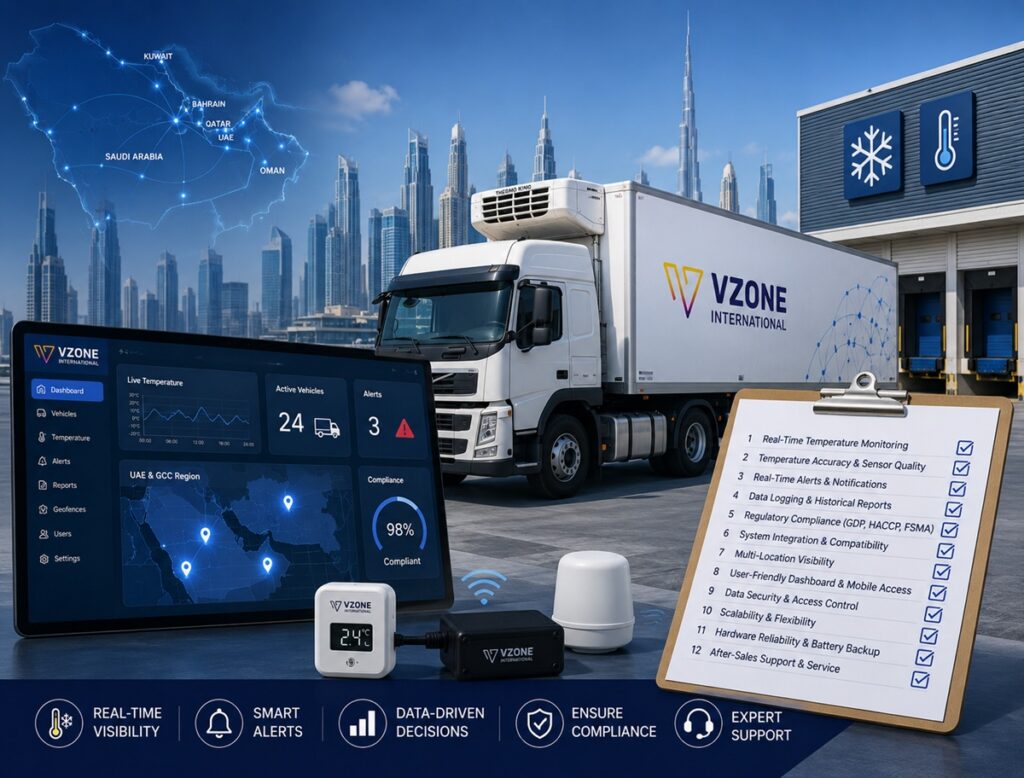
Choosing the wrong cold chain monitoring system costs more than the system itself. A pharmaceutical distributor who deploys a system without calibrated sensors discovers the compliance gap during a MOHAP audit. A food logistics operator who buys a system with no automated HACCP report generation spends three days compiling compliance reports manually every month. A construction company whose cold fleet monitoring system has no pre-alert configuration finds out what temperature excursions cost when cargo arrives condemned.
The cold chain monitoring market in UAE is large enough that buyer confusion is common providers use the same terminology to describe significantly different capabilities, and generic feature lists make it difficult to distinguish systems that genuinely satisfy UAE regulatory requirements from those that satisfy the surface description of those requirements without the operational depth.
This checklist gives you 12 specific, verifiable criteria to apply to any cold chain solution you are evaluating. Each criterion has a clear pass or fail test that you can apply before purchasing. If a provider cannot clearly demonstrate all 12, you are looking at a system that will either underperform operationally or create compliance exposure or both.
Key Takeaways
- Evaluate beyond basic features. Choose a solution that meets UAE regulatory requirements, operational needs, and long-term compliance goals.
- Prioritize real-time visibility. Look for live temperature monitoring with GPS, pre-alerts, and reefer health monitoring to prevent temperature excursions before they become costly.
- Ensure compliance is automated. Automated HACCP/GDP reporting, calibration management, and continuous data logging simplify audits and reduce manual work.
- Assess total value, not just price. Compare the 24-month total cost of ownership including hardware, support, compliance services, and maintenance before making your final decision.
Before You Start: Establish Your Baseline Requirements
Before applying the 12-point checklist, confirm the three baseline parameters that determine which criteria are most critical for your operation:
Your Situation | Your Priority Criteria |
Pharmaceutical distribution (MOHAP GDP) | Items 1, 4, 6, 7, 8, 10 are mandatory any gap creates audit risk |
Food logistics (FSRA / Dubai Municipality) | Items 1, 3, 6, 8 are mandatory items 4, 7 strongly recommended |
Mixed fleet with refrigerated and non-refrigerated | Items 11 (unified platform) and 12 (cost) are critical alongside cargo-specific items |
Cross-border UAE-Oman or UAE-Saudi operations | Item 10 (GCC coverage) becomes mandatory alongside all standard items |
New operation no existing GPS infrastructure | Full 12-point checklist applies; item 12 (total cost) should evaluate 24-month horizon |
Upgrading existing system | Focus on items 6 (automated reporting), 7 (calibration), and 11 (unified platform) most common upgrade gaps |
The 12-Point Cold Chain Solution Checklist
- UAE Regulatory Compliance Certifications
The system must hold the specific certifications applicable to your operation not generic GPS tracking credentials. For Abu Dhabi vehicles: ITC Asateel certified hardware on the approved list. For pharmaceutical fleets: MOHAP-aligned WHO GDP capability (this is not a certification but a documented compliance methodology). For food fleets: HACCP-compatible monitoring and reporting. For UAE-Oman cross-border: OPAL certified hardware. Test: ask the provider to show you the certification document for each applicable programme not a claim that they are ‘compliant’, but the actual certificate or approval letter.
- Real-Time Alerts With GPS Location Context
The system must transmit temperature alerts in real time not on a batch upload schedule and each alert must include the vehicle’s GPS location at the moment the alert fired. An alert that says ‘temperature above threshold’ without a GPS location requires a follow-up call to the driver to establish where the vehicle is. An alert that says ‘temperature +7.8°C and rising, vehicle stationary at delivery address in Al Quoz for 28 minutes’ is actionable intelligence. Test: ask for a live demo of an alert event showing what information reaches the operations manager’s phone.
- Pre-Alert Threshold Intervention Before Breach
The system must support pre-alert configuration at 80 to 90 percent of the allowable temperature limit generating a warning before the regulatory threshold is crossed, not just when it is crossed. For pharmaceutical cargo at +2°C to +8°C, a pre-alert at +6.5°C gives the operations team a 10 to 15-minute window to intervene in UAE summer conditions. A system that only alerts at +8°C provides documentation of a compliance failure, not prevention of one. Test: ask the provider to demonstrate configuring a pre-alert threshold and show you the alert timeline from a historical event.
- Reefer Unit Health Monitoring
Beyond cargo temperature, the system must monitor the refrigeration unit itself compressor operational status, reefer fuel tank level, and return air temperature. A reefer compressor that fails while the cargo is still within temperature (thermal mass providing a 30 to 90-minute buffer) gives you an intervention window only if reefer failure is detected immediately, not when the cargo temperature starts rising. Test: ask the provider whether their system monitors reefer compressor status separately from cargo temperature, and what alert fires when the compressor stops.
- Multi-Zone Independent Sensor Support
The system must support independent sensors at multiple locations within a compartment not just a single sensor at one point. For pharmaceutical vehicles, a minimum two-zone configuration (evaporator zone and door zone) is required to detect the temperature gradients that create compliance exposure without showing an excursion at the monitored point. For dual-temperature vehicles (chilled and frozen), independent zones with independent alert configurations are mandatory. Test: ask the provider for the maximum number of independent sensor zones supported per vehicle and whether each zone has independent alert configuration.
- Automated Compliance Report Generation
The system must generate HACCP-compatible reports (food cold chain) or WHO GDP-formatted trip reports (pharmaceutical) automatically at trip completion without requiring manual data extraction, compilation, or reformatting. A platform that produces raw temperature data requiring an analyst to compile into compliance reports creates unsustainable administrative overhead at operational scale and introduces manual transcription errors that create audit risk. Test: ask the provider to show you a sample automated report from a completed trip and compare it against the specific format your regulatory framework requires.
- Calibration Certificate Management (Pharmaceutical Critical)
For pharmaceutical applications, every monitoring sensor must carry a current calibration certificate traceable to national metrology standards (UAE NMI or equivalent). The system must track calibration expiry dates for every sensor in the fleet, alert the quality manager when certificates approach expiry, and support replacement with pre-calibrated sensors so there is no gap in the certified monitoring record. Test: ask the provider whether they manage calibration as a service (tracking, renewal alerts, replacement), or whether calibration management is the customer’s responsibility.
- Offline Data Buffering and Battery Backup
The system must maintain a complete temperature record during cellular connectivity gaps common on desert routes, at border crossings, and in underground car parks. Offline buffering stores readings locally and uploads them when connectivity is restored, creating a continuous record without gaps. For cold storage facility monitoring, battery-backed sensors maintain both temperature measurement and alert transmission during power failures the most common cause of UAE cold storage excursions. Test: ask what happens to the monitoring record when a vehicle enters a cellular dead zone for 45 minutes, and ask what alert fires when a facility sensor loses mains power.
- Door Sensor and Loading Event Monitoring
The system should monitor door open/close events with duration recording flagging when doors remain open beyond a configured safe duration. In UAE summer conditions, loading dock door exposure is among the top causes of cold chain excursions; monitoring door-open duration creates the operational data to identify problematic loading practices and enforce procedural improvements. Test: ask whether door sensors are available as an add-on and what alert configuration is possible for door-open duration thresholds.
- Cross-Border GCC Coverage and Multi-Country Compliance
If your fleet operates cross-border routes into Oman, Saudi Arabia, Qatar, or Kuwait, the monitoring system must maintain continuous temperature and GPS tracking across borders with dual-SIM or satellite fallback capability for desert and remote route segments. For UAE-Oman pharmaceutical operations, the provider must hold OPAL certification. The platform must be able to generate OPAL-format compliance reports alongside MOHAP-format records from the same data. Test: ask the provider which GCC countries they have compliance certifications for and whether their hardware maintains tracking continuity on the UAE-Oman desert route specifically.
- Unified Platform Temperature and GPS on One Dashboard
Cold chain temperature monitoring and GPS fleet tracking must operate on the same platform not on separate systems that require manual cross-referencing. GPS-paired temperature records require both data streams to be co-transmitted and co-processed. Regulatory requirements for location-stamped temperature documentation cannot be satisfied by separate systems that record temperature on one platform and GPS on another and require manual reconciliation. Test: ask whether temperature monitoring and GPS location data are available in the same dashboard view, and whether trip reports show GPS coordinates at each temperature reading interval.
- Total Cost of Compliance Not Just Subscription Price
Evaluate cost over 24 to 36 months including all components: hardware purchase, installation, monthly platform subscription, UAE compliance portal management (Asateel/SecurePath data submission sometimes charged separately), calibration service costs (pharmaceutical), vehicle qualification study costs (pharmaceutical), and support tier. A system that is cheaper per vehicle per month but requires you to manage Asateel registration independently, compile compliance reports manually, and handle calibration logistics yourself has a higher true cost than a fully managed, higher-subscription solution. Test: ask the provider for a 24-month total cost of ownership breakdown including all chargeable services.
Quick Scoring Guide How to Use This Checklist
Apply the checklist to each provider you are evaluating. Score each item:
- Pass (2 points): Provider demonstrates the capability clearly with evidence
- Partial (1 point): Provider has some capability but with limitations or manual workarounds
- Fail (0 points): Capability is absent or provider cannot demonstrate it
Total Score | Interpretation | Recommended Action |
22–24 points | Strong across all criteria appropriate for pharmaceutical and regulated food fleets | Proceed to contract negotiation; verify UAE certifications with the issuing authority |
16–21 points | Solid for standard cold chain but gaps in regulated applications | Identify specific gaps; acceptable for food/logistics if pharmaceutical items are not critical |
10–15 points | Material gaps may satisfy basic GPS compliance but not cold chain compliance | Do not deploy for pharmaceutical or regulated food fleets; revisit for basic GPS-only needs |
Below 10 points | Insufficient for professional cold chain operations in UAE | Continue evaluation; do not purchase without addressing critical gaps |
10 Questions to Ask Any Cold Chain Solution Provider
Use these questions in your provider evaluation meetings to verify the 12 checklist criteria efficiently:
- Which UAE regulatory certifications do you hold specifically Asateel, SIRA, ADNOC IVMS, OPAL Oman and can you provide the certificate documents?
- Can you show me a live alert demo what does the alert look like when a vehicle’s temperature approaches the limit, and what location information is included?
- Can you configure pre-alert thresholds independently from excursion thresholds, and at what percentage of the limit do your default pre-alerts fire?
- Does your system monitor reefer compressor status separately from cargo temperature what alert fires if the reefer unit stops while cargo temperature is still within range?
- How many independent temperature zones can your system support per vehicle, and can each zone have independent alert thresholds?
- Can you show me a sample automated compliance report from a completed pharmaceutical or food delivery trip what format does it generate, and does it require any manual processing?
- For pharmaceutical deployments do you provide calibration certificate management as a service, including renewal tracking and pre-calibrated replacement sensors?
- What happens to the temperature record when a vehicle is in a cellular dead zone how does the system maintain record continuity, and can you show a trip report from a route with connectivity gaps?
- Are temperature monitoring and GPS location data on the same platform, and do your trip reports show GPS coordinates at each temperature reading interval?
- What is the full 24-month total cost of ownership for a 10-vehicle pharmaceutical cold chain fleet including hardware, installation, subscription, Asateel registration, calibration service, and vehicle qualification support?
How VZone International Scores Against the 12-Point Checklist
Checklist Item | VZone Score | Evidence |
1. UAE Regulatory Certifications | Pass (2) | ITC Asateel, RTA SecurePath, SIRA, ADNOC IVMS, OPAL Oman, ISO all current |
2. Real-Time GPS-Paired Alerts | Pass (2) | Wialon platform co-transmits GPS + temperature every 2–5 min; GPS coordinates in every alert |
3. Pre-Alert Configuration | Pass (2) | Configurable pre-alert at any percentage of limit; standard configuration at 80–85% for pharma |
4. Reefer Unit Health Monitoring | Pass (2) | Compressor status, reefer fuel level, return air temperature monitored alongside cargo temperature |
5. Multi-Zone Sensor Support | Pass (2) | Up to 4+ independent zones per vehicle; independent alert thresholds per zone |
6. Automated Compliance Reports | Pass (2) | GDP-formatted and HACCP-compatible reports generated automatically at trip completion |
7. Calibration Certificate Management | Pass (2) | Managed calibration service; UAE NMI-traceable certificates; renewal tracking; pre-calibrated replacements |
8. Offline Buffering + Battery Backup | Pass (2) | Offline buffering on all devices; 72-hour battery backup on facility sensors with cellular SIM fallback |
9. Door Sensor Support | Pass (2) | Door sensors available as standard add-on; duration alerts configurable |
10. Cross-Border GCC Coverage | Pass (2) | Dual-SIM devices with satellite fallback; OPAL certified for Oman; operational Saudi Arabia coverage |
11. Unified Platform | Pass (2) | GPS + temperature + fuel + driver + maintenance on single Wialon dashboard; GPS-paired trip reports |
12. Total Cost Transparency | Pass (2) | 24-month TCO breakdown provided on request; all services itemised; no hidden compliance portal charges |
Conclusion: Use the Checklist Before You Sign Anything
The cold chain monitoring market in UAE has enough providers and enough marketing language similarity that the only reliable way to distinguish genuinely capable systems from superficially compliant ones is to apply a specific, verifiable evaluation framework not to rely on feature lists, case study testimonials, or provider assurances.
The 12 criteria in this checklist are specific enough to test in a sales meeting or product demonstration. Pre-alert configuration is either available or it is not. Calibrated sensors with managed certificate renewal are either provided or they are not. Automated GDP reports are either generated at trip completion without manual steps or they require manual compilation. Reefer compressor monitoring is either available or the system is monitoring only cargo temperature.
Every gap in this checklist represents either an operational risk (excursions not prevented, reefer failures not detected early) or a compliance risk (documentation that does not satisfy HACCP or GDP audit requirements). In the UAE cold chain context where MOHAP audits, FSRA inspections, manufacturer GDP reviews, and customer supply chain audits all examine the same monitoring documentation closing all 12 gaps is not perfectionism. It is the minimum standard for a professional cold chain monitoring operation.
VZone International 24 / 24 on the cold chain checklist.
This is not a marketing claim it is a verifiable statement. Ask VZone to demonstrate every item on this list before you commit to anything. We will show you the certification documents, the live alert demo, the automated GDP report, the reefer status monitoring, and the 24-month cost breakdown. If any provider cannot do the same for all 12 items, you now know why.
Frequently Asked Questions
The 12 most important criteria for a cold chain monitoring system in UAE are: UAE regulatory certifications for your specific compliance framework; real-time GPS-paired temperature alerts; pre-alert configuration before threshold breach; reefer unit health monitoring; multi-zone independent sensor support; automated HACCP or GDP compliance report generation; calibration certificate management for pharmaceutical applications; offline data buffering and battery backup; door sensor monitoring; cross-border GCC coverage if applicable; unified GPS and temperature platform; and total cost of compliance over 24 months. Any system that cannot demonstrate all criteria applicable to your cargo category creates either operational gaps or compliance exposure.
The ten most important questions to ask any cold chain monitoring provider in UAE are: (1) Which UAE certifications do you hold can you show me the documents? (2) What does a live temperature alert look like with GPS context? (3) Can you configure pre-alerts before threshold breach? (4) Do you monitor reefer compressor status separately from cargo temperature? (5) How many independent zones per vehicle? (6) Can I see an automated GDP or HACCP report from a real delivery? (7) Do you manage calibration certificates as a service? (8) What happens to the record in cellular dead zones? (9) Are GPS and temperature on the same dashboard? (10) What is the full 24-month cost for my specific fleet size and type?
A cold chain solution meets HACCP requirements in UAE if it provides: continuous temperature monitoring (not just departure and arrival readings); automatic alerts when temperature deviates from Critical Control Point limits; GPS-verified delivery temperature records; complete digital documentation of any temperature events with timestamps; and automated journey reports that show temperature at configured intervals throughout the full transit period. The solution must not require manual compilation of any of these records a HACCP compliance programme that depends on manual data processing is operationally unsustainable and creates documentation gaps that inspection bodies and retail customer audits identify quickly.
A basic GPS tracker records vehicle location. A cold chain monitoring system records both vehicle location and cargo temperature simultaneously, generates real-time alerts when temperature approaches or exceeds safe limits, monitors reefer unit health to detect failures before cargo is affected, supports multi-zone sensor configurations to cover temperature gradients within compartments, produces automated HACCP or GDP compliance reports, manages sensor calibration certificates for pharmaceutical applications, and maintains monitoring continuity during connectivity gaps and power failures. These are fundamentally different products serving different operational needs a GPS tracker cannot substitute for a cold chain monitoring system for any regulated cold chain application.