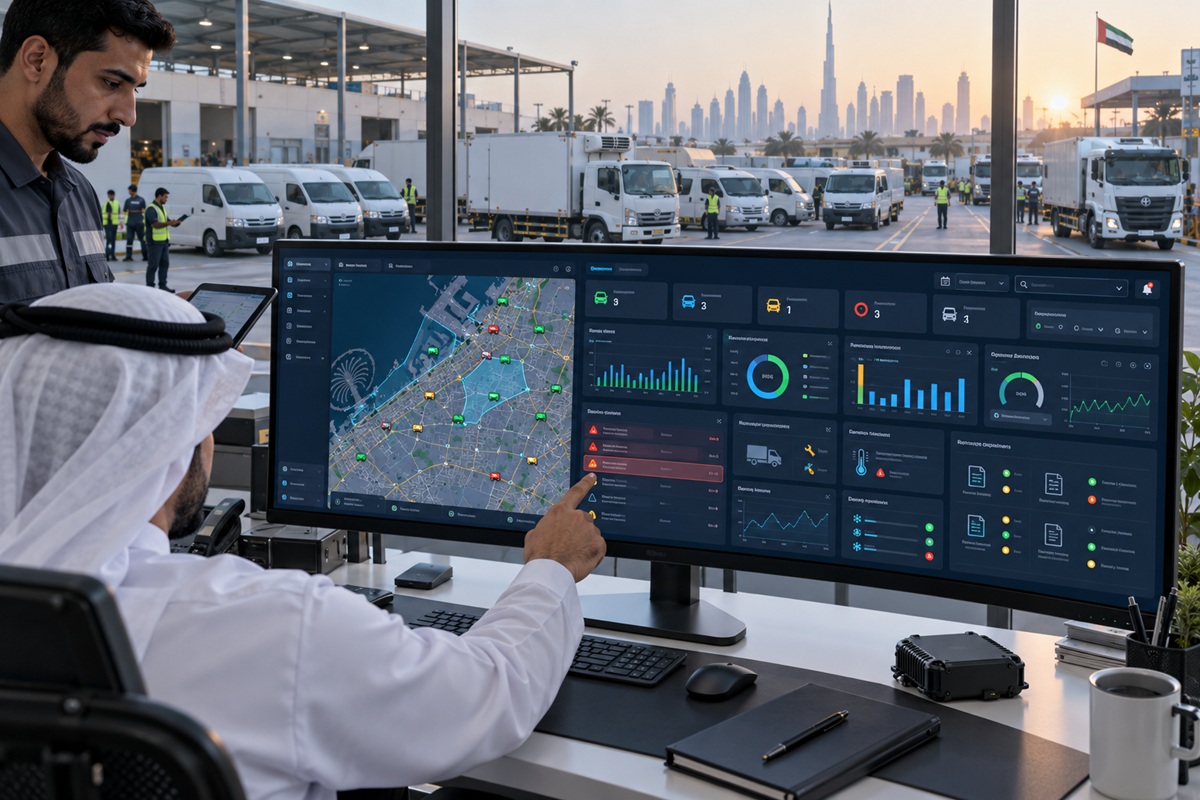
UAE’s food and beverage distribution sector operates in a paradox: the country with one of the highest per-capita food import values in the world, one of the most demanding ambient temperature environments for cold chain logistics anywhere, and one of the most sophisticated retail and hospitality markets in the region also has significant cold chain infrastructure gaps that create avoidable food waste, regulatory risk, and supply chain reliability problems for distributors of all sizes.
For food and beverage distributors serving UAE’s supermarkets, hotels, restaurants, quick service chains, and catering operations, cold chain temperature monitoring is simultaneously a regulatory obligation and a commercial necessity. Dubai Municipality’s food safety inspections and FSRA’s HACCP requirements set the compliance floor. Major retail and foodservice customers increasingly set a higher commercial standard: electronic delivery temperature records, automated compliance documentation, and the ability to demonstrate continuous cold chain integrity throughout the supply chain as a supplier qualification criterion.
This guide covers the specific temperature monitoring requirements for food and beverage distribution in UAE what HACCP requires, what Dubai Municipality and FSRA inspectors examine, how UAE summer conditions affect food cold chain management differently from cooler markets, and how GPS-integrated temperature monitoring for food fleets addresses all of these requirements in a single operational system.
Key Takeaways
- Food and beverage cold chain temperature requirements in UAE span five distinct categories fresh produce, chilled dairy and meat, frozen products, ambient-controlled products, and catering supply each with different temperature limits and different monitoring priorities.
- HACCP treatment of temperature control during transport as a Critical Control Point means UAE food distributors must maintain continuous temperature records throughout delivery routes not just at departure and arrival and must document any deviations with investigation and corrective action records.
- Dubai Municipality food safety inspections and FSRA HACCP assessments are increasingly scrutinising manual temperature records in favour of automated electronic systems with tamper-resistant, timestamped continuous monitoring records.
- Multi-stop urban delivery routes the standard model for UAE food distribution create cumulative thermal exposure challenges that single-departure-temperature monitoring cannot detect: a vehicle compliant at departure may have cargo outside specification by stop 15 on a 25-stop summer afternoon route.
- Major UAE food retail chains and foodservice groups now specify electronic temperature monitoring as a supplier qualification requirement not just regulatory compliance. Distributors who cannot provide automated GPS-verified temperature delivery records are losing contracts to those who can.
- Food waste from cold chain failures in UAE is estimated at 25 to 40 percent of total food supply chain waste the majority preventable with real-time temperature monitoring and pre-alert intervention capability.
Temperature Requirements for Food and Beverage Distribution UAE
UAE food safety regulations set specific temperature requirements for each food category during transport, enforced by FSRA in Abu Dhabi and Dubai Municipality’s Food Safety Department in Dubai. Understanding the specific limits for your cargo categories is the foundation of compliant cold chain monitoring configuration.
| Food Category | Required Temp During Transport | Regulator | Key Monitoring Priority | Consequence of Non-Compliance |
| Fresh leafy vegetables and herbs | +2°C to +8°C | FSRA / DM Food Safety | Humidity as well as temperature; high door-open frequency | Product wilting, weight loss, spoilage; regulatory seizure |
| Fresh fruit (tropical) | +10°C to +13°C | FSRA / DM Food Safety | Chilling injury below minimum; spoilage above maximum | Chilling damage or accelerated ripening; product seizure |
| Fresh meat and poultry | 0°C to +4°C | FSRA / DM Food Safety | Strict upper limit; microbial growth above +4°C | Microbial contamination risk; product recall; regulatory action |
| Fresh seafood | 0°C to +4°C (on ice or refrigerated) | FSRA / DM Food Safety | Strict upper limit; histamine formation in fish above +4°C | Histamine risk (scombroid fish); product recall; public health risk |
| Dairy products (milk, yoghurt) | 0°C to +5°C | FSRA / DM Food Safety | Upper limit critical for microbial safety | Microbial growth; product recall; licence risk |
| Cheese (hard/semi-hard) | +2°C to +8°C | FSRA / DM Food Safety | Mould risk at high humidity + temperature combination | Quality degradation; customer rejection |
| Frozen food (standard) | -18°C and below | FSRA / DM Food Safety | Any thawing event; defrost cycle management | Partial thaw = microbial risk; product recall; fine |
| Ice cream | -18°C to -22°C (transport) | FSRA / DM Food Safety | Partial thaw creates texture damage even below -18°C | Quality damage; customer rejection; product destruction |
| Chilled juices and beverages | +2°C to +8°C | FSRA / DM Food Safety | Upper limit for extended shelf life products | Shelf life reduction; customer complaints; potential recall |
| Catering (ready-to-eat, hot) | +63°C and above (hot) / 0°C to +5°C (cold) | Dubai Municipality / FSRA | Critical for hot food; dual temperature for buffet catering | Food poisoning risk; serious regulatory action; licence suspension |
UAE Regulatory Requirements HACCP, Dubai Municipality and FSRA
HACCP and the Food Transport Critical Control Point
The Hazard Analysis and Critical Control Points (HACCP) food safety management framework mandated by both FSRA and Dubai Municipality for food businesses including distributors treats temperature control during transport as a Critical Control Point (CCP). The CCP designation means temperature control during distribution is not a general good practice but a specific, documented, auditable control measure that must meet defined requirements: a documented critical limit (the temperature specification), monitoring procedures that confirm the limit is being maintained, corrective action documentation for deviations, verification activities confirming the monitoring system is effective, and complete record-keeping demonstrating ongoing compliance.
The record-keeping requirement is where many UAE food distributors create compliance exposure. A HACCP CCP temperature record that shows only departure and arrival temperatures does not demonstrate ‘continuous monitoring’ it demonstrates two spot checks. FSRA and Dubai Municipality food safety inspectors examining HACCP documentation are increasingly distinguishing between genuine continuous monitoring records (electronic logs with readings at defined intervals throughout transit) and retrospective documentation assembled at departure and delivery. The regulatory direction is clearly toward automated electronic records that cannot be falsified or compiled retrospectively.
Dubai Municipality Food Safety Requirements
Dubai Municipality’s Food Safety Department regulates food transport temperature compliance for operators distributing into Dubai. Key requirements for food distribution fleets include: food safety management systems (HACCP-based) covering transport as a CCP; temperature monitoring during transport with records available for inspection; vehicle hygiene and maintenance standards ensuring refrigeration systems are maintained in good working order; and proper loading and unloading practices that minimise temperature exposure during transfers.
Dubai Municipality’s commercial food safety inspection programme examines food distributors’ supply chain temperature records during routine inspections of food business customers supermarkets, restaurants, hotels not just during inspections of the distributor itself. A restaurant that fails to produce delivery temperature records from its distributor may generate a finding that triggers a visit to the distributor’s operations. This creates downstream pressure from food service customers that is often more immediate than direct regulatory inspection: customers who face findings related to their supplier’s temperature records terminate supply contracts faster than regulators issue fines.
FSRA Cold Chain Requirements in Abu Dhabi
The Abu Dhabi Food Safety and Biosecurity Authority (FSRA) applies UAE food safety standards for food distribution operations in Abu Dhabi, with HACCP implementation including transport CCP as a core requirement. FSRA food safety inspections examine both vehicle standards (refrigeration system condition, temperature monitoring equipment, hygiene) and documentation standards (continuous temperature records, corrective action logs, supplier and customer documentation). Electronic temperature records are increasingly the expected standard rather than a premium above the baseline.
For food distributors operating across both Dubai and Abu Dhabi common in the UAE market both Dubai Municipality and FSRA requirements apply. The requirements are substantially aligned in their food safety management approach, but are administered by separate authorities with separate inspection cycles. A single UAE-compliant cold chain monitoring system that generates the same automated temperature documentation for both emirate’s inspection requirements eliminates the overhead of managing separate compliance programmes for the same fleet operations.
UAE Summer Heat Why Food Cold Chain Is Harder Here Than Anywhere Else
The Multi-Stop Cumulative Thermal Load Problem
Food distribution in UAE’s major cities Dubai, Abu Dhabi, Sharjah typically involves multi-stop routes delivering to supermarkets, restaurants, hotels, and catering kitchens across dense urban networks. A standard chilled food distribution route may involve 20 to 35 delivery stops per vehicle per day. Each stop involves opening the refrigerated compartment, unloading product, and closing the door typically taking 5 to 20 minutes per stop depending on the delivery size and the receiving facility’s efficiency.
In UAE summer conditions, each door-open event introduces ambient air at 40°C to 47°C into a compartment designed to maintain +2°C to +5°C. The temperature impact is not uniform across stops: the first five stops of the day, when the vehicle and cargo thermal mass are fully conditioned, tolerate door-open exposure better than stops 20 to 25, when the thermal buffer has been progressively depleted and the reefer unit is working harder to compensate. Fleet temperature monitoring that records temperature continuously throughout all 25 stops not just at departure and arrival is the only way to detect the end-of-route temperature drift that summer afternoon routes in UAE create.
Pre-Cooling Verification The First Line of Defence
A vehicle that departs its depot without completing the pre-cooling cycle starts every delivery stop already behind temperature. In UAE summer conditions, a vehicle interior at +15°C (insufficiently pre-cooled) loaded with chilled cargo at +4°C can expose the cargo to temperatures well above specification on the first delivery stop creating a HACCP CCP deviation from the very first delivery of the route. Pre-cooling verification confirming that the cargo compartment has reached setpoint before loading begins is the most impactful single procedural measure in UAE food cold chain management.
GPS-integrated temperature monitoring enables automated pre-cooling verification: the depot supervisor can see the compartment temperature on the fleet dashboard before authorising loading. A vehicle at +8°C is not ready to load chilled dairy; a vehicle at +2°C is. Making loading authorisation conditional on compartment temperature reaching setpoint enforced through the monitoring system rather than relying on driver self-reporting eliminates one of the most common and most preventable causes of food cold chain failure in UAE operations.
High-Volume Hospitality Sector Delivery Challenges
UAE’s hospitality sector one of the most concentrated in the world, with thousands of hotel food and beverage operations, restaurant groups, and large catering facilities creates specific food cold chain challenges for distributors. Hotel receiving dock procedures often involve product waiting at ambient temperature during inspection and documentation processes before transfer to cold storage. Restaurant deliveries during peak kitchen preparation periods may involve rushed receiving processes that maximise door-open time. Large catering facility deliveries may require staging product at ambient temperature during volume unloading.
Each of these hospitality sector receiving scenarios creates a temperature exposure window that the distributor’s vehicle is present for but may not control. Temperature monitoring that records the compartment temperature through the full unloading process including the loading dock exposure period creates the documentation basis for distinguishing between a temperature deviation that occurred during transit (distributor responsibility) and one that occurred during extended customer receiving procedures (customer facility issue). Without GPS-paired continuous temperature records through the full delivery event, attribution in the event of a dispute is impossible.
What Food and Beverage Distributors Need From a Cold Chain Monitoring System
Continuous Temperature Recording Throughout Multi-Stop Routes
Unlike pharmaceutical cold chain monitoring where a single daily delivery route may involve three to five stops, food distribution routes in UAE involve 20 to 35 stops across four to eight hours of active delivery. The monitoring system must maintain continuous temperature recording at two to five-minute intervals throughout the full route creating a complete temperature profile that shows the temperature condition of cargo at every point, including the critical end-of-route period when cumulative thermal load is highest.
The HACCP critical limit monitoring requirement specifies continuous monitoring of the CCP not periodic sampling. A five-minute recording interval generates 96 to 192 data points on a standard eight-hour food distribution route, providing sufficient resolution to identify the specific delivery event or route segment where a temperature deviation occurred. A 30-minute interval the standard for many basic GPS-temperature systems generates only 16 data points for the same route, missing the short-duration temperature spikes from door events that create HACCP CCP deviations.
Automated HACCP Journey Reports With CCP Documentation
The HACCP journey report is the compliance document that demonstrates the CCP temperature control was maintained throughout transit. For UAE food distributors, this report must show: the delivery route and vehicle identifier; temperature readings at configured intervals throughout the full transit period; the temperature range maintained (within or outside the CCP critical limit); any CCP deviation events with timestamps, GPS coordinates, and duration; and evidence of corrective action if deviations occurred. Automated generation of this report at route completion, without manual data extraction is the operational standard that both regulatory requirements and major customer supply chain audits now expect.
The customer-facing dimension of the HACCP journey report is increasingly significant. UAE’s largest retail chains Carrefour, LuLu, Spinneys, Choithrams and major hotel and restaurant groups conduct supplier supply chain audits that examine temperature delivery records as part of their food safety management system verification. A food distributor who can provide automated, GPS-verified HACCP journey reports for any delivery on request is a preferred supply partner. One who provides manual logs, paper records, or reports that require the customer to navigate a third-party portal to access is a supplier with a documentation gap that supply chain auditors flag.
Multi-Zone Monitoring for Mixed Load Vehicles
Food distribution vehicles in UAE frequently carry mixed cargo categories in the same vehicle: chilled products (+2°C to +8°C) in the main compartment and frozen products (-18°C) in a separate zone, or high-humidity fresh produce and low-humidity dairy products in different compartment areas. Multi-zone independent sensor configurations provide separate temperature records for each zone satisfying the HACCP requirement for independent CCP monitoring of each product category and enabling separate HACCP documentation for each zone.
The operational benefit of multi-zone monitoring extends beyond compliance documentation. A single-sensor system on a mixed-load vehicle provides no warning that frozen product has partially thawed in the frozen zone while the chilled zone’s sensor shows compliant temperatures. Independent frozen zone monitoring with its own pre-alert and excursion alert configuration catches the frozen zone deviation independently of the chilled zone performance enabling the specific corrective response (checking and correcting the frozen zone temperature) rather than a general investigation.
Food Cold Chain Monitoring Across UAE Distribution Sectors
Supermarket and Retail Chain Supply
UAE supermarket chains are among the most documentation-intensive customers for food cold chain distributors. Major retailers conduct supplier audits that include temperature delivery record review, and the trend across UAE retail as international chains apply their global supply chain standards to UAE operations is toward mandatory electronic temperature monitoring as a supplier qualification requirement. A food distributor whose competitors provide automated temperature delivery records while they provide paper logs or manual compilations is at an increasing competitive disadvantage in retail supplier qualification processes.
The operational reality for UAE retail food distributors is that electronic temperature monitoring has shifted from a competitive differentiator to a competitive expectation at major retail accounts. The distributor who invested in automated GPS-temperature monitoring three years ago is now simply meeting the standard; the distributor who has not yet invested is now behind it.
Hotel and Foodservice Supply F&B Chain Requirements
UAE’s hotel and foodservice sector encompassing international hotel chains, major F&B operators, and large catering companies applies food safety standards that reflect the international brand standards of their parent organisations. Marriott, Accor, IHG, Hilton, and other international hotel groups operating in UAE apply their global food safety procurement standards to UAE food suppliers standards that typically include GPS-verified temperature delivery records as a mandatory supplier documentation requirement.
For UAE food distributors supplying international hotel brands, the supply chain audit requirement creates a compliance obligation that exceeds the UAE regulatory minimum. FSRA and Dubai Municipality require HACCP temperature monitoring and records; international hotel brand standards typically require GPS-verified electronic records in a specific format, with a defined retention period and access-on-request capability for their procurement audit teams. Automated GPS-paired temperature monitoring satisfies both the UAE regulatory requirement and the international brand standard simultaneously manual systems satisfy neither completely.
Quick Commerce and E-Commerce Grocery
UAE’s quick commerce sector sub-two-hour and same-day grocery delivery applies maximum thermal pressure to food cold chain monitoring because compressed delivery windows leave no buffer for route inefficiencies or temperature management failures. A driver making 25 chilled grocery deliveries in four hours in Dubai summer conditions will open the compartment door 25 times, each event introducing peak ambient heat into the cargo space. Temperature monitoring for quick commerce food fleets must be highly sensitive to short-duration temperature spikes, configured with aggressive pre-alert thresholds, and provide real-time driver feedback that enables behaviour correction during the route rather than post-route analysis.
The commercial stakes in quick commerce food cold chain are particularly immediate: an end customer who receives a chilled product at ambient temperature warm milk, wilted salad, warm yoghurt posts a negative review and cancels their subscription. The route between a temperature monitoring pre-alert and a customer complaint is short. Monitoring platforms that include driver-facing in-cab temperature displays showing the current compartment temperature to the driver alongside the GPS navigation display provide the real-time awareness that reduces door-management failures on high-frequency urban delivery routes.
How VZone International Supports Food and Beverage Cold Chain in UAE
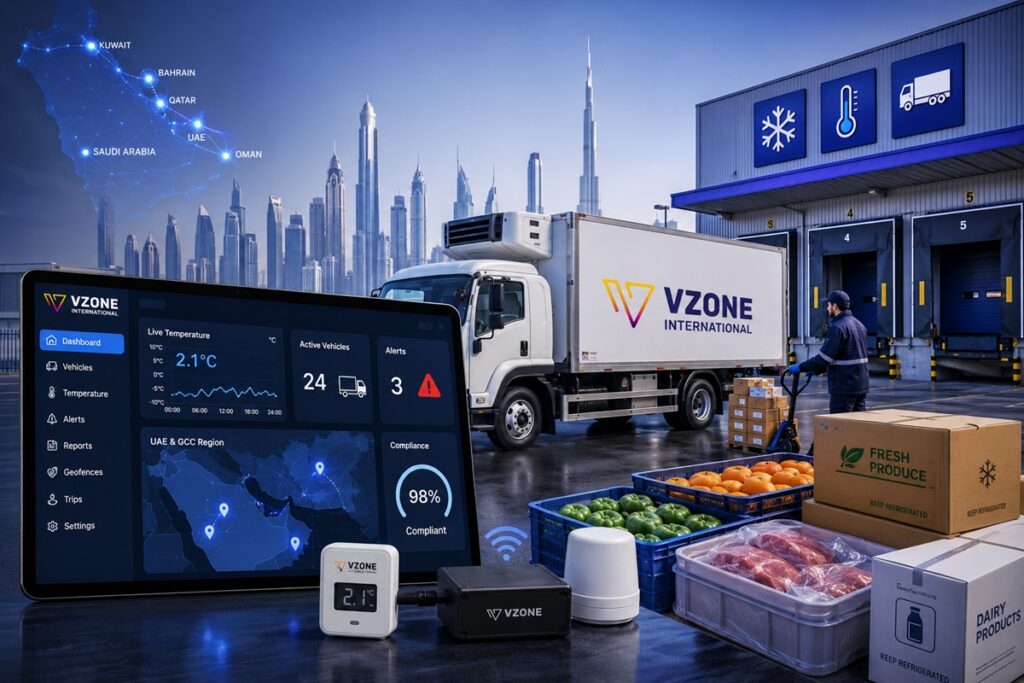
VZone International provides GPS-integrated cold chain temperature monitoring for UAE food and beverage distribution fleets chilled delivery vans, multi-zone trucks, frozen product vehicles, and catering supply fleets with automated HACCP-compatible journey reports, multi-zone sensor configurations, pre-alert thresholds calibrated for UAE summer conditions, and unified fleet management integrating temperature monitoring with GPS route tracking, fuel monitoring, and driver behaviour scoring on the Wialon enterprise platform.
HACCP-Compatible Automated Reporting
VZone’s platform generates HACCP-compatible temperature journey reports automatically at route completion showing temperature at configured two to five-minute intervals throughout the full delivery route, any CCP threshold crossings with timestamps and GPS coordinates, and the vehicle identifier and route details that FSRA and Dubai Municipality food safety records require. Reports are available to quality managers immediately after route completion without manual data extraction, and can be configured for automatic email delivery to customer supply chain audit contacts when delivery documentation is required.
UAE Summer Pre-Alert Configuration
VZone’s standard food cold chain configuration for UAE operations uses pre-alert thresholds calibrated for UAE summer conditions rather than the generic European benchmarks that most monitoring platforms default to. For chilled food at 0°C to +5°C, a pre-alert at +4°C (80 percent of the +5°C upper limit) provides approximately 10 to 20 minutes of intervention time in peak summer conditions. For frozen products, a pre-alert at -15°C provides warning before cargo approaches the partial-thaw risk zone. These UAE-calibrated thresholds are configured as standard for all UAE food distribution fleet deployments not as a premium customisation.
Integration With Driver Behaviour and Route Optimisation
VZone’s food cold chain monitoring integrates with the full fleet management platform driver behaviour scoring, route optimisation, and fuel monitoring available on the same dashboard as temperature monitoring. For food distribution fleet managers, this integration enables cross-data analysis that separate systems cannot provide: correlating high door-open frequency events with specific drivers or delivery stops, identifying routes where the cumulative thermal load consistently approaches pre-alert thresholds, and combining temperature compliance performance with driver safety scoring in a unified fleet performance review framework.
Conclusion: Food Cold Chain Monitoring in UAE Is Both a Regulatory Floor and a Commercial Ceiling
The regulatory floor for UAE food cold chain temperature monitoring HACCP compliance, FSRA certification, Dubai Municipality documentation sets the minimum that food distributors must satisfy to maintain their operating licence and avoid enforcement action. Above that floor, the commercial ceiling is set by what major retail chains, international hotel brands, and sophisticated foodservice operators specify as supplier qualification requirements and that ceiling is rising steadily toward automated, GPS-verified, continuously monitored temperature records for every delivery.
UAE food distributors who invested in GPS-integrated cold chain monitoring three to five years ago are now operating at the standard that major retail and hospitality customers expect. Distributors who have not yet invested are increasingly finding that their temperature documentation capability is a constraint on winning or retaining major customer contracts not just a compliance obligation.
The UAE food cold chain environment is unforgiving: 45°C summer ambient temperatures, multi-stop urban delivery routes, a dense hospitality sector with demanding receiving standards, and increasingly sophisticated customer supply chain audit requirements. The monitoring technology that navigates all of these challenges real-time GPS-paired temperature monitoring, UAE-calibrated pre-alerts, reefer health monitoring, automated HACCP reports, and unified fleet management integration is accessible, proven, and delivers ROI that food distributors at any scale can calculate before committing to the investment.
Protect your food and beverage cargo from UAE’s extreme heat and your contracts from audit findings.
VZone International provides GPS-integrated cold chain temperature monitoring for UAE food and beverage distributors automated HACCP journey reports, UAE-calibrated pre-alerts, multi-zone sensors, reefer health monitoring, and compliance documentation that satisfies both FSRA/Dubai Municipality requirements and major retail and hospitality customer supply chain audits. Get a free cold chain assessment today.
Frequently Asked Questions
UAE food temperature requirements during distribution vary by category: fresh meat and poultry at 0°C to +4°C; dairy and chilled beverages at 0°C to +5°C; fresh produce at +2°C to +8°C depending on type (leafy vegetables) or +10°C to +13°C (tropical fruits); frozen food at -18°C and below; ice cream at -18°C to -22°C during transport; and ready-to-eat hot catering food at +63°C and above. These requirements are enforced by FSRA in Abu Dhabi and Dubai Municipality's Food Safety Department in Dubai, and apply to the temperature maintained throughout transit not just at loading and delivery.
HACCP requirements for UAE food distributors treat temperature control during transport as a Critical Control Point, requiring: defined critical temperature limits for each cargo category; continuous monitoring throughout the full transit period (not just departure and arrival); documented corrective action for any temperature deviation; verification of monitoring system performance; and complete electronic temperature records available for FSRA and Dubai Municipality food safety inspection. Records must demonstrate continuous monitoring periodic spot checks do not satisfy the HACCP continuous monitoring specification for a transport CCP.
Cold chain monitoring reduces food waste through four mechanisms: real-time pre-alerts before temperature thresholds are crossed enable intervention (rerouting, emergency cold storage transfer, or reefer repair) before cargo is condemned; reefer health monitoring detects developing equipment failures before they cause cargo loss; multi-stop route analysis identifies the specific delivery stops and route segments where thermal exposure is highest, enabling operational changes that reduce cumulative temperature pressure; and pre-cooling verification prevents the loading-temperature problem that makes end-of-route compliance impossible on summer afternoon routes. UAE food distributors implementing GPS-integrated temperature monitoring typically reduce cold chain-related food waste by 60 to 80 percent within 12 months.
Major UAE supermarket chains and international hotel brands increasingly require electronic, GPS-verified temperature delivery records as a supplier qualification criterion not just FSRA or Dubai Municipality regulatory compliance documentation. The standard expected by UAE retail and hospitality supply chain auditors includes: automated temperature journey reports showing continuous readings throughout transit (not just departure and arrival); GPS location stamped at each temperature reading interval; HACCP CCP compliance status clearly indicated; records available for access-on-request audit capability; and an electronic records retention period of at least one year. Manual paper temperature logs or systems requiring the customer to navigate a third-party portal do not satisfy this standard at major retail accounts.
The best cold chain monitoring system for UAE food distribution combines: GPS-integrated IoT sensors recording temperature every two to five minutes throughout multi-stop routes; pre-alert configuration calibrated for UAE summer thermal dynamics (not European defaults); reefer health monitoring alongside cargo temperature; multi-zone independent sensor support for vehicles carrying mixed chilled and frozen categories; automated HACCP-compatible journey reports generated at route completion without manual processing; driver-facing in-cab temperature display for real-time awareness; and a unified platform integrating temperature monitoring with GPS fleet tracking, driver behaviour scoring, and route optimisation. VZone International provides this integrated food cold chain monitoring solution for UAE distributors.