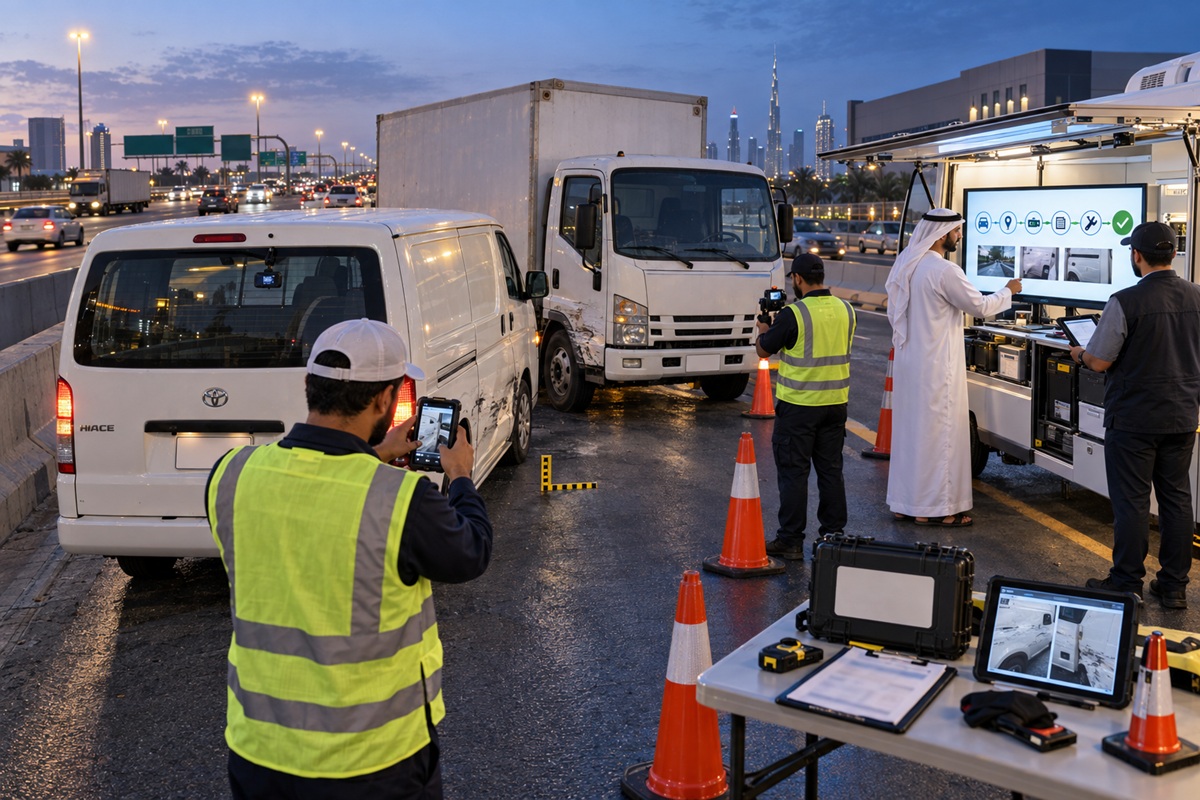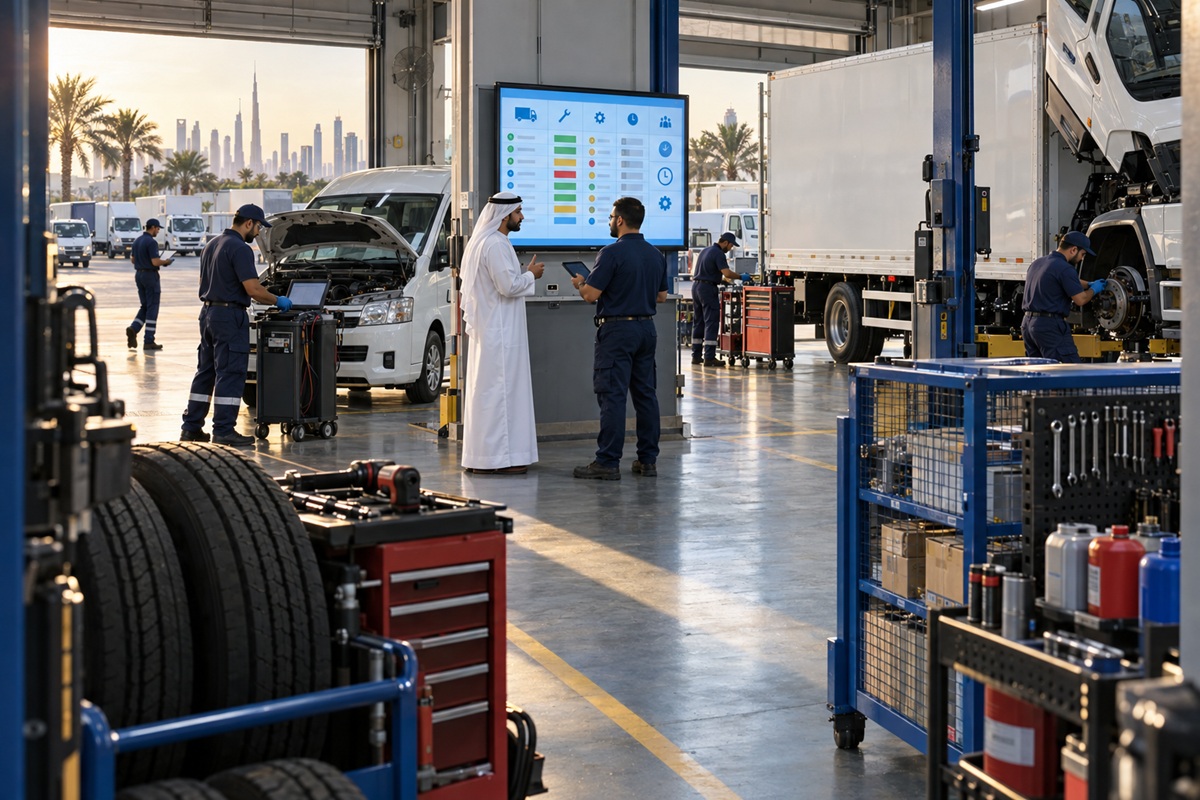
Enterprise fleet management is not simply fleet management at a larger scale it is fleet management at a different level of complexity. A 500-vehicle fleet operating across three UAE emirates, Oman, and Saudi Arabia, with vehicles owned by two separate legal entities, serviced by four depots, managed by regional supervisors with different access levels, integrated with SAP for cost allocation, and required to submit compliance data to ITC Abu Dhabi, ADNOC, RTA Dubai, and the Oman OPAL portal simultaneously is not a larger version of the 20-vehicle logistics fleet managed from a single WhatsApp group. It is a qualitatively different operational and technical challenge.
Enterprise fleet management platforms address this complexity through architecture multi-entity data structures, role-based access hierarchies, API-first integration, AI analytics layers, and compliance management across multiple regulatory frameworks rather than simply by supporting more vehicles than a standard platform. This guide defines enterprise fleet management, explains what differentiates enterprise platforms from standard fleet management tools, and provides a framework for evaluating and deploying enterprise fleet management in UAE and GCC operations.
Key Takeaways
- Enterprise fleet management is defined by architectural complexity multi-entity management, hierarchical access control, bidirectional ERP integration, AI analytics, and multi-country compliance not by vehicle count alone. The correct threshold for enterprise fleet management is when operational complexity exceeds what a single manager with a standard platform can control, typically at 100+ vehicles across multiple depots or entities.
- Smart fleet management solutions apply AI and machine learning to fleet telematics data to do things rule-based systems cannot: predict component failure before it occurs, identify consumption anomalies that fall within fixed thresholds but are genuinely above model predictions, and rank coaching interventions by expected ROI rather than applying uniform coaching to all drivers regardless of their specific inefficiency profile.
- Fleet automation software eliminates the manual workflows that consume fleet management time at scale maintenance alert to work order creation, OBD fault to parts order, card transaction to GPS reconciliation exception, compliance expiry to renewal action queue replacing human decision bottlenecks with automated workflows that trigger human action only when exception or escalation is genuinely required.
- The ROI of enterprise fleet management compounds at scale: a 2 percent fuel efficiency improvement is AED 10,000 per year on a 50-vehicle fleet and AED 100,000 per year on a 500-vehicle fleet. Enterprise fleet management investments that seem expensive relative to a small fleet’s budget are straightforward to justify at large fleet scale.
- VZone International’s Wialon platform is an enterprise-capable deployment for UAE and GCC fleets supporting multi-entity management, 3,400+ device types, SAP/Oracle/Odoo/Zoho ERP integration, AI Fleet Assistant with 300M+ km of UAE training data, and multi-country compliance (Asateel + IVMS + OPAL + SecurePath) from a single platform.
Enterprise Fleet Management System vs Standard Fleet Management
The distinction between enterprise fleet management and standard fleet management is not primarily about vehicle count it is about the operational architecture that the fleet requires. A 200-vehicle fleet owned by a single company, operating in a single city, managed by one fleet manager with a standard subscription platform may be adequately served by standard fleet management tools. A 50-vehicle fleet operating across three countries under two legal entities, with region-specific compliance requirements and bidirectional ERP integration, requires enterprise fleet management architecture from day one regardless of vehicle count.
| Dimension | Standard Fleet Management | Enterprise Fleet Management |
| Entity structure | Single company, single platform account | Multi-entity parent company with subsidiary companies, depots, or country operations managed from one platform with hierarchical visibility |
| Access control | Admin and user roles all admins see all data | Role hierarchy group admin, depot manager, fleet supervisor, driver each sees only their authorised data scope with configurable permissions |
| ERP integration | Manual data export → finance team imports to ERP monthly | Bidirectional API integration cost data flows to ERP automatically; ERP work orders flow to fleet platform; real-time reconciliation |
| Compliance management | Single-country compliance (UAE Asateel or IVMS) | Multi-country UAE Asateel + IVMS + OPAL Oman + GCC country requirements simultaneously from one platform |
| Analytics | Rule-based alerts (threshold crossed = alert) | AI/ML anomaly detection model-based predictions; pattern recognition across full fleet dataset; coaching recommendations ranked by ROI |
| Automation | Alerts require manual follow-up action | Automated workflows alert triggers work order creation, work order triggers parts order, expiry triggers renewal queue human action only at exception |
| Uptime and SLA | Best-effort platform availability; shared support queue | Enterprise SLA (99.9%+ uptime); dedicated implementation team; named support contacts; escalation paths |
| Hardware breadth | Supported device types limited to platform’s standard list | 3,400+ supported device types existing mixed hardware estates supported without device replacement |
| API capability | Read-only data export API for basic integrations | Full REST API bidirectional data exchange; webhook event delivery; custom integration support |
| Data residency | Shared cloud infrastructure; data residency may not be configurable | Configurable data residency UAE-hosted for PDPL compliance; region-specific data isolation |
Enterprise Fleet Management Platform Core Modules
An enterprise fleet management platform integrates more modules than a standard platform and requires each module to share data with all others in real time not as isolated tools that export to a common report, but as interconnected components of a single data architecture.
Multi-Entity and Depot Management
Multi-entity management enables a single platform instance to serve a corporate parent and multiple subsidiary companies, business units, or country operations with each entity seeing only its own data while the parent entity (and authorised enterprise administrators) can see across all entities simultaneously. This architecture serves UAE holding groups whose fleet assets are distributed across multiple UAE companies, ADNOC contractor groups with separate contracting entities for different ADNOC projects, and regional logistics companies with UAE, Oman, Saudi Arabia, and Bahrain operations requiring both separate local reporting and consolidated group reporting.
Depot management within the multi-entity structure assigns vehicles to depots (or sites, or regions) and gives depot-level managers visibility of their assigned assets without access to other depots’ data. A regional supervisor in Al Ain manages the Al Ain depot vehicles and drivers; a Dubai depot supervisor manages Dubai assets; the national fleet manager sees all depots simultaneously. This granular access control is structurally impossible in a single-level standard fleet management account where all administrators see all data.
Enterprise API and Integration Architecture
Enterprise fleet management platforms provide a full REST API enabling bidirectional data exchange with external systems rather than one-way data export. The enterprise API capabilities that large UAE fleet operators require include: event webhook delivery (real-time push of GPS events, alerts, and status changes to external systems without polling), vehicle telemetry streaming (continuous GPS data stream for real-time integration with dispatch or operations management platforms), maintenance integration (work order creation in the external workshop management system triggered by GPS mileage alerts from the fleet platform, with completion status returned to update the fleet platform’s service history), and financial integration (automated cost allocation to ERP cost centres with correct currency, tax code, and project code attribution based on vehicle-to-project assignment in the fleet platform).
For UAE enterprise fleet operators using SAP S/4HANA, Oracle Fusion, Odoo, or Zoho Books, VZone International’s Wialon platform provides native ERP connectors not generic REST API documentation that requires custom development, but pre-built connectors validated against each ERP’s data model and cost allocation structure. The connector configuration (cost centre mapping, vehicle-to-project assignment, currency and tax code setup) is completed during implementation rather than requiring ongoing IT maintenance.
Multi-Country Compliance Management
UAE enterprise fleets operating across GCC countries face a compliance mosaic different GPS certification requirements, different data submission portals, and different vehicle inspection standards in each country. Managing these requirements from separate country-specific systems creates data fragmentation, missed submission windows, and compliance failures when responsibility for cross-border vehicles is unclear. Enterprise fleet management platforms with multi-country compliance capability manage all country submissions from a single platform instance with vehicle position data automatically routed to the correct country portal based on the vehicle’s GPS position.
| Country / Authority | Compliance Programme | Vehicle Categories | Data Submission Requirement | Wialon Support |
| UAE Abu Dhabi (ITC) | Asateel | All commercial vehicles registered in Abu Dhabi | Continuous GPS data submission to ITC portal; non-submission generates compliance notice | Managed automatically; Teltonika devices on certified list |
| UAE Dubai (RTA) | SecurePath | School buses, rental cars, Dubai-mandated categories | Continuous GPS data submission to RTA portal | Managed automatically; RTA-certified configuration |
| UAE ADNOC | IVMS (In-Vehicle Monitoring System) | All ADNOC contractor vehicles | Driver behaviour event data + weekly HSE reports in ADNOC format | Automated IVMS submission + HSE report generation |
| Oman (Authority for Partnership) | OPAL | Commercial vehicles on UAE-Oman routes | GPS data submission to OPAL portal; Teltonika OPAL-certified devices required | Managed automatically for cross-border fleets; Teltonika OPAL-certified |
| UAE SIRA | SIRA (Security Industry Regulatory Agency) | Security company vehicles in Dubai | GPS tracking certification for licensed security firms | SIRA-certified configuration supported |
| Saudi Arabia, Kuwait, Bahrain | Country-specific transport authority requirements (evolving) | Commercial vehicles registered or operating in-country | Varies by country; Saudi Arabia tachograph requirements for heavy vehicles | Platform supports compliance specifics require country-specific configuration |
Smart Fleet Management Solutions AI and Automation Features
Smart fleet management applies artificial intelligence and machine learning to the fleet telematics dataset identifying patterns, making predictions, and generating recommendations that rule-based alert systems cannot produce. The distinction between a smart fleet management solution and a standard telematics platform is the intelligence layer that processes fleet data rather than simply storing and displaying it.
AI Predictive Maintenance
AI predictive maintenance uses machine learning models trained on historical vehicle failure data, OBD diagnostic trends, GPS operating conditions, and maintenance history to predict when specific vehicle components are likely to fail before the failure occurs. The model identifies the combination of operating conditions (high ambient temperature, high engine load, accumulated mileage since last service, OBD parameter drift) that correlates with component failure in the training data, and flags vehicles whose current condition profile matches the pre-failure pattern.
For UAE enterprise fleets, this capability is particularly valuable because UAE’s extreme summer heat creates component failure patterns that are seasonal and partially predictable: cooling system failures peak in July and August after sustained high-temperature operation; battery failures peak in August and September after the highest sustained heat period; tyre failures peak in mid-summer when asphalt surface temperatures exceed design limits. AI models trained on UAE fleet data recognise these seasonal failure patterns and generate pre-season maintenance recommendations for the vehicle cohort most at risk enabling proactive replacement before the failure season rather than reactive breakdown response during it.
AI Fuel Consumption Anomaly Detection
AI fuel consumption anomaly detection compares each trip’s actual consumption against the model’s prediction for that specific combination of vehicle, driver, route, load, and ambient temperature identifying trips where actual consumption is significantly above the contextual prediction even when it falls within the fleet’s fixed alert threshold. This contextual detection identifies the genuine consumption anomalies that rule-based systems miss: a trip that is within the fleet average threshold but 18 percent above the model’s prediction for the specific driver-route-load-temperature combination is flagged as a genuine anomaly; a trip above the threshold but within the model’s predicted range for a high-load route on a hot day is classified as normal and generates no alert.
AI Driver Coaching Prioritisation
Rather than applying uniform coaching to all bottom-quartile drivers, AI coaching prioritisation ranks coaching interventions by expected fuel saving or safety improvement impact. The AI identifies which specific behaviour change for each driver will produce the largest measurable improvement not just which drivers have the lowest overall score, but which drivers have a specific behaviour pattern (harsh acceleration on a specific road type, over-speed on highway sections in the afternoon, idling during breaks) where targeted coaching will produce the largest return per unit of coaching time invested.
Fleet Automation Software: What Gets Automated
Fleet automation software replaces the manual workflows that consume fleet management time not by removing human judgment from decisions, but by removing human action from the information-gathering and routine-processing steps that currently sit between a data event and a management response. The automation layer handles the routing of information and the creation of records; humans handle the decisions that require judgment, relationship management, or escalation.
| Automation Trigger | What Is Automated | Human Action Required | Manual Process Replaced |
| GPS mileage reaches 80% of service interval | Draft maintenance work order created in workshop system with service tasks and parts list; email sent to workshop supervisor | Confirm appointment date and driver availability | Fleet manager calls workshop; workshop manager checks parts; manual work order created |
| OBD critical fault code detected | Fault code classified by severity; critical faults generate immediate push alert to fleet manager and driver; workshop fault work order created; telematics snapshot captured | Fleet manager decides: continue service, route to nearest workshop, or pull vehicle from service | Driver calls in a warning light; fleet manager tries to assess severity without code data; calls workshop for availability |
| Fuel card transaction location mismatch detected | Card-GPS reconciliation exception logged; alert queued for fleet manager review with transaction details, vehicle GPS position, and location gap | Fleet manager reviews exception; contacts driver; escalates to HR if confirmed misuse | Monthly manual reconciliation of card statement against GPS data most mismatches never caught |
| Driver safety score below configured threshold for 3 consecutive weeks | Coaching recommendation generated with top 3 behaviour patterns and GPS event details; coaching appointment added to fleet manager’s calendar | Fleet manager conducts coaching conversation using AI-generated specific data points | Fleet manager reviews paper logs trying to recall which drivers need attention; generic coaching conversation without specific data |
| Compliance document expiry within 30 days | Renewal action item created in compliance queue with document type, vehicle, expiry date, and renewal process checklist; email to fleet manager and PRO | Initiate renewal process with PRO/authority portal | Manual calendar reminder (often missed); reactive renewal when vehicle is stopped for expired document |
| Incident report submitted by driver | GPS speed trace extracted for 60 seconds before incident; dashcam footage flagged for preservation; insurance notification email drafted with GPS data attached; incident logged in safety system | Fleet manager reviews GPS and dashcam evidence; confirms insurance notification; initiates driver interview | Fleet manager calls driver; manually requests GPS data from platform; separately contacts insurer; records on paper |
| Vehicle fuel consumption 15% above baseline for 5 consecutive trips | AI anomaly alert generated with vehicle identity, route type, driver, and the specific consumption pattern that triggered the anomaly; compared against model prediction for conditions | Fleet manager investigates: driver coaching, maintenance check, or route review as appropriate to anomaly pattern | Monthly fuel report review may catch persistent outliers 5-trip early detection not possible manually |
| Depot bulk tank level reaches reorder threshold | Fuel delivery request notification generated; suggested delivery volume calculated from fleet consumption rate and current stock; sent to fuel procurement team | Procurement team confirms delivery with supplier | Manual daily dip measurement; procurement manager estimates when to order based on approximation |
Vehicle Fleet Management Software Build vs Buy vs Subscribe
Enterprise fleet operators evaluating vehicle fleet management software face a build-vs-buy decision that appears more complex than it typically is. The three options building proprietary fleet management software, buying a perpetual licence for an on-premise system, or subscribing to a cloud fleet management platform have materially different cost profiles, time-to-value characteristics, and long-term total cost of ownership implications.
| Dimension | Build (Proprietary) | Buy (On-Premise Licence) | Subscribe (Cloud SaaS VZone/Wialon) |
| Time to deployment | 18-36 months (build, test, integrate) | 3-9 months (install, configure, integrate) | 4-12 weeks (configure, integrate) |
| Upfront cost | AED 2-10M+ for enterprise-grade build | AED 500K-2M perpetual licence + infrastructure | AED 0-50K implementation; ongoing per-vehicle subscription |
| Ongoing cost | Internal development and maintenance team | Annual support/update fees (15-20% of licence); infrastructure maintenance | Per-vehicle monthly subscription; no infrastructure cost |
| Hardware compatibility | Supports only devices built into the system | Platform vendor’s hardware list only | 3,400+ device types existing hardware supported |
| UAE compliance updates | Internal development required for each compliance change | Vendor update; deployment required | Platform updated automatically; no deployment action |
| ERP integration | Custom-built for each ERP | Vendor-supplied connectors (limited); custom for others | Native connectors for SAP, Oracle, Odoo, Zoho; API for others |
| AI/ML capability | Requires dedicated data science team | Vendor roadmap typically 12-24 month lag | Continuously updated AI features; 300M+ km UAE training data |
| Multi-country compliance | Each country requires separate development | Typically single-country focus with extensions | Multi-country managed; GCC countries supported |
| Recommended for | Fleets with unique proprietary requirements that cannot be met by any platform; very few cases qualify | Large fleets with specific data sovereignty requirements and budget for infrastructure | Most enterprise UAE and GCC fleets fastest deployment, lowest TCO, best UAE compliance coverage |
For the vast majority of UAE enterprise fleet operators, the Subscribe (SaaS) model provides superior time-to-value and lower total cost of ownership compared to Build or Buy alternatives. The primary exception is fleets with absolute data sovereignty requirements that cannot be met by a cloud platform with UAE data residency a small subset of government and defence-adjacent fleet operations. For all others, the ongoing product development investment that a platform vendor applies across thousands of client deployments produces capabilities (AI analytics, new compliance programme support, new device type integration) that a proprietary or on-premise system cannot match without continuous internal development investment.
ROI of Enterprise Fleet Management at Scale
The ROI calculation for enterprise fleet management differs from small fleet ROI in two important respects: the absolute AED values are proportionally larger, and the management time saving has enterprise-specific value because enterprise fleet management requires coordinated management teams rather than a single fleet manager.
| ROI Category | Per-Vehicle Annual Saving (AED) | 100-Vehicle Fleet (AED/year) | 500-Vehicle Fleet (AED/year) | 1,000-Vehicle Fleet (AED/year) |
| Fuel cost reduction (25%) | AED 5,000-8,000 | AED 500,000-800,000 | AED 2,500,000-4,000,000 | AED 5,000,000-8,000,000 |
| Maintenance cost reduction (20%) | AED 1,500-3,000 | AED 150,000-300,000 | AED 750,000-1,500,000 | AED 1,500,000-3,000,000 |
| Incident rate reduction avoided cost | AED 1,200-3,500 | AED 120,000-350,000 | AED 600,000-1,750,000 | AED 1,200,000-3,500,000 |
| Insurance premium reduction (15%) | AED 1,500-2,500 | AED 150,000-250,000 | AED 750,000-1,250,000 | AED 1,500,000-2,500,000 |
| Compliance violation avoidance | AED 500-2,000 | AED 50,000-200,000 | AED 250,000-1,000,000 | AED 500,000-2,000,000 |
| Management time saving (automation) | AED 800-1,500 | AED 80,000-150,000 | AED 400,000-750,000 | AED 800,000-1,500,000 |
| TOTAL ANNUAL ROI | AED 10,500-20,500 | AED 1,050,000-2,050,000 | AED 5,250,000-10,250,000 | AED 10,500,000-20,500,000 |
| Fleet Size | Typical Platform Cost (AED/year) | Conservative ROI (AED/year) | Payback Period | 3-Year Net Benefit |
| 100 vehicles | AED 120,000-200,000 | AED 1,050,000 | 5-7 weeks | AED 2,650,000-2,930,000 |
| 500 vehicles | AED 500,000-800,000 | AED 5,250,000 | 4-6 weeks | AED 14,350,000-15,250,000 |
| 1,000 vehicles | AED 900,000-1,400,000 | AED 10,500,000 | 3-5 weeks | AED 30,100,000-31,600,000 |
Enterprise Fleet Management ROI Key Insight
The ROI of enterprise fleet management compounds at scale because the savings are proportional to fleet size while the platform cost grows sub-linearly (per-vehicle subscription costs decrease at volume, and the management team efficiency savings are largely fixed regardless of fleet size). A 1,000-vehicle fleet does not need 10× the management team of a 100-vehicle fleet it needs a better-instrumented management team. Enterprise fleet automation is the technology that enables a 1,000-vehicle fleet to be managed with the same team efficiency as a 100-vehicle operation.
Frequently Asked Questions
An enterprise fleet management system is characterised by five architectural capabilities rather than vehicle count. Multi-entity management: the platform can simultaneously manage multiple companies, depots, or country operations with hierarchical access control each entity sees only its data while parent-level administrators see across all entities. Deep ERP integration: bidirectional data exchange with SAP, Oracle, or equivalent financial systems rather than one-way data export requiring manual import. AI and analytics layers: machine learning anomaly detection, predictive maintenance, and AI-ranked coaching recommendations rather than rule-based threshold alerts. Multi-country compliance: simultaneous management of UAE Asateel, IVMS, OPAL Oman, and GCC country compliance from one platform. Enterprise SLA: dedicated implementation team, named support contacts, SLA-backed uptime guarantees. A 500-vehicle fleet using a basic GPS subscription platform is not enterprise fleet management; a 100-vehicle fleet using a platform with all five enterprise architectural capabilities is.
Fleet automation software works by connecting telematics data events to automated downstream actions replacing the manual workflows where a data event (GPS mileage alert, OBD fault code, fuel card misuse, compliance document expiry) requires a human to notice the event, decide what action is needed, and manually execute the action. In an automated fleet management system, the event triggers a pre-configured workflow: a GPS mileage alert at 80 percent of service interval automatically creates a draft work order in the workshop management system and notifies the workshop supervisor; an OBD critical fault generates an immediate push alert to the driver and fleet manager, creates a fault work order, and captures a GPS telematics snapshot for the investigation record; a compliance document expiry within 30 days creates a renewal action item, sends notifications to the fleet manager and PRO, and provides the renewal checklist for the specific document type. Human judgment is required for the decision (is this fault serious enough to pull the vehicle from service? is this card exception confirmed misuse?); automation handles the information routing, record creation, and follow-up scheduling that currently consumes fleet manager time between the data event and the management response.
Enterprise fleet management delivers ROI through six savings categories: fuel cost reduction (20 to 30 percent from idling reduction, eco-driving coaching, and theft elimination), maintenance cost reduction (20 percent from GPS mileage scheduling and OBD predictive fault detection), incident cost reduction (30 to 40 percent from driver safety coaching and AI dashcam), insurance premium reduction (10 to 20 percent from telematics safety data presented at renewal), compliance violation avoidance (zero-tolerance renewal management), and management time saving from automation (4 to 5 hours per fleet manager per day). At enterprise scale, the absolute AED values are substantial: a 500-vehicle fleet achieving 25 percent fuel reduction on AED 50,000 per vehicle per year fuel spend saves AED 6.25 million annually in fuel alone. Total enterprise fleet management ROI for a 500-vehicle UAE fleet is typically AED 5 to AED 10 million per year against a platform cost of AED 500,000 to AED 800,000 per year a payback period of 4 to 6 weeks.
Yes enterprise-capable fleet management platforms designed for the GCC market handle multi-country operations from a single platform instance. For UAE enterprise fleets, the key multi-country requirements are: UAE Asateel compliance for Abu Dhabi commercial vehicles, OPAL compliance for UAE-Oman cross-border routes (with Teltonika OPAL-certified devices), Saudi Arabia transport authority requirements for vehicles entering KSA, and ADNOC IVMS for contractor vehicles regardless of the country the trip crosses. VZone International's Wialon platform manages all GCC country compliance simultaneously vehicle position data is automatically routed to the correct country portal based on GPS location, store-and-forward handles the cellular coverage gaps on cross-border desert routes, and dual-SIM devices with UAE primary and Oman secondary SIMs handle the cellular network handover at border crossings without data loss. Multi-currency cost reporting, per-country compliance dashboards, and country-specific driver behaviour requirements (Saudi Arabia tachograph for heavy vehicles) are all supported within the same platform deployment.