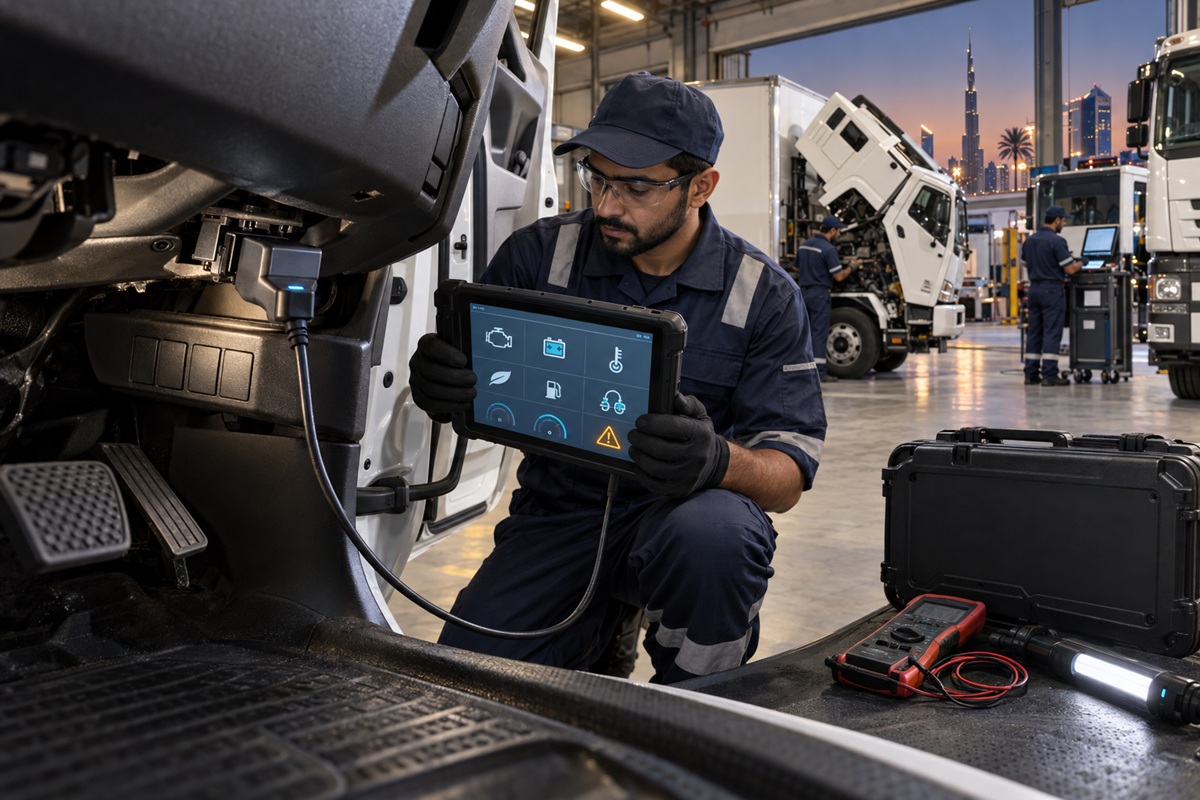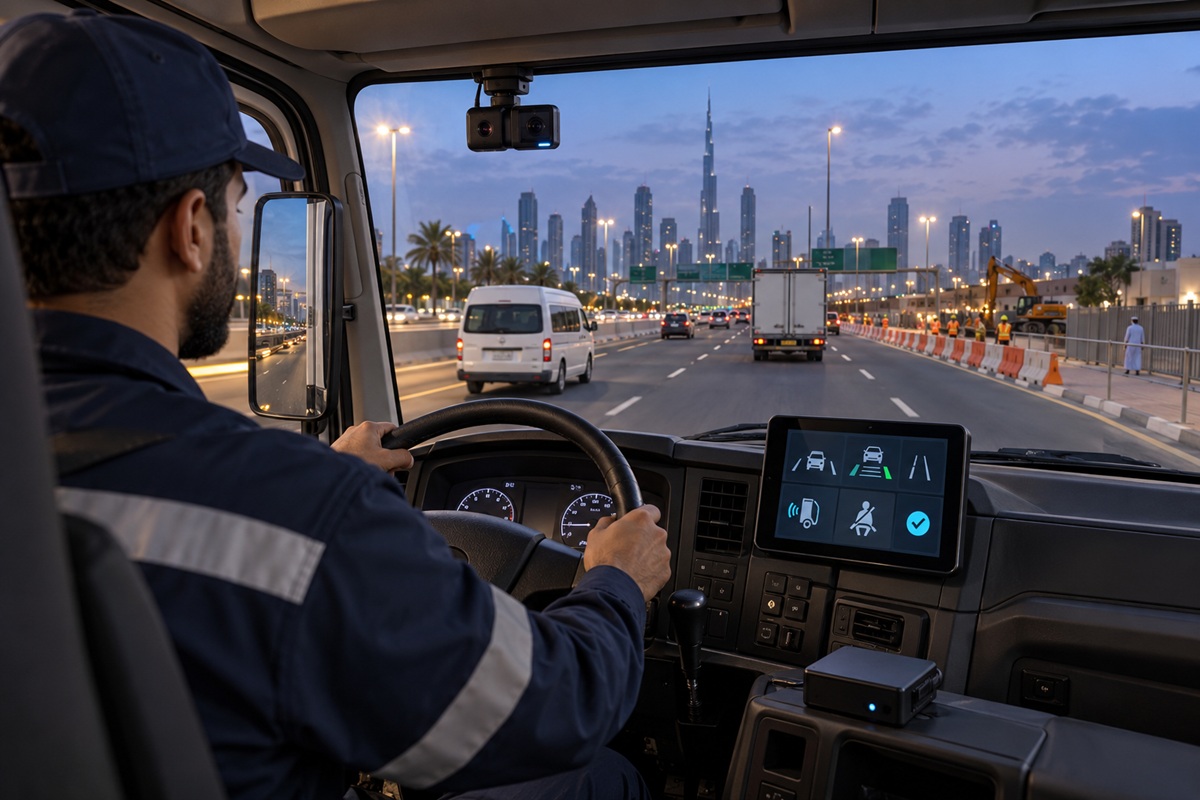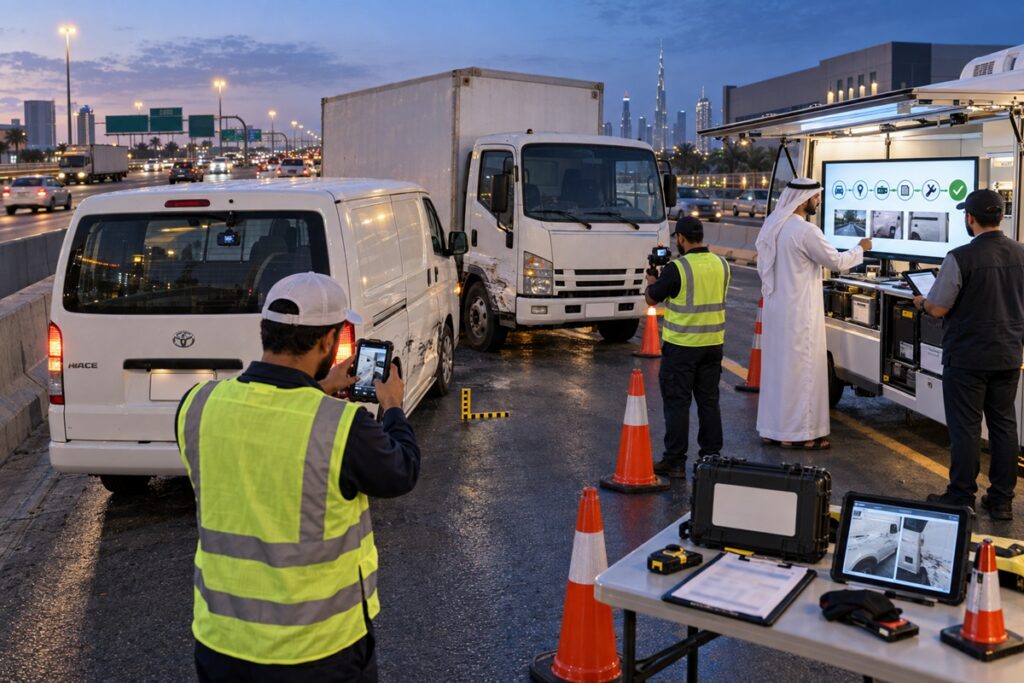
When a commercial vehicle incident is reported, the fleet manager faces a compressed timeline of decisions and actions that determines the financial and reputational outcome of the event. In the first hour: driver welfare check, scene safety, Police notification, and initial evidence preservation. In the first day: GPS reconstruction accessed and documented, dashcam footage retrieved and secured before overwriting, insurance notification submitted, third-party exchange of details confirmed and recorded, and for ADNOC contractor fleets HSE incident notification completed within the regulatory window. In the first week: investigation completed, corrective action identified, insurer provided with the evidence package, and the incident recorded in the fleet safety management system for trend analysis.
Fleet incident reporting software compresses each of these timelines by providing the data, tools, and workflow that a manual process assembles slowly from multiple disconnected sources. This guide explains the complete fleet accident management workflow, what data fleet incident software provides at each stage, and how the 24-hour reporting target is achievable for UAE commercial fleet operators who have the right tools integrated before an incident occurs.
Key Takeaways
- Fleet accident management follows a structured timeline: immediate driver and scene response (0-2 hours), initial evidence collection (0-24 hours), investigation and report completion (24-72 hours), insurer submission and corrective action (1-2 weeks). Fleet incident reporting software reduces each timeline segment by providing instant GPS data access and automated report generation.
- GPS incident reconstruction vehicle speed, GPS location, heading, and driver behaviour events in the 60 seconds before and during the reported incident is the objective factual record that is more reliable than driver accounts, witness accounts, or physical damage patterns alone. It is the most important piece of evidence fleet managers should access first after confirming driver welfare.
- Dashcam footage has a finite retention window most continuous recording dash cameras overwrite footage on a rolling buffer of 24 to 72 hours. Fleet managers must retrieve and lock the relevant footage within this window after an incident; waiting until the insurance adjuster requests it 5 days later risks the footage being overwritten.
- ADNOC contractor fleets have mandatory HSE incident reporting timelines: high-consequence incidents must be reported to ADNOC HSE within 24 hours of occurrence; fatalities or serious injuries require immediate notification. Fleet incident software that generates ADNOC-formatted incident reports from the structured incident record enables compliance with these timelines without manual report compilation.
- Third-party claim management where a third party claims their vehicle, property, or person was damaged by a fleet vehicle is where GPS reconstruction and dashcam evidence provide the most direct financial value. GPS-corroborated evidence that contradicts an inflated or fabricated third-party claim can reduce settlement liability from AED 50,000+ to AED 0-5,000 in cases where the fleet vehicle’s conduct is exonerated by the objective data.
The Fleet Accident Management Timeline
| 0–30 MIN | Immediate Response Driver confirms welfare personal injury or not. If injury: emergency services called immediately. Scene safety: warning triangle deployed, hazard lights activated, vehicle secured safely. Fleet manager notified by driver. Fleet manager accesses GPS platform to see Vehicle’s current location and last known speed before incident. Police called if required by UAE Traffic Law (all incidents involving injury or property damage above AED 2,000 must be reported to Police). |
| 0–2 HRS | Scene Documentation and Evidence Preservation Driver photographs scene: both vehicles, road markings, damage, registration plates, position of vehicles. Exchange of details with third party: name, contact, vehicle registration, insurance details. Fleet manager retrieves GPS incident data: speed at incident time, GPS track for preceding 10 minutes, any GPS harsh events in approach period. Dashcam footage review initiated: fleet manager remotely retrieves or flags footage for preservation before buffer overwrites. Police report reference number obtained if Police attended. |
| 2–24 HRS | Incident Report Completion and Initial Notification Driver completes structured digital incident report in fleet app: incident type, third-party details, conditions, injury details, damage description, photographs attached. Fleet manager completes incident investigation summary from GPS reconstruction and dashcam review. Insurance company notified of incident occurrence with initial details. For ADNOC contractor fleets: HSE incident notification completed if incident meets ADNOC reporting threshold. Vehicle assessed for roadworthiness and either returned to service, repair-scheduled, or taken out of service pending investigation. |
| 24–72 HRS | Investigation and Evidence Package Assembly Full GPS reconstruction report extracted: vehicle speed trajectory, harsh event record, route for preceding journey. Dashcam footage secured: relevant footage downloaded and stored in incident file. Photographs, Police report, driver statement, witness statements (if available) compiled. Liability assessment: was fleet vehicle at fault, partially at fault, or exonerated by GPS/dashcam evidence? Third-party claim initial response: engage insurer for claim management or prepare direct counter-evidence if GPS/dashcam evidence disputes claim. |
| 3–14 DAYS | Report Submission and Corrective Action Completed evidence package submitted to insurer: GPS reconstruction, dashcam footage, photographs, driver statement, Police report, incident report form. ADNOC HSE incident report submitted (contractor fleets) within HSE reporting timeline. Corrective action identified: specific driver coaching, vehicle inspection, route modification, or systemic safety programme change. Incident recorded in fleet safety management system for trend analysis. Insurance claim managed through to settlement. Repair scheduled and completed. Post-incident driver welfare check if driver expressed stress or shock at time of incident. |
GPS Incident Reconstruction: The Objective Record
GPS incident reconstruction is the capability that most frequently determines the financial outcome of third-party claims against UAE fleet operators because it provides an objective, timestamped, court-admissible record of vehicle behaviour that is more reliable than any testimonial evidence.
What GPS Reconstruction Shows
For any fleet vehicle incident, the GPS reconstruction report extracts: the vehicle’s speed at every GPS update point in the 60 to 120 seconds before the incident timestamp (typically accurate to within 0.5 km/h for multi-constellation GNSS devices); the vehicle’s GPS location and heading at each point in the same period (accurate to 2 to 5 metres in open-road conditions); any GPS harsh events recorded in the approach period (harsh braking, rapid acceleration, or sharp cornering events with their precise GPS location and magnitude); and the complete route the vehicle took in the 30 to 60 minutes before the incident (enabling assessment of whether the vehicle was on its authorised route, at the correct time, and operating consistently with normal trip patterns). This data is extracted directly from the fleet management platform and does not depend on the driver’s account of what happened.
How GPS Data Resolves Third-Party Claim Disputes
Third-party claims against UAE commercial fleet vehicles frequently include allegations about fleet vehicle speed or conduct that the GPS record can confirm or contradict. A third party who claims a fleet vehicle was speeding at 120 km/h in a 60 km/h zone when GPS records show the vehicle was travelling at 58 km/h at the incident location is making a claim that the GPS data objectively disputes. A third party who claims whiplash injury from a collision at what they describe as ‘high speed’ when GPS records show the fleet vehicle had already braked to 12 km/h at the point of contact has a claim that the GPS record significantly undermines. These GPS-based counter-arguments reduce fraudulent or exaggerated claims to amounts that reflect the actual incident circumstances or result in the claim being withdrawn entirely.
For UAE fleet operators, the value of GPS reconstruction in claim defence is compounded by the fact that third-party vehicle damage claims and bodily injury claims in the UAE market can reach AED 50,000 to AED 200,000+ for incidents that the fleet vehicle’s GPS record shows were at low speed or in circumstances where the third party’s claimed injuries or damage are inconsistent with the recorded vehicle behaviour. VZone International’s platform generates a formatted GPS incident reconstruction report with the vehicle’s speed trajectory, GPS position map, and harsh event log for the incident period that is formatted for submission to UAE insurers and, where relevant, to UAE Traffic Police investigations.
Dashcam Evidence in UAE Fleet Incident Management
AI dashcam footage provides the visual evidence that GPS data alone cannot supply: what the road ahead looked like in the seconds before the incident, whether the driver was paying attention or was distracted, whether the third party’s vehicle performed an unexpected manoeuvre, and what the driver’s physical condition (fatigue, distress) was at the time of the event. For UAE fleet accident management, dashcam footage is the evidence layer that completes the GPS reconstruction picture.
Forward-Facing Camera Evidence
Forward-facing dashcam footage captures: the road and traffic conditions in the approach to the incident (enabling assessment of whether the fleet driver had adequate warning time for any hazard), the third party’s vehicle behaviour immediately before the collision (including any sudden lane changes, brake failures, or traffic violation by the third party that contributed to the incident), the impact itself and the immediate aftermath (providing evidence of the collision geometry that is more precise than physical damage patterns), and any road condition factors (sand dunes across the road, debris, poor signage) that contributed to the incident. This footage is the primary defence against third-party narrative accounts of incidents that attempt to overstate fleet vehicle fault.
Driver-Facing Camera Evidence
Driver-facing infrared camera footage captures: driver attention status in the approach to the incident (eyes-on-road or distracted), any phone use in the pre-incident period, driver physical condition (fatigue indicators, seatbelt compliance), and driver reaction at the moment of the incident (emergency braking response, steering input). This footage is dual-use: it provides evidence of driver non-fault in incidents where the driver was clearly attentive and responding appropriately; and it provides unambiguous evidence of driver fault in incidents where pre-incident phone use, fatigue, or distraction are clearly visible. Where driver fault is clear from the footage, the footage enables the fleet manager to manage the incident honestly and transparently rather than entering a dispute that the evidence does not support.
Footage Retrieval Timeline The Critical Window
Most commercial dashcam systems record continuously to a loop buffer new footage overwrites the oldest footage when the storage card is full. A dashcam with a 64 GB storage card and a dual-camera system recording at standard resolution will typically overwrite footage within 24 to 72 hours, depending on the recording bitrate. Fleet managers who wait until an insurer or Police investigator requests footage often 5 to 10 business days after the incident routinely find that the relevant footage has been overwritten. Immediately after any incident is reported, the fleet manager should: remotely command the dashcam to lock the footage from the incident period (most fleet-integrated AI dashcam systems support remote footage lock from the fleet platform), or contact the driver and instruct them to not power off the vehicle (some dashcam systems stop recording and preserve the buffer when the engine is off), and retrieve the footage to the fleet platform as soon as possible. VZone International’s AI dashcam integration supports remote footage lock and cloud upload from the fleet management platform fleet managers can initiate footage preservation within minutes of an incident report.
Fleet Incident Reporting for ADNOC Contractor Fleets
ADNOC contractor fleet incident reporting requirements are the most structured and time-sensitive in UAE fleet operations with mandatory reporting timelines that make the 24-hour report target not just a best practice but a regulatory obligation for high-consequence incidents.
| Incident Classification | ADNOC Definition | Initial Notification Timeline | Full Report Deadline | Fleet Software Action |
| Fatality (FAT) | Death of any person directly resulting from a work-related incident | Immediate ADNOC HSE Operations notification within 1 hour | Formal investigation report within 30 days | Immediate GPS reconstruction and dashcam footage lock; incident record initiated; ADNOC notification support |
| Serious Injury / High Potential (HiPo) | Injury requiring hospitalisation; near-miss with high potential for serious consequence | Within 4 hours of occurrence | Preliminary report within 24 hours; full investigation within 14 days | GPS reconstruction and dashcam retrieved; ADNOC-formatted preliminary report generated within 24-hour window |
| Lost Time Incident (LTI) | Injury resulting in absence from work beyond day of incident | Within 24 hours | Full investigation report within 7 days | Structured incident form completed; GPS and dashcam evidence compiled; corrective action identified |
| Medical Treatment Case (MTC) | Injury requiring medical treatment beyond first aid | Within 24 hours | Report within 5 days | Incident record with evidence; medical treatment documented; corrective action |
| First Aid Case (FAC) | Injury requiring first aid only | Recorded internally | Monthly summary to ADNOC HSE | Incident logged in fleet safety system; included in monthly HSE report |
| Property Damage / Vehicle Damage | Damage to ADNOC property, third-party property, or contractor vehicle above AED 5,000 | Within 24 hours if on ADNOC premises | Report within 5 days | GPS reconstruction, damage photographs, repair cost assessment compiled |
VZone International’s fleet management platform generates ADNOC-formatted incident reports from the structured digital incident form that drivers complete via the driver app at the scene. GPS reconstruction and dashcam evidence are appended to the report automatically from the platform’s data records. The completed report in ADNOC’s required format is available within the reporting window without requiring the safety officer to manually compile data from multiple sources.
Fleet Incident Data for Safety Programme Improvement
Individual incident management addresses the immediate financial and compliance consequences of a specific event. Incident data aggregated across the fleet over time identifies the systemic patterns that a safety programme should address because most commercial fleet incidents are not isolated events but expressions of recurring risk factors that repeating across different vehicles, routes, and drivers.
Incident Trend Analysis
Fleet incident reporting software that stores every incident record in a structured, searchable database enables analysis that paper-based or email-based incident reporting cannot support: incidents by vehicle (which vehicles have the highest incident frequency replacement or maintenance candidates?), incidents by driver (which drivers have at-fault incidents coaching or reassignment candidates?), incidents by route or time of day (which routes or time periods generate the most incidents route modification or scheduling candidates?), and incidents by type (rear-end collisions dominating following distance coaching; reversing damage dominating reversing camera deployment; pedestrian incidents dominating site access route review). This trend analysis is the feedback that converts incident data from a financial record into a safety programme improvement input.
Connecting Incidents to Driver Safety Scores
The most powerful fleet safety analytics connects incident occurrence to the driver’s GPS safety score history in the weeks before the incident. If a driver who had an at-fault rear-end collision had a safety score trend showing increasing harsh braking event frequency in the 4 weeks before the incident, the connection between the pre-incident behaviour data and the incident is visible and provides the specific coaching content for the post-incident conversation: ‘Your harsh braking frequency had been increasing for 4 weeks before this incident. Looking at the GPS map of those events, 7 of them were on the same road section where the incident occurred. Let us talk about what was happening on that approach.’ This GPS-to-incident connection is only possible when both the safety scoring and the incident recording are in the same fleet management platform.
VZone International Fleet Incident Reporting Software GPS Evidence, Dashcam Retrieval, ADNOC HSE Reports
VZone International’s fleet management platform includes integrated incident reporting with GPS reconstruction, dashcam footage retrieval and locking, structured incident forms via the driver app, and automated ADNOC-formatted HSE incident reports. Incident data is stored alongside driver safety scores in the same platform for trend analysis and safety programme improvement. Contact our team to integrate fleet incident reporting with your UAE fleet management deployment.
Frequently Asked Questions
Fleet incident reporting software is a digital tool integrated with the fleet management platform that provides a structured workflow for recording, investigating, and reporting commercial vehicle incidents. It includes: structured digital incident forms that drivers complete via the driver app at the scene (capturing incident type, third-party details, conditions, injuries, and photographs), GPS reconstruction reporting that extracts vehicle speed, location, and behaviour data from the fleet tracking platform for the pre-incident period, dashcam footage retrieval and preservation tools, automated incident report generation for insurers and regulatory bodies (including ADNOC HSE-formatted reports for contractor fleets), and incident data storage for trend analysis and safety programme improvement. For UAE fleet operators, fleet incident reporting software replaces the paper incident forms, phone-call data gathering, and manual report compilation that extends the incident-to-report timeline from 24 hours to 5 to 10 business days in unintegrated processes.
For UAE Traffic Police reporting, accidents involving injury or property damage above AED 2,000 should be reported to Police at the scene or as promptly as possible after the incident there is no legal grace period for Police reporting. For insurance notification, most UAE commercial fleet insurance policies require incident notification within 24 to 48 hours of the incident occurring delayed notification can complicate or invalidate claims. For ADNOC contractor fleets, the reporting timeline depends on incident classification: fatalities require immediate ADNOC HSE notification; high-potential incidents require notification within 4 hours; lost time incidents and property damage incidents require notification within 24 hours. Fleet incident reporting software with structured forms and automated report generation enables UAE commercial fleet operators to complete Police reporting, insurance notification, and ADNOC HSE notification within these required timelines.
Yes GPS vehicle tracking data is accepted as evidence in UAE Traffic Police investigations and insurance claim assessments. The GPS data record vehicle speed, location, and harsh event history in the period before and during a reported incident provides objective factual evidence that is treated as corroborating evidence alongside driver accounts, witness accounts, and physical damage patterns. In cases where GPS data contradicts a third party's account of the incident (for example, GPS shows the fleet vehicle was at 55 km/h when the third party claims it was at 120 km/h), the GPS record significantly strengthens the fleet operator's position. GPS data alone is not sufficient to close a liability determination it is one evidence input among several but its objectivity and precision make it the most reliable factual input to incident investigation. VZone International's platform generates a formatted GPS reconstruction report specifically designed for submission to UAE insurers and Traffic Police investigations.
Dashcam footage helps UAE fleet insurance claims in two ways: defending against fraudulent or exaggerated third-party claims, and providing objective evidence of driving conditions. For defence against third-party claims, forward-facing footage showing the third party's vehicle behaviour immediately before a collision sudden lane change, running a red light, stopping without warning provides direct evidence that shifts liability determination away from the fleet vehicle regardless of the third party's account. Driver-facing footage showing driver attentiveness, absence of phone use, and appropriate reaction (emergency braking) corroborates the fleet driver's account. For evidence of conditions, footage showing poor road markings, debris on the road, or extreme weather conditions at the time of the incident provides context that affects liability assessment. The critical operational requirement is footage retrieval speed fleet managers must initiate remote footage lock and retrieval within hours of an incident to prevent the continuous recording buffer from overwriting the relevant footage.