UAE roads see one of the highest commercial vehicle incident rates in the GCC a consequence of high traffic density, significant heavy vehicle volume on major arterials, extreme summer heat that creates driver fatigue and tyre failure risk, and a diverse driver population with varying training backgrounds and road culture familiarity. For fleet operators, the question is not whether commercial vehicle incidents occur they do but how systematically the fleet’s management practices and technology tools reduce the frequency and severity of incidents that the operation generates.
Fleet safety management software addresses this question with data rather than policy: instead of issuing a fleet safety policy document that drivers read once and supervisors cannot enforce consistently, safety management software measures actual driver behaviour on every trip, scores each driver’s safety performance weekly, identifies the specific drivers with the highest risk profiles, and provides the evidence-based coaching data that enables targeted, specific safety conversations rather than generic fleet safety briefings. UAE commercial fleets that implement fleet safety management software with structured coaching programmes consistently report 30 to 40 percent reduction in at-fault incident rates within 12 months a result that translates to hundreds of thousands of AED in avoided incident costs, insurance premium savings, and ADNOC HSE programme compliance outcomes.
Key Takeaways
- Fleet safety management software works through a feedback loop: telematics data identifies risky driving behaviours at the event level, AI scoring aggregates events into per-driver safety scores, weekly scorecard review enables specific coaching conversations, and coaching-driven behaviour change reduces the event frequency that produces incidents.
- The 30 to 40 percent incident rate reduction from systematic fleet safety management software deployment is a 12-month result it requires both the technology (telematics data collection and AI scoring) and the programme (regular coaching conversations, positive recognition for improvement, management commitment to the process). Technology alone without the coaching programme produces lower results.
- AI dashcam fatigue and distraction monitoring is the safety management capability most specifically calibrated for UAE conditions UAE’s desert highway routes create faster fatigue onset than temperate-market norms, and the infrared driver-facing camera that detects eye closure and head drooping provides an early warning system that GPS accelerometer data alone cannot replicate.
- ADNOC IVMS compliance requires weekly driver behaviour reports in ADNOC-specified format fleet safety management software that generates these reports automatically satisfies the HSE documentation requirement that manual data compilation would require 4 to 8 staff hours per fleet per month to produce.
- Fleet safety data AI driver safety scores, harsh event frequency, incident-free period records, coaching programme documentation is the insurance telematics package that UAE commercial vehicle insurers accept for premium reduction at renewal, typically achieving 10 to 20 percent reduction for fleets that present comprehensive safety data.
The Cost of Commercial Fleet Incidents in UAE
The financial case for fleet safety management software begins with the cost of the incidents it prevents. For UAE commercial fleet operators, the cost of an at-fault vehicle incident has three components that together typically exceed the visible repair cost by a factor of 3 to 5.
| Cost Component | Typical Range (AED) | Notes |
| Vehicle repair own fleet vehicle | 5,000-80,000 | Depends on vehicle type and damage severity; commercial truck repair at the upper end |
| Third-party vehicle repair / compensation | 8,000-150,000+ | UAE courts and insurance settlements for third-party commercial vehicle damage; bodily injury claims significantly higher |
| Insurance excess | 2,500-10,000 | Per-incident excess on commercial fleet comprehensive policy; excess increases with claims frequency |
| Insurance premium loading at renewal | 15,000-60,000/year | Claims history drives renewal pricing; multiple incidents in 24 months can increase fleet premium by 20-50% |
| Driver absence (injured driver) | 5,000-25,000 | Replacement driver cost + administrative overhead; medical leave entitlement for injured UAE employee |
| Vehicle downtime replacement vehicle hire | 3,000-15,000 | Rental vehicle during repair period; daily rate × repair duration |
| Customer SLA penalty (if applicable) | Variable | Delivery contract penalty clauses; service disruption charges; relationship cost |
| ADNOC HSE finding (contractor fleets) | Project-dependent | Incident on ADNOC facility triggers HSE investigation; findings affect contractor programme standing and can affect contract renewal |
| Management and administrative time | 3,000-8,000 | Incident reporting, insurance claim management, Police report, driver interview, corrective action documentation |
| TOTAL COST PER AT-FAULT INCIDENT | AED 40,000-350,000+ | Wide range vehicle type, incident severity, third-party involvement, and customer dependency are primary variables |
For a 100-vehicle UAE commercial fleet with an at-fault incident rate of 8 incidents per 100 vehicles per year (a typical rate for an unmanaged commercial fleet), the annual incident cost is AED 320,000 to AED 2,800,000. Fleet safety management software that reduces the at-fault rate by 35 percent saves between AED 112,000 and AED 980,000 annually against a fleet safety software platform cost of AED 80,000 to AED 180,000 per year for a 100-vehicle fleet.
How Fleet Safety Management Software Works
AI Driver Behaviour Scoring
The core mechanism of fleet safety management software is the AI driver behaviour scoring system a continuous measurement of driving conduct that converts raw sensor data into per-driver safety scores that fleet managers can act on. The GPS device’s three-axis accelerometer detects and records harsh braking, rapid acceleration, sharp cornering, and speeding events on every trip; GPS speed data compares vehicle speed against the posted limit for each road segment; and AI dashcam analysis adds distraction and fatigue events to the telematics-only event record.
These events are weighted by type and severity a speeding event above 30 km/h over the limit carries a higher penalty in the scoring algorithm than a brief 5 km/h excess; a severe harsh braking event (indicating emergency braking from insufficient following distance) carries more weight than a minor deceleration event and aggregated into a weekly per-driver safety score. The score is distance-normalised calculated per 100 km driven rather than as raw event counts so that high-mileage drivers who accumulate more events through sheer driving volume are not unfairly penalised relative to low-mileage drivers. VZone International’s AI driver scoring is trained on 300M+ km of UAE and GCC driving data, calibrating the threshold values and event weightings to UAE road conditions rather than European or North American norms.
AI Dashcam Fatigue and Distraction Detection
AI dashcam systems equipped with driver-facing infrared cameras provide safety monitoring capabilities that GPS accelerometer data alone cannot deliver. The infrared camera monitors driver eye closure patterns (detecting microsleep risk from extended eye closure duration), head position (detecting forward head drooping associated with fatigue onset), and gaze direction (detecting eyes-off-road for extended periods associated with distraction events). Phone use detection identifying when a driver is holding or looking at a phone while driving is a specific dashcam detection capability with direct UAE road safety relevance, as phone use while driving increases accident risk by approximately 4 times.
For UAE fleet safety management, dashcam fatigue detection is particularly valuable on desert highway routes where the combination of monotonous landscape, extreme heat, and the physiological effect of sustained attention creates faster fatigue onset than the temperate-market driving conditions that most global fatigue detection systems are trained on. VZone International’s AI dashcam fatigue detection is calibrated for UAE desert highway conditions, adjusting the detection sensitivity to account for the earlier fatigue onset that UAE highway driving produces. In-cab alerts an audible warning that fires immediately when a fatigue or distraction event is detected provide the driver with the real-time intervention that modifies behaviour in the moment rather than requiring after-the-fact coaching.
GPS Incident Reconstruction
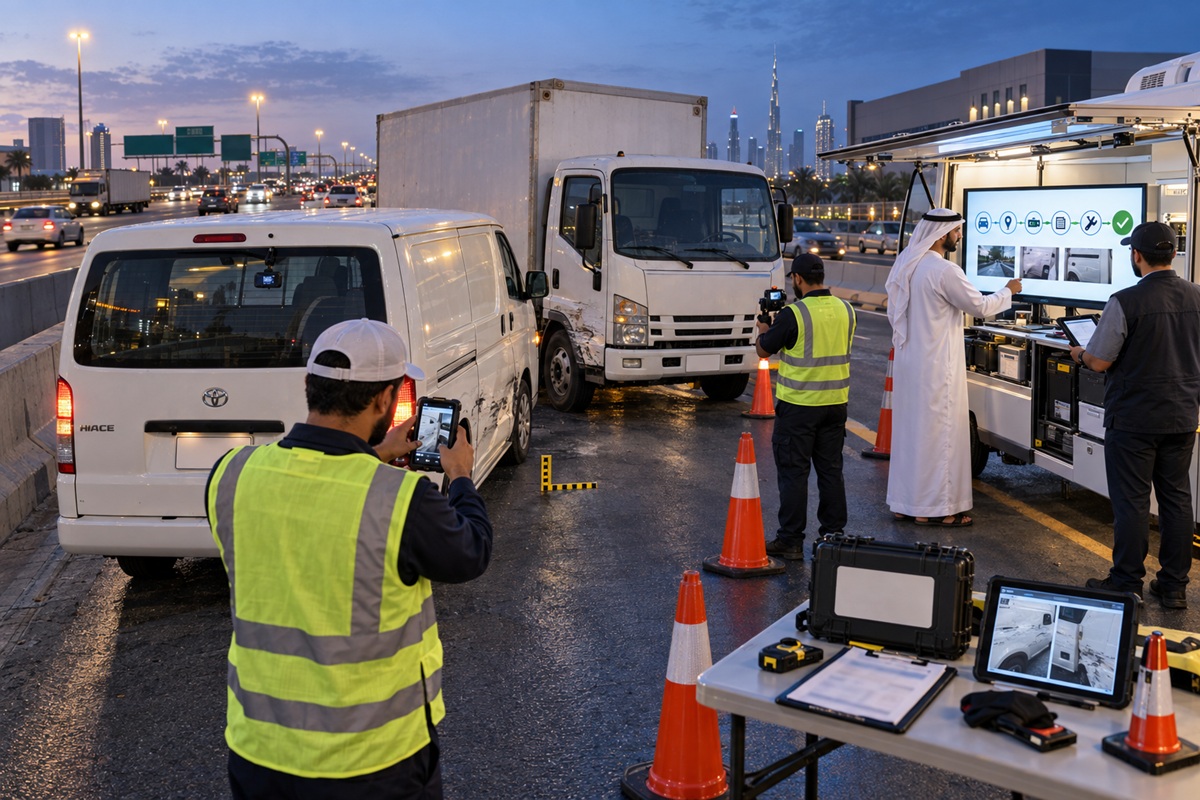
When an incident occurs regardless of whether it involves a dashcam alert, a GPS harsh event, or a driver report fleet safety management software provides the GPS incident reconstruction capability that establishes the objective factual record. The GPS data record for every trip includes the vehicle’s speed at every point, its heading, its GPS position, and the timestamp enabling a precise reconstruction of the vehicle’s movements in the seconds and minutes before, during, and after any reported incident. If a driver reports an incident at 14:23 on a specific road, the GPS record shows exactly how fast the vehicle was travelling, whether it was decelerating (and how rapidly), what route it had taken in the preceding 10 minutes, and whether any GPS harsh events were recorded in the approach period.
This objective GPS record is the most reliable evidence input to incident investigation more reliable than driver accounts (affected by stress and self-interest), more reliable than witness accounts (affected by position and attention), and more reliable than physical damage patterns (which establish collision geometry but not pre-collision driver behaviour). For UAE Police investigations and insurance claim assessments, a GPS-corroborated incident reconstruction is a significantly stronger evidentiary basis than driver testimony alone.
ADNOC IVMS HSE Reporting
For UAE ADNOC contractor fleets, fleet safety management software has an additional compliance-critical function: generating weekly driver behaviour reports and monthly fleet performance summaries in the specific format that ADNOC’s HSE management system requires. ADNOC IVMS compliance mandates that contractor vehicles continuously monitor and report driver behaviour event data multi-tier speed events, harsh braking, harsh acceleration, seatbelt compliance, and driver identification per trip in ADNOC-specified data format. Fleet safety management software that manages IVMS data submission and generates ADNOC-formatted HSE reports automatically replaces the manual data extraction and report compilation that fleet safety officers would otherwise perform for each ADNOC reporting period.
Manual IVMS report compilation takes 4 to 8 hours of fleet safety officer time per fleet per reporting period time that fleet safety management software eliminates by generating the report from the telematics data automatically. The ADNOC HSE report generated by VZone International’s platform includes all required data elements in the correct format, with accurate timestamps for events that occurred during store-and-forward offline periods (remote site operations), and is available for download or direct submission within the platform at the end of each reporting period.
Building a Fleet Safety Coaching Programme
Fleet safety management software provides the data; a structured coaching programme provides the behaviour change that translates data into incident rate reduction. The software alone without the coaching programme achieves a deterrence effect (drivers who know their behaviour is scored tend to drive more carefully) but not the sustained 30 to 40 percent incident reduction that comes from systematic coaching. The coaching programme requires three elements.
Weekly Scorecard Review
Weekly scorecard review fleet manager or supervisor reviewing each driver’s safety score with the driver is the coaching programme’s central interaction. The review should be specific: not ‘your score was 68 this week’ but ‘you had 5 harsh braking events this week, 3 of them on the Al Ain Road approach to the roundabout at different times of day let’s look at the GPS map for those events and talk about following distance on that approach’. The GPS location context of each event enables this specificity; the scoring data identifies which driver needs the conversation; the event record provides the specific coaching content. Weekly review consistency is the programme element most strongly associated with sustained score improvement fleets that skip review during busy operational periods see scores plateau rather than improve.
Positive Recognition for Top Performers
Driver leaderboards visible to the driver population, showing safety score ranking introduce competitive motivation that accelerates improvement. Monthly awards for top-ranked drivers, score-linked bonuses, or public recognition in team meetings sustain engagement with the programme beyond the initial awareness phase. For UAE fleet driver demographics, where professional reputation and team standing matter, positive recognition for safety performance creates the social context that makes score improvement personally meaningful rather than just management-mandated. Fleets that combine negative consequence for persistent high-risk drivers with positive recognition for safe drivers achieve more sustained improvement than those using only one lever.
Escalation Protocol for High-Risk Drivers
Driver safety scores below a defined threshold typically below 60 on a 100-point scale should trigger an escalation protocol beyond the standard weekly review. Escalation steps should include: immediate formal coaching conversation with the driver’s direct supervisor (not just the fleet manager), documentation of the conversation and the specific behaviour changes committed to, a 2-week accelerated review cycle, and for persistent high-risk profiles that do not improve after coaching a formal HR process in accordance with UAE labour law. The escalation protocol must be documented in the fleet safety policy before deployment, communicated to drivers at programme launch, and applied consistently inconsistent escalation (applying formally to some drivers but not others) creates both legal exposure and cultural credibility problems.
Fleet Safety Software and UAE Insurance
UAE commercial vehicle insurance for fleet operators is priced on the expected risk profile of the fleet and the expected risk profile, in the absence of telematics data, is the actuarial average for the vehicle category and driver demographics. A fleet that is actually safer than average pays the same premium as the actuarial average unless it can present objective evidence of its safety performance. Fleet safety management software generates that evidence.
The insurance telematics package that UAE commercial vehicle insurers accept for premium review at renewal includes: 12-month driver safety score summary (fleet average and individual driver distribution), harsh event frequency by category (braking, acceleration, cornering, speeding) over the preceding 12 months, accident-free period documentation, coaching programme records (evidence that safety data is being actioned rather than just collected), and the incident trend (showing that incident frequency is declining rather than static). Presenting this package at renewal enables the fleet manager to negotiate from a position of documented lower-than-average risk rather than accepting the standard actuarial rate.
First-renewal premium reduction for UAE commercial fleets presenting comprehensive fleet safety telematics data averages 10 to 15 percent. Second-renewal reduction builds on improved claims history: the coaching-driven behaviour change that reduces incident frequency in Year 1 reduces claims frequency in Year 1 and Year 2, and the Year 2 renewal pricing reflects the lower claims record. For a 100-vehicle fleet paying AED 1,200,000 in annual commercial motor insurance, a 12 percent first-renewal reduction saves AED 144,000 per year a saving that approaches the cost of the fleet safety management software platform for the same fleet.
Fleet Safety Management Software ROI for UAE Fleets
| ROI Category | Mechanism | Conservative Saving Rate | Annual Saving 100-Vehicle Fleet (AED) |
| Incident cost reduction | 35% at-fault incident rate reduction from coaching programme | 35% of AED 45,000 average incident cost × 8 incidents/100 vehicles/year | AED 126,000 |
| Insurance premium reduction (Year 1) | Telematics data presentation at renewal 12% first-renewal reduction | 12% of AED 12,000/vehicle/year premium | AED 144,000 |
| Insurance premium reduction (Year 2+) | Claims history improvement compounds additional 8% reduction | 8% of AED 10,560/vehicle/year (post-Year 1 premium) | AED 84,480 |
| ADNOC HSE report generation | Automated IVMS report eliminates safety officer manual compilation time | 6 hours/month × AED 80/hour × 12 months (applicable for ADNOC contractor fleets) | AED 57,600 |
| Fraudulent / exaggerated claim defence | GPS incident reconstruction defends against inflated third-party claims | 2 defended claims/year GPS evidence reduces settlement by 40% on AED 40,000 average | AED 32,000 |
| Fuel saving from eco-driving coaching | Same behaviour change that reduces incidents also reduces aggressive acceleration and fuel waste | 10% fuel reduction on AED 5,000/vehicle/month × 100 vehicles | AED 600,000 |
| TOTAL ANNUAL SAVING | AED 1,043,480+ |
Fleet Safety Software ROI 100-Vehicle UAE Fleet
Platform cost (fleet safety management software included in fleet management platform subscription): AED 80,000-150,000/year for 100 vehicles at AED 80-150/vehicle/monthTotal annual saving (conservative, including fuel saving): AED 1,043,480Payback period: 1-2 months24-month net ROI: AED 1,836,960-1,906,960Note: Fuel saving is the largest single ROI category because the same behaviour change (reduced aggressive acceleration) that reduces incident risk also reduces fuel consumption. The safety and efficiency returns compound from the same coaching programme.
Frequently Asked Questions
Fleet safety management software is a technology platform that combines GPS vehicle tracking, AI driver behaviour scoring, dashcam fatigue and distraction monitoring, GPS incident reconstruction, and safety reporting tools to systematically measure, manage, and improve driver safety performance across a commercial fleet. It works by collecting telematics data from GPS devices and AI dashcams installed in fleet vehicles, processing that data through AI scoring algorithms to produce per-driver weekly safety scores, delivering scored data to fleet managers for coaching programme use, and generating safety reports for insurance telematics, ADNOC IVMS HSE compliance, and internal management review. For UAE commercial fleets, fleet safety management software also manages ADNOC IVMS driver behaviour data submission and generates weekly HSE reports in the ADNOC-specified format required for contractor fleet compliance.
UAE commercial fleets using fleet safety management software with systematic driver coaching programmes report 30 to 45 percent reduction in at-fault incident rates within 12 months of deployment. The reduction range reflects the baseline incident rate of the fleet before deployment fleets with higher pre-deployment incident rates (more improvement opportunity) achieve the upper end of the range; well-managed fleets with lower baseline rates achieve smaller percentage reductions. The 12-month timeline reflects the dual requirement: the technology provides the data immediately at deployment, but the behaviour change that reduces incidents takes 3 to 6 months of consistent coaching to become sustained. Fleets that deploy the technology without the coaching programme achieve 10 to 15 percent reduction from deterrence effects alone; fleets with systematic coaching consistently achieve 30 to 40 percent.
Yes VZone International's fleet safety management software on the Wialon platform satisfies ADNOC IVMS requirements for contractor fleet monitoring. The platform captures the driver behaviour event data that IVMS requires (multi-tier speed events, harsh braking and acceleration, seatbelt compliance, driver identification per trip), manages continuous data submission to ADNOC's IVMS system, and generates weekly driver behaviour reports and monthly fleet performance summaries in ADNOC-specified format automatically, without requiring manual data extraction or report compilation. For ADNOC contractor fleets operating on remote Western Region routes with intermittent cellular coverage, store-and-forward data buffering maintains the unbroken IVMS data record that ADNOC HSE management requires, uploading offline data when cellular connectivity is restored with accurate event timestamps.
General fleet management software provides GPS vehicle tracking, route management, maintenance scheduling, fuel monitoring, and compliance reporting covering the operational management of the fleet as a whole. Fleet safety management software is the safety-specific layer within fleet management that focuses on driver behaviour measurement, AI scoring, coaching programme support, incident management, and HSE compliance reporting. In practice, the two capabilities are integrated in a unified fleet management platform rather than deployed as separate systems VZone International's platform includes GPS tracking, maintenance management, fuel monitoring, compliance reporting, and fleet safety management (driver scoring, dashcam, incident reconstruction, IVMS reporting) in the same Wialon deployment. The safety management capability is a configuration of the platform rather than a separate product, which means fleets already running VZone GPS tracking can enable the full safety management capability through platform configuration rather than new hardware procurement.